
The next year will test corporate leaders’ instincts about when to engage, when to stay quiet, and how geopolitical risk intersects with brand, workforce, and investor confidence. This memo brings together public opinion on NATO, U.S. relations with allies, Greenland, and consumer expectations of CEOs under the Trump administration to answer a practical question: What does the public expect from business leaders when global politics become unpredictable?
Morning Consult approaches geopolitical events through the lens of public sentiment, recognizing that shifts in global politics ultimately manifest as changes in consumer behavior, stakeholder expectations, and market risk. By tracking opinion in near real time across countries, demographics, and issues, Morning Consult helps leaders move beyond headlines to understand what is actually breaking through, where views are soft or unsettled, and how narratives are evolving.
Executive Summary
NATO
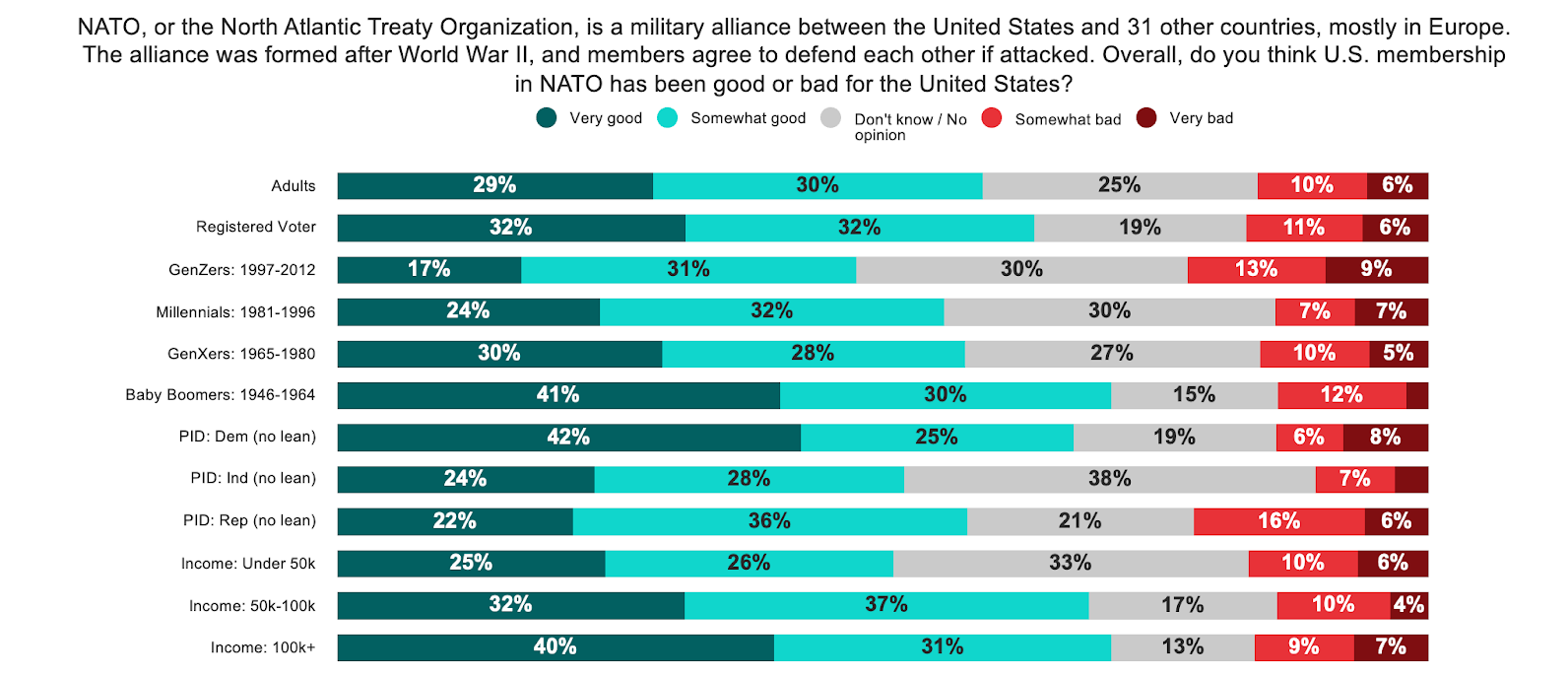
- Americans broadly view NATO positively, though many lack strong opinions. Six in ten adults (59%) say U.S. membership in NATO has been good for the country, while just 16% say it has been bad. A quarter (25%) have no opinion.
- A majority want to stay in NATO. When forced to choose, 52% say the U.S. should remain in NATO because the benefits outweigh the costs, compared to 19% who favor leaving. Nearly three in ten (29%) are unsure.
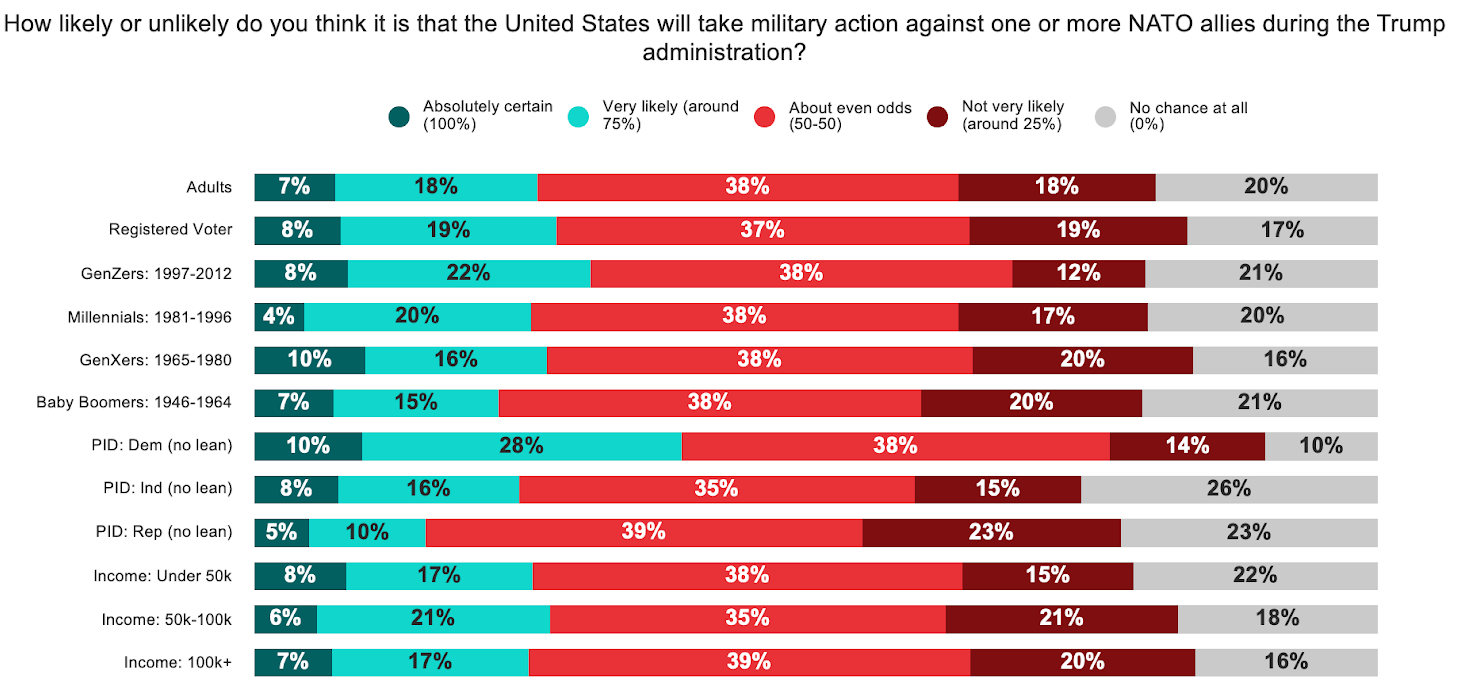
- One in four believe military action against NATO allies is likely. A quarter of adults (25%) say it is very likely or certain that the U.S. will take military action against a NATO ally during the Trump administration. Another 38% see it as 50-50 odds.
Greenland
- Americans reject aggressive approaches to acquiring Greenland. While 30% support buying Greenland, support drops to 25% for economic coercion and just 16% for military action. Majorities oppose all three approaches.
- Allied relationships trump Greenland ambitions. More than half (53%) say the U.S. should prioritize maintaining strong relationships with European allies over acquiring Greenland, compared to 22% who prioritize the acquisition.
CEO Expectations
- Two in 5 Americans say CEOs who criticize Trump are acting responsibly, but only 28% say they should speak out publicly. If a CEO publicly praised Trump, 38% would view the company less favorably.
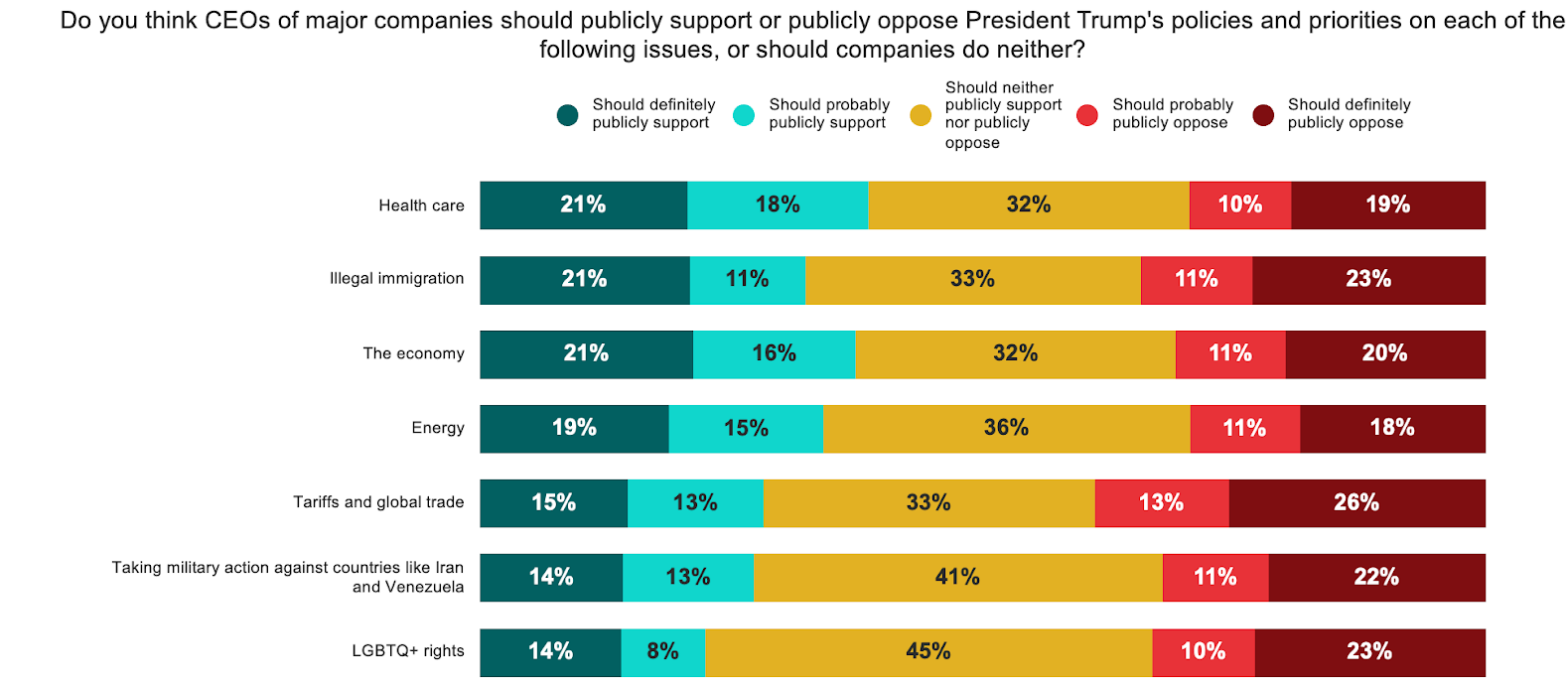
- CEOs expected to stay neutral on most policy areas, but economic issues see more appetite for engagement. Pluralities say CEOs should neither support nor oppose Trump's policies across most issues. The economy (37% support) and health care (39% support) see the most openness to CEO backing.
Methodology
Morning Consult conducted a survey of 1,001 U.S. adults on Jan. 20, 2026. The interviews were conducted online and the data were weighted to approximate a target sample of adults based on age, gender, race, educational attainment, region, gender by age, and race by educational attainment. The full survey results have a margin of error of +/- 3 percentage points.
Six in Ten Say NATO Membership Is Good for the U.S.
Americans have a favorable view of NATO's value to the United States. Nearly six in ten (59%) say U.S. membership has been good for the country, including 29% who say it has been very good. Just 16% view membership negatively, while a quarter (25%) have no opinion—suggesting room for persuasion on both sides.
Keeping Peace in Europe Seen as NATO's Top Achievement
When asked about NATO's biggest accomplishment, keeping peace in Europe and preventing a major war tops the list at 28%. Strengthening U.S. global leadership (16%) and promoting democracy in former Soviet countries (10%) follow. Notably, only 8% cite countering Russian aggression. A third (32%) have no opinion.
|
NATO's Biggest Achievement |
% of Adults |
|
Keeping peace in Europe and preventing a major war |
28% |
|
Strengthening the U.S. position as a global leader |
16% |
|
Promoting democracy and stability in former Soviet countries |
10% |
|
Countering Russian aggression and expansion |
8% |
|
Something else |
6% |
|
Don't know / No opinion |
32% |
"Fair Share" Complaints Top List of NATO Criticisms
Among those who see problems with NATO, the perception that other members don't pay their fair share leads at 22%. Concerns about being dragged into unnecessary conflicts (14%) and the alliance being outdated (11%) follow. Just 6% say NATO has provoked Russia through expansion. Nearly four in ten (39%) have no opinion.
|
Biggest Problem with NATO |
% of Adults |
|
Other member countries don't pay their fair share |
22% |
|
It risks dragging the U.S. into unnecessary conflicts |
14% |
|
It is outdated and no longer serves its original purpose |
11% |
|
It has expanded too aggressively and provoked Russia |
6% |
|
Something else |
9% |
|
Don't know / No opinion |
39% |
Majority Favor Staying in NATO
When asked to choose between staying in or leaving NATO, a majority (52%) say the U.S. should remain because the benefits outweigh the costs. Just 19% favor leaving. However, 29% are unsure—a substantial persuadable segment.
|
Preference on NATO Membership |
% of Adults |
|
Should remain in NATO (benefits outweigh costs) |
52% |
|
Should leave NATO (costs outweigh benefits) |
19% |
|
Don't know / No opinion |
29% |
One in Four See Military Action Against NATO Allies as Likely
A quarter of Americans (25%) believe it is very likely or absolutely certain that the U.S. will take military action against one or more NATO allies during the Trump administration. Another 38% put the odds at 50-50, while 38% see it as unlikely or impossible.
Americans Oppose All Approaches to Acquiring Greenland
Majorities oppose each proposed method for acquiring Greenland from Denmark. Opposition is strongest for military action (60% oppose, including 47% strongly), followed by economic coercion (51% oppose) and purchasing (45% oppose). Only 16% support military action, while 30% support a purchase.
|
Approach |
Strongly Support |
Somewhat Support |
Somewhat Oppose |
Strongly Oppose |
Not Sure |
|
Buying Greenland |
14% |
16% |
14% |
31% |
25% |
|
Economic pressure/trade leverage |
11% |
14% |
18% |
33% |
24% |
|
Military action |
5% |
11% |
13% |
47% |
23% |
Arguments for Greenland Acquisition Have Limited Appeal
No argument in favor of acquiring Greenland convinces a majority. The most persuasive rationales are strategic positioning against China and Russia (49% find at least somewhat convincing) and Greenland's strategic location for national security (48%). The argument that Greenland would be better off under U.S. control is least convincing (37%).
|
Argument for Acquisition |
Extremely/ Very Convincing |
Somewhat Convincing |
Not Too/ Not at All Convincing |
Not Sure |
|
Strengthens U.S. positioning against China and Russia |
31% |
18% |
29% |
21% |
|
Strategic location critical for national security |
29% |
19% |
30% |
22% |
|
Denmark not capable of defending Greenland |
25% |
15% |
36% |
24% |
|
Valuable natural resources U.S. should control |
24% |
19% |
36% |
22% |
|
Greenland would be better off under U.S. control |
22% |
15% |
43% |
21% |
Majority Prioritize Allied Relationships Over Greenland
When forced to choose, 53% say the U.S. should prioritize maintaining strong relationships with European allies over pursuing Greenland. Just 22% prioritize the acquisition, while 25% are unsure.
|
Priority |
% of Adults |
|
Prioritize maintaining strong relationships with European allies |
53% |
|
Prioritize acquiring Greenland for national security |
22% |
|
Not sure |
25% |
ICE Enforcement Making Headlines
More than three-quarters (77%) have seen at least some news about ICE enforcement activities in Minneapolis, with 54% saying they've seen "a lot." The Greenland story has also cut through: 71% have seen at least some coverage.
|
News Story |
A Lot |
Some |
Not Much |
Nothing |
|
ICE enforcement activities in Minneapolis |
54% |
23% |
9% |
15% |
|
Trump discussing acquiring Greenland |
41% |
30% |
14% |
15% |
|
Indiana winning college football championship |
22% |
23% |
17% |
38% |
Public Split on Company Cooperation with ICE
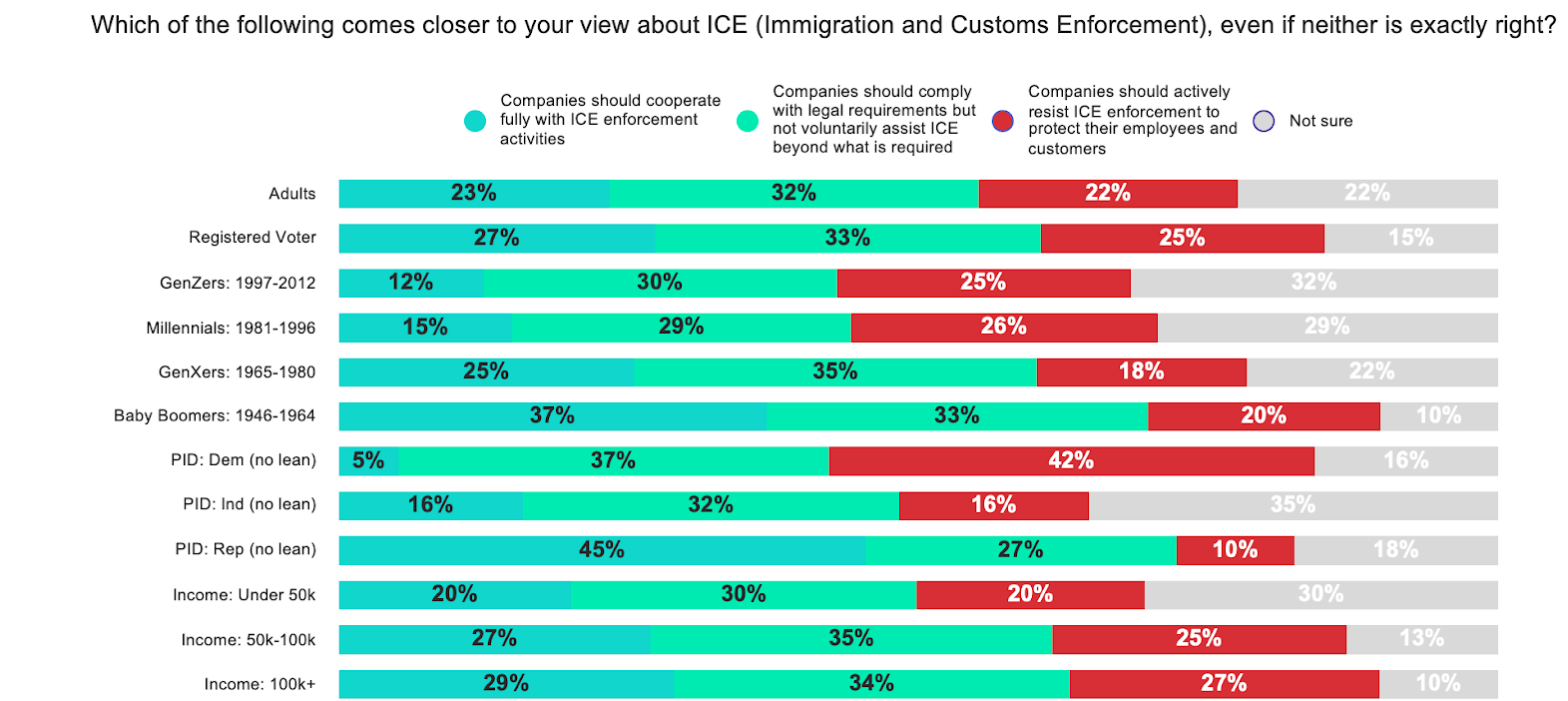
Americans are divided on how companies should handle ICE enforcement. About a third (32%) say companies should comply with legal requirements but not voluntarily assist beyond that. Similar shares say companies should cooperate fully (23%) or actively resist (22%). A fifth (22%) are unsure.
Americans Want CEOs to Speak Up When They Disagree with Trump
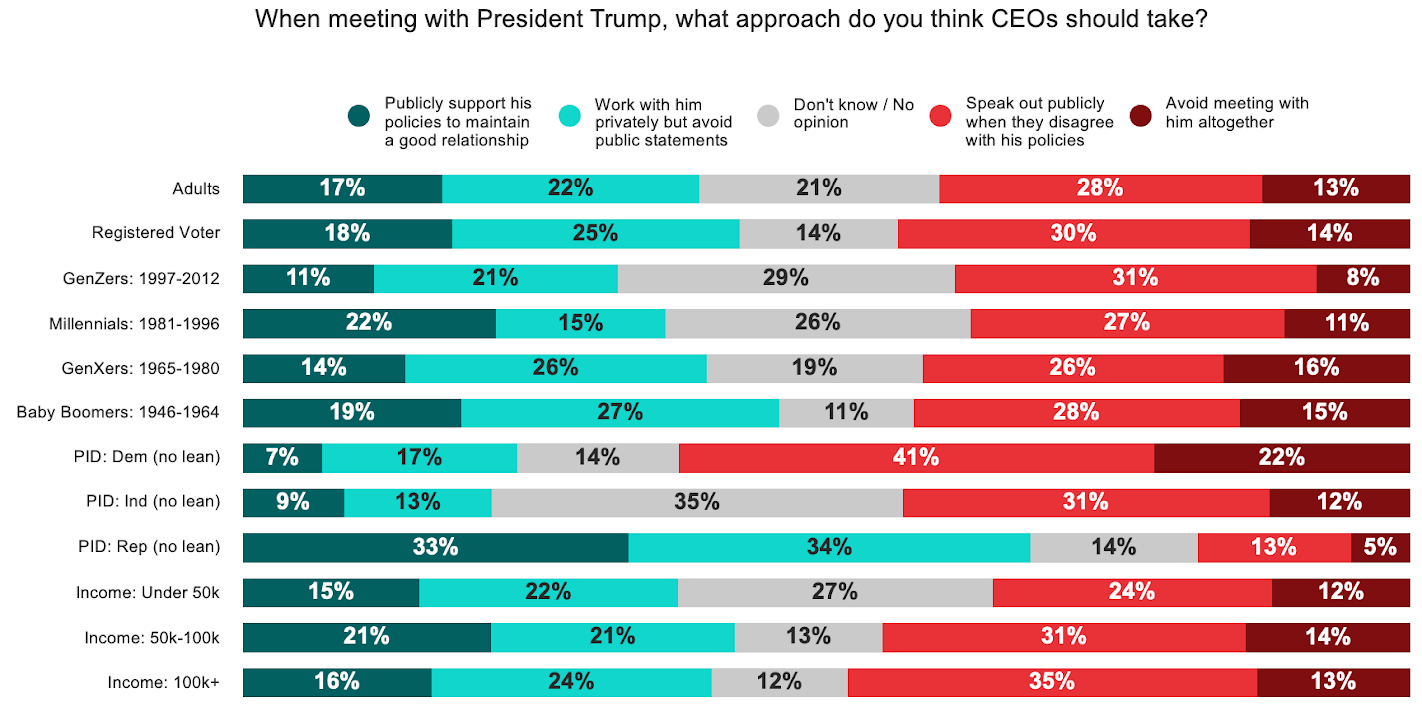
A plurality (28%) say CEOs should speak out publicly when they disagree with the president's policies. About a fifth (22%) prefer private engagement, while 17% say CEOs should publicly support Trump's policies. Just 13% say CEOs should avoid meeting with him altogether.
Majority Say CEOs Who Criticize Trump Are Acting Responsibly
Four in ten (41%) say CEOs who publicly criticize Trump's policies are acting responsibly, while 35% say they're acting irresponsibly. A quarter (24%) have no opinion.
|
Assessment of CEOs Who Criticize Trump |
% of Adults |
|
Very responsibly |
26% |
|
Somewhat responsibly |
15% |
|
Somewhat irresponsibly |
19% |
|
Very irresponsibly |
16% |
|
Don't know / No opinion |
24% |
CEO Praise of Trump Polarizes Consumers
If a CEO publicly praised Trump, 38% would view the company less favorably, while 25% would view it more favorably. A plurality (37%) say it wouldn't change their opinion.
|
Impact of CEO Praising Trump |
% of Adults |
|
Much more favorable |
12% |
|
Somewhat more favorable |
13% |
|
No change |
37% |
|
Somewhat less favorable |
14% |
|
Much less favorable |
24% |
CEOs Expected to Stay Neutral on Most Trump Policy Areas
On most issues, pluralities say CEOs should neither publicly support nor oppose Trump's policies. The strongest preference for neutrality is on LGBTQ+ rights (45%) and military action (41%). Economic policy sees the most appetite for public support (37% support vs. 31% oppose).
.png)
Exploring the Leading Brands in the Cellular Service Category
.png)
Why American Express' Platinum Card Leads the Premium Credit Card Category
.png)