

The bottom line up front
Airline growth in the U.S. faces two sequential constraints. First, which brands come to mind when travelers face everyday friction around cost, timing, and reliability. Second, whether real-world barriers — limited routes, opaque pricing, and unproven recovery systems — block conversion after a brand makes the shortlist. The airlines that grow next will be those that expand their presence across more travel decisions and remove the structural obstacles that prevent consideration from turning into bookings.
The Category Landscape
Travelers choose airlines the way they choose insurance: to reduce risk, not to express identity. The dominant reasons people enter the airline category are fundamentally practical — grabbing the lowest fare, finding a nonstop flight at the right time, avoiding extra baggage fees, flying from the nearest airport, minimizing complex layovers, and trusting the plane is safe. These functional triggers account for the vast majority of how consumers form their initial consideration set.
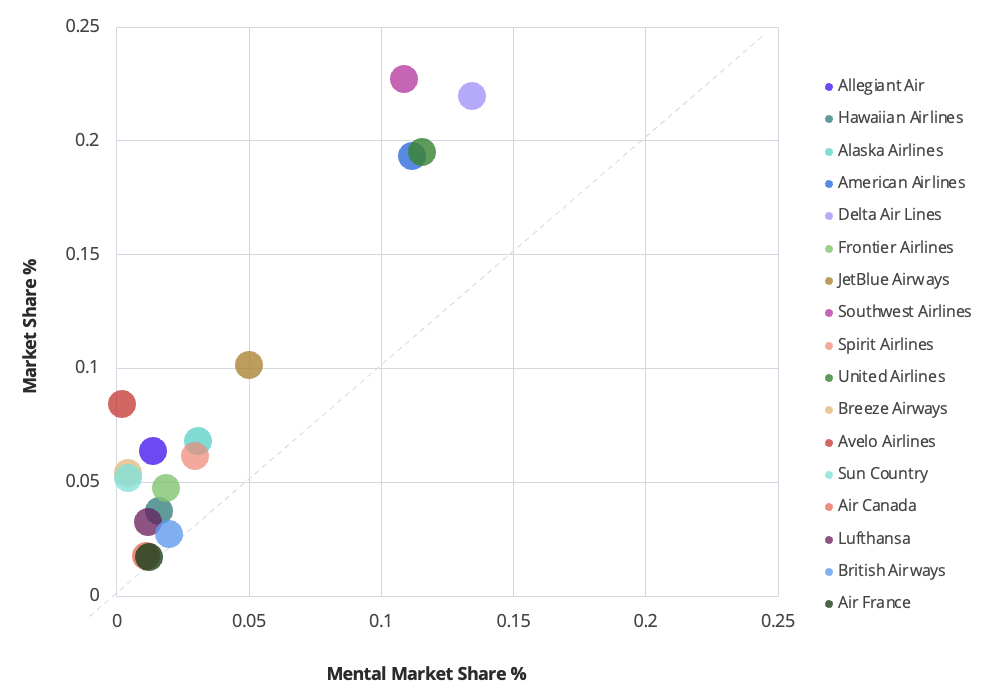
A clear competitive structure emerges: large carriers benefit from broad name recognition across many of these everyday travel situations, while smaller and regional carriers tend to be strongly linked to just one or two triggers (often price or a specific route). The brands with the broadest presence across these entry points hold a structural advantage — not because consumers prefer them, but because they are simply more likely to come to mind.
Where brands over- and under-perform across Category Entry Points
|
% |
Alaska Airlines |
American Airlines |
Delta Air Lines |
Frontier Airlines |
JetBlue Airways |
Southwest Airlines |
Spirit Airlines |
United Airlines |
|
Grabbing the lowest fare |
-5 |
-11 |
-13 |
10 |
2 |
6 |
15 |
-11 |
|
Choosing a nonstop flight at the right time |
-1 |
2 |
1 |
0 |
0 |
2 |
-2 |
3 |
|
Avoiding extra baggage fees |
1 |
0 |
-1 |
1 |
0 |
6 |
1 |
-1 |
|
Flying from the nearest airport |
0 |
0 |
0 |
4 |
0 |
3 |
2 |
2 |
|
Booking the nonstop flight to avoid a complex layover |
0 |
0 |
1 |
0 |
-2 |
0 |
-2 |
2 |
|
Having confidence in the safety of the plane |
3 |
-3 |
-5 |
-1 |
-2 |
-4 |
-2 |
-3 |
|
Trusting the airline will make things right if an issue occurs |
1 |
1 |
2 |
-1 |
0 |
2 |
0 |
-1 |
|
Getting free in-flight Wi-Fi |
1 |
0 |
2 |
-1 |
2 |
0 |
0 |
-1 |
|
Getting to pick a seat for free |
-1 |
2 |
2 |
-1 |
1 |
6 |
1 |
-1 |
|
Being well-cared-for during the flight |
1 |
-2 |
0 |
-3 |
-1 |
-1 |
-3 |
-3 |
|
Wanting extra legroom and overall comfort |
0 |
2 |
3 |
-3 |
0 |
-5 |
-3 |
2 |
|
Enjoying free snacks & drinks onboard |
0 |
0 |
2 |
-1 |
1 |
2 |
-2 |
0 |
|
Sticking with my loyalty airline for status perks |
-1 |
4 |
3 |
1 |
1 |
4 |
0 |
2 |
|
Availability of upgrade options |
2 |
3 |
2 |
0 |
0 |
-3 |
-1 |
5 |
|
Speeding through fast-track security or immigration |
-1 |
0 |
-1 |
-1 |
1 |
-5 |
0 |
2 |
|
Picking an airline with great in-flight entertainment |
-1 |
2 |
4 |
-2 |
2 |
-4 |
-2 |
2 |
|
Enjoying authentic local meals onboard |
0 |
-5 |
-4 |
-1 |
-3 |
-6 |
-2 |
-2 |
|
Access to alliance lounges |
0 |
3 |
3 |
-1 |
-2 |
-4 |
-2 |
4 |
|
Flying with kid-friendly perks |
-1 |
1 |
2 |
-2 |
0 |
2 |
1 |
1 |
|
Choosing a carbon-offset flight |
1 |
-1 |
-2 |
-1 |
0 |
-3 |
0 |
-1 |
Emotional connection reinforces brand choice — it does not create it. Comfort, loyalty programs, and feelings of closeness to a brand influence which airline a consumer ultimately books, but only after the shortlist has already formed around functional needs. Notably, the rank order of brands by emotional connection is remarkably stable across every region of the country — the same airlines lead emotionally everywhere. What changes by region is not which brands people feel close to, but how much that closeness matters. In high-friction markets (congested airports, frequent delays, long-haul routes), emotional connection acts as insurance: it earns forgiveness after disruption and keeps travelers loyal when price or schedule is sub-optimal. In practical, low-friction markets, it barely moves the needle. Emotional connection increases with usage and availability — it does not cause them.
What Blocks Growth After Consideration
Coming to mind is necessary but not sufficient. Our data reveals that even after an airline enters a traveler’s consideration set, a distinct set of market barriers frequently prevents conversion. These barriers are largely structural and brand-agnostic — but they affect carriers unevenly and create a critical diagnostic layer for growth strategy.
Routes and schedules are the primary conversion killers. Limited nonstop options, inconvenient schedules, and lack of service from a preferred airport prevent purchase even when a brand is top of mind. This explains a pattern that puzzles many executives: legacy carriers can underperform on brand recall yet maintain volume (because their networks convert), while value-oriented carriers can win on price associations but fail to scale beyond certain geographies (because their route maps constrain them). Not all recall gaps are fixable with marketing — some are network gaps.
Price opacity actively blocks purchase. Price functions as both an entry point (it draws travelers into consideration) and a barrier (it blocks them from booking). The distinction lies in transparency: fear of hidden baggage fees, confusion around total trip cost, and mismatch between advertised and final price create friction that disproportionately affects travelers earning under $100K, younger and infrequent flyers, and those in the South and Midwest. Winning on price requires clarity, not just low fares.
Operational recovery is the silent premium barrier. Even when an airline is associated with safety or care, past disruption experiences and uncertainty about what happens when things go wrong prevent selection — especially among higher-income travelers, older flyers, women, and those booking long-haul or hub-dependent routes. Trust-related associations only convert into bookings if recovery systems are believed to work.
Loyalty locks can cut both ways. For large carriers, loyalty and status programs function as a conversion moat — keeping travelers booking even when a competitor comes to mind. For smaller carriers, loyalty lock-in at incumbents acts as a structural ceiling that marketing alone cannot breach. This creates an asymmetry: the cost of customer acquisition for challengers rises as loyalty programs deepen, even if their brand recall improves.
Who Are Airline Flyers

Economic sentiment: Airline flyers remain more optimistic than the general population about their personal finances and near-term business conditions, but that confidence has cooled measurably since late 2025. They are bullish on the year ahead, not on current conditions — creating a consumer mindset where demand persists but value scrutiny intensifies.
Demographics: Compared to the general population, airline flyers skew male, higher income, and child-free. They over-index in the South and West — mirroring hub geography — and are more likely to be in-office workers with lower seniority. This profile aligns with a traveler base driven by airport proximity, schedule reliability, and cost control rather than premium experience.
Media footprint: Flyers over-index on Spotify, Reddit, Snapchat, and LinkedIn. They are disproportionately engaged with sports media (NFL, NBA, NCAA, ESPN), podcasts, and live events. They are digitally fluent but increasingly wary of complexity — reinforcing the need for simple, reassuring messages rather than feature-heavy advertising.
Request a briefing on your category's users
How Segments Differ
The core functional triggers hold across all demographics. What changes is which trigger matters most — and how much friction consumers will tolerate before walking away:
-
Younger travelers (21–34): Price, digital ease, Wi-Fi access, and fee transparency are dominant. Brand associations form early in this cohort, making it the most valuable window for building long-term recall.
-
Mid-career travelers (35–64): Nonstop convenience, time pressure, and reliability take priority. These flyers trade willingly on price for predictability.
-
Older travelers (65+): Safety, personal care, simplicity, and predictability dominate. The brand does not change — the doorway into the brand does.
-
Income (the most strategic cut): Below $50K, price and fees act as gatekeepers. Between $50K–$100K — the largest growth pool — travelers make active trade-offs between cost, time, and trust. Above $100K, time efficiency, safety, and recovery expectations lead. Income determines how much friction people tolerate, not whether they value price.
-
Region: The same carriers appear everywhere, but the entry point shifts. Eastern flyers prioritize time efficiency and recovery; Midwesterners value practical access and nearest airport; Southern flyers are price-led; Western flyers weigh safety and long-haul confidence. Growth comes from emphasizing the right triggers regionally, not regional branding.
-
Gender: Women over-index on safety, trust, care, and issue resolution. Men over-index on price, control, convenience, and loyalty mechanics. Gender changes what disqualifies a brand, not which brand is preferred.
Why This Matters Now
-
Diagnose before you spend. The most consequential finding in our data is that airline growth problems come in two distinct flavors — and executives who conflate them will misallocate investment. Some brands underperform because they are not coming to mind in enough travel situations: a recall problem, solvable with broader communications and presence. Others underperform because real-world barriers block conversion after consideration: limited routes, opaque pricing, or unproven recovery systems. The right diagnosis determines whether the growth lever is marketing, operations, partnerships, or distribution. Treating a barrier problem as a recall problem is one of the most expensive mistakes a carrier can make.
-
Coverage beats persuasion — but only where barriers don’t bind. For carriers whose route networks and pricing structures can support conversion, growth comes from showing up across more everyday travel situations, not from sharpening a single positioning. Large carriers that assume they have a preference problem may actually have a coverage gap — missing from key moments like fee transparency, on-time recovery, or digital booking ease. Smaller carriers face the inverse: deep association with one or two triggers but too narrow a presence to scale. Where structural barriers are the binding constraint, however, no amount of broader messaging will unlock growth.
-
Price strategy is a simplicity strategy. Price is simultaneously the most common reason travelers consider an airline and one of the most common reasons they abandon a booking. The difference is transparency. Transparent bundles, predictable fees, and clear total cost framing convert price-driven consideration into bookings. This is especially critical for the $50K–$100K income segment — the largest growth pool — where travelers are actively weighing trade-offs and will penalize brands that create confusion at the moment of purchase.
-
Trust messaging must be matched by proof. As economic confidence cools, the brands that communicate clarity, predictability, and recovery will outperform those relying on aspiration or loyalty alone. But our barrier data shows that trust-related associations only convert if recovery systems are believed to work. Airlines that build strong associations with care and reliability but fail to visibly address delay handling, rebooking, and customer service will find that their brand recall generates consideration without generating revenue.
-
Emotional storytelling pays off — but unevenly. Our data shows that emotional connection does not create regional preference or compensate for route gaps and price barriers. It functions as a downstream multiplier: in high-friction markets like the East and West coasts — where congestion, delays, and long-haul routes are common — emotional closeness to a brand earns forgiveness after disruption and keeps travelers loyal when price or schedule is sub-optimal. In practical, low-friction markets like the Midwest, emotional connection barely differentiates. In price-elastic markets like the South, it softens retention but does not defend against fare competition. The implication for investment: emotional brand-building delivers the highest return in markets where disruption risk is salient and travelers need a reason to stay, and the lowest return where functional simplicity drives choice. Sequence matters — build broad recall and remove barriers first, then layer in emotional storytelling where conditions reward it.
-
Media strategy should follow moments, not demographics. Given the flyer media profile — high engagement with sports, audio, digital, and live events — the most effective activations will be contextual placements tied to travel planning and anticipation moments. Always-on messaging that dramatizes stress-free travel (booking, boarding, recovery) will outperform brand manifestos. Broad reach media that builds familiarity and predictability should precede emotional storytelling, not the other way around.
About this research
Morning Consult conducts over 30,000 daily proprietary surveys in 45 countries covering more than 5,000 brands and 50 economic indicators.
Our category advantage research is aimed at understanding the needs driving consumers in your category — and how your brand can own more of them. This research is built on validated principles of brand-driven growth and powered by Morning Consult’s industry-leading sampling technology.
Measure the true drivers of brand strength
Capture both mental availability (the likelihood your brand comes to mind when consumers face a need or occasion) and emotional closeness (how strongly consumers connect with your brand), benchmarked against competitors.
Uncover Category Entry Points (CEPs)
Directly tied to mental availability, see the specific needs, occasions, and triggers that drive purchase decisions in your category, and how strongly your brand is linked to them.
Pinpoint growth opportunities
Direct investment toward the moments and consumer segments with the greatest potential to grow your brand.
Turn insights into action fast
Get survey results in 4–5 days through a centralized dashboard and short-form memo that equips stakeholders with clear direction on where and how to win.
Learn more
.png)
Why Toyota Leads the U.S. Automobile Category
.png)
United Airlines’ Growth Strategy: Turning Capability Into Consideration
.png)