

The bottom line up front
Delivery apps win by owning moments, not just meals. The category is organized around three jobs—meal relief, skipping the grocery trip, and getting essentials fast. The brands that build the broadest associations with these high-frequency triggers will capture disproportionate share. The growth frontier: expand into grocery and essentials while defending default status in core 'busy and tired' occasions.
The Category Today
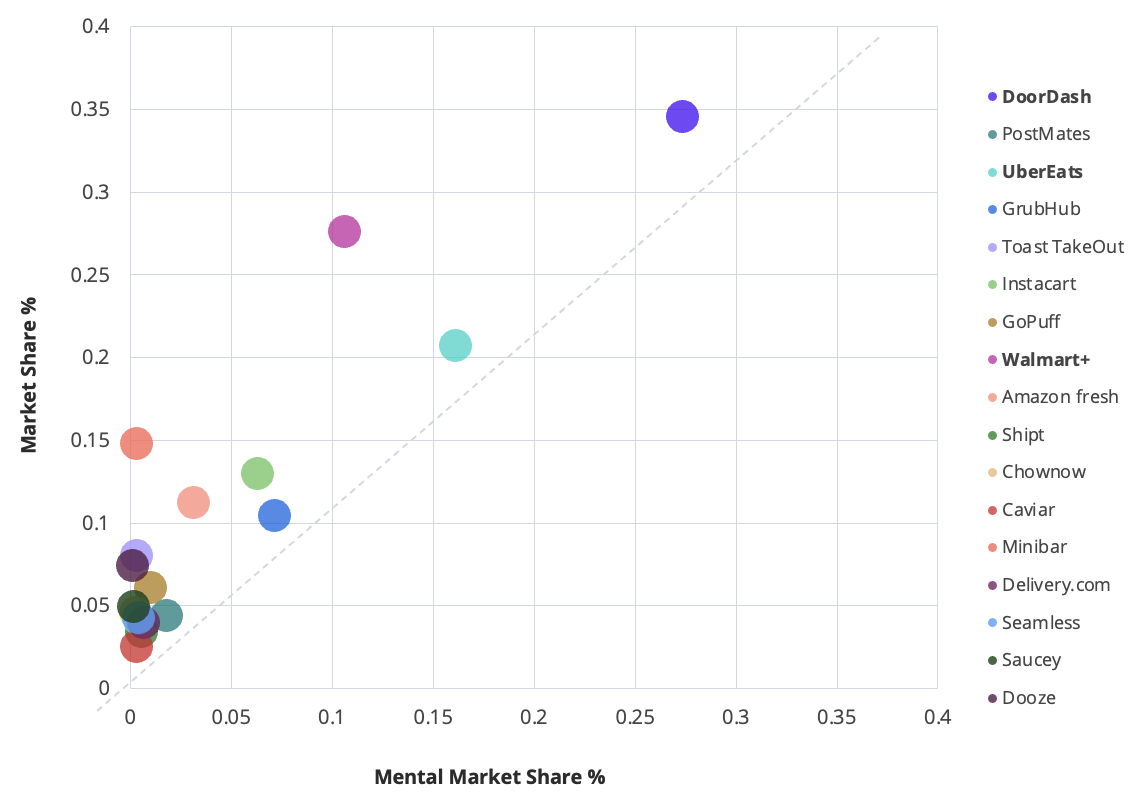
- DoorDash holds commanding lead on mindshare: DoorDash leads on recall, usage occasions, and likelihood to be chosen—functioning as the mental default. Uber Eats is a strong second with broad coverage but less default status.
- Retail-native players own grocery: Instacart, Walmart+, and Amazon Fresh have structural advantages in 'skip the trip' and 'essentials fast' occasions—the primary expansion frontier for restaurant-first platforms.
- The category is anchored in relief: Dominant triggers are functional—too busy, too tired, need it now. These are repeatable, high-frequency situations, not special occasions.
DoorDash, Uber Eats and Walmart+ lead the category on Mental Market Share
Who Are Delivery App Users?
|
51% Male |
Millennial + Gen Z Skew |
Financially Optimistic |
Convenience-Forward |
- Psychographics: Over-index on paying for convenience, trying new products, and willingness to pay more for quality. Health-forward food decisions are increasingly common among heavy users.
- Media footprint: Over-indexed on TikTok, Snapchat, Spotify, and X. Follow food influencers. Sports fandom (NFL, NBA) runs higher than gen pop. Reachable through mass channels but disproportionately present on social and audio.
What's Holding Users Back?
When asked what prevents them from using delivery apps, users point to economic and operational friction. The top barrier—fees—is twice as salient as any other. Value certainty (transparent pricing, deals) is table stakes for frequency.
-
High delivery fees and surcharges (55%)
-
Minimum order thresholds (28%)
-
Long wait times and reliability issues (26%)
-
Limited restaurant or product coverage (23%)
How Segments Differ
The core category structure holds across demographics. What changes is trigger weighting:
- 21–34: Over-index on late-night and social occasions. Brands form default status early here.
- 35–44: Broadest trigger spread—family, workday, weekend. Respond to versatility.
- 45+: Narrower, more functional. Reliability and essentials matter more.
- Income shift: High-frequency usage has moved toward higher earners. Need both value certainty and premium ease.
| DoorDash | UberEats | Instacart | Walmart+ | Amazon fresh | |
|---|---|---|---|---|---|
| Get a meal when I'm too busy or tired to cook or go out | 9 | 4 | -6 | -11 | -7 |
| Saving time by skipping the grocery store | -19 | -17 | 14 | 21 | 12 |
| Get essential items delivered quickly | -13 | -13 | 16 | 26 | 11 |
| Getting late-night snacks | 8 | 6 | -1 | -3 | -5 |
| Feeding the family on busy weekends | 0 | 0 | 0 | 4 | 0 |
| Avoiding long restaurant wait times on weekends | 3 | 4 | -7 | -10 | -3 |
| While staying in a hotel or Airbnb | 9 | 9 | 0 | -6 | -1 |
| Satisfying a late-night sweet tooth with desserts | 9 | 6 | -3 | -4 | -1 |
| Ordering brunch in bed on a lazy Sunday | 6 | 6 | -4 | -6 | -2 |
| Hosting friends without the hassle of cooking for everyone | -2 | 1 | -1 | -1 | -1 |
| Sending comfort food to a loved one | 5 | 5 | 0 | -2 | -2 |
| Grabbing coffee or breakfast on the go | 4 | 1 | -4 | -7 | -4 |
| Trying new local spots | -1 | 1 | -4 | -11 | -6 |
| Grabbing a quick lunch between back-to-back meetings | 4 | 4 | -6 | -9 | -5 |
| Stocking the fridge with drinks for game day | -20 | -17 | 11 | 22 | 8 |
| Find a meal that meets specific dietary needs | -9 | -5 | -1 | 3 | 11 |
| Coordinating a group order for an office lunch-and-learn | 5 | 5 | -4 | -5 | -4 |
Why This Matters Now
-
The battle is for mental real estate. Brands grow by building associations with more buying situations. The widest trigger coverage wins. A single positioning underperforms strategies that link the brand to multiple high-frequency occasions.
-
Grocery/essentials is the expansion frontier. Retail-native players have structural advantages here. Restaurant-first aggregators face a strategic choice: defend meal relief while building credibility in adjacent occasions.
-
One national message won't maximize growth. Different life stages and income levels respond to different triggers. Keep brand cues consistent; rotate which occasions you dramatize by segment.
About this research
Morning Consult conducts over 30,000 daily proprietary surveys in 45 countries covering more than 5,000 brands and 50 economic indicators.
Our category advantage research is aimed at understanding the needs driving consumers in your category — and how your brand can own more of them. This research is built on validated principles of brand-driven growth and powered by Morning Consult’s industry-leading sampling technology.
Measure the true drivers of brand strength
Capture both mental availability (the likelihood your brand comes to mind when consumers face a need or occasion) and emotional closeness (how strongly consumers connect with your brand), benchmarked against competitors.
Uncover Category Entry Points (CEPs)
Directly tied to mental availability, see the specific needs, occasions, and triggers that drive purchase decisions in your category, and how strongly your brand is linked to them.
Pinpoint growth opportunities
Direct investment toward the moments and consumer segments with the greatest potential to grow your brand.
Turn insights into action fast
Get survey results in 4–5 days through a centralized dashboard and short-form memo that equips stakeholders with clear direction on where and how to win.
Learn more
.png)
Why Honda Is One of the Auto Category's Most Structurally Sound Brands
.png)
Chevrolet's Category Advantage Challenge: A Brand Strategy Brief
.png)