

The bottom line up front
Streaming is no longer a single category, but a system of entry moments spanning default entertainment, emotional decompression, habitual background viewing, and live sports rituals. Usage is high, but recall is uneven: people use many services without reliably thinking of them when viewing moments occur. The brands that will grow are not those with the best libraries or the strongest positioning — they’re the ones that show up mentally in more everyday viewing moments, more often.
What’s shaping the streaming category today
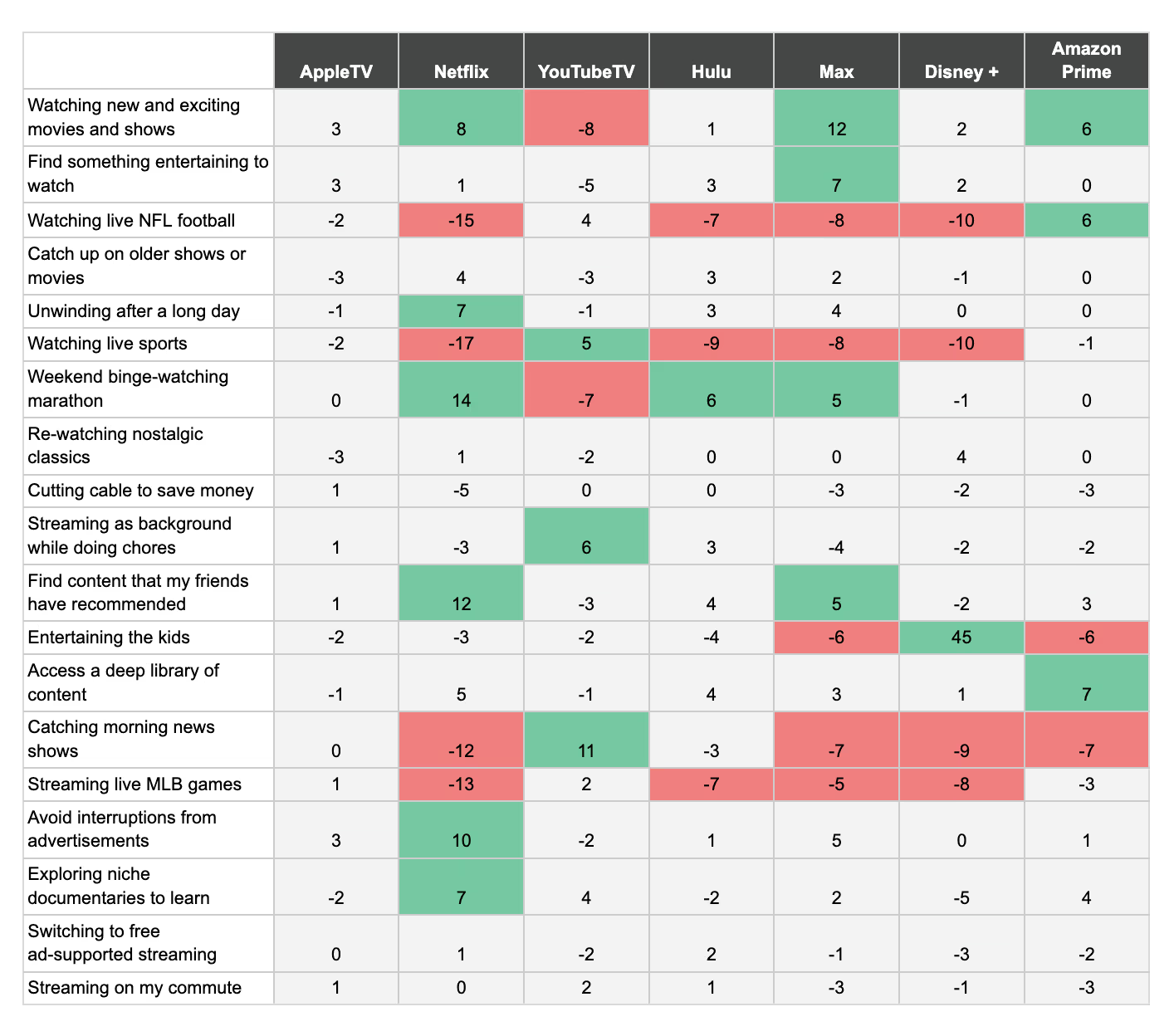
- The category is multi-entry by design. People don’t “shop for streaming.” They arrive through repeatable moments: finding something to watch, unwinding after a long day, catching up on familiar content, weekend bingeing, and live sports. No single entry point dominates.
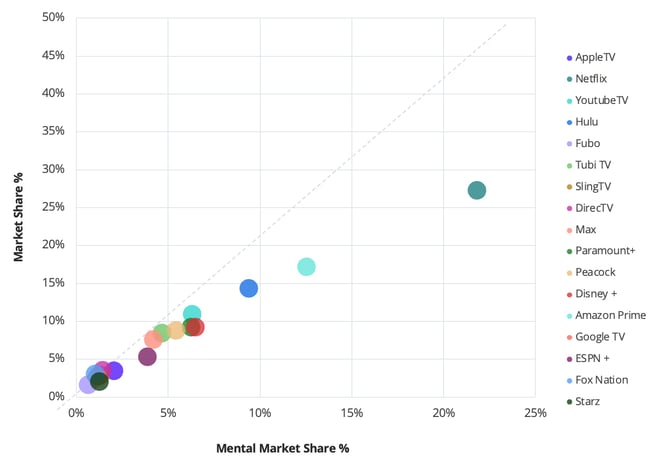
- Usage consistently outpaces recall. Across age, income, gender, and region, market share is higher than mind share for most services. This signals a classic growth problem: brands are being used opportunistically but not remembered systematically. Growth depends on expanding mental presence, not feature differentiation.
- The category is routine-anchored, not novelty-driven. The strongest entry points aren’t innovation-led, but habitual and emotionally functional. This is durable demand. The opportunity lies in owning more of these moments, not inventing new ones.
Streaming Services Gap Analysis
Who are streaming service users?

- Economic mindset: Streaming users maintain higher consumer sentiment than the general population, driven by stronger personal finance expectations. They are willing buyers — friction at the moment of choice is mental, not economic.
- Psychographic profile: They skew aspirational, convenience-seeking, and premium-tolerant. They value ease, breadth, and time savings, and are comfortable paying for quality when it simplifies life.
- Media footprint: Heavy over-indexing on social video (Instagram, TikTok), audio (Spotify), sports media (ESPN), cable and premium entertainment networks, and a mix of serious and mass news. These are high-frequency environments, built for repeated reinforcement—ideal conditions for building mental presence.
How segments differ
The structure holds. The emphasis shifts.
- Sports vs. non-sports entry: Male audiences and the South/Midwest enter disproportionately through live sports (especially NFL). Female audiences and coastal regions skew toward entertainment discovery and unwinding. Sports is a powerful on-ramp—but a narrow destination.
- Income & education: Higher income and more educated users lean into breadth, discovery, and convenience. Lower income segments over-index on cable replacement and value framing. The same entry points apply; the rationale differs.
- Region: The entry-point hierarchy is remarkably stable nationwide. What changes is intensity. The South and Midwest amplify sports and replacement logic; the West and East amplify discovery, bingeing, and emotional payoff. One national story underperforms without weighting.
- Life stage: Younger users are discovery- and culture-led. Older users are habit- and reassurance-led. Growth requires being present for both—not choosing between them.
What's blocking conversion
The recall gap has a behavioral corollary: subscription fatigue and value skepticism.
- Subscription overload is the dominant barrier cluster. Nearly 4 in 10 barriers relate to managing multiple services: 24% don’t want to pay for more than one subscription, 16% find it overwhelming to manage multiple services, and 14% see content as redundant across platforms. The category isn’t struggling with demand—it’s struggling with choice fatigue.
- Price sensitivity is real—but inverted by income. Cost is the #1 stated barrier (34% overall), but the pattern is counterintuitive: households earning $100k+ are more likely to cite price (37%) than those earning under $50k (31%). Wealthier users aren’t budget-constrained—they’re value-questioning. They can afford it; they’re asking whether it’s worth it.
- Age is the sharpest barrier gradient. Price sensitivity nearly triples from younger to older users: 22% of 18–34 year-olds cite cost as a barrier vs. 51% of those 65+. Meanwhile, infrastructure barriers (internet speed, device compatibility) hit younger users hardest—15% of 18–34s cite connectivity issues vs. just 4% of 65+.
- Women are significantly more price-sensitive than men. 39% of women cite cost as a barrier vs. 29% of men—a 10-point gap that suggests value messaging may need gender-specific framing.
- “Good enough” alternatives reduce urgency. 21% say they can get content from free services; 18% are satisfied with broadcast TV. Nearly 4 in 10 don’t see a compelling reason to pay—a differentiation problem, not an awareness problem.Brand over- and underperformance on category entry points.
Brand over- and underperformance on category entry points
Why this matters now
- The category is mentally crowded, but not mentally settled. Consumers juggle multiple services, yet their mental maps remain incomplete. Being “used” is no longer enough. Brands that fail to refresh associations across everyday viewing moments will be silently substituted.
- Optimism creates opportunity—but only for salient brands. Streaming users are more confident, more willing to spend, and more engaged than the general population. That optimism only converts into growth if your brand is top-of-mind when the screen turns on.
- Sports moments are additive, not foundational. Live sports expand reach, but everyday entertainment sustains growth. Brands that over-index on sports risk becoming mentally seasonal. The winners use sports to broaden their mental network, not narrow it.
- Mental presence is the decisive growth lever. In a category defined by low switching costs and high choice overload, the brand that comes to mind first—in more moments—wins. Not because it’s loved more, but because it’s remembered more.
Five strategic implications for streaming services
The streaming category no longer grows by persuasion. It grows by memory structure. Brands that win will be the ones that appear in more everyday moments, across more audiences, with less cognitive effort required from the viewer. Not because they’re loved more—but because they’re remembered more.
1. Close the recall gap before competitors do. Prioritize growth in the number of viewing moments linked to your brand. Expansion into everyday, low-effort occasions matters more than depth in any single use case.
2. Use sports as an acquisition on-ramp, not a silo. Sports entry points are powerful but episodic. Use sports moments to introduce adjacent entertainment, expanding associations beyond sports-only.
3. Match media to viewing moments, not demographics. Users show heavy overlap with social video, sports media, and premium entertainment. Plan media around trigger moments (unwind time, weekend binge cues) rather than audience-only targeting.
4. Address subscription fatigue directly. With 4 in 10 barriers tied to managing multiple services, simplicity is a competitive advantage. Messaging that reduces perceived complexity—or positions your service as the “one to keep”—can unlock conversion.
5. Build emotion after presence, not before. Emotional connection increases with market share—but only after mental presence is established.
About this research
Morning Consult conducts over 30,000 daily proprietary surveys in 45 countries covering more than 5,000 brands and 50 economic indicators.
Our category advantage research is aimed at understanding the needs driving consumers in your category — and how your brand can own more of them. This research is built on validated principles of brand-driven growth and powered by Morning Consult’s industry-leading sampling technology.
Measure the true drivers of brand strength
Capture both mental availability (the likelihood your brand comes to mind when consumers face a need or occasion) and emotional closeness (how strongly consumers connect with your brand), benchmarked against competitors.
Uncover Category Entry Points (CEPs)
Directly tied to mental availability, see the specific needs, occasions, and triggers that drive purchase decisions in your category, and how strongly your brand is linked to them.
Pinpoint growth opportunities
Direct investment toward the moments and consumer segments with the greatest potential to grow your brand.
Turn insights into action fast
Get survey results in 4–5 days through a centralized dashboard and short-form memo that equips stakeholders with clear direction on where and how to win.
Learn more
Olive Garden Is the Most-Loved and Most-Considered Brand in Dining
.png)
Why LinkedIn Is the Social Media Category's Specialist
.png)