Leaders from the world’s largest companies, equity research firms, hedge funds, and the Federal Reserve rely on Morning Consult’s 30,000 daily survey interviews in 45 countries covering more than 5,000 brands, economic indicators, and risk metrics. Schedule a demo to access the always-on consumer signal.
Category Advantage measures the drivers of brand strength by capturing both mental availability (likelihood a brand comes to mind) and emotional closeness (how strongly consumers connect with a brand) among all competitors. Schedule a private briefing on this research. .
The bottom line up front
American Airlines is a broad-coverage but low-intensity brand in the U.S. airline category. It shows up across many buying situations, largely due to network reach and hub presence, but fails to dominate the moments that actually decide choice. Unlike Delta (reassurance) or Southwest (simplicity and value), American’s mental availability is diffuse rather than decisive. The strategic priority is not to add more associations, but to sharpen and concentrate American’s role in high-frequency entry moments — especially where its network advantage should matter most.
The Category Landscape
Airline choice is mentally organized around price entry (lowest fare, fees), convenience (nonstop, nearest airport), and risk reduction (safety, recovery). Category leaders typically win by either depth — owning a small set of moments very strongly — or simplicity — removing reasons to say no. American currently does neither consistently.
Where United Stands
CEP Salience — Broad, But Rarely Leading
American’s salience profile shows moderate strength across many moments, but few clear spikes:
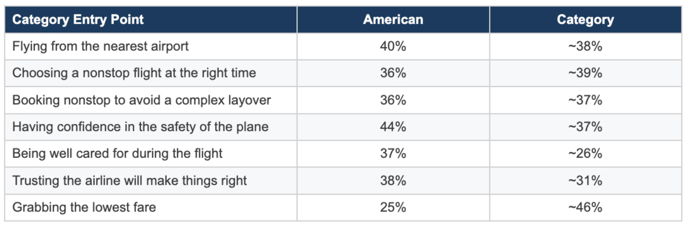
American benefits from structural relevance — network, hubs — but under-indexes sharply on price-led entry, the single biggest doorway into the category. American is often considered, but rarely the obvious choice.
Mental Availability Diagnosis: Breadth Without Intensity
From the Mental Advantage analysis, American shows few strong relative advantages (green cells) but also avoids extreme weaknesses. Neutrality, however, is not a growth strategy. This creates a classic middle problem: not cheapest (loses early in price screens), not most trusted (loses later to Delta and United), and not simplest (loses to Southwest).
American’s mental market share lags its physical market share, indicating an entry weakness rather than a conversion failure. Once shortlisted, American converts adequately. The problem is getting shortlisted often enough — and getting shortlisted for a reason, not by default.
The Core Strength — Network Convenience (Under-Leveraged)
American’s strongest situations cluster around convenience driven by footprint: nearest airport (40%), nonstop timing (36%), and avoiding complex layovers (36%). These should be decisive advantages, but currently behave as background hygiene rather than choice drivers. American’s network works operationally, but not mentally — travelers benefit from it without attributing it to the brand.
The Core Weakness — Price as an Entry Filter
American’s salience on “grabbing the lowest fare” (25%) is almost half the category norm (~46%). This matters because price is not a positioning choice — it is an entry requirement. Even premium-inclined travelers enter the category through price, then trade up. American is often excluded before its strengths come into play.
Request a briefing on your category's users
Reality Check: Market Barriers
|
Barrier analysis clarifies why American’s breadth doesn’t convert into dominance: |
|
|
The Core Insight American Airlines has the reach to be chosen more often, but lacks a clear mental reason to be chosen. The growth problem is not awareness or availability — it is role clarity. American’s network convenience should be a foreground entry cue, not a background fact.
|
Four strategic priorities for American based on this research
|
1. Turn network reach into a reason to choose. Make “best option from your airport” a foreground entry cue, not a background fact. Network convenience must become a mental shortcut, not just an operational truth. Messaging should lead with “nonstop from your airport, at the right time” — activating the triggers where American already has structural advantage (40%, 36%, 36%) but currently fails to convert that advantage into decisive preference.
2. Enter price moments without competing on cheap. American does not need to win “lowest fare” — but it must appear early in price-screened consideration sets and immediately reframe value around convenience and timing. The 25% vs. ~46% gap on price entry is too large to ignore. Clear fare structures, transparent bundles, and “worth it given the alternatives” messaging are the entry levers.
3. Reduce friction where expectations are highest. Focus barrier-reduction investment on hub recovery, schedule reliability, and clear rebooking promises. These are trust multipliers for American: the brand’s moderate trust salience (38%) can be strengthened through visible operational improvement more effectively than through communications. The goal is to move trust from “neutral” to “reliable” — not to match Delta’s reassurance positioning, but to remove trust as a reason American gets eliminated.
4. Measure success through intensity, not coverage. Track growth in price-adjacent CEP salience, strengthening of “nearest airport + nonstop” moments, and reduction in the mental vs. market share gap. The goal is stronger memory in fewer, higher-value moments — not broader presence across moments where American is one of several indistinguishable options. |
About this research
Morning Consult conducts over 30,000 daily proprietary surveys in 45 countries covering more than 5,000 brands and 50 economic indicators.
Our category advantage research is aimed at understanding the needs driving consumers in your category — and how your brand can own more of them. This research is built on validated principles of brand-driven growth and powered by Morning Consult’s industry-leading sampling technology.
Measure the true drivers of brand strength
Capture both mental availability (the likelihood your brand comes to mind when consumers face a need or occasion) and emotional closeness (how strongly consumers connect with your brand), benchmarked against competitors.
Uncover Category Entry Points (CEPs)
Directly tied to mental availability, see the specific needs, occasions, and triggers that drive purchase decisions in your category, and how strongly your brand is linked to them.
Pinpoint growth opportunities
Direct investment toward the moments and consumer segments with the greatest potential to grow your brand.
Turn insights into action fast
Get survey results in 4–5 days through a centralized dashboard and short-form memo that equips stakeholders with clear direction on where and how to win.
Learn more
.png)
United Airlines’ Growth Strategy: Turning Capability Into Consideration
.png)
Airline Growth Strategy: How U.S. Carriers Win Consideration