The bottom line up front
- ChatGPT is the default mental entry point to the AI category. It is not just the most used brand, but the brand people think of first across the widest range of everyday tasks.
- ChatGPT's primary growth challenge is defending and extending that default status as competitors expand distribution, integrate more deeply into operating systems, and specialize around adjacent use cases.
- The strategic priority is not awareness or trial — it is protecting breadth of mental availability and ensuring ChatGPT remains the first brand recalled as the category fragments.
ChatGPT’s competitive strengths
- ChatGPT is the only true generalist brand in the category today. ChatGPT has the highest mental penetration, the largest network of task associations, and the highest mental market share in the category. It is retrieved across nearly every major task cluster, from research and quick answers to writing, learning, translation, and creative ideation.
- ChatGPT is the default brand across age groups, especially younger users. Among 21–34s, ChatGPT's mental dominance is even stronger than in the total population. For many in this cohort, 'Consumer AI' and 'ChatGPT' are effectively synonymous.
- Emotional connection is strongest among category leaders. While emotional scores are moderate across the category, ChatGPT leads on closeness and shows the clearest relationship between depth of use and emotional affinity. Heavy users feel materially closer to ChatGPT than to any competing brand.
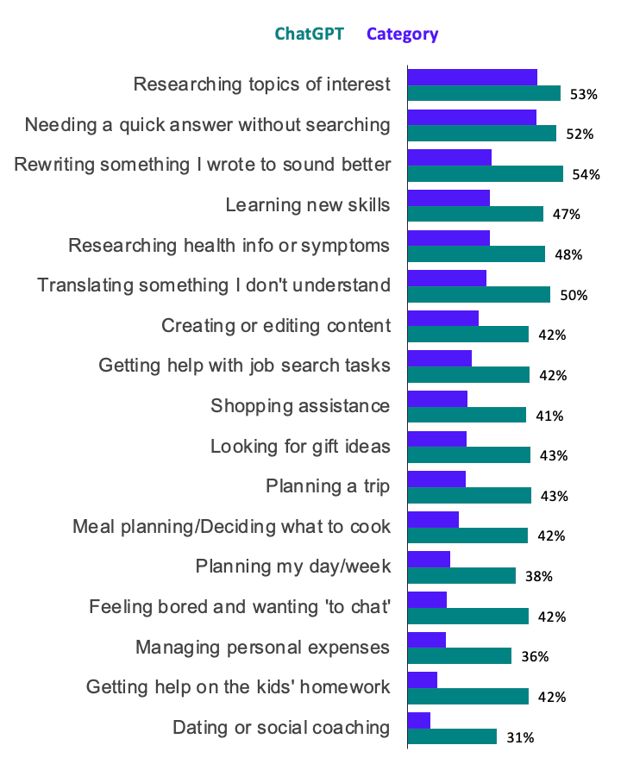
- ChatGPT wins the biggest entry points. The brand is strongly linked to the highest-reach tasks in the category: researching topics of interest, needing a quick answer without searching, rewriting text to sound better, and learning new skills. These account for the majority of category entry and are the foundation of long-term mental availability.
ChatGPT is winning across every category entry point
ChatGPT’s challenges:
- Breadth is both strength and risk. Because ChatGPT is associated with 'everything,' it risks becoming mentally generic as competitors specialize and tell sharper stories around specific jobs (e.g., writing polish, coding).
- Distribution advantages are shifting. OS- and ecosystem-embedded competitors (e.g., Copilot, Apple Intelligence, Meta AI) increasingly reduce friction at the moment of need. Even with strong brand memory, ease of access can erode default choice over time.
- Trust and technology fatigue are rising. Even among AI users, concern about 'too much technology' has increased. As the category leader, ChatGPT will be held to a higher standard on accuracy, transparency, and responsible use.
The core insight ChatGPT is being chosen, not just distributed. Unlike many competitors whose usage is driven by defaults or bundling, ChatGPT's leadership is primarily brand-led. People actively seek it out because it is the most mentally available option across the widest range of needs. The strategic imperative is therefore defensive as much as offensive: to protect ChatGPT's role as the category's mental front door while selectively reinforcing credibility in high-value tasks that competitors are trying to carve out.
ChatGPT’s strongest segments:
- Ages 21-34: ChatGPT is the dominant brand in this cohort, with exceptionally high penetration and top-of-mind recall. This group sets cultural norms for the category.
- Highly educated users: ChatGPT's network of task associations is broadest among college-educated and post-graduate users, consistent with heavy use for learning, writing, and research.
- Heavy category users: As the share of category requirements increases, ChatGPT's emotional connection and likelihood to be selected grow disproportionately.
Want to understand your brand's strongest segments?
ChatGPT’s opportunity segments:
The core task structure holds across demographics. What changes is what triggers usage of AI platforms:
- Older users (45–64, 65+): ChatGPT remains strong but is less culturally embedded than among younger users. In these segments, usage skews toward clarity- and reliability-driven tasks (e.g., researching information, getting quick answers, understanding complex topics), where trustworthy, straightforward performance likely matter more than novelty or experimentation.
- Mainstream education segments: While penetration is high, brand associations tend to be concentrated around fewer core tasks. Reinforcing simple, everyday use cases can help expand network size and increase the number of situations where the brand comes to mind.
Five strategic priorities for ChatGPT based on this research
- Defend the 'default front door' role. ChatGPT's leadership depends on remaining the first brand retrieved when people encounter a problem. This requires sustained reinforcement of the biggest entry points (research, quick answers, learning), not just innovation announcements.
- Add selective sharpness without losing breadth. Rather than trying to 'own' every niche, ChatGPT should signal competence and credibility in a few high-value adjacent tasks (e.g., writing quality, structured learning, creative ideation) to prevent specialists from reframing the category around those jobs.
- Make trust and transparency part of the brand memory. As category leader, ChatGPT must normalize behaviors like citing sources, explaining uncertainty, and giving users control. These aren't just product features — they are memory cues that protect long-term preference.
- Normalize usage across life stages. For older and more cautious users, emphasize simplicity, reliability, and practical outcomes (understanding documents, planning, explanations). This expands penetration without diluting the brand.
- Measure success through mental availability, not just usage. Future success should be judged by sustained mental market share, continued growth in task associations, and stability of top-of-mind recall in younger cohorts — not just by short-term engagement spikes.
Want to understand your brand's strategic priorities?
About this research
Morning Consult conducts over 30,000 daily proprietary surveys in 45 countries covering more than 5,000 brands and 50 economic indicators.
Our category advantage research is aimed at understanding the needs driving consumers in your category — and how your brand can own more of them. This research is built on validated principles of brand-driven growth and powered by Morning Consult’s industry-leading sampling technology.
Measure the true drivers of brand strength
Capture both mental availability (the likelihood your brand comes to mind when consumers face a need or occasion) and emotional closeness (how strongly consumers connect with your brand), benchmarked against competitors.
Uncover Category Entry Points (CEPs)
Directly tied to mental availability, see the specific needs, occasions, and triggers that drive purchase decisions in your category, and how strongly your brand is linked to them.
Pinpoint growth opportunities
Direct investment toward the moments and consumer segments with the greatest potential to grow your brand.
Turn insights into action fast
Get survey results in 4–5 days through a centralized dashboard and short-form memo that equips stakeholders with clear direction on where and how to win.
Learn more
.png)
The Citi Strata Elite Card Over-Indexes on Lifestyle and Status
How The Consumer AI Landscape is Shifting