

The bottom line up front
DoorDash is the default mental entry point to the food & beverage delivery category. It is not just the most used brand, but the brand people think of first across the widest range of meal occasions. DoorDash's primary growth challenge is defending that default status while expanding credibly into grocery and essentials—a frontier where retail-native players (Walmart+, Instacart, Amazon Fresh) hold structural advantages. The strategic priority is not awareness or trial—it is protecting breadth of mental availability in core meal-relief moments while selectively building credibility in adjacent 'skip the grocery trip' occasions.
The Category Landscape
Food & beverage delivery has moved from novelty to everyday utility. The category is now mentally structured around two anchor brands: DoorDash and Uber Eats, with DoorDash holding the clear leadership position.
A second tier includes retail-native players (Walmart+, Instacart, Amazon Fresh) that compete by owning grocery and essentials occasions rather than restaurant delivery. Below that sits a long tail of specialists (GoPuff, Shipt, Grubhub, Postmates) with narrower but sometimes deep associations in specific use cases or geographies.
This is a classic mature-category pattern: one dominant mental front door, one strong challenger, and a widening ecosystem of specialists.
|
Metric |
DoorDash |
Uber Eats |
Others |
|
Mental Market Share |
~27% |
~18% |
Single digits |
|
Mental Penetration |
80–85% |
High 70s |
50–60% |
|
Network Size (avg. CEPs linked) |
~9 |
~8 |
5–7 |
DoorDash leads not just on how many people think of it, but on how many situations they think of it for.
Where DoorDash Stands
The Good News
-
DoorDash is the only true generalist brand in the category today. Mental leadership is broad and deep. DoorDash has the highest mental penetration, the largest network of occasion associations, and the highest mental market share. It is retrieved across nearly every major occasion cluster, from meal relief and late-night to family logistics and travel.
-
DoorDash is the default brand across age groups, especially younger users. Among 21–34s, DoorDash's mental dominance is even stronger than in the total population. For many in this cohort, 'delivery app' and 'DoorDash' are effectively synonymous.
-
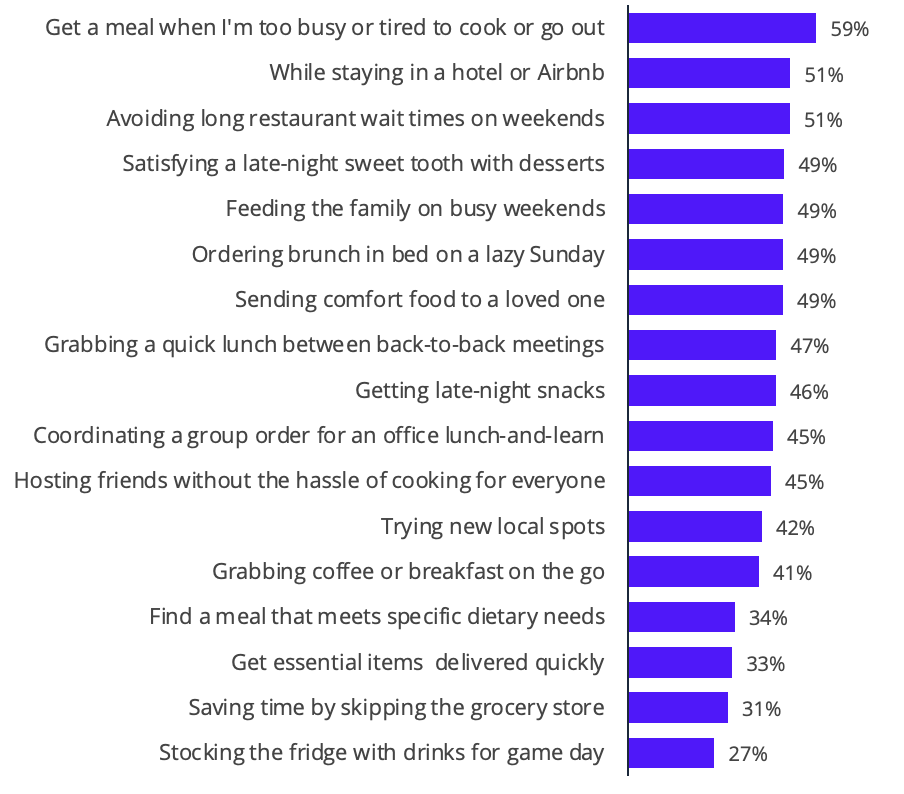
DoorDash wins the biggest entry points. The brand is strongly linked to the highest-frequency occasions: getting a meal when too busy or tired (59%), late-night snacks (46%), feeding the family on busy weekends (49%), and avoiding restaurant wait times (51%). These account for the majority of category entry.
-
Network breadth gives DoorDash optionality. Because DoorDash's network size is large (~9 CEPs), it already has associative connections across many occasions—workday lunch, travel, hosting. That breadth lets it monetize new use cases at lower incremental cost if the product matches the promise.
Category Entry Point Salience for DoorDash
The Challenge
DoorDash's scale creates structural vulnerability.
-
Grocery and essentials are owned by retail-native players. Controlling for brand size, DoorDash under-indexes on 'skip the grocery store' (-19), 'essentials delivered quickly' (-13), and 'game day drinks' (-20). Walmart+, Instacart, and Amazon Fresh lead here—and this is the category's primary expansion lane.
-
This is not primarily a brand memory problem—it's an operational reality. Retail players have logistics, inventory, and merchant footprints purpose-built for grocery. DoorDash will need partnerships or targeted capability builds to compete credibly, not just repositioning.
-
Fee sensitivity is the category's top barrier. 55% of users cite high delivery fees as a barrier to usage—more than twice any other friction point. Value certainty (transparent pricing, deals, reliable substitutions) is table stakes for frequency growth.
The Core Insight: DoorDash is being chosen, not just distributed. Unlike retail players whose usage is driven by existing shopping relationships, DoorDash's leadership is primarily brand-led. People actively seek it out because it is the most mentally available option for meal occasions. The strategic imperative is therefore defensive as much as offensive: protect DoorDash's role as the category's mental front door for meals while selectively building credibility in grocery/essentials—where competitors have structural advantages.
Who Uses DoorDash Today
Strongest Segments (Defend and Reinforce)
-
Ages 21–34: DoorDash is the dominant brand in this cohort, with exceptionally high penetration and top-of-mind recall. Late-night, impulse, and social occasions spike here. This group sets cultural norms for the category.
-
Ages 35–44: The 'everything segment' with the broadest occasion spread—family logistics, workday needs, weekend orchestration. DoorDash's network breadth aligns perfectly with this cohort's varied demands.
-
Higher-income users: High-frequency usage has shifted toward six-figure earners. These users respond to premium ease (speed, reliability, quality assurance) and are less price-sensitive on fees.
Opportunity Segments (Extend and Normalize)
-
Older users (45–64, 65+): DoorDash remains strong but usage skews toward narrower, more functional occasions. Reliability and essentials matter more here; fewer novelty or social occasions. Trustworthy, straightforward performance matters more than experimentation.
-
Lower-income users: App users skew lower income overall, but high-frequency usage has declined in this segment. Value certainty (transparent fees, deals, dependable substitutions) is critical to retain and grow frequency here.
-
Regional gaps: CEP strength is partly operational reality—merchant density, delivery speed, convenience retail coverage. In regions where retail players dominate essentials, focus on meal CEP dominance. Where they're weak, win fast essentials via partnerships.
Five strategic priorities for DoorDash based on this research
1. Defend the 'default front door' role. DoorDash's leadership depends on remaining the first brand retrieved when people encounter a meal problem. This requires sustained reinforcement of the biggest entry points (busy/tired, late-night, family weekends), not just product announcements. Scale CEP-led creative across TikTok, Snap, and connected audio.
2. Expand to grocery/essentials via bundles and partnerships. Partner-first in markets where retail players dominate; build selectively where DoorDash can own speed. 'Tonight + Tomorrow' bundles (meal + breakfast/essentials) surfaced at checkout. Co-branded retailer menus for 'need it now' essentials. Track CEP gains for 'skip the grocery store.'
3. Make value certainty part of the brand memory. Fees are the #1 barrier. Transparent pricing, reliable substitutions, and visible deals aren't just product features—they are memory cues that protect long-term preference. Build these into the brand story, not just the UX.
4. Raise emotional connection in family and female segments. Invest in brand work (not promos) to increase preference in family/hosting occasions. Local-merchant storytelling, 'care' UX cues (proactive substitutions, personalized notes), and CRM emphasizing reliability for family occasions. KPI: emotion score lift in female and 35–44 segments.
5. Measure success through mental availability, not just transactions. Future success should be judged by sustained mental market share, continued growth in occasion associations, and stability of top-of-mind recall in younger cohorts—not just by short-term order volume or GMV.
About this research
Morning Consult conducts over 30,000 daily proprietary surveys in 45 countries covering more than 5,000 brands and 50 economic indicators.
Our category advantage research is aimed at understanding the needs driving consumers in your category — and how your brand can own more of them. This research is built on validated principles of brand-driven growth and powered by Morning Consult’s industry-leading sampling technology.
Measure the true drivers of brand strength
Capture both mental availability (the likelihood your brand comes to mind when consumers face a need or occasion) and emotional closeness (how strongly consumers connect with your brand), benchmarked against competitors.
Uncover Category Entry Points (CEPs)
Directly tied to mental availability, see the specific needs, occasions, and triggers that drive purchase decisions in your category, and how strongly your brand is linked to them.
Pinpoint growth opportunities
Direct investment toward the moments and consumer segments with the greatest potential to grow your brand.
Turn insights into action fast
Get survey results in 4–5 days through a centralized dashboard and short-form memo that equips stakeholders with clear direction on where and how to win.
Learn more
.png)
U.S. Auto Market Trends: What's Driving Purchase Decisions
.png)
Walmart+ Strategy: How It Became the Default for Household Logistics
.png)