Who Is the GLP-1 Consumer? A Data-Driven Profile of America's Most Commercially Valuable Health Segment
Download our Most Trusted Brands 2026 report here for the definitive ranking of the brands that lead the way on consumer trust — spanning 184 brands across 30 rankings.
Based on surveys among 58,008 U.S. adults and brand consideration data across 3,081 brands.
GLP-1 receptor agonists — the class of drugs that includes Ozempic, Wegovy, and Mounjaro — have rapidly moved from niche diabetes treatments to a mainstream cultural phenomenon. But beyond the headlines about celebrity weight loss and pharmaceutical stock prices, a more fundamental question matters for business leaders: who exactly is taking these drugs, and what does that mean for consumer markets?
Morning Consult’s comprehensive analysis delivers a clear answer. GLP-1 users are not just patients managing a condition. They represent one of the most commercially attractive consumer segments in America today.
Key Findings at a Glance
|
Metric |
Finding |
|
Brand consideration uplift |
+12.9 pp average across 3,081 brands |
|
Brands with higher GLP-1 consideration |
99.9% (3,077 of 3,081) |
|
Household income $100K+ |
31% vs. 14% general population (2.2×) |
|
TikTok usage over-index |
+32 pp vs. all adults |
|
Top non-pharma category |
Zero-sugar beverages (+24.4 pp avg.) |
|
This blog post summarizes key findings from Morning Consult’s GLP-1 Consumer Report. Download the full report → |
Demographic Profile: Who Are GLP-1 Users?
The demographic profile of GLP-1 users departs sharply from the general adult population. Gen X is the core generational cohort, making up 35% of GLP-1 users compared to 25% of all adults — a 10 percentage point over-index. Millennials are also over-represented at 31% versus 28%,while Boomers and Gen Z are under-represented.
GLP-1 users are overwhelmingly married (57% vs. 41%, +16pp) and far more likely to have children at home (45% vs. 27%, +18 pp). They skew urban at 41% versus 28% in the general population.
In short, the core GLP-1 consumer is a married, urban GenXer or Millennial with kids — a profile that aligns with peak earning years, peak consumer spending, and the life stage where health management becomes a priority.
Income, Education, and Wealth
The economic profile of GLP-1 users is striking. The share earning over $100,000 in household income is more than double the general population — 31% compared to 14%. Meanwhile, the under-$50,000income bracket shrinks by 18 percentage points. 27% hold a master’s degree or above, versus just 12% of all adults.
|
Socioeconomic Metric |
All Adults |
GLP-1 Users |
Difference |
|
Household income $100K+ |
14% |
31% |
+17 pp |
|
Household income under $50K |
57% |
39% |
−18 pp |
|
Master’s degree or above |
12% |
27% |
+15 pp |
|
$50K+ invested |
25% |
42% |
+17 pp |
|
Private-sector employed |
30% |
45% |
+15 pp |
|
Insured |
86% |
96% |
+10 pp |
|
Unemployed |
13% |
7% |
−6 pp |
Nearly all GLP-1 users are insured (96% vs. 86%), most through employer-sponsored plans — a practical prerequisite for affording GLP-1medications, which can cost over $1,000 per month without coverage.
Early Adopters, Trend Seekers, and Status Seekers
The psychographic data reveals a consumer far more engaged with novelty, status, and social currency than the average adult. GLP-1users are +15 pp more likely to be among the first to try new technology, +15 pp more likely to follow the latest trends, and +14pp more likely to want a lifestyle that impresses others.
They are +12 pp more likely to strive for high social status, +13 pp more likely to say being part of the popular crowd matters, and+12 pp more willing to pay a premium for convenience.
These are consumers primed for premium products, limited editions, and brand storytelling that appeals to aspiration and belonging.
The Impulsive Health-Conscious Paradox
Perhaps the most revealing tension in the data: 49% ofGLP-1 users say they tend to be impulsive (vs. 38% of all adults), yet 74%say health is their primary food decision factor (vs. 63%). They exercise more, lift weights more, and buy athletic apparel more frequently. At the same time, they pay more for convenience, shower loved ones with gifts, and chase every latest trend.
This paradox resolves when you understand GLP-1 users as active managers of competing impulses. The medication itself may be part of this strategy — a pharmaceutical tool that allows them to pursue health goals without fully suppressing their appetite for consumption, novelty, and indulgence. They are not ascetics; they are optimizers.
|
The full report includes all charts, detailed category breakdowns, and methodology. Download the full report → |
Social Media: Hyper-Connected Across Every Platform
The social media gaps are among the most striking findings in the entire dataset. GLP-1 users dramatically over-index on virtually every major platform:
|
Platform |
Over-Index vs. All Adults |
|
TikTok |
+32 pp (68% vs. 36%) |
|
|
+24 pp |
|
|
+22 pp |
|
|
+21 pp |
|
|
+20 pp |
|
Spotify |
+19 pp |
|
Snapchat |
+18 pp |
|
Twitch |
+16 pp |
|
|
+15 pp |
|
FB Messenger |
+14 pp |
|
X (Twitter) |
+11 pp |
|
|
+9 pp |
The combination of high LinkedIn usage (professional networking), high Reddit usage (information-seeking and community), and highTikTok/Instagram usage (trend discovery) paints a picture of a consumer deeply embedded in digital culture across both professional and personal dimensions.
Brand Impact: A Near-Universal Uplift Across 3,081 Brands
GLP-1 users show higher net purchasing consideration for 3,077of 3,081 brands measured — that’s 99.9%. The average uplift is +12.9percentage points, with a median of +12.4 pp.
This near-universality is consistent with the audience profile: wealthier, more engaged, more optimistic consumers with higher media consumption are simply more receptive to a wider range of brands. But the magnitude of uplift varies dramatically by category.
Top Brand Categories by GLP-1 Uplift
|
Brand Category |
Avg. GLP-1 Uplift |
|
GLP-1 Medications |
+40.9 pp |
|
Zero-Sugar Beverages |
+22.5 pp |
|
NFL Teams |
+22.5 pp |
|
Luxury Auto |
+21.6 pp |
|
Streaming Services |
+19.2 pp |
|
Social Media |
+18.6 pp |
|
Amazon Ecosystem |
+17.4 pp |
|
Beer & Alcohol |
+15.9 pp |
|
Fast Food |
+13.6 pp |
|
All Brands (avg.) |
+12.9 pp |
GLP-1 users also show elevated interest in luxury and aspirational brands: Lincoln (+27.8 pp), Rolex (+25.4 pp), Mercedes-Benz (+25.3pp), and Royal Caribbean (+26.8 pp). Amazon’s ecosystem is another major beneficiary: Amazon Fresh (+30.3 pp), Alexa (+31.6 pp), Prime Rewards Visa(+26.0 pp), and Music (+23.6 pp).
Zero-Sugar Beverages: The Standout Category
Among non-pharmaceutical brands, the most striking cluster belongs to zero-sugar and diet beverages, with an average uplift of+20.5 pp. Coca-Cola Zero Sugar leads at +31.8 pp, followed by Diet Coke (+27.0pp), Diet Pepsi (+26.9 pp), and Pepsi Zero Sugar (+26.5 pp).
This connects directly to the audience data: 74% of GLP-1users say health is their primary food decision factor, and they strongly favor lower-calorie options. Zero-sugar beverages are the consumer goods equivalent of GLP-1 medications themselves — tools for managing caloric intake without sacrificing the experience of consumption. The pattern extends to Lean Cuisine(+24.9 pp) and Chobani Zero Sugar (+20.0 pp).
What This Means for Brands
The GLP-1 consumer isn’t a health niche to be targeted with wellness messaging alone. This is an affluent, hyper-engaged, aspirational consumer segment that happens to manage weight with modern pharmaceuticals. They are simultaneously health-conscious and impulsive, status-driven and community-oriented, disciplined about food and enthusiastic about indulgent brands.
For brand strategists, the implications are significant. GLP-1 users are early adopters who will try your new product. They’re status-seekers who respond to premium positioning. They’re digitally omnipresent, reachable across TikTok, Reddit, LinkedIn, and Instagram. And they have the income and willingness to spend.
As GLP-1 prescriptions continue their rapid growth trajectory, this consumer segment will only become more commercially important.The brands that understand them now — as optimizers, not ascetics — will be best positioned to capture their considerable spending power.
Frequently Asked Questions
Who is the typical GLP-1 consumer?
According to Morning Consult’s survey of 58,008 U.S.adults, the typical GLP-1 user is a married, urban Gen Xer or Millennial with children at home. They’re significantly more affluent than the general population — 31% earn over $100,000 (vs. 14% of all adults) and 27% hold a master’s degree or higher (vs. 12%). They are early adopters, trend seekers, and status-driven consumers who are simultaneously health-conscious and self-described as impulsive.
How much do GLP-1 users spend compared to the average consumer?
GLP-1 users show higher net purchasing consideration for99.9% of 3,081 brands measured, with an average uplift of +12.9 percentage points. Their household incomes are more than double the national average at the $100K+ threshold, and 42% have $50,000 or more in investments (vs. 25%).They also report higher willingness to pay premiums for quality (+6 pp),convenience (+12 pp), and sustainability (+8 pp).
What brands do GLP-1 users prefer?
Beyond GLP-1 medications themselves (+40.9 pp uplift),the strongest brand preferences cluster around zero-sugar beverages (Coca-ColaZero Sugar at +31.8 pp, Diet Coke at +27.0 pp), Amazon ecosystem products(Alexa at +31.6 pp, Amazon Fresh at +30.3 pp), and luxury/aspirational brands (Lincoln at +27.8 pp, Royal Caribbean at +26.8 pp, Rolex at +25.4 pp, Mercedes-Benz at +25.3 pp).
What social media platforms do GLP-1 users use most?
GLP-1 users over-index on virtually every social platform. The largest gaps versus the general population are TikTok (+32 pp),WhatsApp (+24 pp), Reddit (+22 pp), Instagram (+21 pp), LinkedIn (+20 pp), andSpotify (+19 pp). This makes them reachable across professional, entertainment,and community-driven platforms simultaneously.
Why should brands care about GLP-1 consumers?
GLP-1 users represent a large and rapidly growing consumer segment that is wealthier, better educated, more digitally active, and more brand-receptive than the average American. They show elevated purchasing consideration across nearly every product category — not just health and wellness. As GLP-1 prescriptions continue to grow, this audience will become increasingly important for brands in categories from luxury auto to fast food to streaming services.
How are GLP-1 users different from typical health-conscious consumers?
Unlike traditional health-focused segments, GLP-1 users are not ascetics. They score high on both health-consciousness (74% say health is their primary food factor) and impulsivity (49% describe themselves as impulsive). They exercise more and choose zero-sugar options, but they also chase trends, shower loved ones with gifts, and gravitate toward indulgent and aspirational brands. Morning Consult describes them as “optimizers” — they use tools like GLP-1 medications to manage health while still fully participating in consumer culture.
|
Get the complete analysis with all charts, data tables, brand-level breakdowns, and methodology from Morning Consult. Download the full report → |
Data based on surveys among 58,008 U.S.adults and brand consideration data across 3,081 brands.
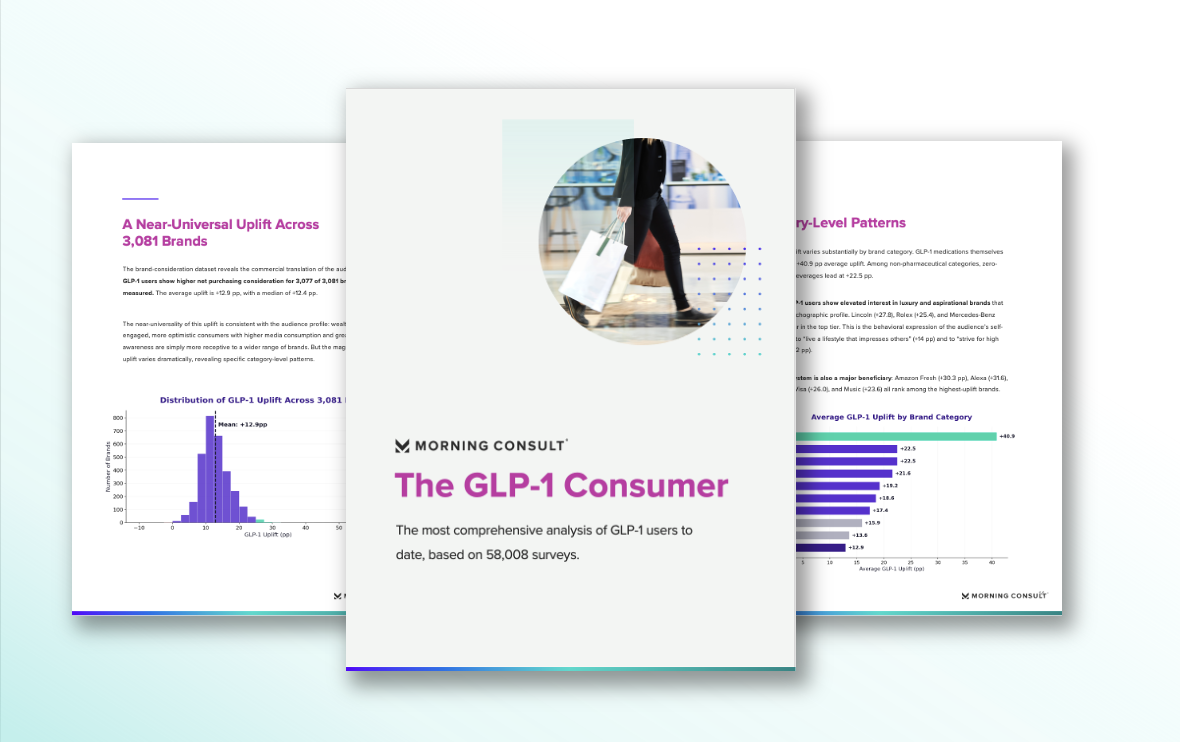
Download the full report
The most comprehensive study on GLP-1 users to date
You May Also Like
These Related Stories

Gen Z Brand Trust: Why 94% of Brands Score Lower

How Brands Are Putting Morning Consult’s AI Connector to Work