
The bottom line up front
Corporate reputation used to be something you measured quarterly and managed slowly. That model is over.
Today, a single news cycle can reshape how millions of people feel about your company—and the audiences reacting to it aren’t all responding the same way. Younger customers may pull away while older ones stay loyal. Employees may be alarmed while investors shrug. What looks stable at the aggregate level can mask serious erosion underneath.
This piece makes the case that reputation is no longer something to observe—it’s something to actively manage. It walks through real scenarios where companies that waited for a crisis to resolve on its own saw permanent damage, while those that understood their emotional foundation with different audiences were able to respond with precision and recover faster.
For communications, strategy, and executive leaders thinking about how to protect and build trust in a more volatile environment, this is your starting point.
Reputation Is No Longer a Spectator Sport
Corporate reputation has always shaped how organizations are perceived, but the conditions that govern it have changed fundamentally. What was once shaped by relatively centralized media and slower opinion cycles now takes shape across a fragmented landscape of social platforms, niche media, influencers, and highly polarized audiences. In this environment, the same corporate action can generate sharply different reactions at the same time — across generations, political identities, and stakeholder groups, without a single shared narrative to anchor interpretation.
For most of the past few decades, organizations managed reputation by looking backward. Scores were reviewed quarterly, rankings updated annually, and dashboards consulted after issues had already played out. That worked because public perception shifted slowly enough that teams had time to analyze, deliberate, and respond. Even as digital media expanded, most reputation systems were built for after-the-fact review, not real-time decision-making.
That model no longer holds. Today, political and social polarization amplifies reputational risk, drawing corporations into debates over identity, values, fairness, and trust — often regardless of intent. Audience fragmentation means reputational impact is rarely uniform: confidence may erode quickly among some groups while remaining stable among others. For leaders, this has compressed the response window and raised the stakes of every decision about whether to engage, how to communicate, and which audiences to prioritize.
As a result, the leaders closest to reputation — the CCO, CMO, CEO, CHRO, and corporate affairs teams — now operate under constant pressure to interpret signals and act with speed and precision. What once felt manageable through periodic reporting now requires ongoing judgment calls: when to respond and when to hold; when to reassure employees or investors; when to recalibrate a narrative; and when a brand has the resilience to absorb criticism versus when intervention is required.
In this environment, reputation can no longer be treated as a static score or a set of signals to monitor. It must function as decision intelligence — a system that helps leaders understand what is changing, why it is happening, and how to act to protect trust, maintain their license to operate, and build long-term resilience. This is the challenge modern communications leaders face, and it is the lens through which reputation must now be managed.
When a Crisis Doesn't Resolve on Its Own
One of the clearest demonstrations of why activation matters shows up in moments of crisis—especially those that leaders expect to be temporary.
In a heavily regulated sector, a highly visible executive-level incident sent shockwaves through the entire industry. Reputation scores declined across multiple organizations almost immediately, reflecting the intensity of public and stakeholder attention. The initial pattern looked familiar: a sharp drop following intense coverage, followed by early signs that attention might fade.
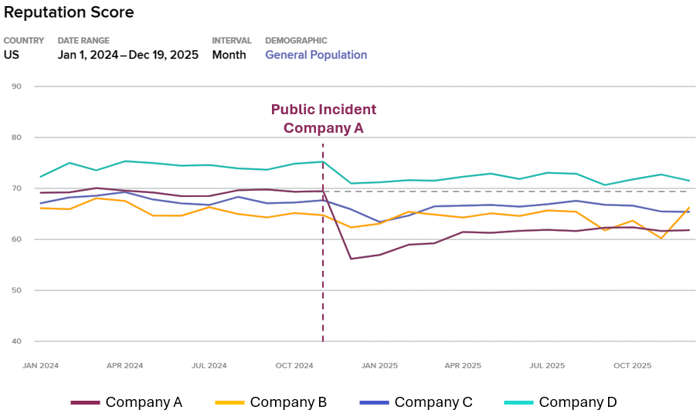
But as weeks passed, amid increasingly intense public discourse among stakeholders, the data told a more complex story. While several peers began to recover as scrutiny eased, one organization did not. Its reputation fell more steeply and failed to return to its prior baseline, even as broader industry sentiment stabilized.
For a communications leader, this is not an abstract insight. It is a daily operational challenge. The risk was not the initial decline but the assumption that recovery would occur organically. Activation became essential: determining whether confidence was rebuilding on its own or stalling, identifying which stakeholder groups remained skeptical, and deciding where intervention was required to prevent longer-term damage.
This is the difference between monitoring a crisis and managing one. Some reputational shocks resolve as attention shifts. Others persist because the organization enters the moment without sufficient underlying reputational strength to rebound naturally. In those cases, waiting is not a strategy. Activation is.
When leaders have both continuous signals and a deeper understanding, patterns emerge that would otherwise remain invisible.
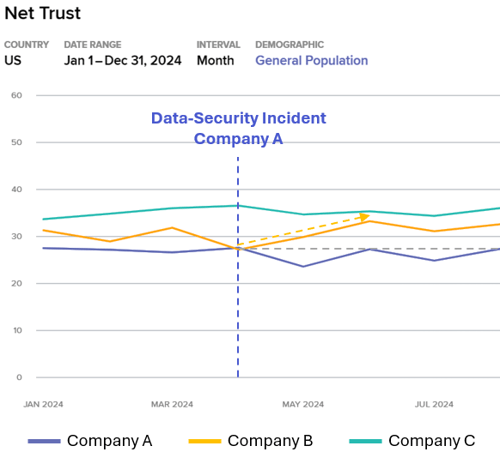
Consider a major data-security incident in a consumer technology or telecommunications category. Multiple organizations face similar exposure, yet reputational outcomes diverge quickly. One brand sees trust deteriorate sharply and linger. Another stabilizes. A third even gains relative strength.
The difference is not the incident's severity alone. It is the emotional foundation each organization has built before the event. Brands with stronger emotional closeness and perceived competence are better positioned to reassure stakeholders and recover. Those with weaker foundations must work harder and longer to rebuild confidence.
The Reputation Problem No One Talks About
Most organizations don’t struggle because they lack reputation data. They struggle because they lack actionable clarity.
Traditional reputation approaches often create a false sense of control. Leaders see a score, a rank, or a directional arrow and assume they understand the situation. Yet reputation rarely shifts for a single reason, and topline stability can mask deeper fragility.
This leads to predictable missteps: overreacting to short-term noise, underreacting to slow erosion, or deploying one-size-fits-all messaging to audiences that are responding in very different ways.
What’s missing is not information. You are missing interpretation. Reputation leaders need intelligence that explains why something is happening and what to do about it—not just that it happened. It needs to be built with communication in mind, not as a market research program.
Reputation Is Emotional Before It Is Rational
To activate reputation effectively, leaders first need to understand what actually drives it. At its core, reputation isn’t a rational scorecard of corporate actions—it’s an emotional relationship between an organization and the people it serves. People decide whether to trust, admire, forgive, or support a company based on how it makes them feel: whether it seems credible, aligned with their values, and “for people like me.”
Rational perceptions follow emotion, and behavior follows both.
This emotional reality explains why two companies can face similar scrutiny yet experience very different outcomes. It also explains why recovery is not automatic. A brand with strong emotional foundations can absorb criticism and rebound. A brand with weaker emotional ties may see even modest pressure compound over time.
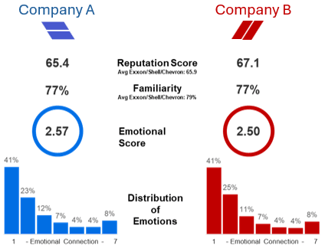
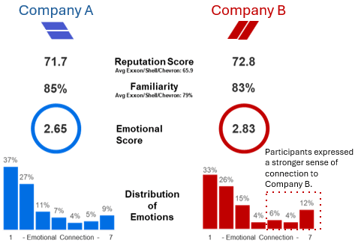
In the energy sector, for example, the same strategic move can trigger markedly different responses depending on the region. Local stakeholders may interpret the decision through the lens of employment, community investment, or political identity, while national audiences respond more abstractly.
Activation in this context requires localized engagement rather than uniform messaging. Communications leaders must understand where emotional stakes are highest and tailor responses accordingly. National narratives alone are rarely sufficient when reputational meaning is shaped by regional experience.
| National Level Emotional Connection | Texas Emotional Connection |
 |
 |
Cultural volatility is especially pronounced in sectors where brands are closely tied to identity and values. In entertainment, audiences often evaluate companies not only on performance or consistency, but on cultural alignment, which can produce sharper reputational swings for some brands while others remain steadier by anchoring expectations around reliability rather than identity. The activation implication is significant: brands with stronger emotional closeness can build resilience through consistency and cadence, while brands with greater emotional distance face heightened risk when cultural tensions rise. Communications strategies that stabilize one type of brand can amplify volatility for another, making it essential for leaders to recognize which dynamic is at play and respond with clarity or continuity accordingly.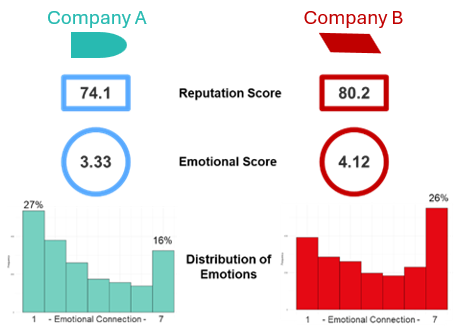
Understanding the emotional foundation and how your message resonates with audiences enables communications leaders to elicit the right response rather than relying solely on instinct. Stakeholders expect unique messages, not corporate generalities.
When Pressure Accumulates Instead of Explodes
Not all reputation challenges arrive as discrete crises. Many now emerge from sustained exposure to the political, social, and cultural pressures that define the current environment. In an era of heightened polarization, companies are increasingly drawn into debates about identity, values, and fairness—often despite their intent. What might once have been a contained issue now reverberates across audiences that interpret the same action in very different ways.
This pattern is particularly evident in the retail sector. Over several years, a large national retailer navigated a series of highly visible moments tied to social and cultural debates, consumer boycotts, pricing transparency amid inflation, competitive retail dynamics, and leadership uncertainty. None of these moments alone defined the brand. Together, they reflect the reality of operating in a polarized environment where reputational pressure accumulates rather than dissipates.
What’s striking about the data is not just the overall decline but also how uneven it plays out. Across generations — and by extension, across values and identity — confidence erodes at different rates. Some audiences grow distant quickly, while others remain relatively stable. At the aggregate level, reputation can appear resilient. Beneath the surface, emotional distance grows, quietly increasing sensitivity to the next issue.
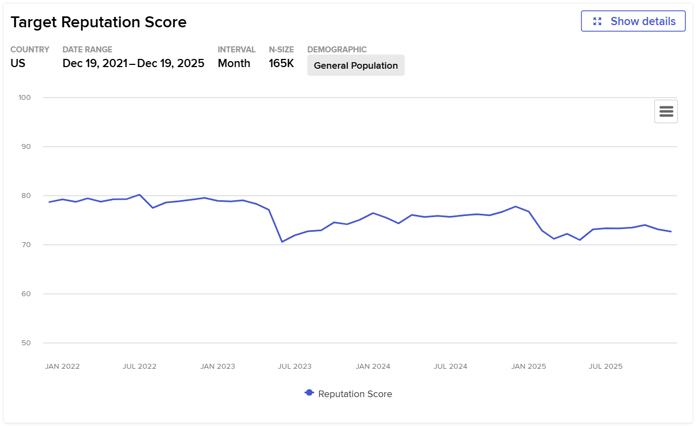
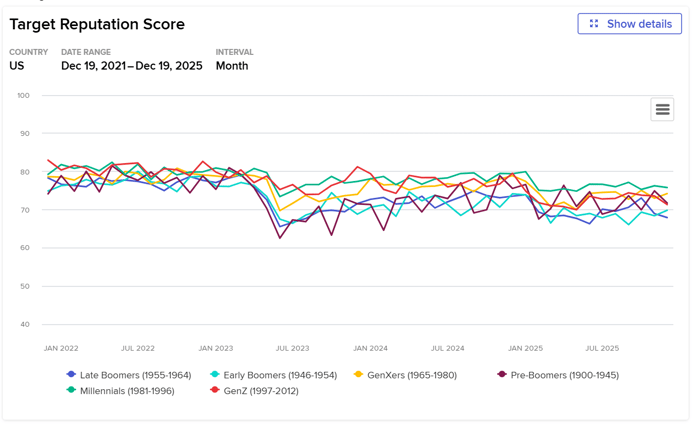
We also see customers becoming increasingly distant from the company, particularly compared to other retailers. Company C has an overall Emotion Score lower than its peers, driven by how distant customers feel toward the company. In comparison, almost one-third of Company A’s customers feel very close to the company, which reflects a high emotional score and ultimately elevates its rational perceptions, supporting a high reputation score.
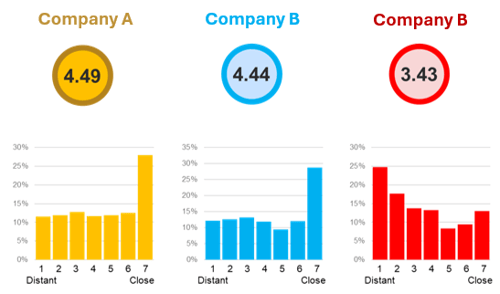
For communications leaders, this insight is critical. It explains why a brand can become increasingly reactive to controversy, even without a single defining crisis. In this context, activation looks very different from crisis response. It requires sustained narrative work, audience-specific engagement, and a clear understanding of which emotional levers must be reinforced to rebuild connection over time.
Why Activation Requires a Different Kind of Intelligence
These two scenarios — a sudden crisis that fails to resolve and a slow, cumulative erosion — share a common lesson: data alone doesn’t protect you. Action does. And action requires knowing what to do, when, and for whom.
To activate effectively, communications leaders need three things working together:
First, they need continuous visibility into how reputation is changing—not quarterly snapshots but day-to-day signals that show when sentiment shifts, when buzz spikes, and when audiences diverge.
Second, they need interpretive depth—an understanding of emotional drivers, perceptual gaps, and audience differences that explain why those movements occur.
Third, they need confidence in the data and in what to do next. Clarity on which messages to deploy, which audiences to prioritize, and how to know whether their actions are working.
This is where Morning Consult’s approach is fundamentally different from legacy agencies.
Our Reputation Score is built on five transparent metrics: Trust, Admired Employer, Community Impact, Favorability, and Value. These metrics are organized around two dimensions that matter to communications leaders: Brand Appeal and Corporate Credibility & Character. It is not a black box. Leaders can see what is moving and where the pressure lies.
Behind that score lies a broader reputation framework that traces how emotions shape perceptions, how perceptions intensify into feelings, and how those feelings translate into action. This is reputation science applied to real-world decision-making.
And crucially, this understanding is paired with always-on intelligence that shows how reputation moves across brands, sectors, audiences, and markets — not in isolation but in context.
This is where agentic intelligence becomes especially valuable for communications leaders. As the volume and complexity of reputation signals increase, the challenge shifts from collecting data to interpreting it quickly enough to act. Morning Consult’s AI-supported reputation reporting is designed to do exactly that — synthesizing always-on reputation signals, audience dynamics, competitive movements, and external events into a clear, decision-ready view of what is changing and why.
Grounded in Morning Consult’s reputation science and transparent measurement approach, agentic reporting helps teams identify emerging patterns, pinpoint which audiences are driving shifts, and determine where attention is most urgently needed. Used well, it accelerates activation by reducing noise and sharpening judgment, enabling leaders to move faster from signal to insight while preserving the human decision-making that effective reputation management demands.
Learn more about AI in reputation reporting
Together, these elements create something rare in the reputation space: a system designed not just to measure reputation, but to activate it.
The Future of Reputation Leadership
Reputation leadership today is defined by a simple but demanding reality: trust is continuously shaped across fragmented audiences in an environment where political, social, and cultural pressures intersect with every corporate decision. Measuring perception after the fact is no longer enough. Leaders must interpret signals as they emerge, understand what they mean for different stakeholders, and decide how to act — quickly and with confidence.
This is why the future of reputation management belongs to organizations that treat reputation as a living system rather than a static metric. Always-on intelligence reveals movement as it happens. Reputation science explains why some brands absorb pressure while others struggle to recover. And interpretive tools, including AI-supported insights, help communications teams move faster from signal to action without sacrificing judgment.
What distinguishes Morning Consult is not a single metric or method, but the ability to integrate these elements into a coherent operating system for reputation leadership. By combining continuous measurement, deep emotional and perceptual understanding, and decision-ready interpretation, we enable leaders to activate reputation deliberately — not reactively — in the moments that matter most.
In a world where expectations are harder to manage and missteps carry greater consequences, reputation is no longer something to observe from a distance. It is something leaders must actively manage. Morning Consult exists to make that possible — by turning reputation intelligence into the clarity and confidence communications leaders need to act.
Reputation doesn't wait for your next quarterly report.
Morning Consult gives communications and marketing teams an always-on consumer signal — so you can see what's shifting, who's reacting, and where to focus before it becomes a crisis.
Learn how Morning Consult supports communications teams

Social Media and Brand Reputation: Scrolling on Borrowed Trust
.png)
U.S. Auto Market Trends: What's Driving Purchase Decisions
.png)