

Download our Most Trusted Brands 2026 report here for the definitive ranking of the brands that lead the way on consumer trust — spanning 184 brands across 30 rankings.
The bottom line up front
- Consumer AI is still a land grab for establishing brand prominence, not just a usage race.
- ChatGPT and Gemini are the two mental 'front doors,' but neither has locked in dominance.
- The category is anchored in functional, repeatable tasks and the brands that build the strongest associations with those tasks will win as AI shifts from novelty to infrastructure.
What’s shaping the consumer AI category today
- ChatGPT leads on brand recall, task associations, and likelihood to be chosen.
- Gemini is a strong second with broad reach, but when given a choice, most consumers still default to ChatGPT. Together, they function as the category's generalist 'front doors.'
ChatGPT and Gemini command mental market share
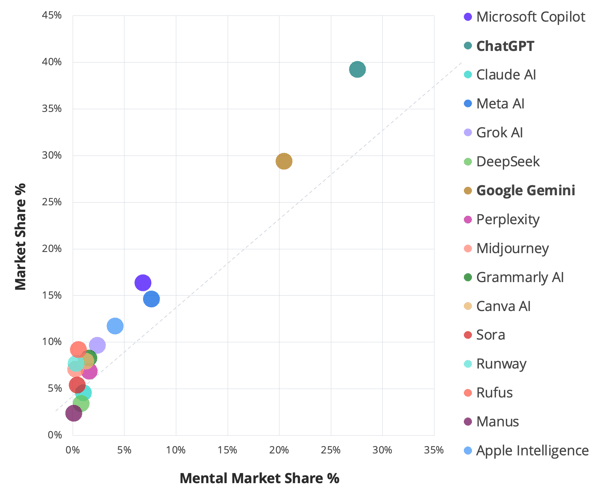
- The category is functionally anchored: Top triggers are research, quick answers, rewriting, learning, and translation — repeatable 'cognitive work' jobs, not novelty use cases. This is a durable category built on ongoing demand.
- Consumer AI brand differences are driven by use-case: Grammarly and Canva compete by owning specific task territories (productivity, writing, creative, device-embedded). Google Gemini dominates on tasks that build upon traditional search functions.
Brand over- and underperformance on category entry points among higher earners ($100k+)
|
% |
Copilot |
ChatGPT |
Claude AI |
Google Gemini |
Perplexity |
Grammarly AI |
Canva AI |
|
Researching topics of interest |
1 |
2 |
1 |
6 |
-1 |
-5 |
-4 |
|
Needing a quick answer without searching |
0 |
4 |
-2 |
10 |
1 |
-4 |
-2 |
|
Rewriting something I wrote to sound better |
0 |
5 |
2 |
-11 |
-2 |
26 |
0 |
|
Learning new skills |
1 |
-1 |
0 |
1 |
2 |
-2 |
4 |
|
Researching health info or symptoms |
0 |
0 |
2 |
7 |
1 |
-5 |
-1 |
|
Translating something I don't understand |
1 |
3 |
0 |
4 |
-2 |
9 |
-7 |
|
Creating or editing content |
-3 |
-9 |
0 |
-13 |
-4 |
-2 |
23 |
|
Getting help with job search tasks |
3 |
-1 |
-3 |
4 |
-1 |
-2 |
-2 |
|
Shopping assistance |
0 |
-4 |
-2 |
3 |
0 |
-4 |
-2 |
|
Looking for gift ideas |
-3 |
-4 |
0 |
2 |
-3 |
-6 |
0 |
|
Planning a trip |
2 |
-1 |
0 |
4 |
2 |
-6 |
-4 |
|
Meal planning/Deciding what to cook |
-1 |
1 |
-1 |
-1 |
-1 |
-2 |
-2 |
|
Planning my day/week |
4 |
-2 |
0 |
-3 |
4 |
-3 |
1 |
|
Feeling bored and wanting 'to chat' |
-4 |
6 |
4 |
-5 |
-2 |
-1 |
-3 |
|
Managing personal expenses |
3 |
0 |
1 |
0 |
4 |
-1 |
2 |
|
Getting help on the kids' homework |
-1 |
2 |
0 |
-6 |
0 |
9 |
-3 |
|
Dating or social coaching |
-3 |
0 |
0 |
-4 |
1 |
-1 |
-1 |
Who are AI users?
- Economic sentiment: AI users are more optimistic than gen pop, but that confidence has cooled steadily over the last six months. Their optimism is concentrated in the 12-month horizon — bullish on next year, not on today or the distant future.
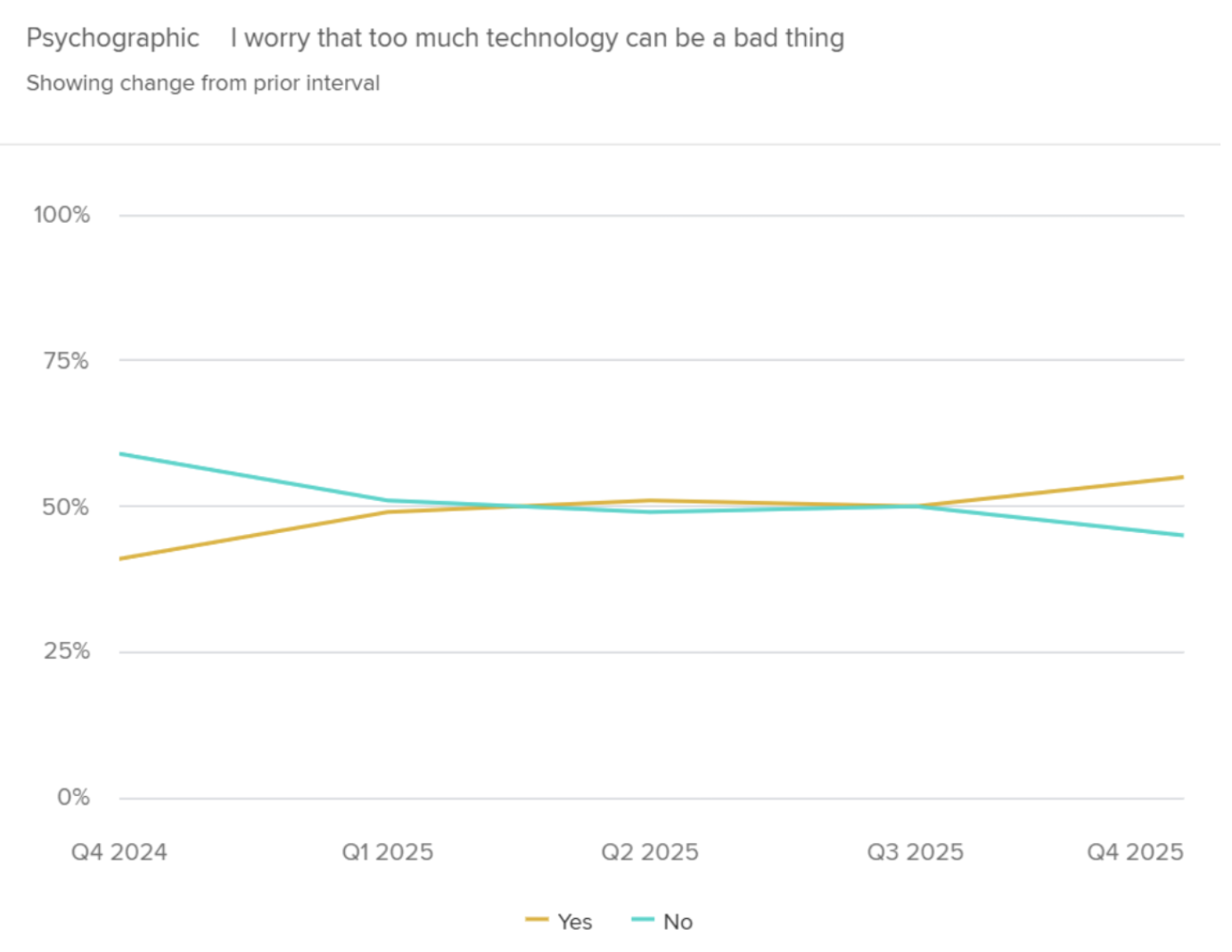
- Psychographics: Novelty-seeking (66% vs 34%), convenience-driven (75% pay premium for ease), status-conscious (53% vs 30%). But more than half now believe too much technology can be a bad thing — a reversal from 15 months ago.
- Media footprint: Over-index heavily on Spotify, Reddit, Snapchat, and LinkedIn. 2x more likely to attend live events and listen to podcasts. Present on mass platforms but disproportionately reachable through niche channels.
How segments differ in AI needs
The core task structure holds across demographics. What changes is weighting:
- 21-34: Life orchestration matters more (career, planning, shopping). Brand roles form early in this cohort.
- 35-64: Work utility spine dominates (writing, research, learning). Single positioning works with channel tuning.
- Lower income: 'Get ahead' utility (job search, learning, budgeting) becomes disproportionately salient.
- Parents: Overrepresented among AI users. Index into homework help, planning, decision simplification.
Three trends to watch as the category matures
- Distribution is not the same as preference. Industry signals suggest platform-embedded assistants (via Android, Windows, iOS) are gaining usage rapidly. But our data shows mental availability still concentrates in ChatGPT. The strategic question: are distribution-led players building brand preference, or are they being used without being remembered? The Copilot pattern — usage exceeding recall — may be a warning sign for others.
- The window for mental positioning is narrowing. As AI moves from standalone apps toward embedded infrastructure, the brands that build strong task associations now will become the invisible defaults later. Once AI is 'just there,' it will be harder to shift consumer mental maps.
- The technology paradox may decide the next phase. Our data shows even power users are growing wary of technology excess. As AI embeds deeper into daily life, trust becomes a scaling constraint. Brands that prove utility without triggering skepticism will have an advantage that pure distribution cannot replicate.
AI paradox: AI users increasingly worry about the risks of too much technology
About this research
Morning Consult conducts over 30,000 daily proprietary surveys in 45 countries covering more than 5,000 brands and 50 economic indicators.
Our category advantage research is aimed at understanding the needs driving consumers in your category — and how your brand can own more of them. This research is built on validated principles of brand-driven growth and powered by Morning Consult’s industry-leading sampling technology.
Measure the true drivers of brand strength
Capture both mental availability (the likelihood your brand comes to mind when consumers face a need or occasion) and emotional closeness (how strongly consumers connect with your brand), benchmarked against competitors.
Uncover Category Entry Points (CEPs)
Directly tied to mental availability, see the specific needs, occasions, and triggers that drive purchase decisions in your category, and how strongly your brand is linked to them.
Pinpoint growth opportunities
Direct investment toward the moments and consumer segments with the greatest potential to grow your brand.
Turn insights into action fast
Get survey results in 4–5 days through a centralized dashboard and short-form memo that equips stakeholders with clear direction on where and how to win.
Learn more
.png)
Understanding The Cat Food Category Today
.png)
Why Celsius Is the Energy Drink Category's Functional Specialist
.png)