

The bottom line up front
Anthropic has the smallest mental market share in the 8-brand competitive set (1.9–2.2%) — but its depth metrics tell a different story. Among ITDMs, Anthropic’s network size (8.1) is the highest of any challenger, and its buyer network size (9.0–9.1) approaches category-leader territory. The mental advantage data reveals a brand with distinctive strengths in exactly the right places: Governed Innovation (+6 ITDM), Audit-Ready Governance (+6 BDM), Enterprise-Grade Reliability (+3 BDM), and Stakeholder Alignment Engine (+11 ITDM). These are governance and institutional trust CEPs — the very dimensions where Google and OpenAI are weakest. Anthropic’s challenge is reach: it must dramatically expand the number of buyers who think of it while preserving the depth advantages that make it distinctive.
Where Anthropic Stands in the Enterprise AI Category
The Good News
Highest challenger ITDM network size (8.1) with exceptional buyer depth (9.1). Among ITDMs who have used Anthropic, the brand is linked to 9.1 out of 18 use cases — a figure that rivals Google (9.7) and exceeds Microsoft (9.8 non-rebased). This is the strongest ‘experience premium’ among all challenger brands: hands-on usage of Anthropic creates associations as broad as the category leaders.
Stakeholder Alignment Engine (+11 ITDM) is the highest mental advantage score for any challenger on any CEP. ITDMs who know Anthropic disproportionately associate it with helping organizations align around AI adoption. This is a unique brand territory that no other brand — including the leaders — occupies.
Governed Innovation (+6 ITDM) and Audit-Ready Governance (+6 BDM) are governance-territory strengths. Anthropic punches above its weight on institutional trust CEPs — precisely the dimensions where Google (Governance -5/-6) and OpenAI (Governance -4/-6) are weakest. This creates a natural positioning at the intersection of safety, trust, and innovation.
Enterprise-Grade Reliability is positive among BDMs (+3). This is a green cell that neither Google (-5) nor OpenAI (-1) achieves among BDMs. Anthropic is perceived as more enterprise-reliable than the category’s two largest brands by the audience that controls budgets.
Future intent is the strongest among challengers. 52–53% of buyers say they will definitely or probably use Anthropic in the next year — the highest future-intent score in the challenger tier, driven by high ‘probably will use’ responses that signal growing consideration.
The Challenge
Anthropic’s depth is genuine — but its reach is the smallest in the competitive set, creating a fundamental scale constraint on growth.
-
Lowest MMS in the 8-brand set (1.9–2.2%). Anthropic is thought of in fewer buying situations than any competitor. Even with strong depth metrics, the brand simply does not appear in enough mental maps to capture meaningful share.
-
Mental penetration (56–57%) is limited. More than 40% of category buyers do not think of Anthropic in any enterprise AI context. This is a top-of-funnel problem that constrains every downstream metric.
-
Usage is the lowest in the set. Only 24–27% used Anthropic in the past four weeks, and 49–50% have never used it. The exceptional buyer network premium (9.0–9.1) proves that usage converts to broad associations — but the usage base itself is too small.
-
Emotional closeness is the lowest in the set (2.5). Despite strong governance perceptions and deep buyer associations, Anthropic has not built affective brand connection. This may reflect a product-first, brand-second go-to-market approach that has not yet invested in emotional storytelling.
-
Trustworthy AI advantage is negative among BDMs (-1) and mixed among ITDMs (+1). Despite Anthropic’s safety-focused brand identity, it is not yet punching above its weight on the category’s #1 CEP. The governance strengths have not translated into the broader ‘trust’ association that drives the most category entry.
The Core Insight: Anthropic is the anti-pattern of Meta AI: narrow reach but exceptional depth. Buyers who know Anthropic associate it with governance, alignment, and institutional trust — the exact CEPs where leaders are weakest. The strategic question is whether Anthropic can scale this depth before the competitive window closes. The brand has a genuine, differentiated position in the category’s most strategically important territory. It simply needs more people to know about it.
What Anthropic Owns — and Where It’s Exposed
The mental advantage grid reveals the most distinctive challenger profile in the competitive set:
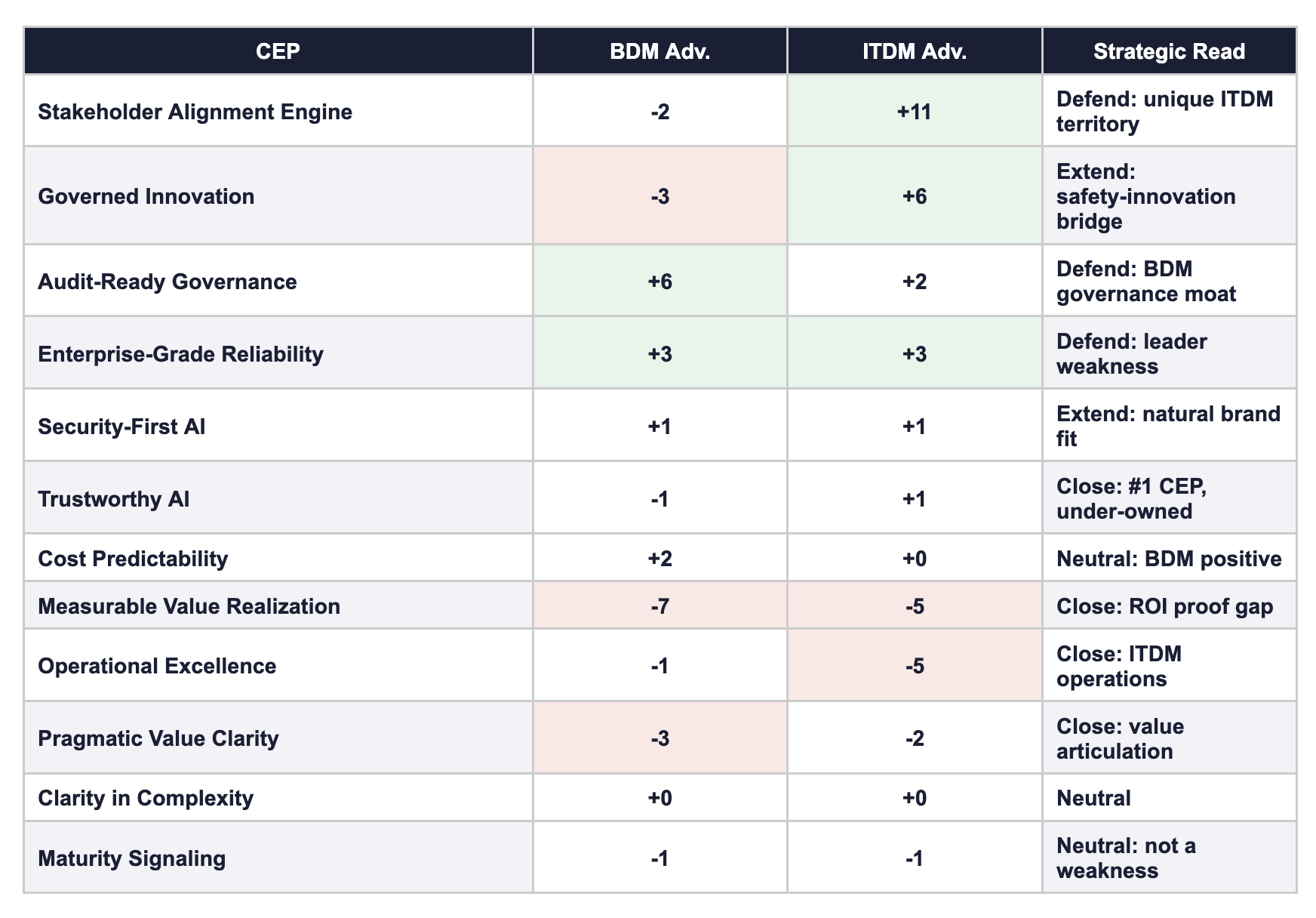
The profile is remarkable for a brand of this size. Anthropic has green cells on Governed Innovation, Audit-Ready Governance, Enterprise-Grade Reliability, and Stakeholder Alignment Engine — four of the five governance-and-trust CEPs. These are precisely the CEPs where Google has red cells (-5 Reliability, -5/-6 Governance) and OpenAI has red cells (-6 Governance, -7 Business Case, -8 Maturity). Anthropic’s brand is building in the structural gaps left by the market leaders.
The key weakness is Measurable Value Realization (-7 BDM, -5 ITDM). Anthropic is perceived as trustworthy and well-governed, but not yet as a brand that delivers trackable business outcomes. Closing this gap is essential for moving from ‘respected’ to ‘chosen.’
Six Strategic Priorities for Anthropic Based on This Research
1. Scale reach without diluting depth. Anthropic’s 56–57% penetration is the binding constraint on growth. Expanding awareness through developer community, AI safety thought leadership, business media presence, and strategic partnerships can grow the top of funnel. The risk to manage: scaling messaging to broader audiences without losing the governance-and-trust specificity that makes the brand distinctive.
2. Own the Trustworthy AI + Governed Innovation intersection. Anthropic’s brand identity is built on safety and responsibility — yet it only scores +1/-1 on Trustworthy AI, the category’s #1 CEP. The governance strengths are not yet translating into the broader trust association. Marketing should explicitly bridge ‘responsible AI’ into ‘AI you can trust for your business’ to claim the CEP territory that most aligns with the brand.
3. Build Measurable Value Realization proof. The -7/-5 gap is Anthropic’s most actionable weakness. Customer case studies with quantified outcomes, ROI calculators, and ‘before-and-after’ deployment stories can close this gap. The narrative: ‘Trustworthy AI that also delivers measurable results.’
4. Invest in trial-to-adoption at scale. The 9.0–9.1 buyer network size proves that hands-on experience with Anthropic creates associations as broad as the category leaders. Every growth dollar spent on getting more buyers to try the product will compound into expanded mental availability. Free tiers, API credits, and frictionless onboarding should be strategic priorities.
5. Position as the enterprise alternative to leaders’ governance gaps. Google and OpenAI’s red cells on governance CEPs are not just competitor weaknesses — they are Anthropic’s addressable market. For regulated industries, risk-averse organizations, and governance-sensitive IT leaders, Anthropic should position itself explicitly as ‘the AI built for organizations that take governance seriously.’
6. Build emotional connection through brand storytelling. At 2.5 emotional closeness, Anthropic’s affective brand is underdeveloped. Safety and governance are cognitively respected but not emotionally resonant. Humanizing the brand — through user stories, mission-driven content, and community building — can close the gap between respect and affection.
About this research
Morning Consult conducts over 30,000 daily proprietary surveys in 45 countries covering more than 5,000 brands and 50 economic indicators.
Our category advantage research is aimed at understanding the needs driving consumers in your category — and how your brand can own more of them. This research is built on validated principles of brand-driven growth and powered by Morning Consult’s industry-leading sampling technology.
Measure the true drivers of brand strength
Capture both mental availability (the likelihood your brand comes to mind when consumers face a need or occasion) and emotional closeness (how strongly consumers connect with your brand), benchmarked against competitors.
Uncover Category Entry Points (CEPs)
Directly tied to mental availability, see the specific needs, occasions, and triggers that drive purchase decisions in your category, and how strongly your brand is linked to them.
Pinpoint growth opportunities
Direct investment toward the moments and consumer segments with the greatest potential to grow your brand.
Turn insights into action fast
Get survey results in 4–5 days through a centralized dashboard and short-form memo that equips stakeholders with clear direction on where and how to win.
Learn more
.png)
Panera’s Category Advantage: Owning Health, Trust & Weeknight Growth
.png)
Chevrolet's Category Advantage Challenge: A Brand Strategy Brief
.png)