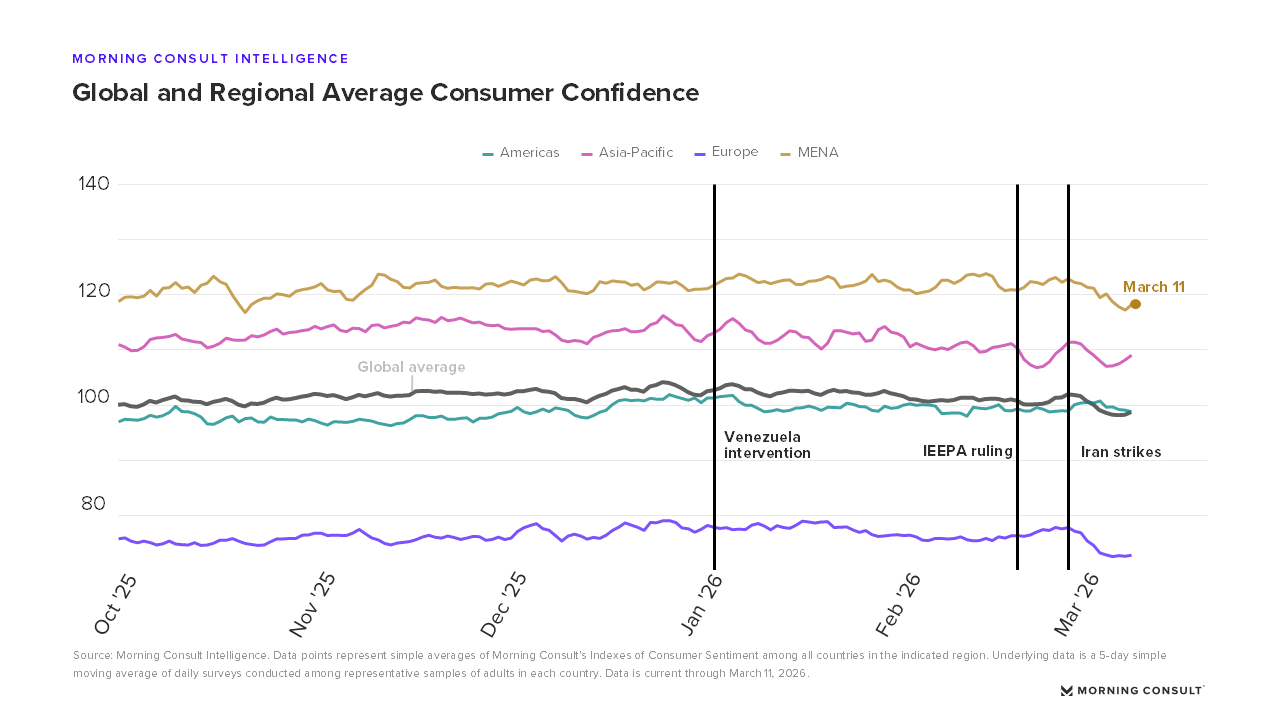
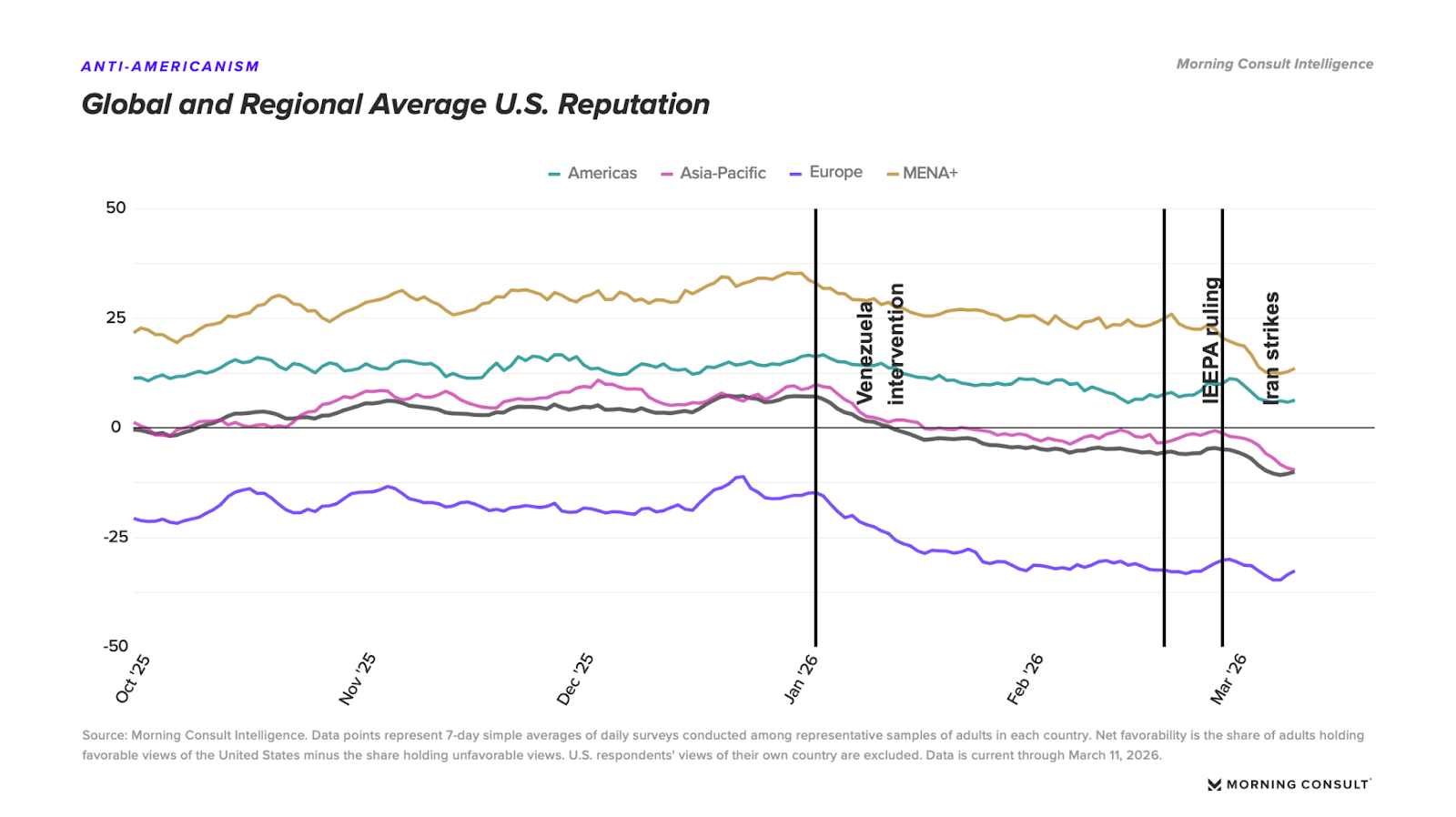
Global consumer confidence has taken a sizable hit this week (-1.7pts WoW) compared to last week’s .2pt decline, while the deterioration in global views of the United States has accelerated (-4pts WoW, compared to -1.2pts last week) as the Iran conflict continues.
The biggest hits to “Brand America” are beyond the gulf
As was the case last week, views of America have again fallen the most in Muslim-majority countries outside the Gulf, but U.S. multinationals should continue to plan for reputational risks globally as views of the United States deteriorate across the board. Similarly, while the decline in consumer confidence has been concentrated in the Middle East, sentiment has worsened in virtually every other country.
See the table below for expanded MENA coverage drawn from Morning Consult’s daily geopolitical tracking data followed by our forecast of where consumer confidence is headed globally, and in two major outlier markets — Russia and China.
|
MORNING CONSULT GLOBAL OUTLOOK (3/12/26) |
||||
|
Market |
Consumer Sentiment |
WoW (+/-) |
U.S. Reputation |
Outlook |
|
Global Avg. |
100.6 |
-1.7 |
-4 |
Negative |
|
Americas |
||||
|
U.S. |
91.9 |
-2.3 |
-- |
Negative |
|
Brazil |
116.2 |
-4.6 |
-4.7 |
Negative |
|
Canada |
76.2 |
-0.2 |
3.5 |
Neutral |
|
Mexico |
110.8 |
0.3 |
-6.7 |
Neutral |
|
MENA+ |
||||
|
Algeria |
125.3 |
-0.2 |
-18.1 |
Negative |
|
Egypt |
120.9 |
-1.6 |
0.3 |
Neutral |
|
Indonesia |
122 |
-0.7 |
-7.2 |
Negative |
|
Malaysia |
115.6 |
-6.3 |
-15.5 |
Negative |
|
Morocco |
129 |
5.7 |
2.1 |
Positive |
|
Pakistan |
108.2 |
-4.8 |
-15.7 |
Negative |
|
Saudi Arabia |
152.6 |
-4 |
-5.9 |
Negative |
|
Turkey |
61.4 |
-1.6 |
-5.4 |
Negative |
|
UAE |
148.1 |
-3.6 |
-4.3 |
Negative |
|
EUROPE |
||||
|
France |
60.4 |
-3 |
2.6 |
Neutral |
|
Germany |
68.9 |
-1.2 |
2.1 |
Neutral |
|
Italy |
66.7 |
-7.9 |
-8.9 |
Negative |
|
Netherlands |
78.9 |
-1.2 |
10.1 |
Neutral |
|
Poland |
82.7 |
-2.2 |
-8.7 |
Negative |
|
Russia |
111.6 |
10.4 |
-4.8 |
Neutral |
|
Spain |
79.3 |
-1.7 |
-2.9 |
Negative |
|
U.K. |
72.6 |
-0.8 |
-5.4 |
Negative |
|
APAC |
||||
|
Australia |
79.2 |
1 |
-0.5 |
Neutral |
|
China |
148.3 |
-4.8 |
-0.8 |
Negative |
|
India |
134.5 |
-1.3 |
-5.3 |
Negative |
|
Japan |
67.6 |
-2.4 |
-2.7 |
Negative |
|
S. Korea |
93.7 |
-2.9 |
-5.2 |
Negative |
Global Confidence: Trends And Outliers Worth Watching
While consumer confidence is down globally since the onset of the conflict, we’re starting to see preliminary signs of optimism in our data: As the International Energy Agency prepares to release strategic oil reserves in record quantity (and as Trump signals a possible conflict wind-down), confidence in most regions is getting a slight boost. Importantly for thinking through the President’s motivations, our data shows that Trump’s Iran campaign hasn't produced a rally-around-the-flag effect: the President’s approval rating remains near its record low. If the oil is released as planned — and if Trump does in fact continue to signal the conflict is winding down — we expect the global upswing to consolidate.
By country, there are two outliers worth watching. First, Russia has seen a 10pt WoW increase in consumer confidence, in line with Moscow’s finances benefiting substantially from rising oil prices and suggesting war-weary consumers may expect some positive trickle-down effects.
Second, China has seen a nearly 5pt WoW decline in confidence. As the largest buyer of Russian oil and a massive buyer overall, the current price shock appears to be making Chinese consumers nervous.
For anyone looking askance at the increase in confidence in Morocco, that country holds the world’s largest reserves of phosphate, and stands to benefit from the current supply shock stemming from shipping disruptions through the strait of Hormuz on top of existing Chinese export restrictions.
The good news is that we expect all of these trends will be relatively short-lived, as long as the conflict is also so. The IEA’s release of record reserves into global markets will limit the gains for Russia, but it should also cushion the blow for global consumers and corporations concerned about rising energy prices. China’s exceptionally large oil reserves suggest that the dip in confidence is more indicative of momentary consumer jitters than a long-term trend. And fertilizer prices could normalize in time for spring planting in the northern hemisphere, if normal trade resumes.
If you want to receive weekly analysis, subscribe here.
Iran Strikes Driving Anti-Americanism Up, Confidence Down
High-Income Consumer Confidence Is Cracking. Luxury Brands Are Next.