
The consumer group that powered the luxury market through five years of disruption is showing cracks — and Morning Consult’s data suggests this moment is different from prior confidence dips
For most of the past five years, luxury brands operated with quiet confidence: whatever turbulence hit the broader economy, high-income consumers would hold. Inflation? They absorbed it. Tariffs? They kept spending. The K-shaped economy, for all its inequality, was at least predictable — lower-income consumers bore the brunt while the top of the income ladder remained sturdy.
That assumption is now being tested in ways our data hasn’t shown since COVID-19.
A Confidence Drop of Historic Proportions
Morning Consult tracks consumer sentiment daily across income groups using the same methodology as the University of Michigan’s widely cited index. What we recorded starting December 27, 2025, was a 17.8-point decline in sentiment among consumers earning $100k or more — a magnitude we haven’t recorded since the early weeks of the pandemic — one that erased virtually all the gains this group had built across 2025, in roughly two weeks.
What makes this particularly striking is what wasn’t happening at the same time. The stock market was near record highs. There was no singular crisis event. Yet high-income consumers pulled back sharply and suddenly.
This wasn’t a narrow decline. All five subcomponents of Morning Consult’s index fell simultaneously — personal finances current and future, macroeconomic expectations near and long-term, and current buying conditions. When prior disruptions hit, like the tariff announcements earlier in 2025, only future-oriented indicators fell while present-day financial confidence held. This time, the floor dropped everywhere at once.
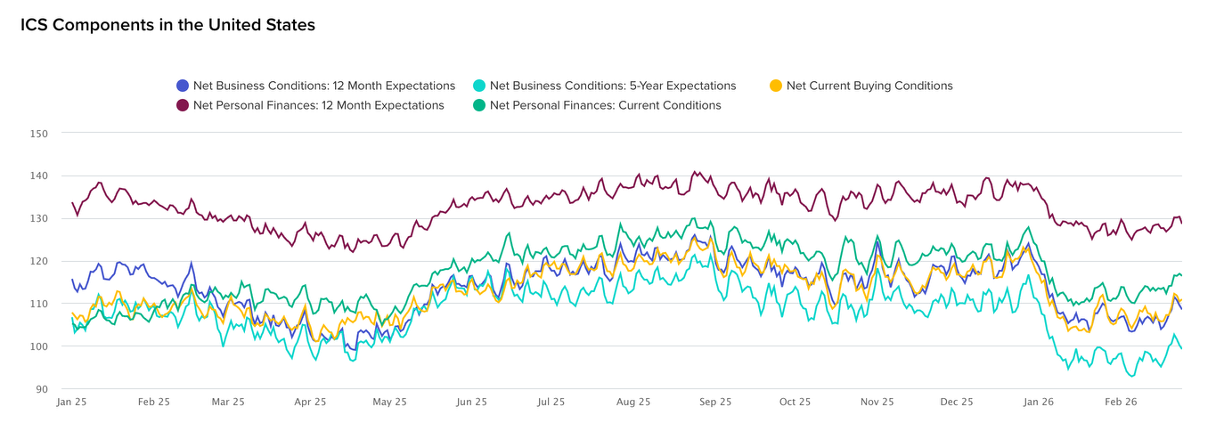
IC Components in the United States, 5-day moving average, January 1, 2025 - February 24, 2025, Adults with reported incomes of $100,000 or more.
The Real Driver: Labor Anxiety Meets AI Uncertainty
The proximate cause is a weakening labor market. Morning Consult’s pay loss rate data — which tracks weekly whether consumers report losing pay or income — shows a marked uptick for high-income adults beginning in late December. These aren’t primarily outright layoffs. They’re hours reductions and wage adjustments that don’t always surface in headline unemployment figures but register immediately in how people feel.
Layered on top is already building structural anxiety: the share of employed adults concerned their job will be eliminated over the next decade has been rising steadily. For knowledge-economy workers — the professionals disproportionately represented in the high-income cohort — near-term labor market weakness and long-term AI uncertainty are compounding, making this pullback harder to dismiss as a temporary blip.
The Engine of Luxury Demand Is Pulling Back
This matters specifically for luxury because high-income consumers weren’t just participating in market growth — they were the engine. Morning Consult spending data shows that in 2025, the $100k+ cohort drove spending growth at 15.1% since December 2024, compared to flat or declining figures for lower-income groups.
The picture is even sharper when you look at likely luxury consumers. Adults earning $200k or more — a closer proxy for the household that regularly buys designer goods, stays in luxury hotels, and reaches for premium spirits — saw an even steeper drop than the broader high-income group over the same period, a 20.5-point decline beginning just one day later.
That pullback is showing up in purchasing behavior across every major category we track — autos down 19 points on Net Purchase Consideration among high-income households, appliances down 15.6, apparel down 14.1, all measured from December 2025 to February 2026. Morning Consult’s Price Sensitivity Index, which tracks willingness to walk away from a purchase due to cost, spiked sharply for high-income consumers in January in a similarly broad pattern, not isolated to any single sector.
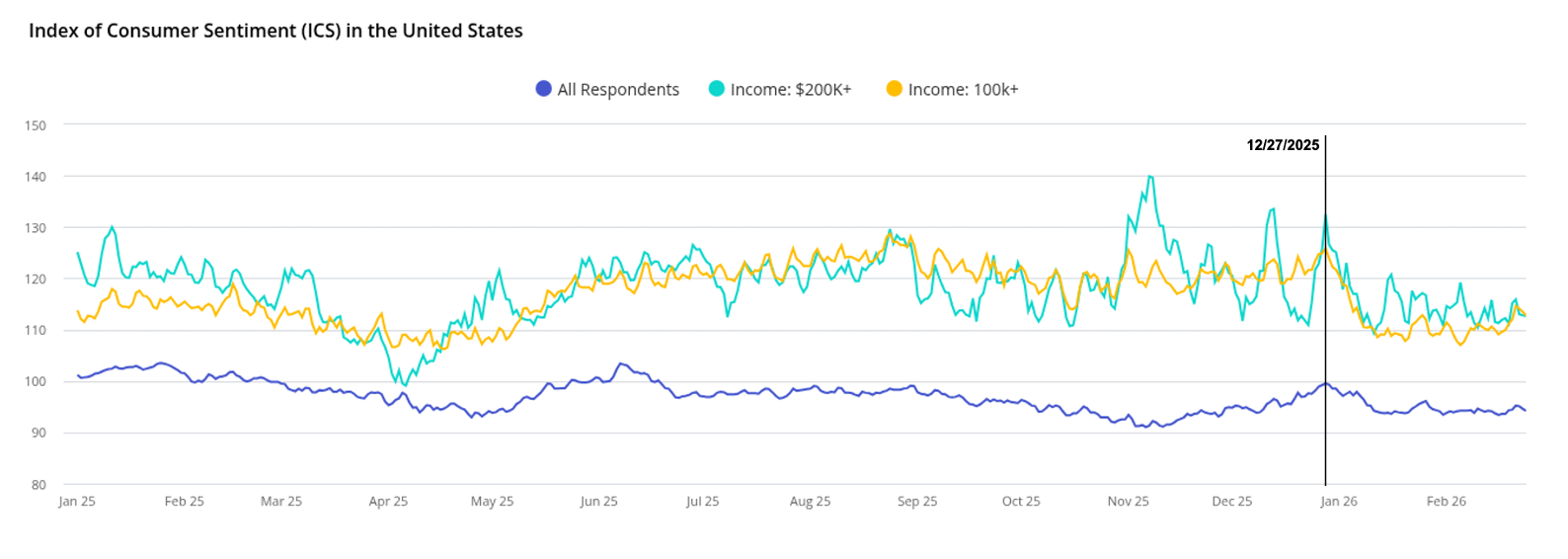
Index of Consumer Sentiment in the United States, 5-day moving average, January 1, 2025 - February 24, 2025
Experience-Based Luxury Is Holding. Product-Based Luxury Is Not.
When confidence softens, affluent consumers don’t abandon luxury — they recalibrate how they participate in it. Our data shows this playing out most clearly in the relative resilience of experience-based luxury. Luxury travelers are holding up better than fashion buyers, as consumers shift toward fewer, more emotionally justified experiences over big-ticket goods. Luxury hotels lead all categories we track in both Consideration (67.8%) and Net Value Perception (65.5) — suggesting that when consumers become more selective, they consolidate around purchases that feel most defensible.
Heritage matters too — heritage houses average 66% Purchase Consideration versus 53% for fashion-forward brands. But heritage creates permission; it doesn’t guarantee it. The brands best insulated are those that can clearly articulate why they deserve continued confidence, whether that case rests on craftsmanship, experience, or cultural meaning. The ones most at risk are those relying on momentum alone.
Act While High-Income Buffers Hold
Despite the severity of the sentiment drop, high-income consumers remain financially healthy. Their financial obligations ratio is low relative to other income groups; 75% report money left over after basic expenses each month, and credit card repayment concerns remain minimal. Their spending capacity is still there.
But that buffer is precisely why now is the moment to act. These consumers are exercising discretion, not facing constraint — which means brands still have the opportunity to influence where that discretion lands. Waiting for the hesitation to show up in quarterly numbers means waiting until the window has already narrowed.
The signal is already here.
Morning Consult tracks consumer sentiment, spending behavior, and brand health daily across 45+ markets. To explore how high-income consumer trends are affecting your category, watch the full webinar or speak with our team.

5 Economic Signals Every Business Leader Should Be Watching
How Researchers Across the Federal Reserve Use Morning Consult Data
.png)