The bottom line up front
The U.S. cellular category is at an inflection point. Consumers are tethered to their providers by necessity rather than choice — and the data makes that distinction impossible to ignore. Awareness of the Big Three is effectively universal, yet emotional connection across the entire category remains below the midpoint of a seven-point scale. Trust is conditional. Loyalty is structural rather than earned. The perception of hidden fees, opaque pricing, and painful switching experiences has calcified into category-wide anxiety that no single brand has fully resolved.
T-Mobile holds the clearest reputation advantage in the category, but it is contestable. Verizon’s new leadership has publicly acknowledged pricing missteps. AT&T is pressing harder on network investment to re-enforce is historical strengths. Competitive intensity is accelerating precisely because the category’s reputation vulnerabilities are now widely understood.
For communications and reputation leaders, the strategic question is who moves first — and whether they have the credibility to back it.

A category shaped by wariness, not aspiration
The cellular category suffers from deep and persistent consumer wariness — a feeling that the relationship between provider and customer is weighted in the provider's favor.
Seventy-six percent of U.S. adults agree or strongly agree that cellular providers often have hidden fees or unexpected charges, making it the most widely held negative perception in the category. Sixty-six percent say there are too many plans and options to choose from. While 76% agree that service is reliable when they need it most — a genuine product strength — that trust in the network does not translate into trust in the provider.
The emotional register of the category confirms the pattern. When asked how cellular providers make them feel, consumers lean meaningfully toward the negative poles: anxious rather than confident, trapped rather than in control, skeptical rather than reassured, and frustrated rather than supported. The category delivers on the network — people know their phones will work — but it falls short on the relationship. That gap between functional reliability and relational trust is where reputations are built or surrendered.
The category has a credibility problem far more than a capability problem — and communications strategy should reflect that distinction. Messaging that leads with network performance speaks to what consumers already accept. Messaging that addresses the anxiety — the fees, the complexity, the lock-in — speaks to what they actually feel. Brands willing to address that anxiety directly hold the greater reputational opportunity.
The moments that drive reconsideration
Consumer decisions in the cellular category stem from dissatisfaction. The triggers that prompt people to consider switching are overwhelmingly economic and protective — a desire to pay less, to understand what they are paying, and to avoid being surprised. “Wanting a better price” is cited by 56% of U.S. adults, making it the single largest entry point for reconsideration. “Better network coverage” (30%), “reducing monthly spending” (27%), and “needing fast, consistent data” (21%) follow closely. Excitement, novelty, and brand desire are absent from the top of this list.
|
Switching trigger |
% adults selecting |
|---|---|
|
Wanting a better price |
56% |
|
Better network coverage |
30% |
|
Trying to reduce monthly spending |
27% |
|
Needing fast, consistent data |
21% |
|
Replacing or upgrading a phone |
21% |
|
Looking for better customer service |
20% |
|
Wanting predictable pricing |
15% |
|
Concerned about privacy / security |
15% |
|
Wanting simpler plans |
15% |
A category shaped by economic anxiety rewards brands that speak the language of control: control over cost, control over the switching experience, and control over what appears on the bill. Reputational equity accrues to the brand that makes ordinary interactions feel effortless and honest — the loudest advertiser rarely wins that ground. Anxiety reduction and relief combined with reliable performance will results in business success, a pattern we have seen across all the categories we have studied this year in our category advantage analyses.
The reputation landscape: who leads, who is exposed
Brand-level reputation scores reveal a clear hierarchy — and real exposure within it. T-Mobile leads with an overall Reputation Score of 69.0, ahead of Verizon (62.7) and AT&T (60.9). Its favorability index is 76%, and 45% of consumers would give T-Mobile the benefit of the doubt if something went wrong — the highest score in the set and a reliable proxy for reputational resilience. A decade of deliberate brand behavior explains the gap: T-Mobile’s Un-carrier strategy systematically dismantled the category’s most corrosive perceptions — overage charges, long-term contracts, opaque pricing — before those issues became the category’s vocabulary. Its 2026 additions, a five-year price lock and a fifteen-minute switching promise, extend the same logic.
Verizon and AT&T trail meaningfully in the composite score. Verizon’s CEO publicly acknowledged pricing mistakes in early 2026 — a rare and strategically significant moment that creates a real opening if followed by genuine change. AT&T is investing $250 billion in network infrastructure, yet its reputation score of 60.9 and 36% benefit-of-the-doubt rating signal that consumer trust has not yet caught up with the investment. For both, the communications challenge is to convert product and operational progress into a consumer trust narrative people can actually feel.
|
Brand |
Rep score |
Favorability |
Value score |
Trust (a lot+some) |
Benefit of doubt |
|---|---|---|---|---|---|
|
T-Mobile |
69.0 |
76% |
72.7 |
56% |
45% |
|
Verizon |
62.7 |
63% |
63.1 |
54% |
39% |
|
AT&T |
60.9 |
64% |
60.9 |
51% |
36% |
|
Metro by T-Mobile |
58.3 |
57% |
67% |
58% |
34% |
|
Spectrum Mobile |
56.7 |
62% |
61% |
58% |
31% |
|
Boost Mobile |
54.3 |
58% |
63% |
55% |
32% |
|
Xfinity Mobile |
53.0 |
56% |
59% |
55% |
33% |
Mapping the field: two quadrant analyses
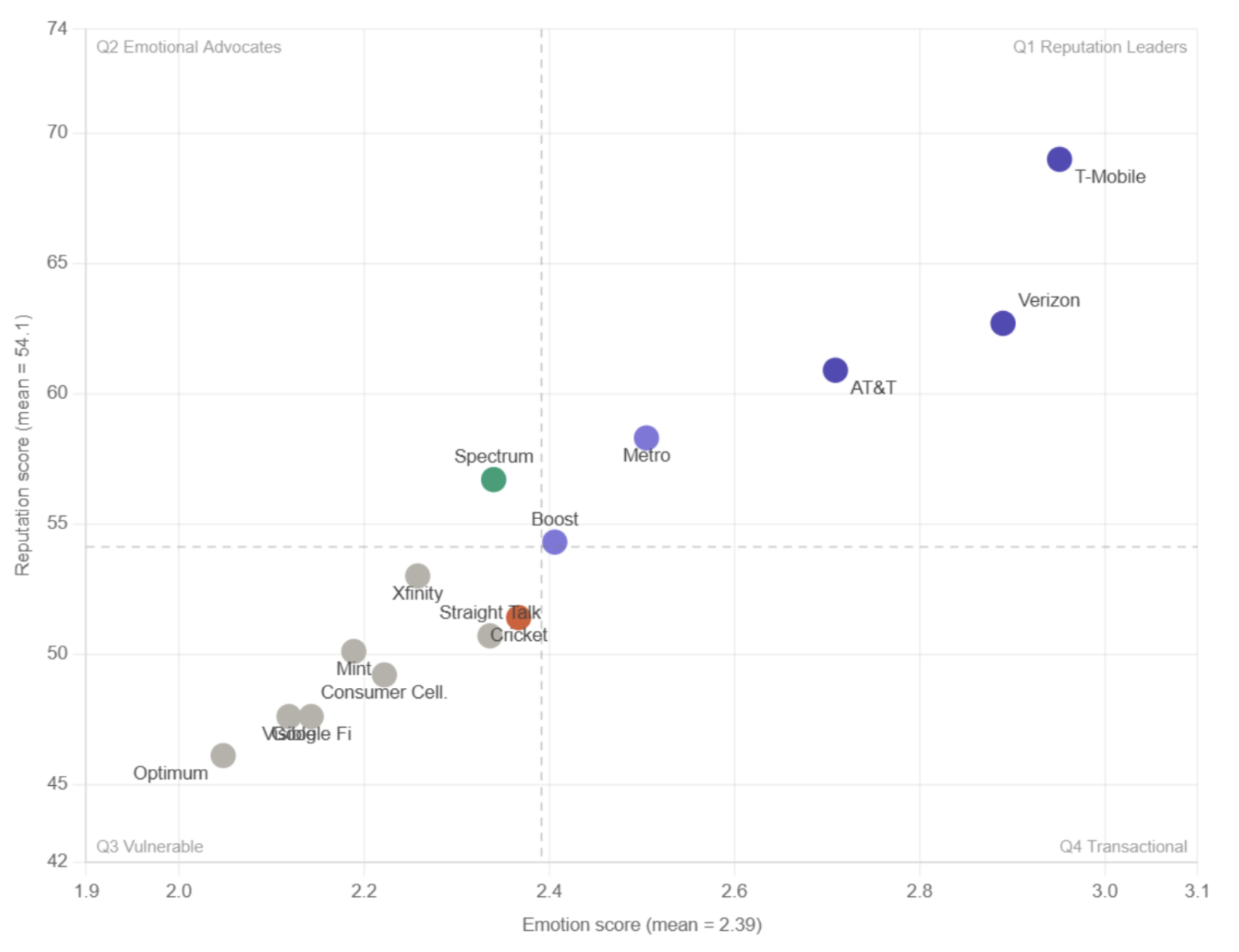
Quadrant one: emotion vs. reputation
Axes set at category mean: Emotion Score mean = 2.39 | Reputation Score mean = 54.1
T-Mobile, Verizon, AT&T, Metro by T-Mobile, and Boost Mobile occupy the Reputation Leaders quadrant: above average on both emotional connection and reputational standing. Boost’s inclusion is the more notable finding — it sits just above both mean thresholds and has built a base of genuine consumer engagement and credibility that its category standing tends to understate. Their risk is letting scale and name recognition do the work that active reputation investment should be doing.
Spectrum Mobile occupies the Transactional quadrant: its Reputation Score of 56.7 clears the 54.1 threshold, but its Emotion Score of 2.34 falls just below the 2.39 mean. Spectrum is recognized and reasonably well-regarded, yet it generates little affinity. Transactional relationships are the most exposed in this category — a competitor with a sharper value story and warmer resonance can dislodge these consumers without needing to overcome an emotional barrier. Spectrum’s communications task is to develop a genuine consumer identity before a rival matches its household distribution advantage.
The Emotional Advocates quadrant (Q2) is empty — no brand in this set combines high emotional engagement with a below-average reputation score. The passion and advocacy that could fuel a challenger’s breakout have not yet materialized at scale. That absence is a strategic opening: the brand that earns genuine emotional investment from consumers not already attached to the Big Three will hold the most asymmetric reputation advantage in this category.
The Vulnerable quadrant contains most of the mid-tier: Cricket Wireless, Xfinity Mobile, Straight Talk, Mint Mobile, Consumer Cellular, Google Fi, Visible, and Optimum Mobile. Xfinity’s position is the most strategically consequential given Comcast’s scale — a brand with that level of physical distribution should not be in the lowest-reputation quadrant. Xfinity has a brand problem, not a reach problem, and solving it requires a fundamentally different approach than its cable parent has historically taken. For the other Vulnerable brands, budget pricing alone will not shift their position. These brands need a specific, credible claim — simplicity, no lock-in, community — not a broader value message.
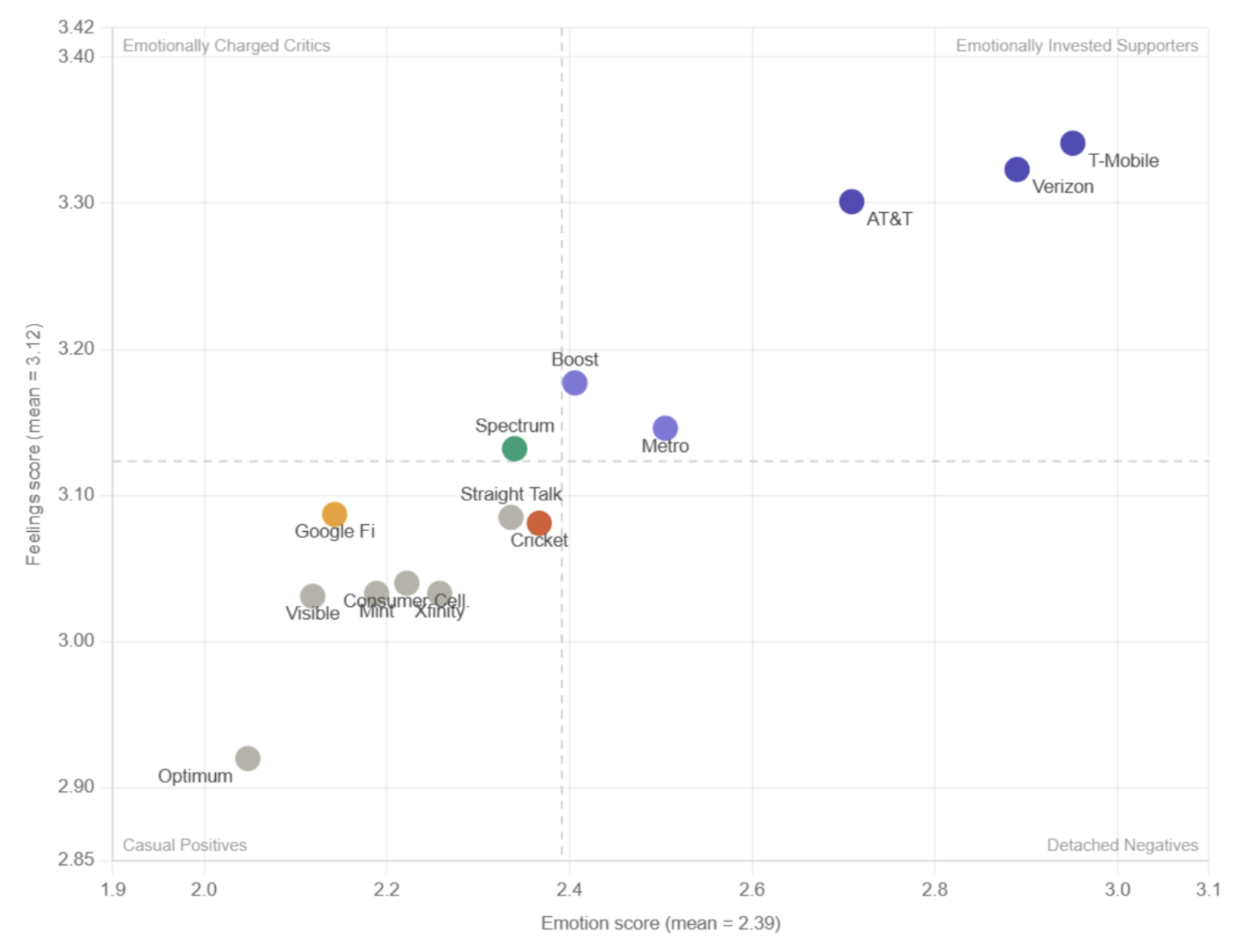
Quadrant two: emotion vs. feelings
Axes set at category mean: Emotion Score mean = 2.39 | Feelings Score mean = 3.12
The Big Three, Metro, and Boost remain in the Emotionally Invested Supporters zone — above average in both engagement and positive feeling. Their communications priority is to sustain the warmth of the existing consumer relationship while continuing to deliver on the functional promises that underpin it.
Spectrum sits alone in the Casual Positives quadrant: its Feelings Score just clears the mean, yet emotional engagement remains below average. Spectrum users feel broadly positive without being invested — a profile characteristic of a brand that benefits more from inertia than from loyalty. Converting passive acceptance into active preference is the communications challenge before a more resonant competitor claims that ground.
Cricket falls into the Detached Negatives zone under corrected thresholds — both emotion and feelings scores fall below their respective means. A value or coverage message will not move this position; Cricket needs to build a consumer relationship before it can activate one. Google Fi is the sole Casual Positives brand: emotion is below average, while feelings edge above the mean. Google Fi loses customers by being out-of-mind at the moment of reconsideration — invisibility, not hostility, is its exposure. The remaining mid-tier brands sit in Detached Negatives — neither engaged nor positive, with no emotional foundation to build on.
Self-Expansion: how deeply consumers embed these brands into their lives
Self-expansion brings the relationship into focus, showing how consumers evaluate brands, but more importantly, how deeply those brands are integrated into their daily lives. The willingness to give a brand the benefit of the doubt is one of the clearest separators in the category. Loyalty here is about resilience rather than advocacy alone. When something goes wrong, strong brands retain their position.
Looking at the top agreement, the Big Three lead convincingly on every self-expansion (brand integration) dimension. Metro by T-Mobile and Spectrum Mobile trail the Big Three by a substantial margin across all five measures.
AT&T presents the sharpest tension in the data: leading on good value for me (45%), would recommend (47%), and benefit of the doubt (46%) — yet it carries the lowest Reputation Score of the Big Three at 60.9. AT&T’s users feel strongly about the brand. The gap between that engaged user base and AT&T’s broader reputation score points to a communications challenge in making existing loyalty visible and transferable — turning satisfied customers into credible public advocates rather than quiet retainers.
T-Mobile leads on “stays connected to what matters” (44%) and is close across the other four dimensions. Its self-expansion profile is the most balanced of the five, with no obvious weak point — a direct reflection of the behavioral consistency that underpins its overall reputation lead.
Verizon’s most distinctive finding is its leadership on benefit of the doubt at 47% — the highest single score in the set. Among its own users, Verizon retains substantial goodwill even as its broader reputation has come under pressure. That goodwill among existing users is the raw material for Verizon’s turnaround narrative — if the communications function can make it visible and give loyal users a reason to advocate publicly for a brand they already forgive privately.
Metro and Spectrum score in the 24–36% range across all five dimensions, well below the Big Three’s 38–47% range. Metro has not successfully transferred the T-Mobile parent brand’s consumer trust into its own identity. Both brands are holding distribution advantages that their brand communications have not yet converted into consumer trust.
|
Dimension |
T-Mobile |
Verizon |
AT&T |
Metro |
Spectrum |
|---|---|---|---|---|---|
|
Fits naturally into my daily life |
41% |
38% |
40% |
34% |
24% |
|
Helps me stay connected to what matters |
44% |
40% |
41% |
34% |
29% |
|
Good value for people like me |
40% |
38% |
45% |
34% |
28% |
|
Would recommend to others |
46% |
43% |
47% |
36% |
27% |
|
Would give benefit of the doubt |
44% |
47% |
46% |
34% |
31% |
Figures represent % agree + strongly agree (Top2Box). Color scale: teal ≥ 44% | purple 40–43% | coral 34–39% | gray <34%
The communications imperative: who earns the right to own trust
The crossroads in this category is about trust — specifically, which brands have done enough to credibly claim it. The category has named its vulnerabilities in the data: hidden fees, switching anxiety, and plan complexity define the emotional landscape. Every brand faces the same fork: continue managing the perception of those issues, or resolve them and communicate that resolution with enough conviction to change how consumers feel.
T-Mobile’s trajectory shows what sustained behavioral investment in trust yields at scale. Its Un-carrier positioning, five-year price lock, and fifteen-minute switching promise are sequential investments in the same thesis — remove what consumers fear most, then say so consistently. A Reputation Score of 69.0, a 45% benefit-of-the-doubt rating, and leading self-expansion scores are the compounded return.
Verizon has the foundation for a trust-recovery story. A CEO admitting pricing mistakes opens a door; Verizon’s operational actions in 2026 will determine whether that admission becomes a genuine reputation asset or a liability. The premium segment — $100K+ households, where Verizon leads in Mental Market Share — is the highest-value terrain to contest and the segment most responsive to credibility signals. The 2026 subscriber-growth guidance suggests momentum; making that momentum legible to consumers, not just investors, is the communications job.
AT&T has committed $250 billion to network infrastructure, added 50 megahertz of new spectrum, and earned RootMetrics’ Best Overall and Most Reliable designations in 2025. The translation problem is that infrastructure credibility is measured at the category level, while self-expansion scores are measured at the personal level. AT&T’s communications investment should be concentrated on making network investment feel personally relevant to the consumer paying the monthly bill — rather than speaking primarily to the analyst community.
For mid-tier brands in the Vulnerable and Transactional quadrants, budget pricing is table stakes in a world where MVNOs run on the same networks as the Big Three. The brands that gain ground will own a specific consumer need, with enough clarity to be recalled at the moment of reconsideration.
Where the category goes from here
The cellular category runs on trust, and the brands that invest most deliberately in earning it are gaining ground. Transparency in pricing, simplicity in plans, and ease in every consumer interaction are the proven path to a reputation advantage. Brands that deliver on those dimensions and communicate that delivery consistently will compound reputational equity over time.
Priorities vary by position. Leaders need to protect the behavioral record that built the reputation — scale and familiarity are not substitutes for continued investment. Challengers need to stop competing on the Big Three’s terms and own the specific emotional territory where data already shows consumer permission. Consumer anxiety is running high, switching intent is genuine, and the window for a clear positioning move is open — but it closes as soon as a competitor takes it.
This memo draws on Morning Consult’s Cellular Category Reputation Advantage study, fielded April 2026, among n=301 U.S. adults 18+. Reputation Score is a composite index across favorability, value, trust, community impact, and admiration. Emotion Score and Feelings Score are derived from brand-level connection and sentiment measures. Self-Expansion dimensions reflect % agreeing or strongly agreeing across five brand integration statements (Top2Box). Category Advantage data integrates Mental Market Share and Category Entry Point analysis from the companion Cellular Category Advantage study, April 2026.
.png)
Understanding The Cat Food Category Today

Ross Is the Deepest-Value Brand in the Category