

The bottom line up front
The common narrative about GLP-1 users — that they’re rebuilding their drinking lives around health and moderation — is not what their mental map shows. The health and moderation moment is the least salient entry point in the category for this audience, trailing eighteen other occasions. What drives GLP-1 users into the alcohol category is the same set of triggers that drives everyone else: travel, socializing, unwinding at home, and holidays. The real story is narrower and more useful. THC beverages and non-alcoholic drinks have captured the small-but-symbolic health moment decisively, while legacy alcohol still owns the volume occasions — but with mental positions that are quietly slipping on the one moment that matters most: relaxing at home.
And this is not a small audience to misread. More than one in four U.S. adults (21+) — 27.2% — report current or past use of weight-loss, diabetes, or weight-management medications, and they skew toward the alcohol category’s highest-value buyers: high-income, post-graduate-educated, 35–44, parents, and male-leaning. Current GLP-1 users over-index in the “high category usage” group for alcohol while simultaneously over-indexing as light users of emerging formats. They are not abandoning alcohol. They are moderating with intention — and the brands that read their mental map correctly will win the moderation economy before it consolidates
Who we mean by GLP-1 users
Current users — 16.2% of U.S. adults 21+. Currently taking medication for weight loss, diabetes, or another health condition. Skew high-income (24.5% of 100k+ households), post-grad (26.9%), 35–44, male, and parents (notably high-income parents at 33.5% and millennial men at 27.1%).
Past users — 11.0% of adults. A distinct and meaningfully different audience: younger and more diverse, over-indexing among Gen Z (18.1%), single parents (20.6%), Black Americans (16.9%), LGBTQ+ adults (14.1%), and urban women (15.5%). A mix of those who stopped for cost or side effects and those who completed treatment.
Never-users — 72.8% of adults. The category baseline.
The Alcohol Category Today for GLP-1 Users
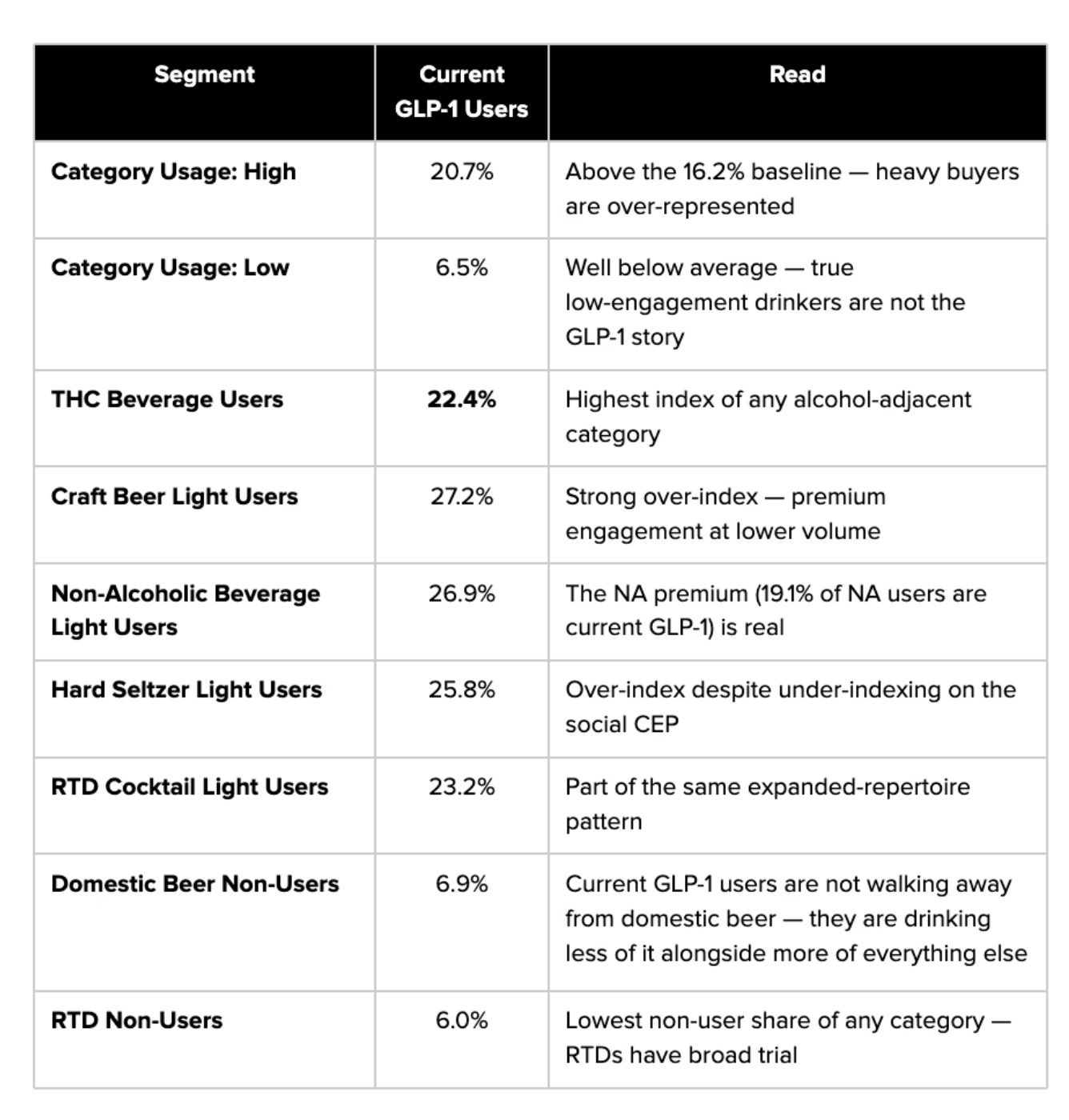
Health is the signal, not the story. On “choosing drinks that feel healthier or lower in alcohol,” THC beverages over-index by ~13 points and non-alcoholic drinks by ~7 — the two largest mental advantages any category holds on any single CEP for this audience. This is the moment where the GLP-1 mental map looks most different from the general population. But it is also the least salient moment for these consumers: only ~19% cite it as a purchase trigger. The health CEP is an owned moment on a small stage. The brands winning it are winning a directional fight, not the volume fight — but they are winning it with the right consumer. Current GLP-1 users are the highest-indexing segment among THC beverage users (22.4% vs. 16.2% overall) and among non-alcoholic beverage users (19.1%), confirming that health-coded alternatives are pulling disproportionate share from this audience even though the occasion itself is narrow.
Travel and socializing anchor the category, and no single drink dominates either one. The top two entry points for GLP-1 users — “drinking while on vacation or traveling” (~39%) and “socializing with friends on a night out” (~37%) — are both structurally contested. Tequila leads both (+6pp on each). Domestic beer, imported beer, and rum follow on travel; gin, whiskey, and vodka follow on socializing. No drink owns these moments the way Champagne owns celebration or wine owns dining. The brands that can build multiple credible associations across these two CEPs will out-grow the specialists.
The “relaxing at home” moment is where the category is quietly eroding. Relaxing at home is the third-largest entry point for GLP-1 users at ~35% salience — a top-three volume occasion. Domestic beer still leads the mental map (+7pp), but non-alcoholic drinks (+5pp) and THC beverages (+4pp) sit firmly in the top tier. Hard seltzer, vodka, and tequila all under-index. For a high-volume, daily-use occasion, the proximity of two non-traditional categories to the leader is the most important competitive signal in this data — and the behavioral data reinforces it. Current GLP-1 users over-index as light users of hard seltzer (25.8%), craft beer (27.2%), RTD cocktails (23.2%), and non-alcoholic beverages (26.9%). The pattern is not abstention; it is selective, lower-volume engagement across many formats, which is precisely the behavior that erodes a category leader’s home-occasion grip.
Wine and Champagne own the occasion economy, but those occasions are mid-tier in salience. Wine holds the largest mental advantage in the matrix — gifting (+15pp) — and Champagne owns celebration (+15pp). Both drinks dominate their moments cleanly. But gifting ranks 12th in salience (~27%) and celebration ranks 9th (~29%). These are defensible, high-margin positions on low-frequency occasions. They are not volume drivers for this audience.
The Moments that Matter
“Drinking while on vacation or traveling” (~39%) — the single largest entry point. Mentally contested, with tequila leading (+6pp), followed by rum (+5pp) and Champagne (+5pp). A travel-coded positioning is the single most valuable association a brand can build in this segment.
“Socializing with friends on a night out” (~37%) — tequila (+7pp) and gin (+6pp) punch up meaningfully here, despite not being the volume leaders in total alcohol. Hard seltzer under-indexes sharply (−8pp), a notable weakness given its category tailwinds.
“Relaxing at home after a long day” (~35%) — the erosion zone. Domestic beer leads (+7pp) but faces credible mental competition from non-alc (+5pp) and THC (+4pp). Beer brands that do not develop low- or no-ABV extensions will likely cede share on the single biggest daily-use occasion for this audience.
“Celebrating holidays or festive events” (~34%) and “Having drinks at a party or gathering” (~33%) — Champagne owns holidays (+10pp); vodka leads parties (+5pp) in a fragmented field. Wine under-indexes by 9pp on parties despite being a gifting leader, a reminder that ownership of one celebration moment does not transfer to the next.
“Going out for dinner and ordering drinks” (~32%) — tequila (+6pp) and liqueurs/vermouth (+6pp) lead. Wine, which owns pairing at home (+13pp), leads less definitively in restaurants, a subtle on-premise vs off-premise split worth exploring.
Below 30% salience, the mental advantages get larger but the addressable volume shrinks. The health CEP (~19%), despite hosting the biggest index swings for THC and NA drinks, is a directional indicator, not a primary battleground.
The Behavioral Signature: Moderation, Not Abstention
The mental-map pattern is corroborated by what GLP-1 users actually buy. Current users show two signatures simultaneously: concentration in the high-usage tier of the alcohol category overall, and over-representation among light users of virtually every emerging or health-adjacent format. They are not a niche abstainer segment. They are a selective heavy-buyer segment with an expanded repertoire.
Why This Matters Now
Diagnose before defending. GLP-1 users skew toward alcohol’s highest-value buyers — disproportionately high-income (24.5% of 100k+ households are current users, vs. 11.9% of sub-50k), post-graduate educated (26.9%), 35–44, and parent-heavy (high-income parents 33.5%). Segment your consumer file by probable GLP-1 usage before reallocating investment, and identify which of your brand’s occasions are most exposed to the erosion signal (especially relaxing at home). Regional skew is modest but real: current use is slightly higher in the South (17.0%) and West (17.5%) than in the Northeast (13.8%) or Midwest (15.3%), which gives field teams a coarse first pass at geographic prioritization.
Compete on occasion, not on category. The health CEP is an owned moment on a small stage; chasing it with a big brand-level health repositioning will misallocate spend. The real battleground is the home occasion, where health-coded alternatives are quietly pulling even with the category leader. Win that moment through product innovation, not marketing.
Premium is a margin lever, but it must be coded as “fewer but better.” Cognac’s relative strength on premium-indulgent and wine’s grip on gifting both point to the same consumer instinct: drinking less, paying more per occasion. The demographic data reinforces the permission to price for it — this audience has the income and education profile to absorb premium positioning. Pricing, pack size, and emotional positioning should follow: smaller formats, higher price per ml, stronger craft and quality cues.
Breadth still beats depth — but the breadth that matters has changed. Among GLP-1 users, category breadth now includes the question of whether a drink can credibly appear on the relaxation and home CEPs without triggering the “this doesn’t fit what I’m doing” reflex. Legacy breadth leaders that fail this test will find their mental networks narrowing even as their distribution stays wide.
Do not confuse current users with past users. The 11.0% of adults who are past GLP-1 users look almost nothing like the current-user segment — younger, more diverse, over-indexing among Gen Z (18.1%), single parents (20.6%), Black Americans (16.9%), and LGBTQ+ adults (14.1%). Treating the combined 27.2% as one audience will over-weight a premium-older profile and under-weight the cultural and creative cues that matter to a segment that has already cycled through these medications. These are two different mental maps. Plan for them separately.
About this research
Morning Consult conducts over 30,000 daily proprietary surveys in 45 countries covering more than 5,000 brands and 50 economic indicators.
Our category advantage research is aimed at understanding the needs driving consumers in your category — and how your brand can own more of them. This research is built on validated principles of brand-driven growth and powered by Morning Consult’s industry-leading sampling technology.
Measure the true drivers of brand strength
Capture both mental availability (the likelihood your brand comes to mind when consumers face a need or occasion) and emotional closeness (how strongly consumers connect with your brand), benchmarked against competitors.
Uncover Category Entry Points (CEPs)
Directly tied to mental availability, see the specific needs, occasions, and triggers that drive purchase decisions in your category, and how strongly your brand is linked to them.
Pinpoint growth opportunities
Direct investment toward the moments and consumer segments with the greatest potential to grow your brand.
Turn insights into action fast
Get survey results in 4–5 days through a centralized dashboard and short-form memo that equips stakeholders with clear direction on where and how to win.
Learn more
.png)
Why Nike Is the Mental Availability Leader in Athletic Apparel
The Communications Imperative in the U.S. Cellular Category
.png)