

The bottom line up front
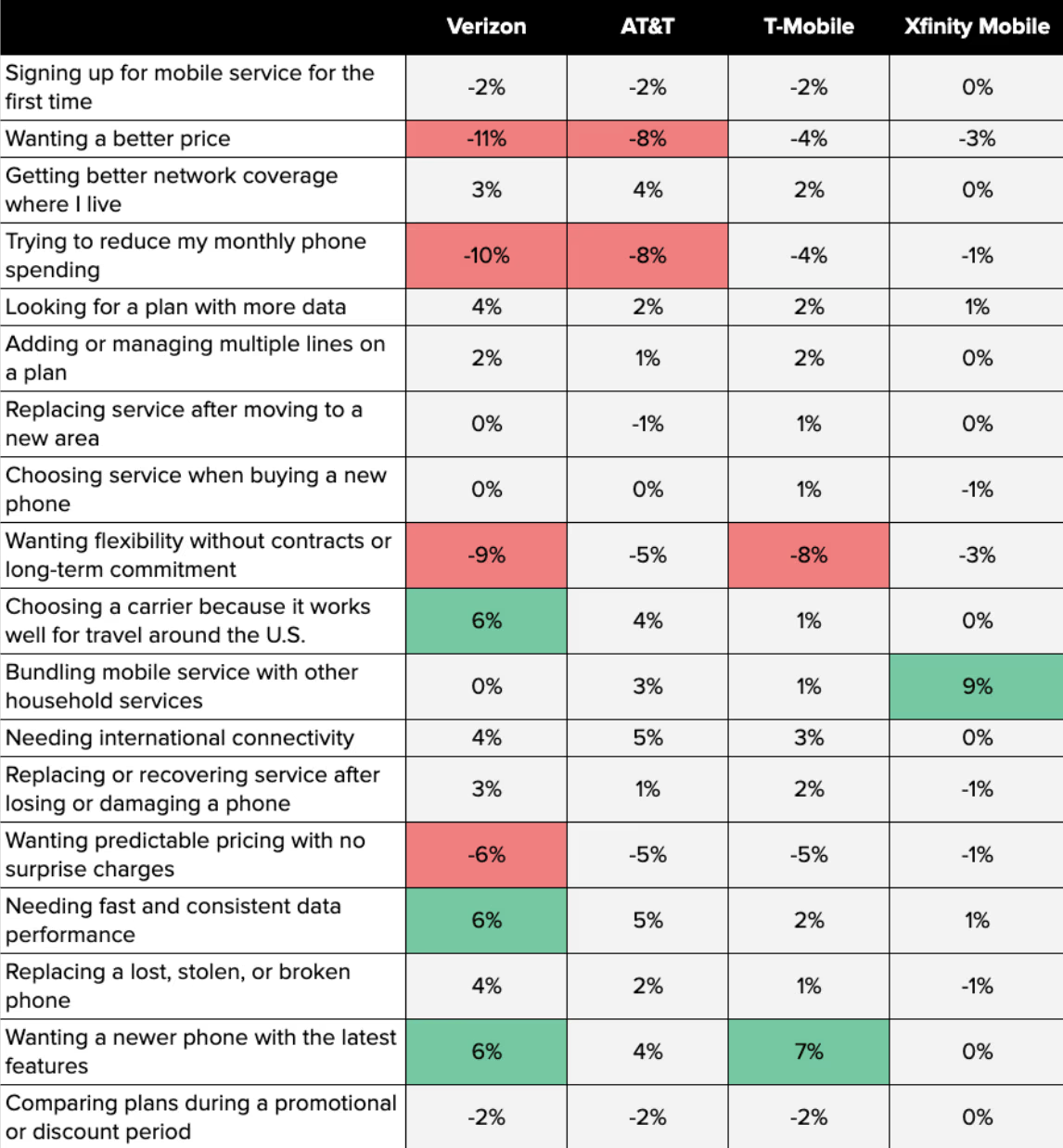
Xfinity Mobile’s bundling mental advantage (+9) is the single highest brand-occasion score in the entire category. But that advantage does not extend to other occasions and needs. At 3.8% MMS, 42% Mental Penetration, and a Network Size of just 6.4, Xfinity Mobile trails the big brands in this space. The brand’s awareness itself is structurally limited — 45% at Total, compared to 80%+ for the Big Three and an Emotional Connections score (2.2) that trails the leaders. Xfinity Mobile’s strategic question is not whether it can compete with T-Mobile or Verizon across the full category. It’s whether it can convert its bundling advantage into a household-consolidation brand before cable-backed competitors like Spectrum Mobile claim the same positioning.
Where Xfinity Mobile Stands
Xfinity Mobile occupies a niche position in the mental landscape — known by fewer, thought of for less. At 3.8% MMS, Xfinity Mobile ranks behind not just the Big Three but also Metro by T-Mobile (6.2%), Straight Talk (5.5%), and Cricket Wireless (5.0%). Its Mental Penetration of 42% means fewer than half of category buyers associate it with any purchase trigger. Network Size of 6.4 — compared to 10.3 for T-Mobile and 10.1 for Verizon — confirms the brand is thought of for a narrow set of occasions even by those who do recall it.
Emotional Connection is among the lowest in the set. At 2.2 on a 7-point scale, Xfinity Mobile’s EC sits below Cricket (2.1), Straight Talk (2.3), and most MVNOs. Among 18–34s, EC rises to 2.7, but among 65+ it drops to 1.8 — the lowest of any brand in any age segment. Consumers don’t feel connected to Xfinity Mobile; they evaluate it transactionally. That’s not necessarily a weakness for a bundling play — but it limits the brand’s ability to compete on occasions that require trust or affinity.
The mental advantage profile is a one-note story: bundling. Xfinity Mobile’s BOI score on “bundling mobile service with other household services” (+9) is its only material advantage. Every other occasion registers within ±2 points of neutral. The brand has no mental disadvantage that rises to crisis level — but it has no secondary strength either. The competitive positioning is defined entirely by the existing household relationship.
What Category Entry Points T-Mobile
Xfinity Mobile occupies a niche position in the mental landscape — known by fewer, thought of for less. At 3.8% MMS, Xfinity Mobile ranks behind not just the Big Three but also Metro by T-Mobile (6.2%), Straight Talk (5.5%), and Cricket Wireless (5.0%). Its Mental Penetration of 42% means fewer than half of category buyers associate it with any purchase trigger. Network Size of 6.4 — compared to 10.3 for T-Mobile and 10.1 for Verizon — confirms the brand is thought of for a narrow set of occasions even by those who do recall it.
Emotional Connection is among the lowest in the set. At 2.2 on a 7-point scale, Xfinity Mobile’s EC sits below Cricket (2.1), Straight Talk (2.3), and most MVNOs. Among 18–34s, EC rises to 2.7, but among 65+ it drops to 1.8 — the lowest of any brand in any age segment. Consumers don’t feel connected to Xfinity Mobile; they evaluate it transactionally. That’s not necessarily a weakness for a bundling play — but it limits the brand’s ability to compete on occasions that require trust or affinity.
The mental advantage profile is a one-note story: bundling. Xfinity Mobile’s BOI score on “bundling mobile service with other household services” (+9) is its only material advantage. Every other occasion registers within ±2 points of neutral. The brand has no mental disadvantage that rises to crisis level — but it has no secondary strength either. The competitive positioning is defined entirely by the existing household relationship.
Who Xfinity Mobile Is Winning — and Losing
The Northeast and high-income segments are Xfinity Mobile’s narrow stronghold. MMS in the Northeast rises to 5.2% — its highest regional score. Among $100K+ households, MMS reaches 4.5% and awareness jumps to 57%. These are consumers most likely to evaluate bundling economics. The brand’s mental presence correlates closely with its bundling advantage — strongest where household-services consolidation is most salient.
Among younger consumers, Xfinity Mobile shows an unexpected signal. Mental Penetration among 18–34s reaches 53% — the brand’s highest age-segment score, 11 points above Total. MMS holds at 4.0%, and Network Size rises to 7.1. Younger consumers appear more willing to consider cable-backed carriers than older segments — possibly because they have fewer incumbent carrier loyalties and evaluate bundling more aggressively.
Among 65+ consumers, the brand virtually disappears from consideration. Mental Penetration drops to 35%, EC falls to 1.8, and MMS holds at 4.4% only because those few who do recall the brand link it deeply to bundling. This segment indexes highest on contract aversion (33%), poor customer service (30%), and predictable pricing (26%) — friction categories where Comcast’s parent-brand reputation may be a liability rather than an asset.
What's Blocking Conversion for Xfinity Mobile
Xfinity Mobile’s primary barrier is not friction — it’s invisibility. With 45% awareness and 38% “definitely will not use,” the brand faces an awareness-plus-rejection problem. The rejection rate is notable: more than a third of consumers have actively dismissed the brand before considering it. Category barriers around hidden fees (29%) and unreliable service (28%) land harder on Xfinity Mobile because the Comcast parent brand carries its own trust baggage in customer service perception.
The Comcast reputation is a double-edged sword. The household relationship that gives Xfinity Mobile its bundling advantage also imports customer-service risk. Among the barriers most relevant to Xfinity’s consideration set — poor customer service (24%), hidden fees (29%), hassle of switching (13%) — these friction points may be amplified when consumers associate the mobile brand with their existing cable experience.
About this research
Morning Consult conducts over 30,000 daily proprietary surveys in 45 countries covering more than 5,000 brands and 50 economic indicators.
Our category advantage research is aimed at understanding the needs driving consumers in your category — and how your brand can own more of them. This research is built on validated principles of brand-driven growth and powered by Morning Consult’s industry-leading sampling technology.
Measure the true drivers of brand strength
Capture both mental availability (the likelihood your brand comes to mind when consumers face a need or occasion) and emotional closeness (how strongly consumers connect with your brand), benchmarked against competitors.
Uncover Category Entry Points (CEPs)
Directly tied to mental availability, see the specific needs, occasions, and triggers that drive purchase decisions in your category, and how strongly your brand is linked to them.
Pinpoint growth opportunities
Direct investment toward the moments and consumer segments with the greatest potential to grow your brand.
Turn insights into action fast
Get survey results in 4–5 days through a centralized dashboard and short-form memo that equips stakeholders with clear direction on where and how to win.
Learn more
.png)
Microsoft Copilot's Brand Strengths and Challenges
.png)
DraftKings’ Competitive Edge: Where Participation Becomes Competition
.png)