
.jpeg?width=40&height=40&name=T1E3MEGMN-U022704924V-ff83bc119e5e-512%20(1).jpeg)
Morning Consult is hosting an exclusive Fashion & Beauty Roundtable on May 12. Powered by our real-time consumer intelligence, this session brings together senior executives from marketing, communications, and strategy departments to explore and unpack evolving consumer trends in fashion and beauty and what they mean for your brand. To get more information, contact James Cowling-Vega.
The consumers who buy beauty products and the consumers who shop luxury fashion occupy a lot of the same cultural territory.
Both are younger and more diverse than the U.S. average, both are confident spenders in an anxious economy, both hold brands to a high standard and act on it. But they are not the same consumer, and the differences between them matter as much as the similarities.
What follows is a six-trend portrait of each audience, benchmarked against the general U.S. adult population.
Youth Has Taken Over and Brought Diversity With It
Beauty and fashion buyers by generation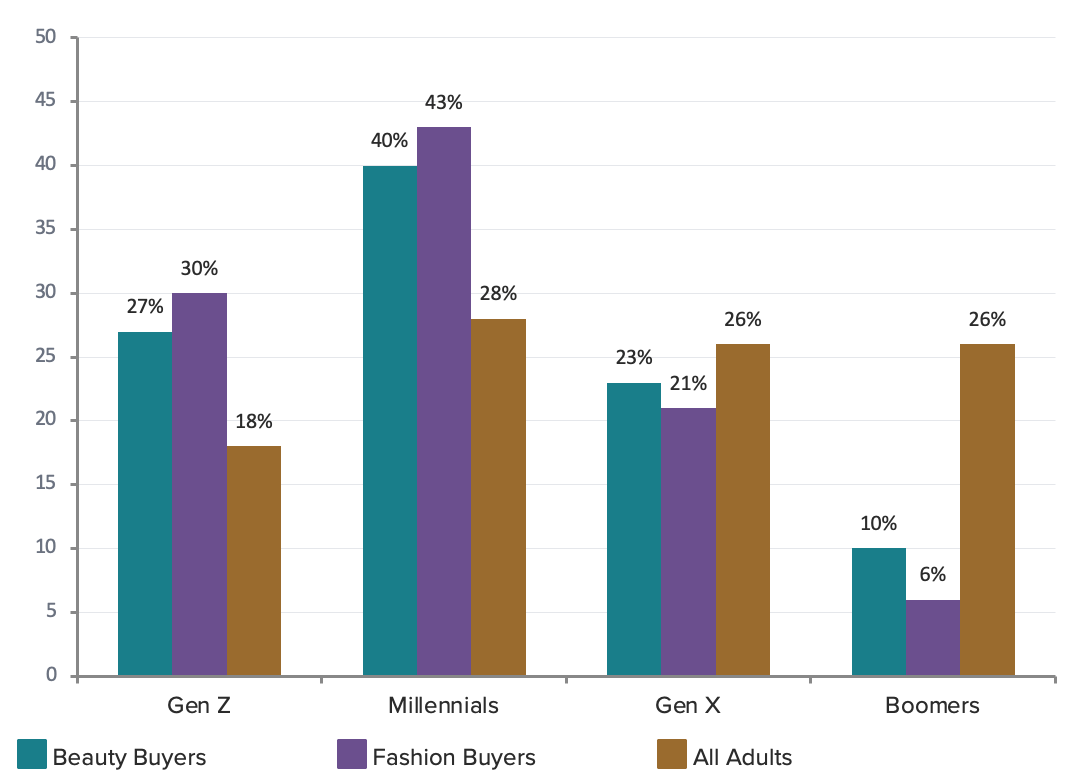
Boomers account for just 10% of beauty buyers and 6% of fashion buyers despite making up 26% of all U.S. adults. In their place: a Millennial-and-Gen-Z majority that accounts for 67% of beauty buyers and 73% of fashion buyers. These are not emerging consumers. They are the dominant consumers, and strategies built around older cohorts are increasingly misaligned with who is actually in the market.
Diversity is the second headline. Both audiences significantly over-index on Hispanic identity (26% each, vs. 18% overall), Black identity (17% beauty, 20% fashion vs. 13% overall), and Muslim faith (7–8% vs. 2% overall). Bilingual Spanish-English speakers are twice as represented in both segments as in the general population.
What to do with this insight: Audit your creative and channel mix against who is actually buying and who you're trying to sell to. Millennial/Gen Z-first content, culturally fluent representation, and Spanish-language capability should be seen as the baseline, not a bonus.
Status Is the Strategy
Beauty and fashion buyer psychographics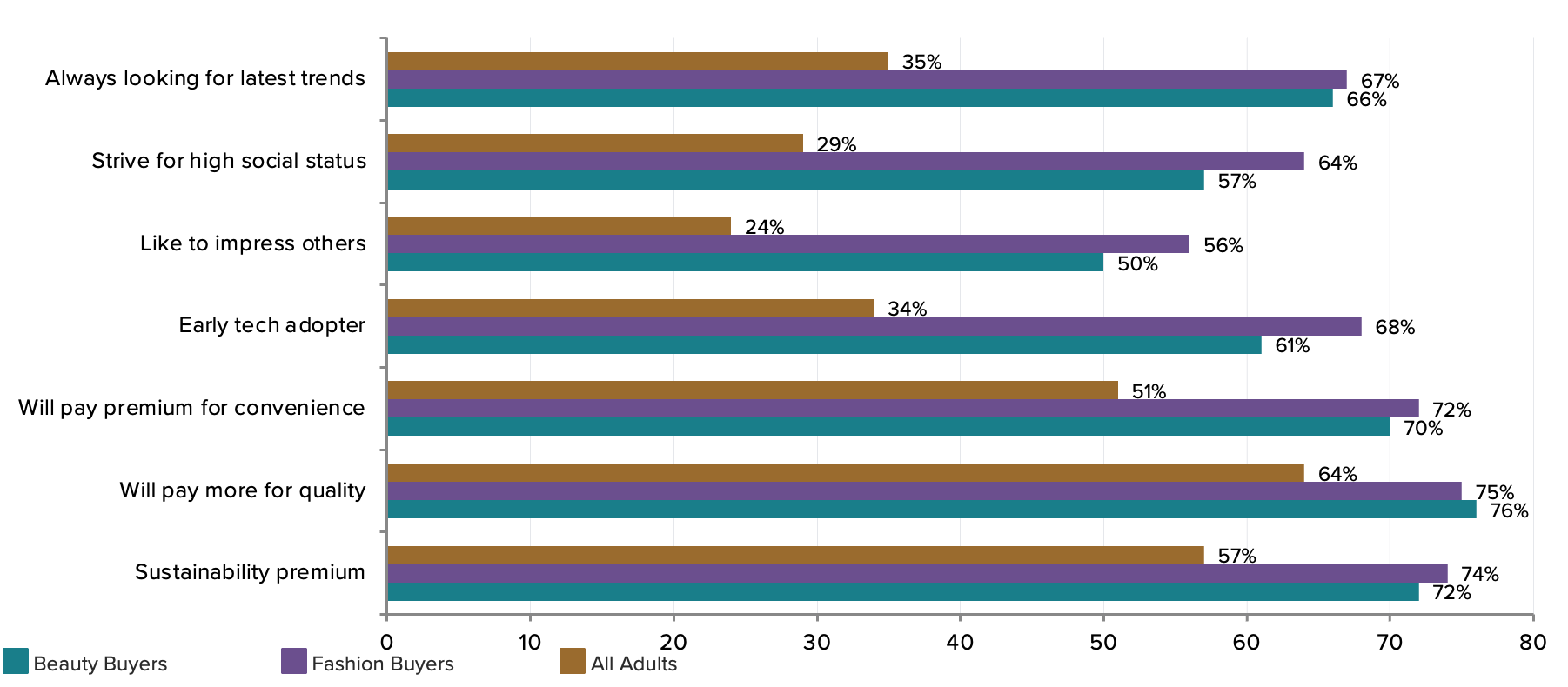
The psychographic data tells a story of two audiences that are oriented toward aspiration, novelty, and social recognition to a degree that far exceeds the general population. 63% of fashion buyers and 57% of beauty buyers strive to achieve high social status (vs. 29% overall). Both over-index heavily on wanting to live a lifestyle that impresses others (56% fashion, 50% beauty vs. 24% overall) and on always looking out for the latest trends (67% each vs. 35% overall).
That aspiration is backed by spending willingness. 72% of fashion buyers and 70% of beauty buyers will pay a premium for convenience, and both segments over-index sharply on willingness to pay for quality and sustainability. Fashion buyers lead on early technology adoption: 67% consider themselves among the first to try new technology products (+33 pp vs. general), vs. 61% of beauty buyers. One nuance worth noting: despite this novelty-seeking orientation, 85–86% of both audiences say honesty and authenticity are very important to them.
What to do with this insight: Lead with aspiration and social currency in your positioning, but anchor it in authenticity. These consumers will reward prestige and punish posturing.
They Live Online and They Buy There Too
Digital habits of beauty and fashion buyers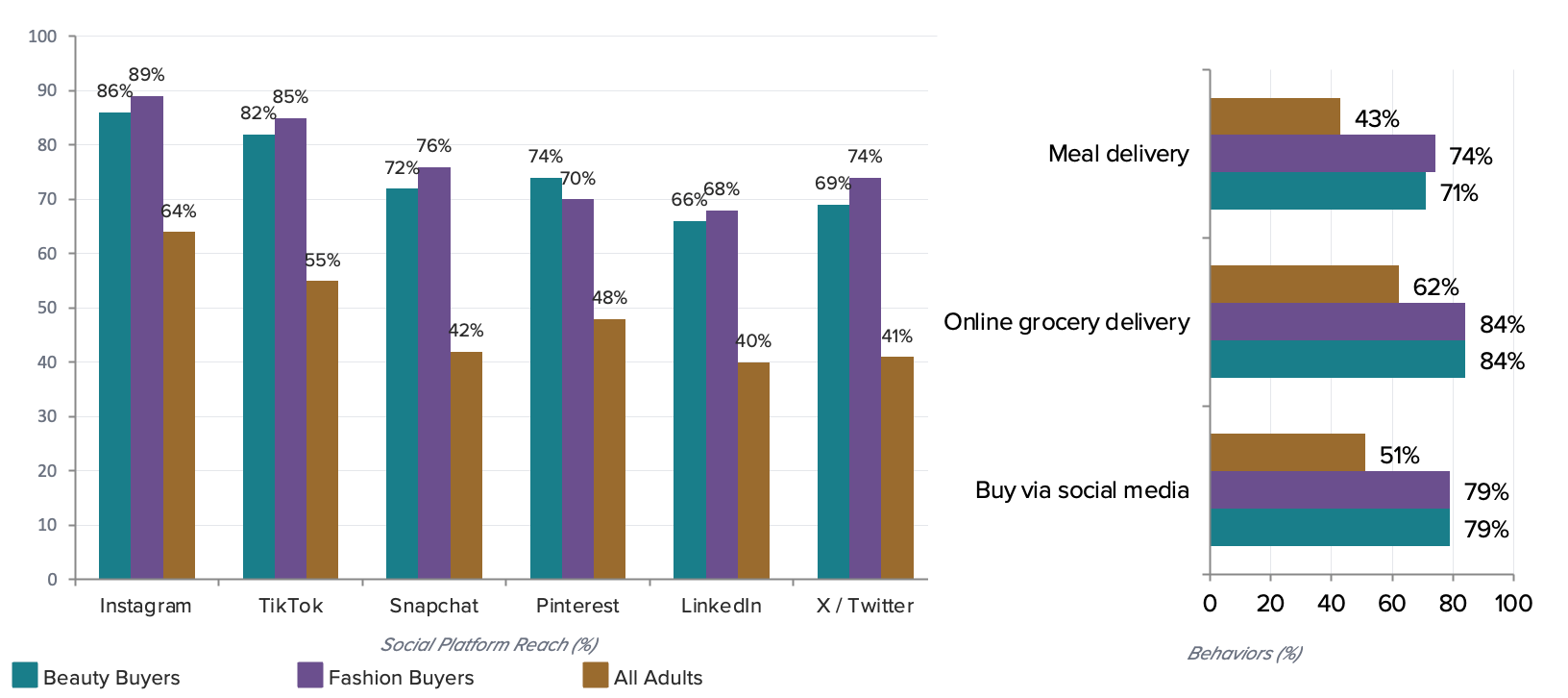
Both audiences are platform omnivores with social commerce deeply embedded in their behavior.
Fashion buyers are the more saturated of the two: 89% are on Instagram, 85% on TikTok, 75% on Snapchat, and 74% on X, all exceeding beauty buyers’ already-elevated usage. LinkedIn reaches 67% of fashion buyers (vs. 66% of beauty buyers), reflecting their higher professional seniority. Both groups are on every platform simultaneously, at high frequency.
Social commerce has moved from emerging channel to primary behavior for fashion buyers in particular: 79% make purchases through social media at least occasionally (vs. 51% of all adults).
What to do with this insight: Treat Instagram and TikTok as primary retail environments, not awareness channels - discovery and conversion now happen in the same scroll.
GLP-1 Is Already Reshaping Their Relationship With Health
GLP-1 usage amongst beauty and fashion buyers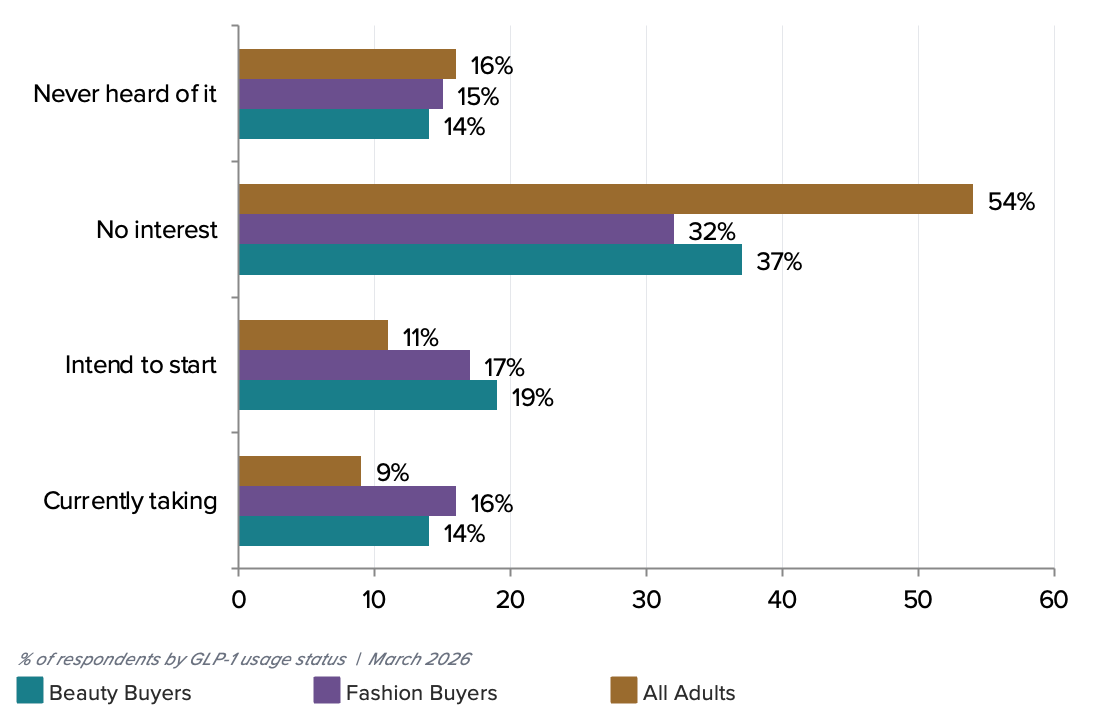
GLP-1 adoption among beauty and fashion buyers is not a future scenario, but rather something happening right now. As of March 2026, 14% of beauty buyers and 16% of fashion buyers currently take a GLP-1 medication, compared to just 9% of all U.S. adults. The intent pipeline is equally significant: 19% of beauty buyers and 17% of fashion buyers plan to start, versus 11% overall.
For brands in both categories, the downstream implications are already arriving. GLP-1 adoption at this scale reshapes conversations about body image, skincare and complexion changes, clothing fit and sizing, and the wellness products consumers reach for alongside their prescriptions. Both of these audiences are at the leading edge of that shift and they are precisely the consumers most likely to reorient their purchasing around it first, fastest, and most vocally.
What to do with this insight: Begin scenario planning now for how weight-loss adoption reshapes sizing, product formulation, and body image messaging within your category.
AI Is Already Part of Their Daily Life
AI usage amongst beauty and fashion shoppers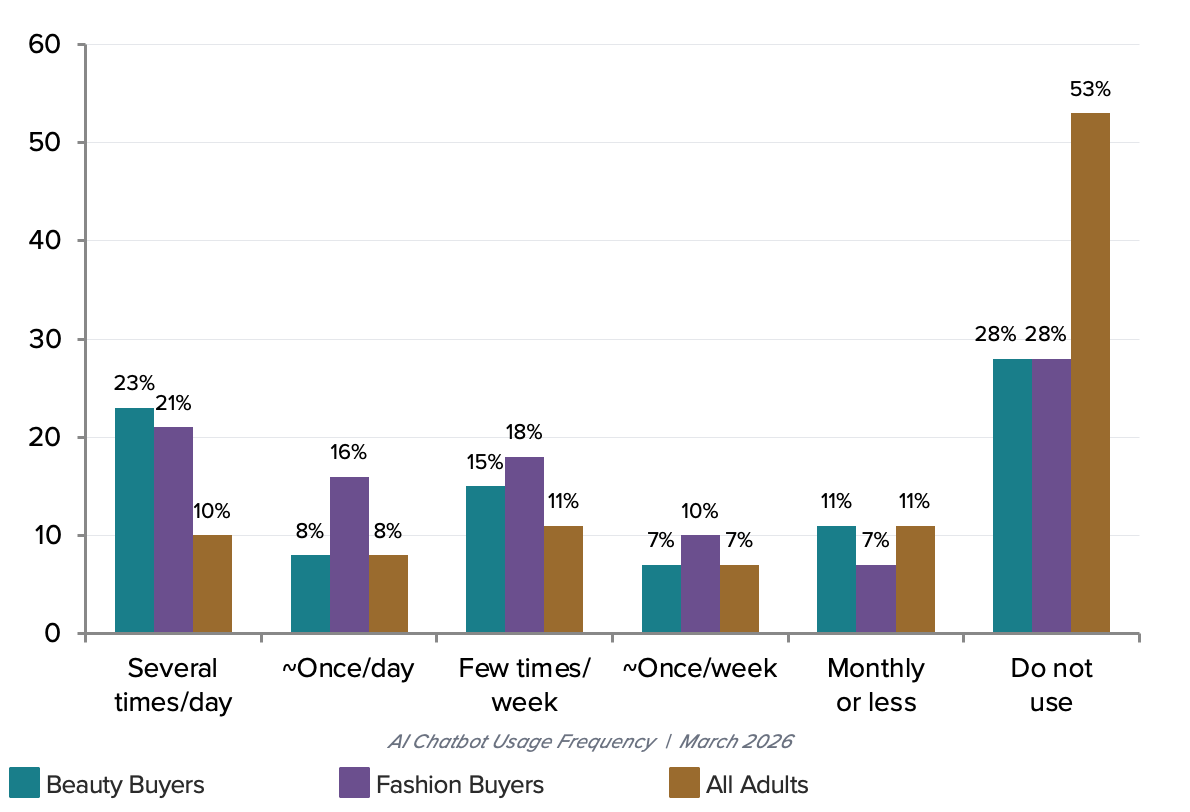
Both audiences use AI at roughly double the national rate.
23% of beauty buyers and 21% of fashion buyers use AI chatbots several times a day, which is roughly double the 10% rate among all U.S. adults. Only 28% of either audience does not use AI at all, compared to 53% of the general population.
For beauty and fashion brands, the implication is direct: the consumers most likely to drive category growth are already comfortable with AI-powered tools. Personalization engines, AI-driven product discovery, virtual try-on, and conversational commerce are not features these consumers need to be convinced to try. They are features these consumers already expect. The question is whether the industry is building at the pace its best customers are moving.
What to do with this insight: Skip the "education" phase - these consumers are already power users; invest in personalization, virtual try-on, and conversational commerce as competitive necessities.
They Hold Brands Accountable
Share of beauty and fashion shoppers who have boycotted a company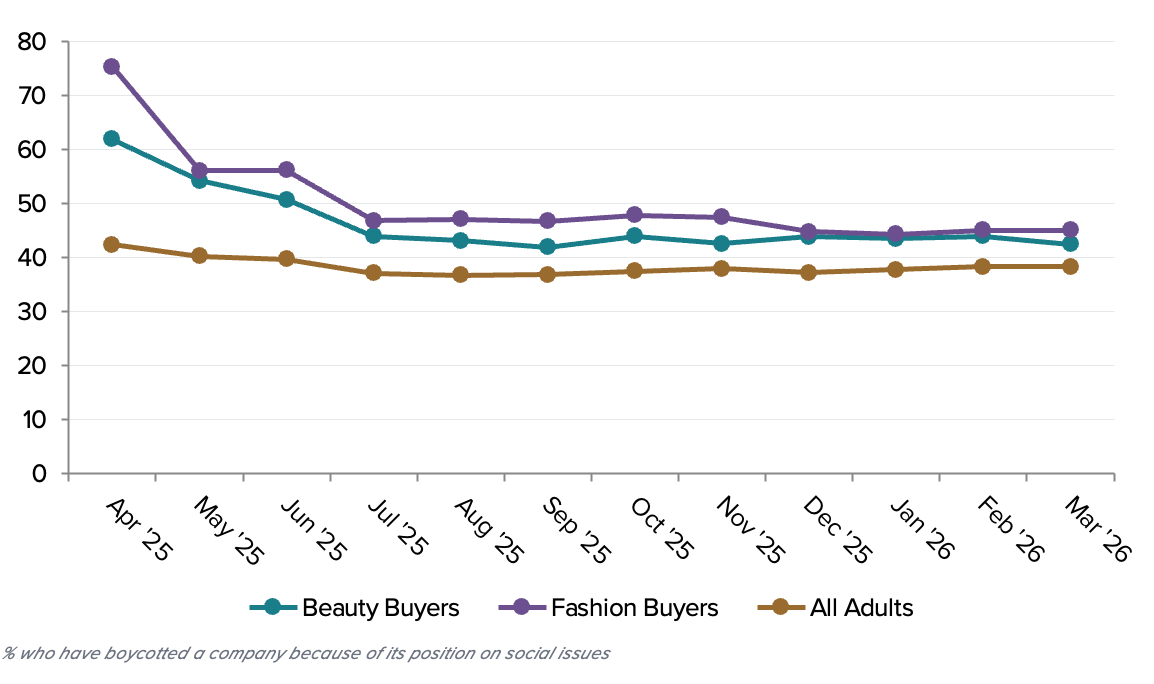
Both audiences boycott at higher rates than the general public, and the values alignment they expect from brands is non-negotiable.
As of March 2026, 44% of fashion buyers and 43% of beauty buyers have boycotted a company over its social positions, compared to 38% of all U.S. adults. Both rates peaked higher in mid-2025 (54% for fashion, 62% for beauty) before moderating to their current levels, suggesting the behavior is stabilizing rather than fading.
The psychographic backdrop explains why. 83% of both audiences admire companies that speak out for what they believe in, and 80–81% say contributing to society is important to them.
What to do with this insight: Earn the right to your values by living them visibly and consistently. Silence reads as absence, and the gap between claimed and demonstrated values is where boycotts begin.
Methodology
Data in this memo comes from Morning Consult Intelligence's continuous tracking surveys of U.S. adults. All figures reflect data collected between January 1, 2025 and March 31, 2026.
Beauty Category Buyers are defined as U.S. adults who have made a purchase from at least one of the following brands: Sephora, ULTA Beauty, Bluemercury, Clinique, Kylie Cosmetics, Maybelline, Revlon, YSL Beauty, or bareMinerals. The Beauty Category Buyer sample includes 50,415 respondents.
Fashion Category Buyers are defined as U.S. adults who have made a purchase from at least one of the following luxury and premium fashion brands: Louis Vuitton, Gucci, Chanel, Prada, Hermès, Balenciaga, Bottega Veneta, Christian Dior, Givenchy, Versace, J.Crew, Gap r H&M. The Fashion Category Buyer sample includes 37,773 respondents.
IHOP’s Equity Is Unusually Concentrated
Gen Z Brand Trust: Why 94% of Brands Score Lower
.png)