The bottom line up front
Facebook’s 38% mental market share — the share of social media occasions in which a brand surfaces — looks like category dominance, until you segment by age. Among adults under 35, Facebook, Instagram, and TikTok are essentially tied at roughly 20% each, with no platform having locked in a lasting mental advantage in the cohort marketers most want to reach. The apparent stability of this category is an older-cohort artifact, concentrated in 45+ users who account for nearly all of Facebook’s commanding lead. For platform strategists and the brands advertising alongside them, that creates a specific set of decisions: which platform to bet on as the mental landscape fragments by generation, where conversion friction is concentrated, and why an audience that worries about too much technology keeps showing up anyway. The platform that resolves the tension between ambient skepticism and habitual engagement will consolidate the next decade of category leadership.
The Social Media Category Today
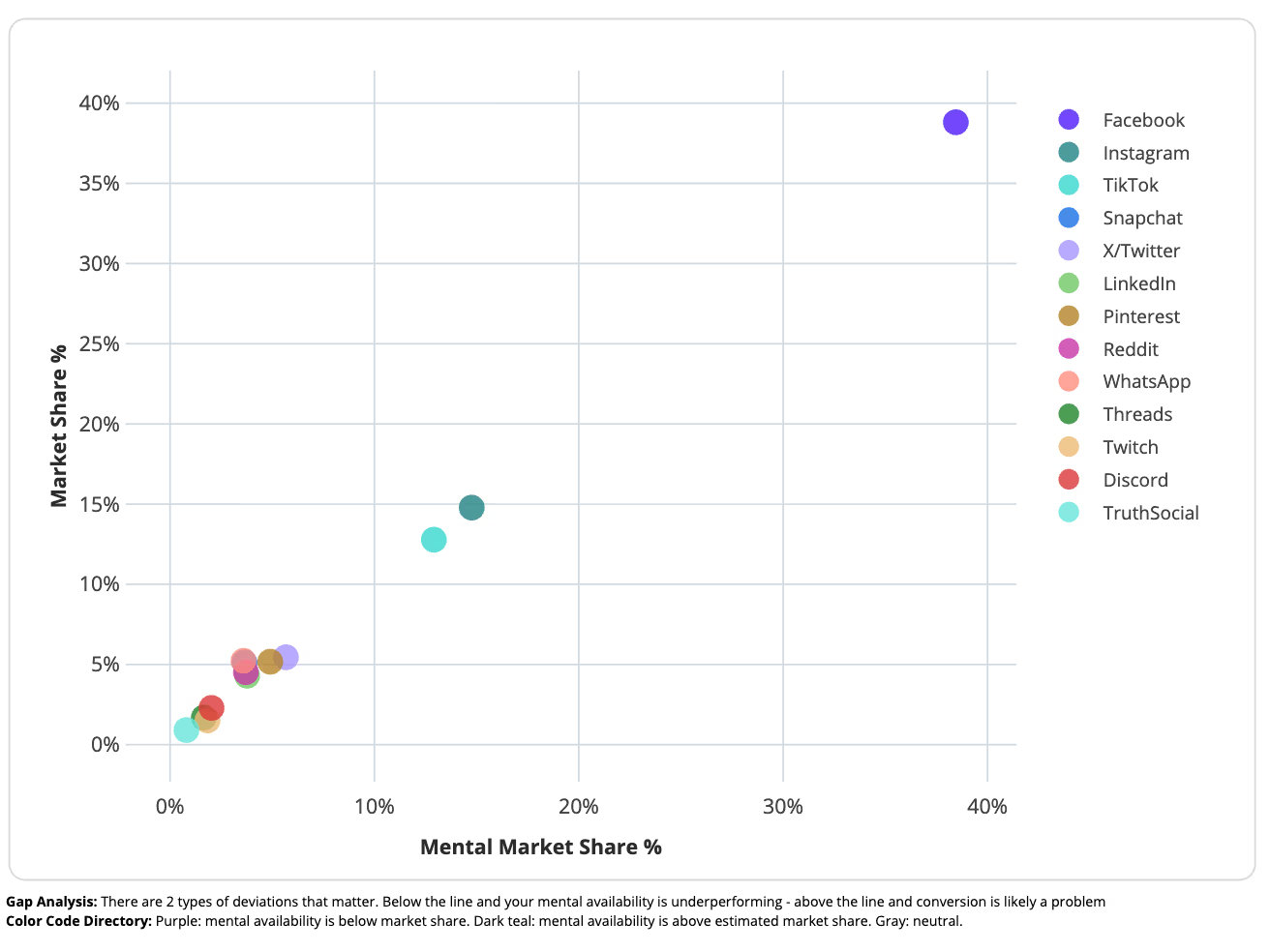
Facebook’s dominance is real but aging. Across all U.S. adults, Facebook comes to mind in roughly 38% of all social media situations — more than Instagram (15%) and TikTok (13%) combined. Its Mental Penetration (the share of users who link a brand to at least one purchase occasion) reaches 90%, and its Network Size — the average number of situations in which it surfaces — is 11.6, above Instagram’s 9.9 and TikTok’s 9.5. No other platform comes close on breadth. But strip out the 45–64 and 65+ cohorts, where Facebook holds 45% and 57% MMS respectively, and the landscape looks entirely different.
Among young adults, three platforms are locked in a mental tie. In the 18–34 cohort, Facebook’s MMS falls to ~22%, Instagram sits at ~20%, and TikTok at ~21% — a statistical dead heat. This is the segment brands compete hardest for, and in it there is no category leader. The front door hasn’t been installed yet. What makes this significant is that awareness is near-universal across all three: 87%, 85%, and 84% Mental Penetration respectively among 18–34 year olds. The battle is being fought not at the level of who consumers know, but at the level of which platform surfaces first across which occasions — and no one is winning that fight.
Instagram and TikTok are differentiating on occasion type, not on breadth. Instagram’s single clearest CEP advantage is celebrity and influencer following, where it nearly matches Facebook (40% vs. 41%). Relative to other brands, TikTok's largest strength is short-form video consumption, ahead of Instagram or Facebook, and is the second-strongest platform for product and brand discovery after Pinterest. These are not broad recall advantages — they are occasion specializations. LinkedIn owns professional networking (39%) and Pinterest holds inspiration and discovery (36%) almost exclusively among women. Both are category specialists rather than front doors: thought of for one thing and one thing only.
Emotional connection across the category is lukewarm and uniform. Facebook and Instagram score highest on the brand connection scale at 3.1 out of 7 — below the scale midpoint, and essentially tied with each other. No platform generates meaningful emotional affinity. This is a category governed by habit rather than brand love, which has direct implications for how advertising should work here: reach and salience do the heavy lifting, not relationship-building.
The Moments that Matter for Facebook, Instagram and TikTok
Social media occasions fall into three families. The highest-salience triggers are about connection and escape — not aspiration or identity.
“Catching up on what friends and family are doing” (~49%) is the category’s largest entry point. This is Facebook’s most decisive owned CEP: 74% of consumers associate it with Facebook, compared to 35% for Instagram and just 20% for TikTok. Platforms winning on this trigger must signal social utility and presence, not entertainment or discovery.
Passing time when bored, or having nothing to do (~44% and ~39%) together define the habitual-use cluster. Facebook leads both, but TikTok and Instagram compete aggressively on boredom (both at 38–39% association). These triggers don’t require brand love — they require default positioning. Whoever lives on the home screen wins by default.
Short-form video and news (~38% each) are the two most actively contested high-frequency occasions. On short-form video, TikTok (41%) has nearly closed the gap with Facebook (50%) — not controlling for brand size. On news and current events, Facebook leads decisively (49% vs. Instagram’s 27% and TikTok’s 24%). Creator-driven content consumption is where the competitive edge is actively being built — and where brand sponsorships tied to creator content earn the highest contextual salience.
Secondary triggers — inspiration, product discovery, live events, professional networking — account for 18–26% salience each and are largely owned by specialists rather than contested by the majors.
How Segments Differ
Age is the dominant structural variable — more consequential than income, gender, or region combined.
Age: The 18–34 cohort is the most contested terrain, with no dominant platform. The 35–44 cohort represents peak Facebook engagement: the highest Network Size of any demographic group (13.2 CEPs per user), meaning this segment uses Facebook across the widest range of situations. The 65+ cohort is Facebook’s fortress at 57% MMS — structural inertia that advertising alone is unlikely to move.
Income: Facebook’s MMS is inversely correlated with income (43% among under-$50K vs. 32% among $100K+). Instagram runs opposite: 18% MMS among high-income users versus 13% among lower-income. This gradient makes Instagram the more attractive environment for premium and aspirational brand advertising, while Facebook’s lower-income skew serves mass-reach and value-oriented campaigns more efficiently.
Gender: Two direction reversals clear the strategic significance threshold. Pinterest’s female-skewed MMS (7% among women vs. 3% among men) makes it disproportionately powerful for women-targeted brand strategies in the inspiration and discovery space. X/Twitter’s male over-index (8% MMS among men vs. 4% among women) means its overall low MMS understates its relevance for news-adjacent and real-time event advertising reaching men.
What's Blocking Conversion
The barriers in this category are not about awareness — nearly every major platform clears 60%+ aided awareness. The friction is structural and attitudinal.
Monetization resistance is the dominant barrier. The top two barriers — “I don’t want to pay for premium features” (27%) and “important features or content require payment” (15%) — together represent more category friction than any technical or access issue. This is a direct indictment of paywall and subscription strategies across the category. In a falling-ICS environment, this resistance will not soften. Platforms pushing premium subscription models against this backdrop face a structural headwind, not a messaging problem.
Account friction blocks discovery for emerging platforms. “Requires creating an account to use” (21%) is the second-largest barrier — and it falls hardest not on incumbents but on platforms trying to build new audiences. Threads’ 47% awareness but only 35% Mental Penetration, and Discord’s similarly wide gap, are precisely this friction at work. Reducing account-setup friction is the single highest-leverage growth lever for platforms outside the top three.
Data and access friction skews toward the most valuable users. Data usage concerns (17%), multi-platform fragmentation (“I need multiple platforms,” 10%), and network blocking (8%) are all meaningfully higher among 18–34 and male users — the two demographic segments most actively sought by platform advertising teams. These are not loyalty problems. They are access architecture problems that fall disproportionately on the highest-value segment.
Why This Matters Now
The youth market has no leader — and the window is closing. Among 18–34 year olds, mental availability is essentially equal across Facebook, Instagram, and TikTok. This is not a stable equilibrium; it’s an open competition during the period when habitual associations are still being formed. Platforms that show up consistently across more occasion types in this cohort — through creator investment, cultural presence, and frictionless access — will build the Network Size advantage that Facebook established with earlier generations. The brands and platforms that do not invest now will have to buy back this ground later at much higher cost.
Don’t treat older-cohort strength as category health. Facebook’s 38% overall share is not representative of where the category is going. Advertisers anchoring media planning to total-market MMS will systematically over-weight the 45+ cohort and under-invest in contested youth terrain. Segment-level MMS — not aggregate — should be the standard input for platform selection and budget allocation.
Monetization tension is not a niche concern. The gap between this audience’s willingness to pay for premium convenience (52% say they’ll pay for a faster, easier experience) and their categorical resistance to platform premium features (27% barrier rate) reveals a specific failure mode: these users are willing to pay for outcomes, not for access. Monetization strategies that bundle features into subscription tiers will underperform. Those that charge for tangible outcomes — better visibility, stronger connection quality, amplified reach — will find more receptive audiences.
The ambient skeptic is an untapped emotional position. Sixty percent of social media users — including heavy weekly+ users — worry that too much technology is a bad thing. They’re using these platforms anyway, but without emotional connection or brand affiliation. The platform that helps users feel their time is well-spent rather than merely consumed has an unoccupied emotional positioning to claim. No brand in this category is currently winning that argument.
About this research
Morning Consult conducts over 30,000 daily proprietary surveys in 45 countries covering more than 5,000 brands and 50 economic indicators.
Our category advantage research is aimed at understanding the needs driving consumers in your category — and how your brand can own more of them. This research is built on validated principles of brand-driven growth and powered by Morning Consult’s industry-leading sampling technology.
Measure the true drivers of brand strength
Capture both mental availability (the likelihood your brand comes to mind when consumers face a need or occasion) and emotional closeness (how strongly consumers connect with your brand), benchmarked against competitors.
Uncover Category Entry Points (CEPs)
Directly tied to mental availability, see the specific needs, occasions, and triggers that drive purchase decisions in your category, and how strongly your brand is linked to them.
Pinpoint growth opportunities
Direct investment toward the moments and consumer segments with the greatest potential to grow your brand.
Turn insights into action fast
Get survey results in 4–5 days through a centralized dashboard and short-form memo that equips stakeholders with clear direction on where and how to win.
Learn more
.png)
Smirnoff, Grey Goose, and Tito’s Lead the Vodka Category
.png)
The NHL Holds the Cleanest Specialist Position in the Secondary Tier of Sports Leagues