

The Bottom Line
People don't buy a wearable to train harder. They buy one to keep tabs on their own health: aging, heart health, weight, and how fit they really are. Those health moments dominate the category, and Apple Watch leads every one of the five biggest, with roughly half of the people who know it linking it to each. Fitbit is the only brand that contests Apple, and only on weight loss and with older adults. Everyone else has built awareness without building a reason to be chosen. The strategic question for challengers is not how to be seen but which health moment to claim, and how to make the price and subscription feel worth it once they do.
The Category Today
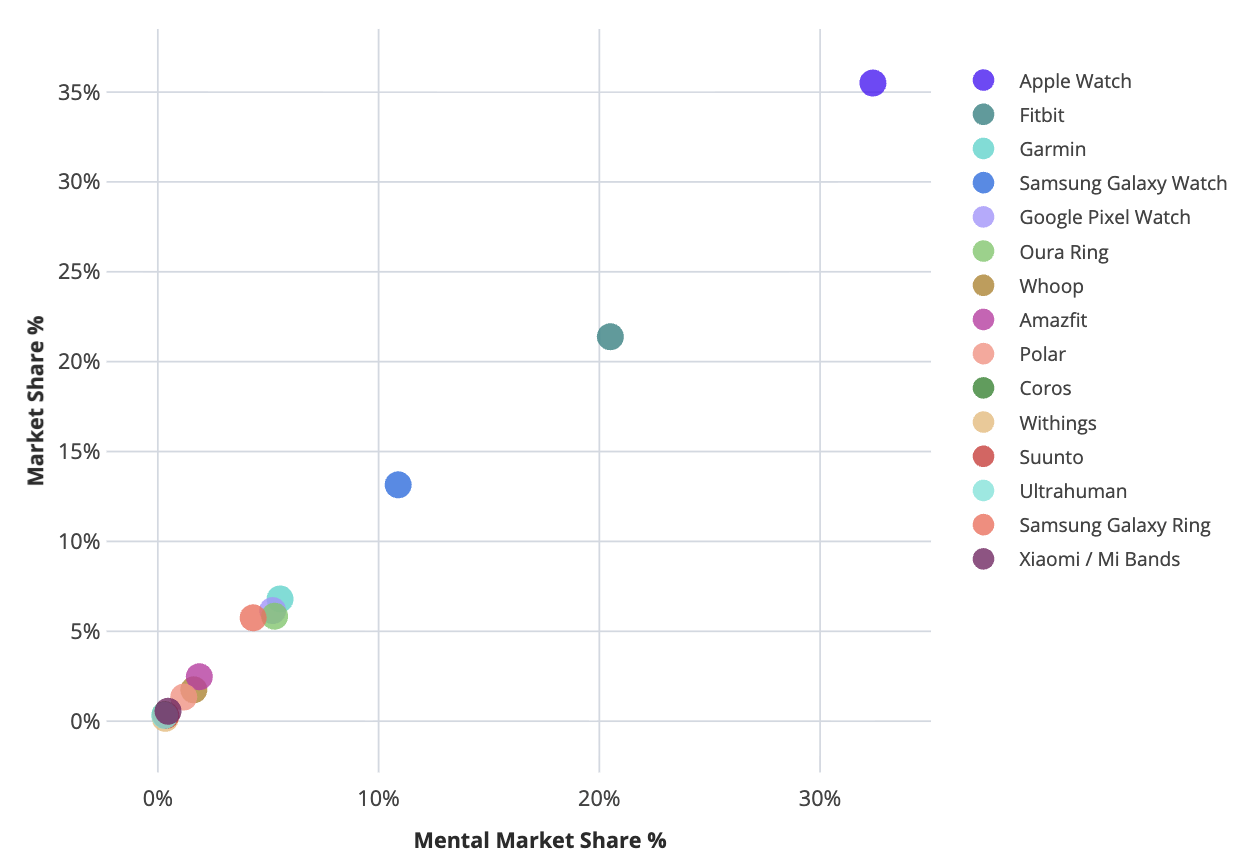
Two brands dominate, and the gap behind them is wide. Apple Watch captures ~32% of the category's mental market share (a brand's share of all purchase-trigger associations in the category) and Fitbit ~21%. Samsung Galaxy Watch follows at ~11%, and then no other brand exceeds ~6%. Apple Watch also reaches ~79% mental penetration (the share of brand-aware consumers who associate the brand with at least one purchase trigger) and links to about 12 purchase occasions on average (network size), well ahead of the 7-8 typical of the mid-field.
Awareness is not the problem for the middle tier; relevance is. Garmin, Oura Ring, Google Pixel Watch and Samsung Galaxy Ring are each known to roughly a third of adults (33-39%), yet each holds only ~4-6% of mental share. Consumers know these brands exist. They just don't reach for them when a purchase moment fires.
Intent follows mental share, so thought-of is the lever, not distribution. When consumers allocate their next ten wearable purchases, the same three brands lead in the same order as mental share: Apple Watch, Fitbit, then Samsung Galaxy Watch. That ordering suggests purchase consideration follows the brands that come to mind first, so mental share is the lever to pull.
The Moments That Matter
The category opens on health anxiety and self-knowledge, not performance. Four triggers lead.
"Getting older and becoming more conscious of my health" (~27%) is the single largest entry point, and it rewards the brand that feels most like a health device. Among people who know each brand, ~53% link Apple Watch to it and ~43% link Fitbit.
"Trying to lose weight" (~24%) is the one major moment where Apple's lead is thin. Apple Watch (~49%) leads Fitbit (~46%) by only about 2 points, which makes weight loss the most contestable high-salience trigger in the category.
"Wanting to monitor my heart health day to day" (~23%) and "Wondering how healthy or fit I really am" (~22%) both go to Apple Watch (~53% and ~52%), with Fitbit and Samsung Galaxy Watch behind.
Performance triggers sit at the bottom: training for a race, earning employer rewards and competing on daily steps are each ~8-9%. Brands positioned around athletic performance are competing for the smallest moments in the category. (Association rates for brands known to only ~3% of adults, such as Suunto, Coros and Ultrahuman, rest on very small aware bases and should not be read as leadership.)
How Segments Differ
The core structure holds across demographics. What changes is which brand benefits.
Age flips the leader. Among adults 65 and older, "getting older and becoming more conscious of my health" is ~41%, and Fitbit's mental share (~28%) runs ahead of Apple Watch's (~23%). Among 18-34s, Apple Watch is ~38% while Fitbit is ~16%. Fitbit's strength is the older, health-first buyer; Apple's is the younger one.
Younger adults carry the performance and social triggers. Race training (~17%), gym or run-club joining (~21%), employer rewards (~14%) and stress tracking (~21%) all run meaningfully higher among 18-34s. This is the audience where fitness-performance positioning has a base to build on.
Higher-income households are the occasion-rich segment. Among $100K+ households, replacing an old device (~22%), active-trip prep (~18%) and moving more during a desk job (~18%) all run roughly 7-8 points above average, and Apple Watch's mental share is ~36%. This is the premium-upgrade audience.
All-in-one beats specialist, even on the specialist's own moment. Apple Watch links to about 12 purchase occasions on average, against 7-8 for Garmin, Oura Ring and Google Pixel Watch, and it still leads each specialist's signature moment among people who know the brands: sleep (~48% vs. Oura's ~35%, no higher than Fitbit's ~35%), training readiness (~49% vs. Whoop's ~31%) and race training (~49% vs. Garmin's ~26%). Feature depth has not bought any specialist ownership of its moment, so a challenger built on one feature has to win that moment outright to matter.
What's Blocking Conversion
Price is the dominant barrier, and it is nearly twice the size of anything else. "Costs more upfront than I want to spend" is cited by ~32%, followed by "requires a subscription to access all features" at ~17%. Together they form a single affordability problem: the sticker price and the ongoing cost. The lever is clarity about total cost and what the subscription actually unlocks.
Trust in the data is the second cluster. Health data privacy (~14%), data accuracy (~14%) and worry about becoming obsessive about the numbers (~10%) matter more in a category where people buy for health reassurance. Brands need to show that readings are reliable and private.
Fit and compatibility come next. Comfort for long wear (~14%), phone compatibility (~13%) and charging frequency (~11%) are real but secondary.
Access barriers are minor. Stock-outs, inability to try on, sizing kits and return windows each sit at ~5-9%. Distribution is not what is holding the category back.
Why This Matters Now
Win a health moment outright; don't just claim it. Garmin, Oura Ring, Google Pixel Watch and Samsung Galaxy Ring each hold 33-39% awareness but a fraction of mental share. The health triggers are 22-27% salient and performance triggers are under 10%, so the larger pool sits in the top four health moments. But Apple Watch already leads all four, along with sleep, training readiness and race training. A challenger has to beat Apple Watch on one moment, not just appear in it, and leading with performance positioning targets the smallest moments in the category.
Fitbit should lead with weight loss and with older adults. Those are the two places Fitbit is closest to, or ahead of, Apple Watch. Investing there extends a position it holds rather than attacking Apple on ground Apple has already taken.
Fix the price story before spending on access. With upfront cost at ~32% and subscription at ~17%, versus ~5-9% for every access barrier, budget spent on more stores or sizing programs will underperform budget spent on transparent total-cost messaging and a clear account of what the subscription includes.
Breadth beats depth. Apple Watch leads because it appears across nearly every moment, not because it dominates one. A brand that wins a single trigger will stay a niche choice. The route to the top tier is a credible claim on several of the health moments that open the category.
About these metrics. Total U.S. adults (n=1,402 unweighted), one wave of data. Because there is no earlier wave, this memo makes no claims about change over time. No Morning Consult Intelligence supplemental was used, so there is no sentiment or audience-profile section. Percentages are rounded; segment differences are reported only where they cleared Category Advantage reporting thresholds and the survey's significance test against the total.

U.S. Auto Market Trends: What's Driving Purchase Decisions

Where Progressive Wins — and What's Holding It Back
