Consumer sentiment continued to fall this week, with the overall adult ICS falling 2.0 points to 90.4, extending the decline from last week's Iran-driven 2.1 point drop and bringing the cumulative two-week loss to over 4 points.
Despite that steady deterioration, the pace of decline is still relatively moderate compared to prior shock periods. The ICS is being supported by a stabilizing labor market, uncertainty regarding the inflationary impact of the Iran conflict (see below) and a stock market buoyed by investors’ hopes of AI-driven profits and tariff rebates.
The most concerning signal in this week's data is the disproportionate deterioration among households earning over $100k. A sustained decline in high-income sentiment would have outsized implications for discretionary spending, as this cohort drives a disproportionate share of consumer expenditure. This most recent period of volatility for high-income consumers follows the period earlier this year when layoffs and labor market concerns provided a dramatic shock.
| MORNING CONSULT U.S. ECONOMIC OUTLOOK (3/17/2026) |
|||
|---|---|---|---|
| Consumer Sentiment (ICS) |
This Week |
WoW (+/-) |
Risk Outlook |
| Adults | 90.4 | -2.0 | Medium |
| Under $50k | 84.7 | -2.3 | High |
| $50k-$100k | 92.1 | 0 | Medium |
| Over $100k | 105.1 | -3.5 | High |
| Inflation Expectations (ICIE) |
This Week |
WoW (+/-) |
Risk Outlook |
| Adults | 4.9% | 0 pp | Medium |
| Under $50k | 4.3% | -0.1 pp | Medium |
| $50k-$100k | 5.7% | 0.1 pp | Medium |
| Over $100k | 5.3% | 0.1 pp | Medium |
| Pay Loss Rate | This Week |
WoW (+/-) |
Risk Outlook |
| Adults | 12.1% | -0.4 pp | High |
| Under $50k | 14.1% | -0.5 pp | High |
| $50k-$100k | 10.6% | -0.4 pp | High |
| Over $100k | 7.9% | -0.2 pp | Medium |
Why Iran Isn't Ukraine
One of the more surprising developments this past week was the relative stability in Indirect Consumer Inflation Expectations (ICIE), which rose a modest 0.1 pp for the week and remained unchanged on a 4-week moving average. Given all the media coverage of gas price increases, one could reasonably assume in the absence of weekly data that inflation expectations spiked higher this past week, but that assumption would have been wrong and extremely dangerous for policymakers convening at the Fed this week.
There are 3 primary reasons the conflict in Iran will not spillover in the near-term to drive inflation as high as 2022 following Russia’s invasion of Ukraine:
- Falling Trend Inflation - Inflation and inflation expectations have been trending lower during the run-up to the U.S. bombing of Iran, while they were shooting higher in early 2022 in response to widespread supply shortages and robust consumer demand.
-
Weakened Finances and Labor Markets - Americans’ finances are weaker now than they were in 2022, when lockdown-induced spending bans and stimulus checks were still supporting savings at record high levels, and the U.S. labor market is essentially at a standstill now compared to the record demand 4 years ago. If gas prices top $4/gallon, consumers are not as well-positioned financially to absorb that shock without cutting back their spending elsewhere. In other words, weaknesses in the economy are actually a good thing from the perspective of keeping inflation under control.
-
Military Policy Uncertainty - Putin had a longer timeline to wage his war because he was not constrained by political considerations to the same extent as Trump is currently. As of this past week, only 30% of U.S. voters are willing to sustain operations "as long as it takes," and another 30% say the U.S. shouldn't be involved at all. There remains a probability that the conflict with Iran ends in the next few weeks, and that probability continues to anchor inflation expectations lower.
-
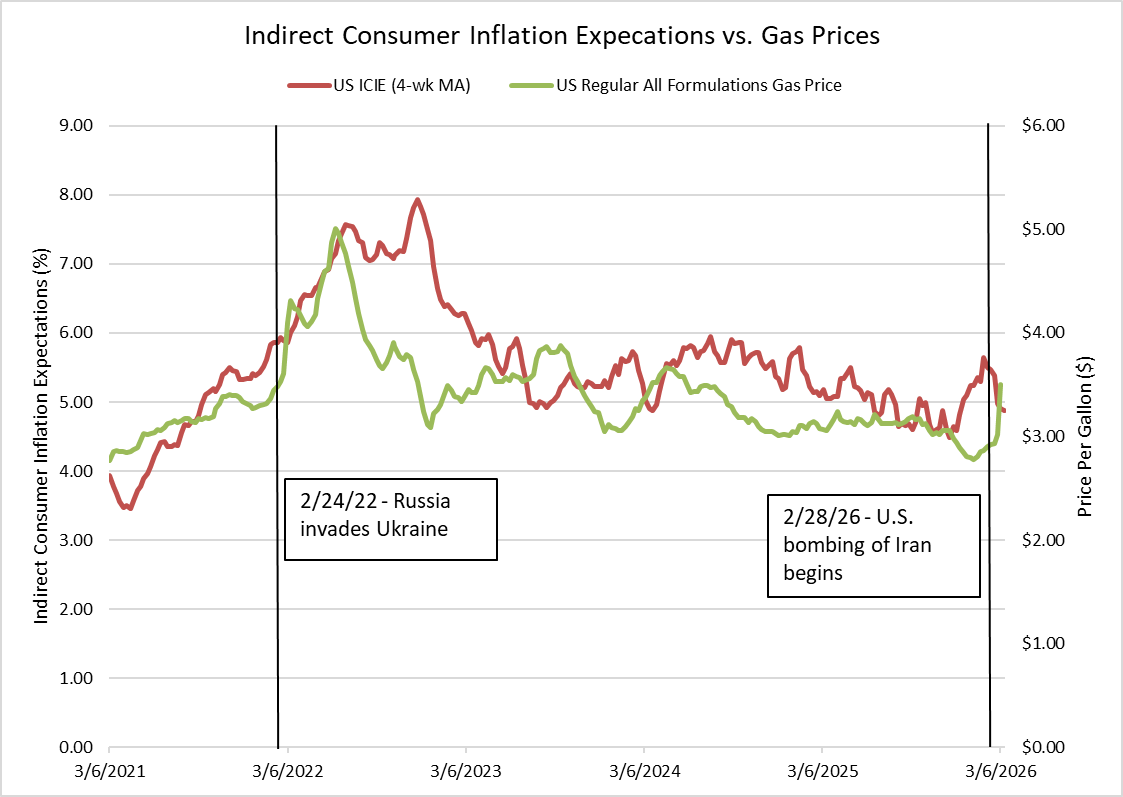
Source: Morning Consult, U.S. Energy Information Administration

Consumers Say Gas Prices Have Gone Up, and Blame Trump
.jpg)
What To Expect From a Second Energy Shock As the Ceasefire With Iran Ends