

The bottom line up front
Spectrum Mobile occupies a paradoxical position in the cellular category: it outperforms Xfinity Mobile on nearly every mental availability metric — higher MMS (4.6% vs 3.8%), broader Mental Penetration (47% vs 42%), and deeper Network Size (8.1 vs 6.4) — but does so with substantially lower awareness (32% vs 45%). Spectrum Mobile’s mental advantage profile mirrors Xfinity’s dependence on bundling (+9), but the brand shows a more balanced secondary presence across value and promotional triggers that Xfinity lacks entirely. The strategic opportunity is to leverage that broader mental profile to escape the one-occasion trap that limits all cable-backed carriers. But with 34% active rejection and only 32% aided awareness, the window is narrow: Spectrum Mobile must build mental availability faster than the Big Three can neutralize the bundling advantage.
Where Spectrum Stands
Spectrum Mobile punches above its awareness weight on mental availability. At 4.6% MMS, Spectrum Mobile outranks Xfinity Mobile, Mint Mobile (3.2%), Boost Mobile (1.8%), and Visible (1.5%) despite having lower aided awareness than all except Boost and Visible. Its Mental Penetration of 47% and Network Size of 8.1 place it in the upper half of the mid-tier — closer to Cricket Wireless and Metro by T-Mobile than to the MVNOs. Among those who do think of Spectrum Mobile, the associations are surprisingly broad.
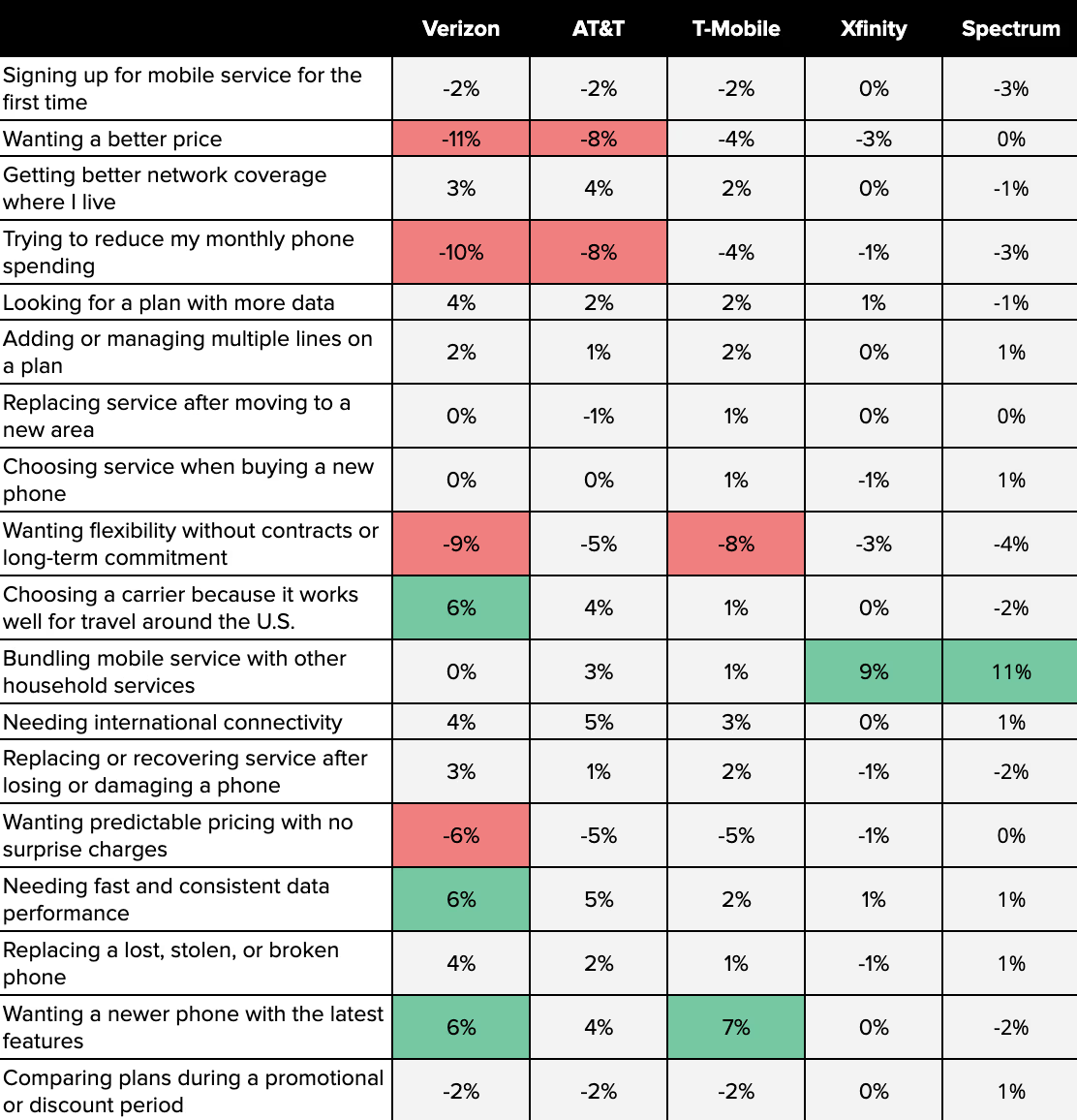
The brand’s mental profile is more balanced than Xfinity’s but still anchored in bundling. Spectrum Mobile’s top mental advantage is bundling (+9), identical to Xfinity’s. But it also holds moderate advantages on international connectivity (+2), managing multiple lines (+2), and replacing a lost phone (+2). Unlike Xfinity, which is flat outside bundling, Spectrum shows signs of secondary mental presence. The under-indexes are concentrated on flexibility/no contracts (-4), newer phone features (-3), and coverage (-2) — a pattern suggesting the brand is perceived as a household utility, not a technology choice.
Emotional Connection is low but tracks the cable-backed cohort. At 2.3 on a 7-point scale, Spectrum Mobile’s EC matches Straight Talk and sits marginally above Xfinity Mobile (2.2). Among lower-income households (<$50K), EC rises to 2.5 — the brand’s strongest affective segment, suggesting that value-seeking consumers respond more favorably to the brand’s bundling and cost-reduction associations.
The CEPs Spectrum Owns — And the Ones It Doesn't
Bundling is Spectrum’s anchor, but the brand shows broader competitive presence than its cable peer. On “bundling mobile with household services” (~10% salience), Spectrum holds 29% association — ahead of Xfinity (23%) and behind only AT&T (32%). On “wanting a better price” (35% salience), Spectrum holds 23% — well above Xfinity (14%) and competitive with Mint Mobile (23%). On “comparing promotional plans” (14% salience), Spectrum holds 25%, its second-highest absolute association. The brand’s mental presence on value and promotional triggers gives it a secondary pathway that Xfinity lacks.
On performance triggers, Spectrum Mobile is mid-pack but present. On “fast data” (23% salience), Spectrum holds 23% association; on “better coverage” (22% salience), 19%. These are not leadership positions, but they are meaningfully above the MVNO average and above Xfinity’s flat ~15% baseline. Spectrum Mobile has built mental presence on more occasions than its 32% awareness level would predict.
Who Spectrum Is Winning — and Losing
Spectrum Mobile’s mental availability is strongest among female, lower-income, and younger consumers — a different profile than Xfinity’s.
The gender split is the most distinctive in the mid-tier. Spectrum Mobile’s MMS among women (5.5%) is nearly 50% higher than among men (3.7%). Mental Penetration among women (51%) outpaces men (42%) by 9 points. Network Size among women (8.6) exceeds men (7.5). No other mid-tier brand shows this degree of female over-indexing. This could reflect household decision-making dynamics — women more frequently managing household bills and bundling decisions.
Lower-income segments are Spectrum’s volume base. Among <$50K households, MMS rises to 5.6% and Mental Penetration to 51% — both the brand’s strongest income-segment scores. Network Size reaches 8.9, suggesting deep associative breadth among value-seeking consumers. Among $100K+ households, MMS drops to 3.6% and Mental Penetration falls to 34%. The brand’s mental availability is inversely correlated with income — the opposite of AT&T’s pattern.
The 35–44 cohort is a hidden strength. Network Size among 35–44 year-olds surges to 9.8 — the brand’s highest in any segment and approaching the Big Three’s Total scores. MMS holds at 4.9%. This is the peak household-formation cohort: managing multiple lines, consolidating bills, making the bundling decision. Spectrum Mobile’s mental depth in this segment aligns precisely with its structural advantage.
What's Blocking Conversion for Spectrum
Awareness is the binding constraint. At 32% aided awareness — compared to 45% for Xfinity Mobile and 84% for T-Mobile — Spectrum Mobile cannot convert consideration it never generates. The brand’s mental availability metrics are strong relative to its awareness base, which means the problem is reach, not relevance. Every point of awareness gained should translate to disproportionate MMS growth, given the brand’s relatively high conversion rate among those who know it.
Active rejection is elevated but not disqualifying. At 34% “definitely will not use,” Spectrum faces a rejection rate comparable to Xfinity (38%). The same cable-industry trust deficit applies: hidden fees (29%) and poor customer service (24%) are category-level barriers that bite harder when the brand carries a cable parent’s reputation. Spectrum’s advantage over Xfinity is that its lower awareness means a larger share of the market hasn’t formed an opinion yet — the brand still has a blank-slate opportunity with roughly two-thirds of consumers.
About this research
Morning Consult conducts over 30,000 daily proprietary surveys in 45 countries covering more than 5,000 brands and 50 economic indicators.
Our category advantage research is aimed at understanding the needs driving consumers in your category — and how your brand can own more of them. This research is built on validated principles of brand-driven growth and powered by Morning Consult’s industry-leading sampling technology.
Measure the true drivers of brand strength
Capture both mental availability (the likelihood your brand comes to mind when consumers face a need or occasion) and emotional closeness (how strongly consumers connect with your brand), benchmarked against competitors.
Uncover Category Entry Points (CEPs)
Directly tied to mental availability, see the specific needs, occasions, and triggers that drive purchase decisions in your category, and how strongly your brand is linked to them.
Pinpoint growth opportunities
Direct investment toward the moments and consumer segments with the greatest potential to grow your brand.
Turn insights into action fast
Get survey results in 4–5 days through a centralized dashboard and short-form memo that equips stakeholders with clear direction on where and how to win.
Learn more
.png)
Xfinity’s Bundle Mental Advantage Is Its Main Advantage in the Cellular Category
.png)
Why T-Mobile Is the Leader in the Cellular Service Category
.png)