
Demand for air travel remains structurally strong. From our recent Category Advantage research we see that travelers continue to enter the category driven by the same fundamental needs: finding the lowest fare, securing the most convenient route, minimizing travel time, and reducing complexity. And yet, growth is uneven.
Growth is more about reducing friction than a battle for identity. Mental availability and route networks help a brand make it onto a traveler's shortlist, but reputation ultimately influences whether they book or abandon.
The disconnect happens at the point of conversion, rather than the point of entry into the category. Airlines aren't having trouble simply being considered — they're having trouble being chosen consistently amid friction.
The main challenge for 2026 is that, although travel demand stays strong, consumer "friction tolerance" has hit a critical low. This is where reputation becomes crucial.
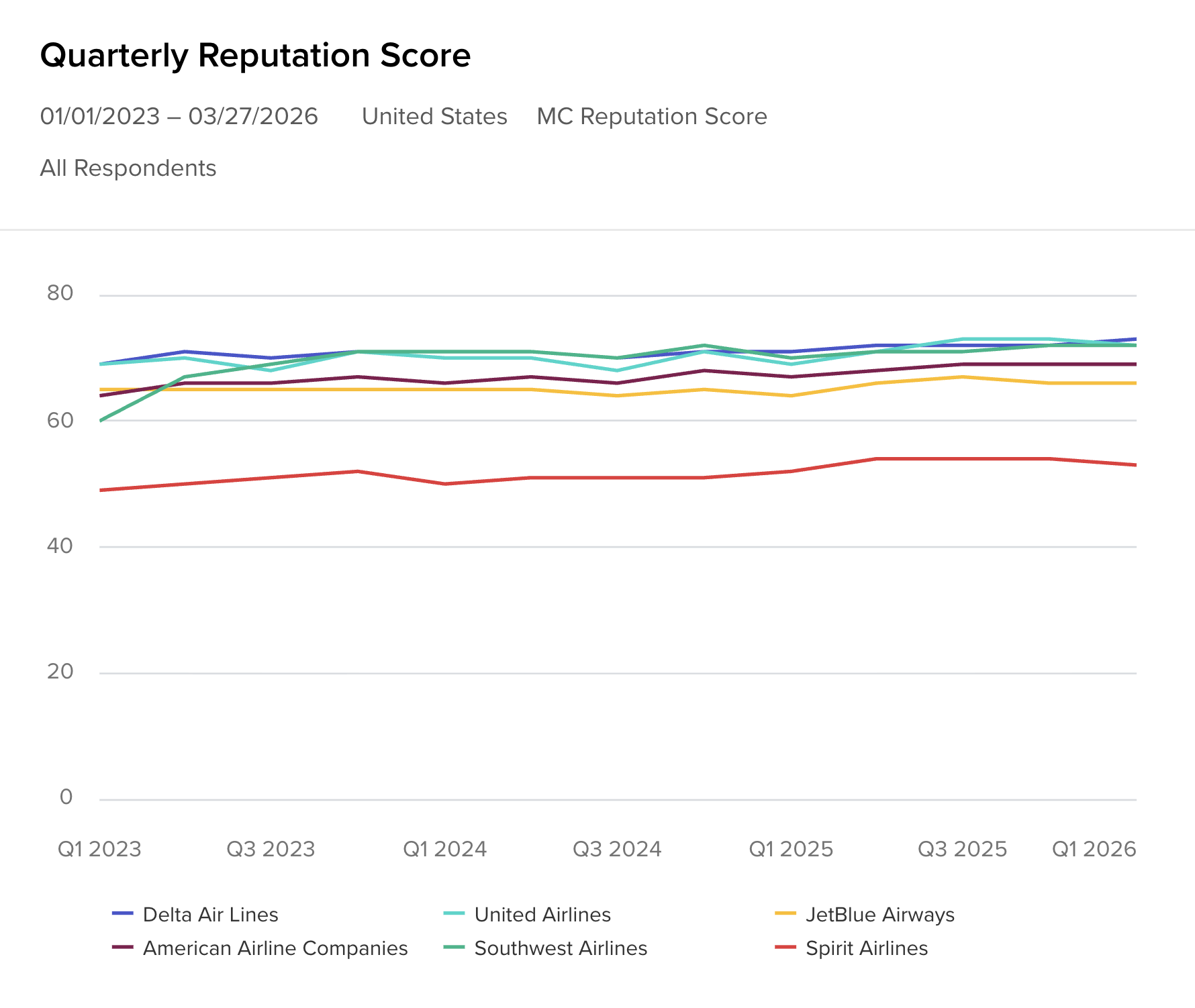
Morning Consult’s Reputation Framework redefines reputation as an active system rooted in human emotion: Emotion -> Perception -> Feelings -> Action. For airlines, a high reputation score is not just a "nice-to-have" sentiment; it is "Behavioral Equity." It acts as the psychological safeguard that helps a brand sustain passenger loyalty even when operational issues inevitably occur.
Reputation doesn't generate demand in the airline industry. Instead, it influences how much friction or tension travelers are willing to accept once demand is present.
A Category Built on Necessity — and Tension
Airlines serve a dual purpose: vital infrastructure and customer-focused services. This creates an inherent tension in how they are perceived. Airlines are widely regarded as essential to the economy, yet they are also seen as profit-driven and sometimes disconnected from passenger interests.
Airlines are trusted to provide the core service, but not consistently trusted to handle the surrounding experience in a way that feels fair or predictable.
Category Trust & Integrity (Net Agree %)
|
Statement |
Net Agree |
|
Airlines act responsibly |
50–55% |
|
Airlines treat passengers fairly |
45–50% |
|
Airlines are transparent about pricing |
<45% |
|
Airlines handle disruptions effectively |
<40% |
Category Foundation: Where Growth Lives
Growth in the airline industry is mainly practical. Travelers pick airlines to lower risk, focusing on functional triggers (Category Entry Points or CEPs) like the lowest fares, nonstop flights, and avoiding hidden fees.
However, what comes to mind is only a "shortlist" victory. Structural barriers—limited routes, opaque pricing, and unproven recovery systems—often block conversion after a brand is considered. Emotional connection does not drive the initial choice in this category; instead, it reinforces it later, acting as insurance that earns forgiveness after disruption.
The Reputation Environment: A Climate of Skepticism
The current industry landscape is characterized by a deep-rooted "Transparency Deficit." While the sector performs well on overall measures of Responsibility and Integrity, scores drop significantly when travelers assess specific aspects: Transparency and Operational Recovery. This creates an emotional baseline where travelers feel Anxious rather than Confident and Frustrated rather than Supported.
This skepticism is most volatile among the $50k–$100k income growth segment. This group drives the industry—travelers who can afford to fly but are highly sensitive to perceived risks. They are much more likely to penalize brands for opaque pricing, judging price based on integrity rather than just cost. For these travelers, reputation mainly influences their view of "Price Fairness."
Affordability: The Category’s Central Fault Line
Affordability isn't just about price — it's about perceived fairness. This difference determines whether price encourages or deters conversions.
Affordability & Fairness
|
Statement |
Result |
|
Air travel is becoming too expensive |
~70% agree |
|
Airlines price fairly |
<50% agree |
|
Costs feel justified |
45–50% |
|
Airlines prioritize profits over passengers |
Majority agree |
Integrated Diagnosis: Reputation as the Friction Filter
Friction is anything that makes it harder for a consumer to move from consideration to action, or to stay loyal after the experience.
The idea of friction is implicit in both systems:
|
Category Advantage |
Reputation Advantage |
|
At the category level, structural barriers to conversion play a role
|
Reputation introduces perception-based friction (psychological) Low trust → hesitation Perceived unfair pricing → resistance Negative emotions → avoidance Weak identity → no loyalty
|
To foster growth, communications leaders need to reframe operational failures as reputational character flaws. The "What" of Category Advantage must be confirmed by the "Why" of Reputation Advantage.
- Price is a Fairness Problem: "Price" is the most common entry point, but "Price Opacity" is the biggest conversion killer. When an airline hides total trip costs, it damages Corporate Credibility & Character, leading to a direct decrease in Value perceptions and hurting the airline's Brand Appeal.
- Delays are a Trust Problem: Safety is a basic expectation, but Operational Recovery acts as the hidden premium barrier. A brand with high Trust attracts more skeptical travelers because they believe the recovery systems truly work..
- Emotion is Friction Tolerance: Emotional connection doesn't generate demand, but it influences how much friction a brand can endure. Delta Air Lines leads significantly in Behavioral Equity, with a 75.7 index for "Benefit of the Doubt." This "Forgiveness Insurance" enables Delta to maintain volume in high-friction markets where other brands would see a complete drop in consideration.
Loyalty Programs: The System That Re-Routes Friction
Loyalty programs are more than just retention tools—they fundamentally alter how consumers engage with the airline industry. For major U.S. carriers, they account for about 40–55% of the company’s value, primarily due to credit card partnerships rather than actual flights. This shifts how friction functions.
For most travelers, friction determines whether a booking occurs. But for frequent flyers, loyalty programs guide behavior even before the search starts. The decision is often made early — and friction shifts from blocking conversions to testing retention.
In other words, Loyalty programs do not eliminate friction; they re-route it.
Brand Archetypes: The Forgiveness Hierarchy
Morning Consult’s two-dimension framework—Corporate Credibility & Character and Brand Appeal—reveals a clear competitive structure:
|
Reputation Archetype |
Key Brands |
Reputation Profile |
Strategic Advantage |
|
The Trust Anchors |
Delta, American |
High Credibility; High Forgiveness |
Behavioral Equity: Brands that maintain volume despite premium pricing because recovery is trusted. |
|
The Value Challengers |
Southwest, JetBlue |
High Appeal; Moderate Credibility |
The Fragile Shortlist: Win on "Value" but lack the trust buffer to survive a major operational crisis. |
|
The Functional Bottom |
Spirit, Frontier |
Low Credibility; Low Forgiveness |
The Friction Trap: Every delay is a conversion killer because they lack the "benefit of the doubt". |
The Reputation-Optimized Message Map
To move a traveler from the "Shortlist" to a "Booking," communications must synchronize functional triggers (CEPs) with reputational buffers:
- Trigger: Emergency Travel (CEP: Time & Nonstop)
- Reputation Lever: Trust & Integrity.
- Strategy: Shift from "We have the most flights" to "The most reliable network when your schedule can’t afford a delay." Highlight faster rebooking and recovery technology.
- Trigger: Budget Booking (CEP: Lowest Fare)
- Reputation Lever: Value & Transparency.
- Strategy: Improve the fairness message by starting with "Total Trip Cost" to lower cart abandonment. Shift focus from "Low Fares" to "Predictable pricing with zero friction at checkout."".
- Trigger: High-Stakes Travel (CEP: Safety & Comfort)
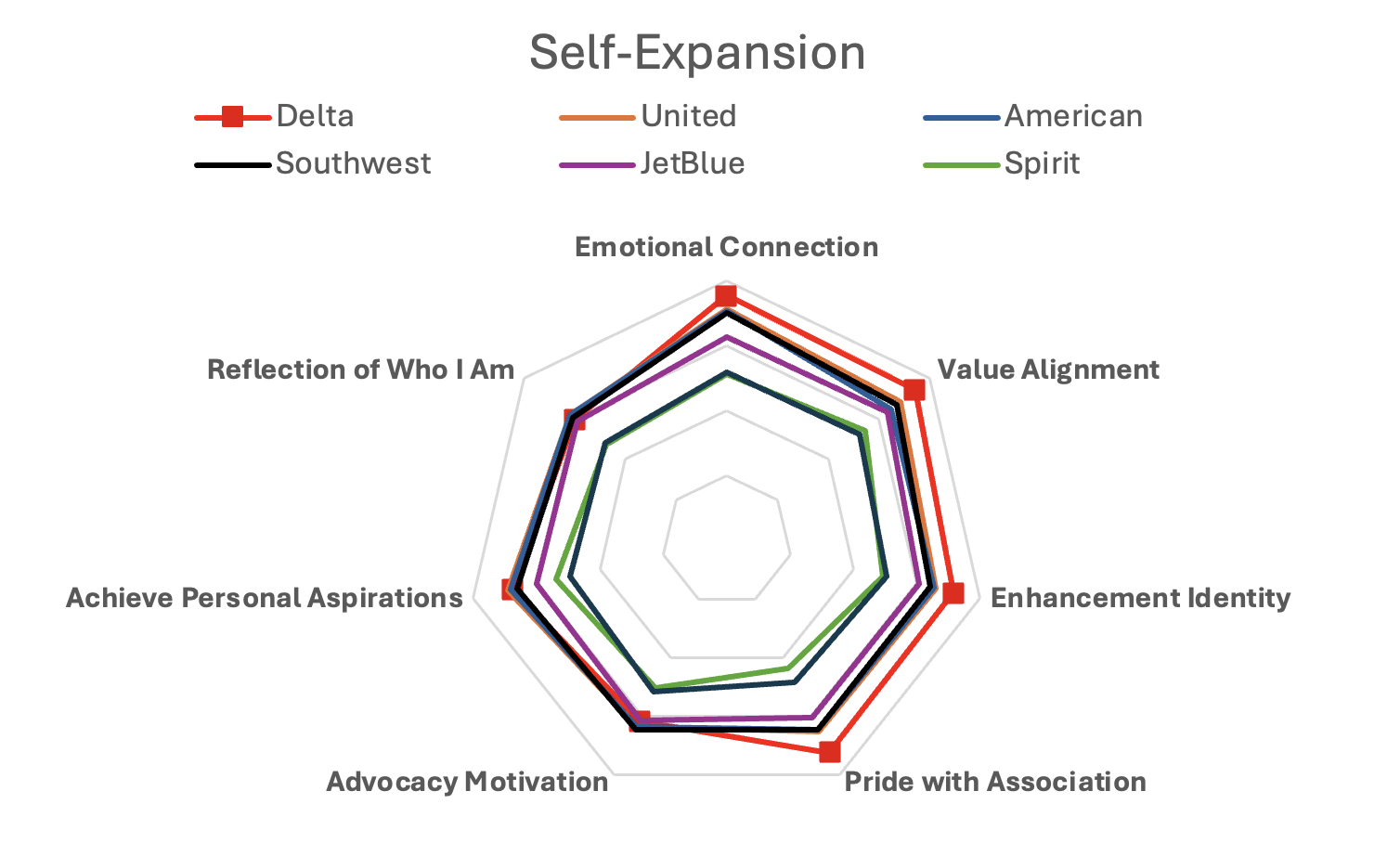
- Reputation Lever: Self-Expansion & Emotion.
- Strategy: Use "Brand-Self" storytelling to connect the airline's resilience with the traveler’s personal values. When your story becomes theirs, you achieve Self-Expansion, creating a resilient barrier against competitor fare-warping and linking the customer to the airline’s identity.
Strategic Implications: From Diagnostic to Action
To unlock growth in 2026, Communications teams must lead a transition from "Aspiration" to "Actionability."
- Invest in Forgiveness Insurance: In high-congestion markets, focus on Corporate Character messaging (Employer Brand and Community Impact). This helps create the emotional connection needed to safeguard the brand's license to operate during disruptions. Boosts Trust.
- Transform Employees into Reputation Proxies: Since Admired Employer scores are a weak area, stories that showcase empowered staff serve as a stand-in for a well-managed, dependable airline, directly impacting Trust and Advocacy.
- Diagnose Before You Spend: Treat a barrier issue as a barrier issue, not a recall issue. If growth is hindered by a lack of Transparency or Recovery, no amount of broader brand messaging will boost revenue until those reputational flaws are fixed.
Airlines do not win by eliminating friction — they win by building a reputation and loyalty system strong enough to absorb it.
Category Advantage shows where growth lives. Reputation Advantage shows which airlines can capture it. Loyalty determines how consistently they can retain it.
.png)
Understanding The Cat Food Category Today
.png)
DraftKings’ Competitive Edge: Where Participation Becomes Competition
-1.png)