

We last looked at consumer AI back in January. This memo tracks how the category has shifted since then.
The bottom line up front
Microsoft Copilot is at a make-or-break moment. The brand has structural advantages no challenger can match — 57% awareness (third in category, +4pp this wave while ChatGPT’s has plateaued), the broadest distribution surface in the Microsoft 365 ecosystem, and emerging mental advantages on three of the four largest CEPs (Health Info, Quick Answer, Researching topics). At the same time, three forces are working against the brand simultaneously: the awareness-to-active-use conversion gap is the widest among major brands; the productivity territory Copilot owned in January has weakened sharply ; and premium and educated audiences are leaking increasingly to Claude. The coming months will determine whether Copilot becomes the work-and-utility AI for the broader consumer base or the preinstalled-but-unused option for users who actively choose another brand. The category is consolidating fast, and the lanes Microsoft is best-positioned to own are being claimed by competitors that have positioned themselves more deliberately.
|
In this memo, we use the Category Advantage research framework to measure how consumers consider different types. A few terms you should know: |
|
Where Copilot Stands
Awareness is the brand’s real structural advantage — and it is still expanding while competitors’ plateau. Copilot reaches 57% of U.S. AI users (third in the category) and rose +4pp wave-over-wave at a moment when ChatGPT’s awareness has saturated and Gemini’s is flat. Among the major brands, Copilot has both the longest awareness runway and the only meaningful awareness gain. The Microsoft 365 distribution surface that drives this is unmatched in the category.
Conversion is the widest gap with the leaders, and the gap is structural, not transient. Active use of 21% has held essentially flat (-0.3pp) while awareness rose. ChatGPT and Gemini convert ~57% of awareness into monthly active use; Copilot converts 36% — the lowest among major brands. The gap is not driven by trial, since Microsoft 365 surfaces the brand to most aware users repeatedly. It is a relevance problem: aware users are not finding the moment when reaching for Copilot becomes the natural choice.
Mental Market Share of 9% places the brand fourth in the category. Mental penetration of 58% means about a three in give AI users link Copilot to at least one usage trigger compared with ChatGPT’s 79% and Gemini’s 81%. Network size of 6.1 is the lowest among the major brands by a meaningful margin: when consumers do recall Copilot, they link it to fewer occasions than they do for ChatGPT (9.0) or Gemini (8.1). The brand is broadly known but narrowly associated.
Mean emotional connection eroded the most among major brands. Copilot scores 2.7 on emotional connection (1–7 scale), down from 3.2 — a -0.5 decline. Most major brands lost EC this wave (Meta AI -0.65, Gemini -0.45, ChatGPT -0.42, Claude -0.34) as AI use becomes routine across the category. Copilot’s drop is on the higher end of that range but not anomalous. The signal worth attention: EC typically leads mental availability by one to two waves, so any specific drivers behind Copilot’s decline are best diagnosed and addressed before they show up in mental penetration or active use.
The CEPs Copilot Owns — and the Ones It Doesn’t
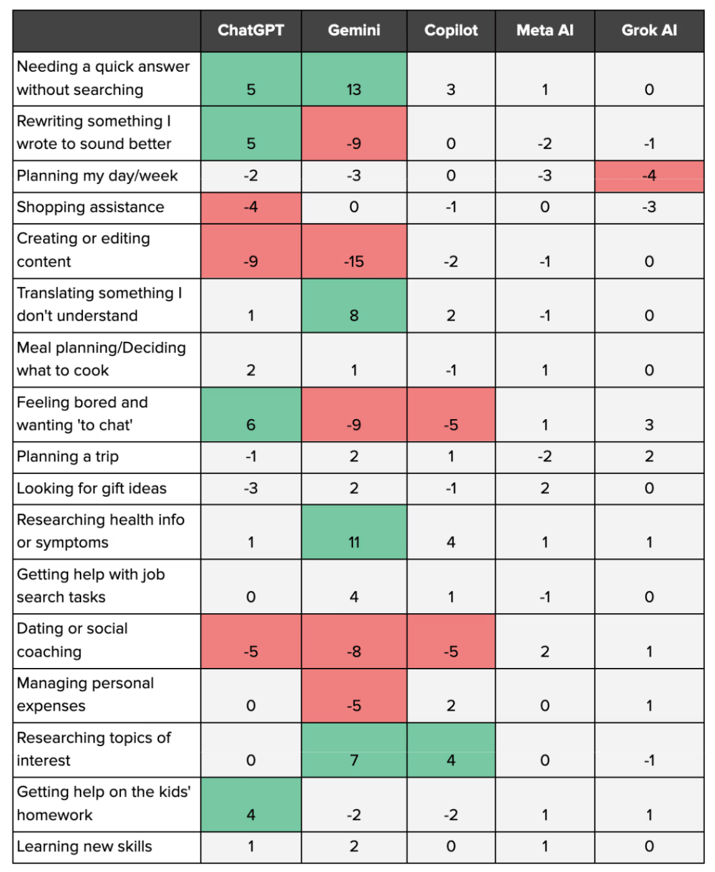
New mental advantages emerged on three of the four largest CEPs in the category — the most underweighted positive signal in the data. Mental advantage — a measure of whether the brand captures more or less than its fair share of associations on a given Category Entry Point given its size — moved from -0.4 to +3.8 on Health Info, from -0.2 to +2.9 on Quick Answer, and from +1.4 to +3.9 on Researching topics of interest. These are exactly the high-salience information CEPs where Gemini holds the broader category position. Copilot is the only major brand other than Gemini gaining mental advantage on them. If sustained, this is the foundation for a credible utility-AI position alongside Microsoft’s productivity heritage.
The productivity territory weakened sharply this wave — the most urgent strategic concern in the data. Day/week planning fell from +4 to 0; Job search from +3 to +1; Managing expenses held positive at +2.4 but eroded from +3.1. The lane Microsoft naturally has permission to own is currently contested, and the timing matters: Claude is gaining on these CEPs in the $100K+ and post-graduate segments, where the brand is positioning itself as the considered, work-oriented alternative. Without explicit positioning that anchors Copilot in productivity in the next two quarters, the lane will consolidate around a competitor that has positioned itself there more deliberately.
Three persistent disadvantages reveal where the brand is structurally absent. Copilot under-indexes on Boredom/chat (-5), Dating/social coaching (-5, deepened from -3), and Creating content (-2). The conversational and creative use cases are not territory the brand has ever credibly claimed, and the data suggests no progress toward doing so. ChatGPT, Canva, and the visual specialists own this CEP cluster decisively. These are not the priority — they are reminders of where competitive effort would not pay back.
Who Copilot Is Winning — and Losing
|
The Critical Window
The category has organized into clear lanes — and Copilot is being squeezed in the gaps between them. ChatGPT owns the conversational and personal-life lane. Gemini is consolidating the information-utility lane. Claude is building a credible third position in the premium-professional segment. Copilot’s previous productivity territory is now being claimed by Claude with explicit positioning, and the brand’s emerging information-utility advantages sit in territory Gemini is consolidating faster. Without a sharpened positioning that anchors a defensible lane, the brand risks becoming the AI users encounter without the AI they choose.
The next two quarters are decisive because consolidation is happening now. Switching inertia (“happy with the AI I currently use”) rose +4.3pp this wave — the only barrier moving meaningfully upward. Once category leaders convert active users into committed defaults, displacement becomes exponentially harder. Brands that establish a credible CEP position before the inertia barrier compounds will hold structural advantage. Brands that delay will face increasingly settled defaults in the segments they need to win.
The conversion gap, the productivity erosion, and the premium leakage are all symptoms of one underlying issue: the brand has no sharply differentiated positioning. Microsoft 365 distribution puts Copilot in front of users repeatedly, but consumers don’t know what Copilot is for in a way they can articulate. ChatGPT is for conversation. Gemini is for information. Claude is for serious work. Copilot is everywhere, but it is for what? Resolving this question is the prerequisite for solving every other issue in the brand’s data.
What to Do About It |
|
Reassert productivity leadership before the lane consolidates around Claude. Microsoft has structural advantages on this lane that competitors do not: the deepest work-context distribution, the broadest enterprise install base, and decades of consumer association with productivity software. Translating those advantages into explicit AI brand positioning — “AI for getting work done”, business-grade reliability, work-context proof points — would harden the lane against Claude’s emergence and Gemini’s information-utility expansion. Without this move in the next two quarters, the lane consolidates around competitors that have positioned themselves there deliberately. Close the conversion gap by surfacing CEP-specific moments inside Microsoft 365. The brand’s structural advantage — Microsoft 365 distribution — is currently underutilized. Generic Copilot prompts inside Office, Outlook, and Teams are generating exposure without converting it into chosen use. Surfacing the brand at moments aligned with the CEPs where Copilot is gaining mental advantage (Health Info, Quick Answer, Researching topics) and the ones it has natural permission to own (Day planning, Job search, Managing expenses) would convert distribution into habit at the moment of relevance, not after. Address the premium leakage with differentiated value, not additional reach. Post-graduate active use fell 15pp this wave. These users have access to ChatGPT, Gemini, and Claude alongside Copilot, and they are increasingly choosing alternatives. The retention play is not awareness or distribution; it is differentiated value at the professional-tier price point. What does Copilot deliver that the bundled or chosen alternatives do not? Resolving this question — and proving it credibly — is the prerequisite to reversing the premium-segment trajectory. Diagnose the EC drivers ahead of competitors to gain timing advantage. Most major AI brands lost EC this wave; Copilot’s drop is on the higher end but not anomalous. The brands that diagnose the underlying drivers and act on them first will hold the affective advantage when others are still experiencing the decline. Likely candidate hypotheses: in-context experience friction; mismatched expectations between Microsoft 365 surface prompts and standalone use; positioning that does not differentiate sharply enough from ChatGPT and Gemini in moments that build affection. |
About this research
Morning Consult conducts over 30,000 daily proprietary surveys in 45 countries covering more than 5,000 brands and 50 economic indicators.
Our category advantage research is aimed at understanding the needs driving consumers in your category — and how your brand can own more of them. This research is built on validated principles of brand-driven growth and powered by Morning Consult’s industry-leading sampling technology.
Measure the true drivers of brand strength
Capture both mental availability (the likelihood your brand comes to mind when consumers face a need or occasion) and emotional closeness (how strongly consumers connect with your brand), benchmarked against competitors.
Uncover Category Entry Points (CEPs)
Directly tied to mental availability, see the specific needs, occasions, and triggers that drive purchase decisions in your category, and how strongly your brand is linked to them.
Pinpoint growth opportunities
Direct investment toward the moments and consumer segments with the greatest potential to grow your brand.
Turn insights into action fast
Get survey results in 4–5 days through a centralized dashboard and short-form memo that equips stakeholders with clear direction on where and how to win.
Learn more
Olive Garden Is the Most-Loved and Most-Considered Brand in Dining
.png)
Fragmented, Shifting, Winnable: The U.S. Makeup Category
-1.png)