

We last looked at consumer AI back in January. This memo tracks how the category has shifted since then.
The bottom line up front
ChatGPT remains the U.S. consumer AI category’s mental-availability leader by every measure — 85% awareness, 67% mental penetration, and the broadest network of CEP associations. But the brand’s competitive position is sharpening on two fronts at once. ChatGPT’s mental fortress in conversational and personal-life occasions is consolidating (Kids’ homework jumped from +2 to +4, Rewriting strengthened to +5, Boredom held at +6), while its presence in the largest information-utility CEPs has weakened against Gemini. Gemini’s lead on Quick Answers widened from +10 to +13; on Translation from +5 to +8; on Health Info from +8 to +11. ChatGPT’s mental advantage on Researching topics — the second-largest CEP in the category — disappeared entirely, falling from +2 to zero. Emotional connection eroded faster for ChatGPT than for any other major brand. The brand is leading from a position that is structurally narrowing: defended in the personal lane, contested in the utility lane, and losing premium-segment share to Claude.
|
In this memo, we use the Category Advantage research framework to measure how consumers consider different types. A few terms you should know: |
|
Where ChatGPT Stands
|
ChatGPT leads the category on every core mental availability metric. Mental Market Share of 33% is the highest in the category. Mental penetration of 67% means two-thirds of AI users link the brand to at least one purchase trigger, ahead of Gemini (61%), Microsoft Copilot (33%), and Claude (15%). Network size of 9.0 — the average number of triggers linked to ChatGPT per person who recalls it — is the broadest in the category by a meaningful margin.
Emotional connection is ChatGPT’s warmest moat — and its fastest-eroding one. ChatGPT scores 3.65 on emotional connection (1–7 scale), the highest of any AI brand, but down from 4.06 four months ago. The decline is steeper than Gemini’s (-0.45) or Copilot’s (-0.48), and it is happening even as mental penetration holds. Users still think of ChatGPT first; they feel less warmly about it than they did. AI is becoming utilitarian for the brand’s audience, and the affection layer that justifies premium pricing and identity-driven loyalty is thinning.
The brand’s mental advantage profile is hardening into a clear shape. ChatGPT’s strongest mental advantages — a measure of whether the brand captures more or less than its fair share of a given CEP based on its size alone — sit in the personal and conversational lane. Boredom/chat (+6), Rewriting (+5), Quick answer (+5), and Kids’ homework (+4) are the CEPs where the brand over-indexes most, and three of those four strengthened this wave. By contrast, on Researching topics — the second-largest CEP in the category — ChatGPT’s mental advantage fell from +2 to zero, while Gemini’s strengthened to +7. ChatGPT remains the leader by mass, but its distinctive mental territory has narrowed in four months, not broadened.
|
The CEPs ChatGPT Owns — and the Ones It Doesn’t
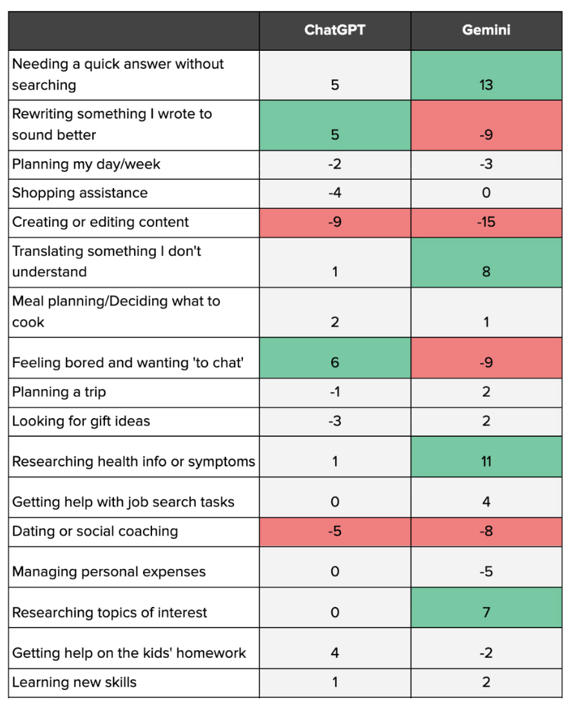
The conversational and personal-life fortress is reinforcing, not eroding. On Boredom and casual chat, ChatGPT captures 40% of associations vs Gemini’s 22% (Gemini’s mental disadvantage on this CEP deepened from -5 to -9 — Gemini is actively retreating from conversational territory). On Kids’ homework, ChatGPT’s mental advantage rose from +2 to +4. On Day planning, expense management, meal planning, and dating coaching, ChatGPT leads outright. This cluster represents the bulk of personal-and-family AI use and is the brand’s most defendable territory. The key dynamic this wave: this fortress is consolidating.
The information-utility lane is contested — and the gap with Gemini is widening. On Quick answers (48% salience), Researching topics (47%), Health info (31%), and Translation (28%), ChatGPT trails Gemini in raw association share, and the trajectory is sharpening. Gemini’s mental advantage on Quick Answer rose from +10 to +13; on Translation from +5 to +8; on Health Info from +8 to +11. ChatGPT’s mental advantage on Translation compressed from +3 to +1; on Researching topics it disappeared. The four largest CEPs in the category represent more than half of all AI moments and are increasingly Gemini’s structural territory.
Two persistent mental disadvantages remain unaddressed. On Creating or editing content (-9), ChatGPT is meaningfully under-indexed and the position has barely moved (-9 in Jan, -9 now). The category’s advantage there belongs to Canva (+28), Runway (+12), and Sora (+11) — visual-creative specialists. Despite ChatGPT’s image and video generation capabilities, consumers are not crediting the brand with them. On Shopping assistance (-4), Rufus (+23) has captured commerce-adjacent association almost entirely, and ChatGPT’s position weakened slightly. Both are sizable addressable CEPs where the brand has the technology but not the mental association.
Who ChatGPT Is Winning — and Losing
|
Parents are ChatGPT’s most loyal segment. Active use among parents is approximately 58%, essentially flat. Family-life CEPs — kids’ homework, meal planning — anchor parental loyalty more than any other use case in the dataset. This is the segment least at risk of leakage. 18–34 users remain disproportionately ChatGPT’s, but Gemini is catching up. Active use leads Gemini in this cohort by a wide margin, but Gemini gained +6pp on mental penetration here this wave. The generational moat is real but no longer growing. $100K+ is the segment already moving. Active use among premium-income users fell from 68% to 63% this wave (-6pp), while Claude rose from 8.5% to 17.1% (+9pp) and Gemini rose +4pp. Notably, Claude’s mental advantage on Job Search jumped from -2.9 to +1.7 — the largest single Claude move in the dataset, and consistent with the brand’s traction in white-collar segments. The premium audience is where subscription conversion happens, and ChatGPT has not lost it, but it is no longer the only premium choice. Older users are tilting toward Gemini. Among 65+ AI users, Gemini retains an advantage driven by Google-ecosystem familiarity, and ChatGPT’s mental penetration weakened in this group. The trajectory matters because the 65+ cohort is overrepresented in MCI’s optimistic-economic-sentiment audience and is structurally important for stable subscription revenue. |
What’s In the Way
Switching inertia now cuts both ways. “Happy with the AI I currently use” rose +4.3pp to 29% this wave — the largest barrier movement in the dataset. For the brand with the largest installed mental base, this is half-fortress and half-trap. It protects ChatGPT’s share against new entrants but limits the brand’s ability to win users who have settled on Gemini or Claude. The defensive value is real; so is the offensive limitation.
Premium pricing friction concentrates in the segment where ChatGPT’s share is leaking. “Too expensive” is cited by 27% of AI users overall but rises to 30% among $100K+ earners and 28% among 35–44 year olds. This is the same audience where Claude is gaining ground. Claude’s traction suggests the value-justification gap is widening — premium buyers are not seeing the upgrade case that ChatGPT’s price requires, and Claude is now the credible alternative for that decision.
Gemini’s information-lane consolidation accelerated this wave. On all four of the largest CEPs, Gemini’s mental advantage either strengthened or held; ChatGPT’s either eroded or disappeared. This is no longer a static gap — it is an actively widening one. Without a meaningful product or positioning intervention on research, quick answers, health, and translation, the gap will continue to compound.
What to Do About It |
|
Defending the personal-and-conversational fortress is the first priority. ChatGPT’s cleanest mental advantages — Boredom, Rewriting, Kids’ homework, Day planning — are also the use cases where the brand’s conversational personality differentiates from Gemini and Claude. This wave’s data shows the fortress is consolidating. Reinforce it: tone, voice, instruction-following quality, family-context understanding. These CEPs are not the largest in absolute terms, but they are uncontestable for the brand if investment in the experience continues.
Reclaiming research must be a near-term focus before Gemini’s consolidation hardens further. “Researching topics of interest” is the second-largest CEP in the category, and ChatGPT’s mental advantage there fell from +2 to zero this wave. Position the brand explicitly as the research and synthesis tool — citation features, source transparency, deep-research workflows, study modes. The technology is there; the consumer association is not. Without action, this CEP becomes Gemini’s by default within two waves.
Premium leakage to Claude needs proof, not features. $100K+ users are not leaving because Claude has more capabilities — they are arriving at Claude because it offers a different positioning (sophisticated, trustworthy, work-oriented). Compete on enterprise-grade trust signals, business-user proof points, and the seriousness frame. Claude’s gains in this segment are about identity, not specs.
The commerce CEPs are the lowest-cost expansion territory, and the window is narrowing. Shopping assistance and Gift ideas are CEPs where ChatGPT has the technology to compete and currently lacks mental association. Amazon’s Rufus has captured the commerce lane decisively (+23 mental advantage vs ChatGPT’s -4). Investment in shopping features, retailer partnerships, and explicit positioning of ChatGPT as a commerce-intelligence tool is available now and shrinking with each month Rufus tightens its association.
|
About this research
Morning Consult conducts over 30,000 daily proprietary surveys in 45 countries covering more than 5,000 brands and 50 economic indicators.
Our category advantage research is aimed at understanding the needs driving consumers in your category — and how your brand can own more of them. This research is built on validated principles of brand-driven growth and powered by Morning Consult’s industry-leading sampling technology.
Measure the true drivers of brand strength
Capture both mental availability (the likelihood your brand comes to mind when consumers face a need or occasion) and emotional closeness (how strongly consumers connect with your brand), benchmarked against competitors.
Uncover Category Entry Points (CEPs)
Directly tied to mental availability, see the specific needs, occasions, and triggers that drive purchase decisions in your category, and how strongly your brand is linked to them.
Pinpoint growth opportunities
Direct investment toward the moments and consumer segments with the greatest potential to grow your brand.
Turn insights into action fast
Get survey results in 4–5 days through a centralized dashboard and short-form memo that equips stakeholders with clear direction on where and how to win.
Learn more
PayPal: The Payment Category's Mental Shortcut
.png)
Adidas Over-Indexes on Team Sports, Running and Training
.png)