

The bottom line up front
The U.S. makeup category isn’t ruled by one brand — it’s ruled by two competing logics. Top-of-mind across the full population still belongs to legacy mass-market lines (Maybelline, CoverGirl, L’Oreal Paris) coasting on older buyers and the most prosaic trigger in the category — running out of product. But the buyer base is skewing rapidly younger, more digital, and more trend-driven, and in that audience e.l.f. has already overtaken every legacy brand on mental presence. Add a fragmented MMS distribution where no one tops 11%, and the urgent strategic question isn’t who leads — it’s who can consolidate before the demographic tilt reshapes the leaderboard.
In this briefing, we use the Category Advantage research framework. A few terms you should know:
- Mental Market Share (MMS) measures a brand’s "mental availability"—how often it comes to mind, compared to competitors, when consumers think of buying in a category
- Category Entry Points (CEPs) are the specific needs, motivations, situations, or feelings that trigger a consumer to consider a product category and the brands within it
- Network Size refers to the average number of distinct usage occasions or buying situations that consumers mentally associate with a brand
The Category Today
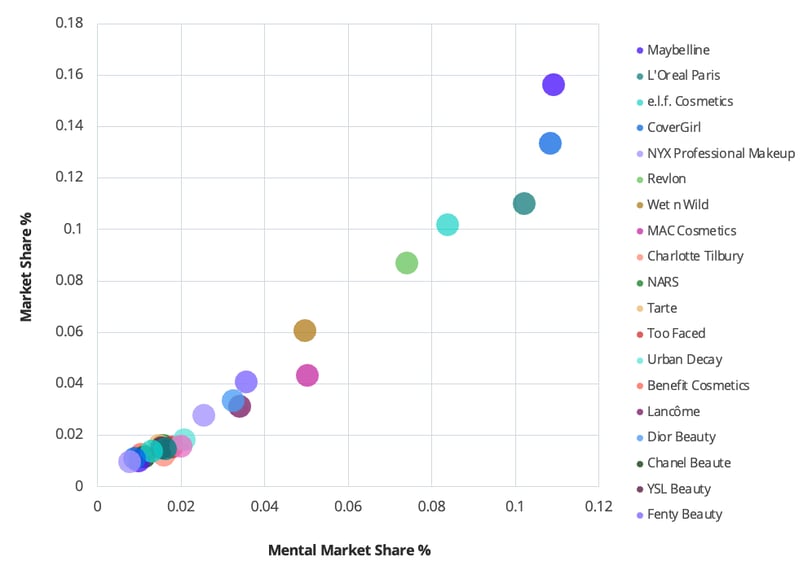
Mental availability is fragmented; nobody owns the category. Maybelline (~11%), CoverGirl (~11%), L’Oreal Paris (~10%), and e.l.f. (~8%) sit in a tight cluster at the top, with Revlon (~7%) close behind. In a 25-brand frame, no one has consolidated above the ~15% threshold that signals defensible dominance. This is a winnable category — the brand that builds the broadest CEP network fastest is positioned to consolidate.
Breadth, not awareness, separates leaders from challengers. Among consumers who know it, e.l.f. has the highest Mental Penetration in the category (82%) and the largest Network Size (7.2 CEPs) — meaning a higher share of the people aware of it associate it with more situations than any rival. Maybelline (78% / 7.2) and CoverGirl (78% / 7.2) match it on breadth but trail on freshness. Wet n Wild posts solid Mpen (73%) but a narrower 5.9-CEP network, weighted heavily toward affordability triggers.
Legacy leadership is propped up by an aging base. Among consumers 65+, Maybelline (19%), CoverGirl (18%), and Revlon (14%) command more than half of all mental availability. Among 18–34s, the picture inverts: e.l.f. leads at 10.2% MMS, L’Oreal sits at 10.1%, and Fenty Beauty (6.4%) and Rare Beauty (3.4%) climb into the top tier — Revlon slips out of the top five entirely (3.2%), and CoverGirl falls from co-leader at 65+ (~18%) to #3 in 18–34 (6.7%). Because the buyer base is a Millennial/Gen Z majority (+13pp vs gen pop), today’s top-line MMS rankings are increasingly trailing indicators.
Affordability is contested; “premium upgrade” is owned in fragments. Wet n Wild and e.l.f. are the only brands strongly tied to dupe-and-savings triggers — Wet n Wild leads on “more affordable options” at 47% and e.l.f. leads on “lower-cost alternative” at 41%. On the opposite end, Dior (38%), Chanel (37%), and Lancôme (37%) own the “upgrading to premium” trigger — but premium upgrade is only ~13% of all category triggers. The mass affordability lane is high-volume; the prestige lane is concentrated and defensible but smaller.
Makeup Audience Context
Economic sentiment. Beauty users are notably more optimistic about personal finances than the general population — 28% say they’re better off now (vs 21% gen pop), and 42% expect to be better off next year (vs 36%). But that confidence is softening, and “Wrong Track” sentiment has climbed steadily since January. The implication: this is a buyer who feels personally cushioned but increasingly economically wary — receptive to value framing but not desperate for discounts.
Media footprint and motivation. Beauty users are aggressively digital (over-index +16pp on TikTok, +20pp on Pinterest, +19pp on Snapchat) and aggressively trend-aware: 52% say they actively look for the latest trends (+17pp), 49% are early-tech adopters (+15pp), and 42% strive for high social status (+12pp). They are not bargain-hunters in disguise — 63% say they will pay a premium for ease of buying (+11pp). The activation lever is short-form social video paired with frictionless purchase, not price-led performance.
The Moments That Matter
Triggers in makeup are anchored in routine and replenishment far more than in aspiration. The top three carry roughly half of all category entry, and they reward broad mental presence, not standout creativity.
“Replacing a product I’ve run out of” (~33%) — the single largest entry point and pure replenishment territory. It rewards default-set brands. Maybelline (42%), e.l.f. (37%), and CoverGirl (36%) lead this trigger; brands not already in the routine don’t get pulled into the consideration set here.
“Getting ready for a special occasion” (~24%) — a higher-stakes, moderately aspirational moment, more contested. CoverGirl, Maybelline, and e.l.f. tie at the top, with prestige names (MAC, Charlotte Tilbury) gaining share among higher-income segments.
“Doing my everyday routine” (~23%) and “Looking for makeup that suits my skin / shade match” (~21% each) — daily-use and fit triggers, broadly contested across mass-market players.
Beneath these, two cluster types emerge clearly: an affordability cluster (~20% of all triggers, owned by Wet n Wild and e.l.f.) and an influencer/trend cluster (“influencer recommendations” at ~12% and “keeping up with trends” at ~11%, both owned by Fenty, Kylie Cosmetics, Huda Beauty, and Charlotte Tilbury). The affordability cluster is mass-volume and price-defended; the trend cluster is each-CEP-small but disproportionately important among 18–34 women, where it is the rising share.
How Segments Differ
The category structure flips by age more than by any other dimension.
Age. Among 18–34s, “keeping up with trends” rises +5.6pp and “influencer recommendations” rises +5.5pp; replenishment falls −8.4pp. Among 65+, replenishment surges to ~50% (+17pp) and trend-following collapses to ~2% (−9pp). These are effectively two different categories. Brands optimizing for both will outperform brands optimizing for either.
Income. $100K+ buyers are more interested in collection-building (+8pp) and premium upgrades (+7pp). The mass-market battleground (Maybelline / CoverGirl / e.l.f. / Wet n Wild) is concentrated at <$50K and middle-income. Wet n Wild’s MMS drops from 6% under-$50K to 2% at $100K+ — the brand has effectively no presence in the prestige tier.
Gender. Men are mostly absent from the buyer base (−7pp) and from the top triggers — replenishment salience drops −19pp among men. The sub-segment of men who do buy is small and likely best activated through the “buying for someone else” gift trigger rather than core occasions.
What's Blocking Conversion
Friction in this category has two distinct shapes — and the dominant one shifts by age.
Price friction is the headline barrier (40.5%) — but it is concentrated at the older end. Buyers 65+ cite price as a barrier at 56% (+15pp); 18–34s cite it at just 27% (−13pp). Translation: legacy mass-market brands aren’t being out-priced in the demographic they actually depend on (older, value-conscious replenishers); they’re losing on freshness among younger buyers who are far less price-sensitive than the headline number suggests.
Inability to test or shade-match is the second-tier barrier (22% / 17%) — and it is the silent killer at the prestige end. Among $100K+ buyers, “the brand doesn’t offer a shade that matches my skin tone” rises +5pp. Premium and prestige brands have an inclusivity gap that Fenty Beauty has already partially capitalized on (77% Mpen overall, climbing to 88% among 18–34s) and that other prestige players have not.
Stockouts of specific products or shades (22%) are a top-tier barrier, and online-availability friction sits just behind. This audience expects beauty to be social-purchasable and instantly fulfillable. Brands without strong DTC and social-commerce infrastructure are leaking conversion to those that do.
Why This Matters Now
Win the under-35 audience now or lose the next decade of MMS. The buyer base is skewing rapidly Millennial and Gen Z. The brands leading on top-of-mind today (Maybelline, CoverGirl, Revlon) are doing so disproportionately on a 65+ base whose share of category buying is contracting. Mental availability has to be rebuilt in the audience that will define the category — and rebuilt in the channels they actually live in (TikTok, Pinterest, Snapchat).
Don’t compete on price in a category that’s optimizing for ease. Beauty buyers will pay a premium for frictionless purchase (63%, +11pp). The performance dollar that goes to discount-led acquisition is underperforming the dollar that goes to social-commerce, creator-led, easy-to-buy execution. Wet n Wild and e.l.f. are both winning the affordability trigger — but e.l.f. is doing it through breadth, not just price, which is why its Network Size is 1.3 CEPs higher than Wet n Wild’s despite a similar value position.
Breadth beats depth, and freshness beats heritage. The brands consolidating mental availability are showing up across many triggers and refreshing the trigger set itself — pulling “trend,” “influencer,” and “discovery” into the same mental file as “replacement” and “everyday routine.” Heritage brands that lean only on replenishment are aging with their base.
Diagnose before spending. In segments where Mpen already exceeds purchase share, more reach is wasted spend. Premium brands with strong $100K+ Mpen but limited shade range should fix the inclusivity gap before scaling reach. Mass brands with high Mpen on older audiences but weak under-35 presence should redirect toward social-first creative rather than buying more linear awareness.
About this research
Morning Consult conducts over 30,000 daily proprietary surveys in 45 countries covering more than 5,000 brands and 50 economic indicators.
Our category advantage research is aimed at understanding the needs driving consumers in your category — and how your brand can own more of them. This research is built on validated principles of brand-driven growth and powered by Morning Consult’s industry-leading sampling technology.
Measure the true drivers of brand strength
Capture both mental availability (the likelihood your brand comes to mind when consumers face a need or occasion) and emotional closeness (how strongly consumers connect with your brand), benchmarked against competitors.
Uncover Category Entry Points (CEPs)
Directly tied to mental availability, see the specific needs, occasions, and triggers that drive purchase decisions in your category, and how strongly your brand is linked to them.
Pinpoint growth opportunities
Direct investment toward the moments and consumer segments with the greatest potential to grow your brand.
Turn insights into action fast
Get survey results in 4–5 days through a centralized dashboard and short-form memo that equips stakeholders with clear direction on where and how to win.
Learn more
.png)
Haircare Is Two Markets: Routine and Repair
What $100K+ Households Reveal About the Real Coffee & Breakfast Leaders
.png)