The bottom line up front
Haircare is two markets pretending to be one. Mass brands — Dove, Head & Shoulders, Suave, Pantene — win the autopilot moments: what’s running low, what just ran out, what fits the regular routine. Together they account for roughly 46% of the category’s mental real estate, and they own it on breadth, not love. The growth frontier sits in the one moment they don’t own: hair that has broken, frayed, or been chemically beaten up. That’s where Olaplex, K18, Moroccanoil, and the prestige tier are quietly winning the argument — but most of them are invisible. The strategic question for the category isn’t “what should we say?” — it’s “who will solve their awareness problem before someone else solves it for them?”
In this briefing, we use the Category Advantage research framework. A few terms you should know:
- Mental Market Share (MMS) measures a brand’s "mental availability"—how often it comes to mind, compared to competitors, when consumers think of buying in a category
- Category Entry Points (CEPs) are the specific needs, motivations, situations, or feelings that trigger a consumer to consider a product category and the brands within it
- Network Size refers to the average number of distinct usage occasions or buying situations that consumers mentally associate with a brand
The Category Today
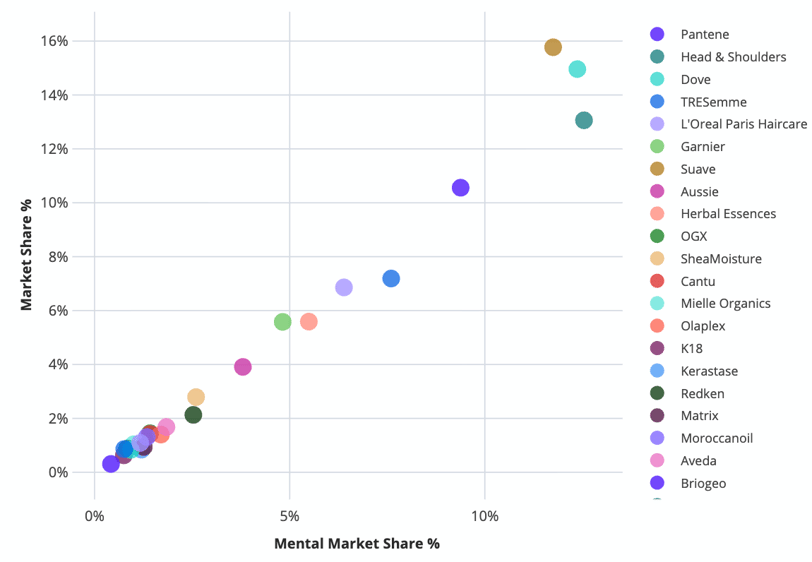
No brand has locked in dominance, and none are even close. Head & Shoulders and Dove tie at the top with ~12% Mental Market Share — neither commanding double-digit territory in the way category leaders do in adjacent personal-care spaces. Suave (~12%) and Pantene (~9%) round out the four brands consumers think of without being prompted. Together that top four covers roughly 46% of share-of-mind. The remaining 54% is distributed across 21 brands, none above 8%. This is a category where “consideration” is a long, shallow list — and where a single sticky brand in a specific moment can punch well above its weight.
Mass brands win on breadth; the prestige tier wins on intensity. Among consumers who have heard of K18 (only ~7% of adults), 82% link it to a specific haircare moment — the highest Mental Penetration in the category alongside Head & Shoulders. Olaplex (~70%), Briogeo (~70%), and Kerastase (~60%) post similar numbers on similarly narrow aware bases. These brands are not failing on relevance. They are failing on reach. When a consumer encounters them, the brand sticks. The question is whether enough consumers ever encounter them.
Aveda is the cautionary tale of the category. Aveda has ~26% awareness — meaningful and salon-built — but it is tied with Redken at the bottom of the category for emotional connection (2.3 on a 7-point scale), has the smallest network of CEP associations (4.6 vs. category average 5.8), and just 1.8% Mental Market Share. Consumers know Aveda exists. They cannot articulate what it is for. This is an unusual and structurally fragile position: high recognition, low meaning.
Where consumers want repair, prestige brands actually compete. “Repairing damaged or dry hair” is the single most important non-routine moment in the category (~23% salience) — and it is where the rankings reshuffle. Moroccanoil, Olaplex, Mielle Organics, SheaMoisture, and K18 all rank in the top five for damage-repair association, ahead of every mass brand except Pantene. This is the category’s only competitive moment in which prestige brands are not just present — they are leading. It is also the only growth lever where premium pricing can be defended on functional grounds.
Haircare Audience Context
Economic confidence is real. Beauty buyers are more optimistic than the general public on personal finances — ~42% expect their finances to improve over the next year vs. ~36% of all adults — and substantially more confident about business conditions (33% expect good times in the next 12 months, vs. 29% of all adults). That confidence is a tailwind for premium pricing. Two-thirds of beauty buyers also say they’ll pay more for sustainable products (+9pp vs. gen pop) — a meaningful positioning territory that no haircare brand in the consumer’s mind currently owns.
Media footprint is mobile-first, social-saturated, and over-indexed on aspirational platforms. Beauty buyers over-index by 16–20 points on Pinterest, Snapchat, TikTok, and Spotify; ~74% use TikTok vs. 58% of all adults. They are also unusually heavy sports media consumers, especially on women’s sports (NCAA Women’s Basketball +14pp). They buy through social media at sharply higher rates and are willing to pay a premium for any service that makes the buying process easier or faster (+11pp). This is a high-attention, high-trial, high-spend audience reachable across both precision and mass channels.
The Moments That Matter
Haircare is dominated by two routine moments. “Doing my regular haircare routine” (~39%) and “Replacing a product I’ve run out of” (~37%) together account for roughly three-quarters of category recall. These reward brands that are familiar, available, and unobjectionable — which is exactly what mass leaders are. There is no path to mental advantage here for premium brands, and trying to compete in this moment is the most common strategic error in the category.
The growth moment is “Repairing damaged or dry hair” (~23%) — concentrated among women (~30%), 18- to 34-year-olds (~28%), and parents (~29%). It is the highest-margin moment in the category because consumers will pay a premium when the problem is acute. It is also the only moment where the prestige tier is already winning the association game.
Secondary triggers cluster around identity and trial: ~18% of consumers cite “trying a new haircare product” — which over-indexes sharply at incomes above $100K (+9pp) and post-grad education (+5pp). Specialty triggers (curly/textured hair ~13%, color-treatment prep ~10%) are smaller but underserved, with brand assortment cited as a barrier by ~11% of consumers — and substantially more among Black and Hispanic consumers buying for textured hair.
How Segments Differ
Women drive the growth moments; men drive the routine. “Repairing damage” jumps from 23% to ~30% among women, and “managing frizz” rises from 9% among men to 25% among women — nearly tripling. Men’s salience concentrates in routine and replacement. Women own the brand-switching decision in this category, and the brand-switching decision is what changes the share map.
Younger consumers are the prestige beachhead. Olaplex awareness reaches ~19% among 18- to 34-year-olds vs. ~6% among 65+. K18 nearly doubles from ~7% overall to ~12% among the youngest cohort. These are the consumers who have already absorbed the prestige category’s vocabulary — the ones who say “bond builder” without scare quotes. They will set the trajectory.
Income is where premium runway lives. Among $100K+ households, awareness for Olaplex (~22%), Kerastase (~24%), and Briogeo (~10%) sits roughly two to five times higher than at sub-$50K. This segment also over-indexes on “trying a new product” (+9pp) and “discovering or browsing” (+6pp) — the two CEPs prestige brands need to win.
What's Blocking Conversion
Price friction is the top barrier overall (~30% cite price relative to alternatives as a reason they didn’t buy a specific product). It does not concentrate in low-income brackets — if anything it indexes slightly higher among $100K+ households (~35%) and 45+ consumers (~34%), suggesting it reflects value-for-money judgment as much as affordability. For prestige brands, the lever isn’t discounting — it’s smaller-format trial sizes and bundled regimens that lower the entry price into the brand.
Distribution friction is the most overlooked barrier. ~18% can’t find products at their usual store and ~17% report items out of stock. For brands like Olaplex and K18 — which depend on professional or specialty channels — physical availability is a more urgent problem than messaging.
Assortment friction is real. ~14% of consumers cite “not available for my specific hair concern,” and ~11% specifically cite difficulty finding products for textured or curly hair. Cantu and Mielle Organics are winning here precisely because they fill that gap — and they hold the #1 and #2 association positions for caring for curly, coily, or textured hair. Mass brands attempting to compete on textured hair without credible assortment will not close that ranking.
Brand-recognition friction is the prestige tier’s structural ceiling. Olaplex, K18, Briogeo, Kerastase, and Moroccanoil all win when seen — and lose because they aren’t. This is a paid media problem, not a creative problem.
Why This Matters Now
Diagnose before spending. Mass brands have a recall surplus and a conversion gap; prestige brands have a relevance surplus and a recall gap. They need different budgets, not louder versions of the same one.
Own the damage-repair moment or cede it. Damage-repair is the only moment where premium pricing is functionally defensible and where the rankings are still in motion. Olaplex has a head start; K18 has the strongest Mental Penetration in the category. Mass brands either find a credible repair platform (Pantene’s #6 ranking is the strongest mass position) or watch this moment leave them.
Sustainability is unowned territory. Two-thirds of beauty buyers say they’ll pay more for sustainable products (+9pp vs. gen pop), but no haircare brand currently anchors that meaning in the consumer’s head. The brands that claim it credibly — with proof points, not vibes — will inherit a mature, defensible territory.
Breadth beats depth, but only for the brands big enough to afford it. Mass leaders need to keep showing up everywhere. Prestige brands need to pick the one moment they can win and stop trying to be regimen brands. The middle — Aveda, Redken, Matrix, Nutrafol — is where the gap between awareness and meaning is widest in the data. They are not too small to be remembered. They are too unfocused to be remembered for anything.
About this research
Morning Consult conducts over 30,000 daily proprietary surveys in 45 countries covering more than 5,000 brands and 50 economic indicators.
Our category advantage research is aimed at understanding the needs driving consumers in your category — and how your brand can own more of them. This research is built on validated principles of brand-driven growth and powered by Morning Consult’s industry-leading sampling technology.
Measure the true drivers of brand strength
Capture both mental availability (the likelihood your brand comes to mind when consumers face a need or occasion) and emotional closeness (how strongly consumers connect with your brand), benchmarked against competitors.
Uncover Category Entry Points (CEPs)
Directly tied to mental availability, see the specific needs, occasions, and triggers that drive purchase decisions in your category, and how strongly your brand is linked to them.
Pinpoint growth opportunities
Direct investment toward the moments and consumer segments with the greatest potential to grow your brand.
Turn insights into action fast
Get survey results in 4–5 days through a centralized dashboard and short-form memo that equips stakeholders with clear direction on where and how to win.
Learn more
.png)
U.S. Auto Market Trends: What's Driving Purchase Decisions
.png)
Why Toyota Leads the U.S. Automobile Category