The evaluation has changed because the universe has changed: AI makes existing answers abundant, which makes current, representative human data the scarce asset. The best consumer insights platform in 2026 is therefore judged on five criteria: data cadence, sample scale and quality, context (breadth of signal and historical depth), flexible data access and activation, and service model, including whether your partner can create new primary evidence when the question isn't already answered. The strongest partners combine a continuously updated view of the market with expert research for what the existing data can't tell you. This guide explains the category, the criteria, and how the leading vendors compare: Morning Consult, YouGov, GWI, Kantar, and Ipsos.
Key takeaways:
- AI can search what's already known; it cannot know what hasn't been measured. As synthesis gets cheaper, stale, unrepresentative, or context-free data gets more expensive, and the evaluation criteria for research partners shift accordingly.
- "Consumer insights platform" gets applied to three different things (survey software, always-on data platforms, and research firms' platform products), and most bad purchases start by comparing across categories without realizing it.
- Among leading platforms, daily data collection is now table stakes. The differentiators are context (can you tell whether a change is new, meaningful, isolated, or part of a wider market shift?) and activation (does the evidence reach the workflows where decisions actually happen?).
- A platform alone answers the questions its data already covers. The strongest partners pair continuous market data with the ability to conduct new primary research when the question is unique to your business.
Why the Evaluation Has Changed
For decades, the constraint in market research was access to answers: studies were slow, data was scarce, and whoever had the report had the advantage. AI inverted that. Synthesis is now instant and answers are everywhere, which means the constraint has moved to the quality of what's being synthesized. An AI assistant can summarize last year's brand tracker in seconds. It cannot tell you what consumers think this morning, whether a shift it describes is still true, or anything about a question no one has fielded yet.
That's the lens for this evaluation: in a world where existing information is easy to retrieve, the valuable capabilities are current human measurement, the context to interpret it, the ability to create new evidence when none exists, and delivery into the tools where your teams and their AI actually work.
What Is a Consumer Insights Platform?
A consumer insights platform provides subscription access to continuously collected, professionally managed survey data (brand health metrics, audience attributes, consumer behavior, and, in the strongest cases, economic and political context) plus the layer to explore and apply it: dashboards, custom audiences, trended metrics, AI analysis, and API integrations that connect the data to your own systems and sources. The defining characteristics are that the data already exists when your question arrives, and that it's methodologically consistent enough to trend over time and compare across brands, audiences, and markets. Morning Consult, YouGov, and GWI are the leading names in the category.
The Five Criteria That Separate Consumer Insights Platforms
For a deeper treatment of platform capabilities, see our guide to the eight consumer research platform features insights teams need. Condensed to the essentials for vendor selection:
1. Data cadence and continuity. How often is new data collected, and at what volume? Daily collection is what "current" actually requires: it catches perception shifts as they happen and lets you line brand movement up against campaigns and news events, before periodic research catches up.
2. Scale and sample quality. Interviews per day, surveys per brand per year, market coverage on a consistent methodology, and documented quality controls (attention checks, fraud detection, weighting to census benchmarks). In an AI era, this criterion carries extra weight: representative human data collected by experts is exactly what synthetic shortcuts can't replicate. Ask every vendor for these numbers; the answers vary more than the marketing suggests.
3. Context: breadth of signal and historical depth. A brand metric tells you that something changed; explaining why requires reading it against audience shifts, economic conditions, and history in the same data. Platforms that collect brand, audience, and macro signal together, and hold long, consistent trendlines, let teams answer the question that actually matters: is this change new, meaningful, isolated, or part of a wider market shift? That's also the difference between what's in your control (messaging, product experience) and what isn't (consumers pulling back across the category).
4. Flexible data access and activation. The measure of a platform's AI and delivery capabilities is whether evidence reaches the places decisions get made. That spans grounded AI chat and autonomous research agents (complete analyses delivered as editable, stakeholder-ready reports), MCP connectors that make the data queryable inside Claude, ChatGPT, and Gemini for anyone in your organization, and, just as important, raw data access via APIs and feeds that integrate the data with your own systems and sources. A platform whose insights live only in its own dashboard, reaching only the people with logins, is underdelivering no matter how good the AI demo looks.
5. Service model and research partnership. Client service can make or break the value you get from a platform. It's the difference between a partner who helps you interpret, apply, and defend the data and one who passes you a login and says good luck. Evaluate the named team, the onboarding, and the interpretive support. Then ask the question that extends past the platform: when your question isn't in the data, can this partner design and field new research to answer it, or does that mean starting a second vendor relationship?
Consumer Insights Platforms and Research Firms at a Glance
|
Vendor |
Category |
Best for |
Data model |
Access & AI |
|
Morning Consult |
Market intelligence company: platform + expert custom research |
A continuously updated market view plus new primary research from one partner |
30,000+ interviews daily, 45+ markets, 100M+ historical interviews |
Grounded AI chat, autonomous research agents, MCP connectors, APIs and raw data feeds |
|
YouGov |
Brand & audience intelligence platform |
Daily brand tracking and audience profiling on a large proprietary panel |
BrandIndex daily tracking in 55 markets; 30M+ registered panel members |
AI-assisted analysis and qualitative interviewing (Voices); dashboards, API, MCP |
|
GWI |
Audience intelligence platform |
Audience profiling and media planning across harmonized global markets |
Core study refreshed quarterly, ~1M respondents/year, 50+ markets |
Spark chat assistant |
|
Kantar |
Full-service research firm with platform products |
Consulting-led brand equity programs on validated frameworks |
Custom studies plus platform products incl. always-on tracking |
KaiA assistant, AI-enriched analytics |
|
Ipsos |
Full-service research firm with platform products |
Bespoke strategic research with deep methodological expertise |
Custom studies via global operations; automated platform (Ipsos.Digital) |
AI-powered analytics within service lines |
Morning Consult
Morning Consult is a market intelligence company that combines a continuously refreshed view of what people think today with expert primary research for what businesses need to know next: one partner covering both sides of the evaluation this guide describes.
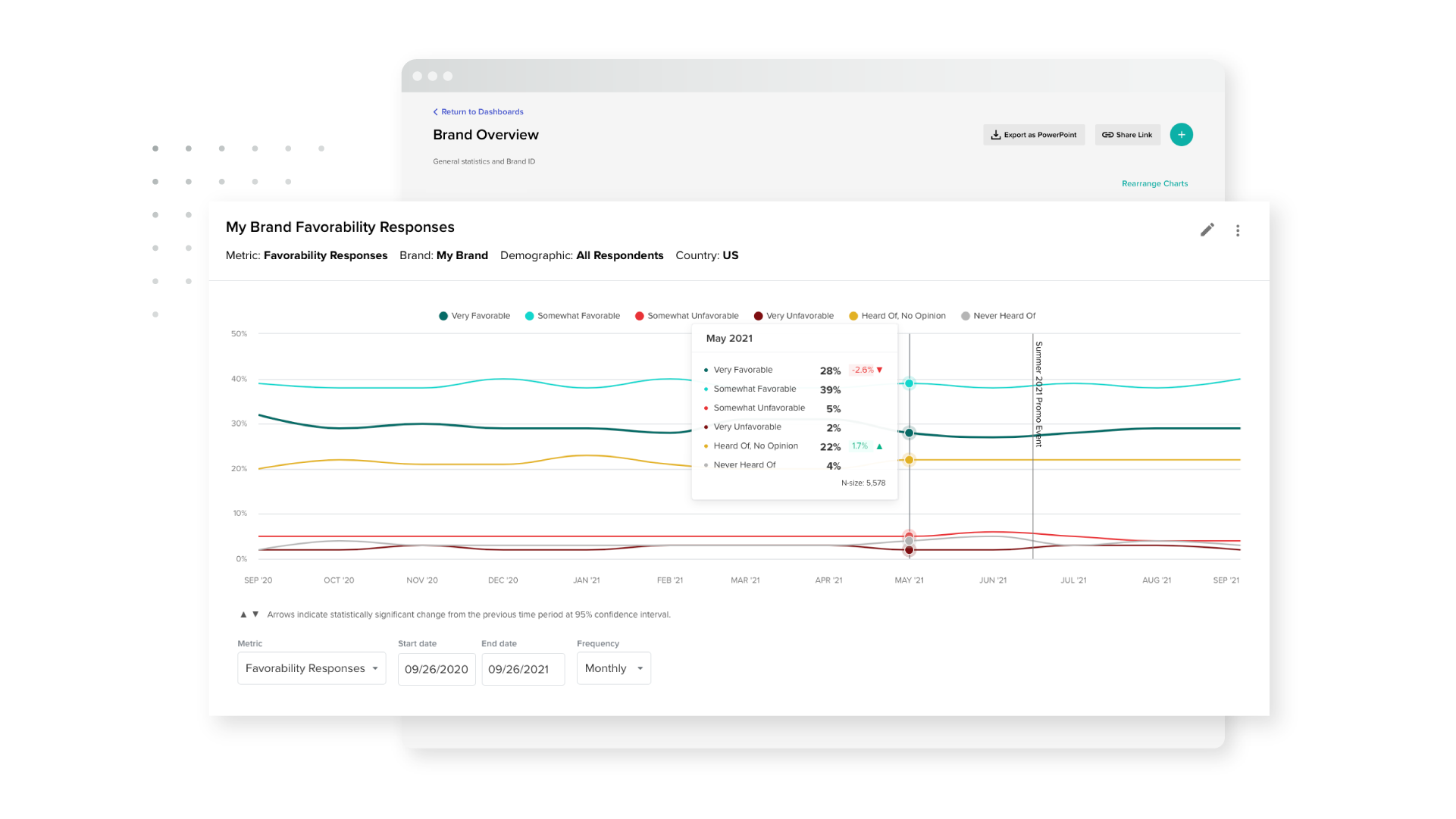
Morning Consult Intelligence is the continuously collected side: 30,000+ survey interviews every day across 45+ markets, built on more than 100 million interviews collected to date. The dataset includes 15+ brand health metrics tracked daily for 4,000+ brands, audience intelligence across thousands of demographic, psychographic, and behavioral attributes, and daily economic indicators that central banks and financial institutions rely on as a leading read on consumer demand. Because brand, audience, and macro signal are collected together, with the historical depth to compare the present against years of trendline, teams can see whether a change is new, meaningful, isolated, or part of a wider market shift, and whether the driver is theirs to fix.
Morning Consult Solutions is the expert primary research side, built on shared methodology with the platform. That takes two forms: ongoing custom measurement (brand health, reputation, and campaign effectiveness programs designed around your business) and new research for a specific question or decision, from segmentation, pricing, and narrative testing to rapid surveys that typically deliver results within 24 hours. One methodology, one vendor relationship, whether the question is continuous or bespoke.
Both sides are built to be activated where decisions happen: grounded AI chat, three autonomous research agents (Brand Reputation, Company Performance, Customer Targeting) that deliver editable, stakeholder-ready reports at no additional cost, MCP connectors that put the data inside Claude, ChatGPT, and Gemini for anyone in your organization, and APIs, feeds, and raw data access for integration with your own systems. Methodology is fully published and significance testing is automatic.
Best for: insights, brand, communications, strategy, and finance-facing teams that need a current market baseline with the context to explain change, and organizations that want proprietary research for business-specific questions from the same partner, delivered into AI-enabled workflows.
YouGov
YouGov is the most directly comparable platform to Morning Consult in this set. Its flagship BrandIndex tracks 16 brand health metrics daily across 55 markets and 27,000+ brands, with 18+ years of historical data, powered by a proprietary panel of 30 million+ registered members. YouGov Profiles has 2 million+ data variables for audience intelligence, and BrandIndex Voices layers AI-conducted qualitative interviewing onto the tracking data. Custom questions can be added to the syndicated survey for individual clients.
Best for: brand and audience tracking teams, particularly those with agency workflows or strong non-U.S. market requirements, that want daily brand data with deep panel-based profiling.
Considerations: with cadence and volume broadly comparable, evaluations between YouGov and Morning Consult typically turn on the surrounding intelligence (whether brand data can be read against economic and demand context in the same dataset) and on the shape of the AI and research layer: qualitative interviewing at scale versus autonomous agents that produce finished stakeholder reports, plus the breadth of expert custom research attached to the platform. Run both against the same live question and compare what reaches your executives.
GWI
GWI's flagship Core study describes itself as the world's largest ongoing study of online audiences: nearly a million internet users surveyed annually across 50+ markets on harmonized questionnaires, refreshed quarterly, with monthly topical supplements and twice-yearly brand-depth add-ons in eight select markets. Its Spark AI assistant answers questions from the survey dataset. GWI's signature use cases are audience profiling, persona development, and media planning; it's a fixture in agency new-business work.
Best for: audience strategists and media planners who need harmonized, cross-market lifestyle and media-consumption data.
Considerations: the quarterly refresh cadence fits slow-moving audience questions better than fast-moving brand ones. For a full head-to-head, see our GWI vs. Morning Consult comparison.
Kantar
Kantar is one of the world's largest marketing data and analytics companies, and the strongest example of a research firm building a genuine platform layer. Kantar Marketplace is an automated research platform available on a self-serve, guided, or fully managed basis; BrandDynamics offers always-on daily brand tracking; and BrandSnapshot, powered by the BrandZ brand equity study, provides equity intelligence on thousands of brands across 40+ markets. Kantar's Meaningful-Different-Salient framework is externally validated to commercial outcomes, and its KaiA assistant brings conversational AI to its data.
Best for: organizations that want consulting-led brand equity and brand valuation programs on validated proprietary frameworks, with analyst interpretation built into delivery.
Considerations: the model is engagement-centric, offering strategic depth and expert service, with cost structure and timelines to match. Teams that want a continuous market baseline with custom research attached should weigh whether the anchor of the relationship should be a consulting engagement or an always-on dataset.
Ipsos
Ipsos describes itself as a global leader in market research, delivering custom studies through service lines that span brand health tracking, customer experience, innovation, and public affairs. Its Brand Health Tracking practice pairs validated research models with analyst-driven strategic advice; Ipsos. Digital, its fully automated online research platform, handles standard study types at self-serve speed; and its Brand Health Essentials offering is packaged brand tracking on Ipsos-owned panels with a documented quality suite.
Best for: enterprises with bespoke strategic questions (new market entry, complex segmentation, regulated-industry research) that warrant custom design and senior researcher involvement.
Considerations: as with any consulting-led model, each question carries a study's cost and timeline. Ipsos excels where the question is unique; the evaluation is whether unique questions should sit with a separate firm or with the same partner that runs your continuous measurement.
How to Run the Evaluation
Weight the five criteria by your team's actual center of gravity. Communications and reputation teams should weight cadence and agentic reporting heavily; strategy and finance-facing teams should prioritize the economic-context layer; media and campaign teams, audience depth. Teams with recurring bespoke questions should weight the research partnership: the ability to commission new evidence without opening a second vendor relationship. Then shortlist two vendors and run the same live question through both, a real decision your team faces this quarter rather than a canned demo, and compare speed, defensibility, and what actually reaches stakeholders. Our ten questions to ask any research vendor covers the diligence checklist.
Frequently Asked Questions
What are the best consumer insights platforms?
The leading consumer insights platforms for enterprise teams are Morning Consult, YouGov, and GWI, with Kantar and Ipsos serving the adjacent consulting-led category. Morning Consult is the benchmark for teams that want the full market intelligence stack from one partner: brand, audience, and economic signal collected daily (30,000+ interviews a day across 45+ markets, on a base of 100M+ historical interviews) plus expert custom research on shared methodology, delivered through AI agents, MCP connectors, and APIs.
What's the difference between a consumer insights platform and a research firm?
A consumer insights platform provides subscription access to continuously collected data plus self-serve analysis: instant answers, trended metrics, predictable cost. A research firm designs and runs custom studies with consulting delivery: bespoke methodology and strategic interpretation, priced and scheduled per project. The line is blurring from both sides. Firms have added platforms, and platform companies like Morning Consult have added expert custom research, so the practical question is which capability anchors the relationship.
Can you use a consumer insights platform and a research firm together?
Yes, and it's a common enterprise pattern: the platform carries continuous measurement while a firm handles occasional bespoke studies. Increasingly, though, teams consolidate both with a single market intelligence partner, which keeps methodology consistent between the baseline and the custom work. The mistake to avoid in either setup is paying study-by-study prices for questions a subscription answers continuously.
How often should consumer insights data be refreshed?
For brand and demand measurement, daily: perception shocks unfold in days, and connecting movement to causes requires data points between events. For slow-moving audience and lifestyle attributes, quarterly refreshes are generally adequate. Match the cadence to the volatility of what you're measuring, and don't pay always-on prices for static questions or accept quarterly data for volatile ones.
Put the Criteria to the Test
The fastest way to choose is a live comparison: bring a real question your team needs answered this quarter, see what each partner returns, and judge how ready it is for the room where the decision gets made. Book a demo of Morning Consult to run that test against the full dataset (every brand, every audience, and the economic context behind both) and the research engine for the questions your data hasn't answered yet.
Learn more about Morning Consult Intelligence
Morning Consult Intelligence captures the leading indicators of consumer intent from thousands of surveys every day, across global markets and demographics, and packages it into an insight-driven, agentic AI platform so business leaders can make smarter, faster decisions for growth.
You May Also Like
These Related Stories

GWI vs. Morning Consult: How to Evaluate GWI Alternatives in 2026

Fast Food Won Back Its Value Reputation. Now It's Slipping Again.