8 Consumer Research Platform Features Insights Teams Need
The consumer research platforms that serve insights teams best in 2026 share eight capabilities: always-on daily data collection, a deep audience builder with sample-size feedback, full-funnel metrics from a single methodology, self-serve dashboards with built-in statistical testing, AI chat grounded in real survey data, agentic reporting, MCP connectors for AI assistants, and transparent, enterprise-ready operations. Whether you're renewing an existing contract or evaluating alternatives to your current platform, these are the features that separate tools built for occasional lookups from platforms an insights team can run its function on.
Key takeaways:
- Data recency is the first filter: platforms built on continuous daily collection can answer "what changed this week" — platforms built on periodic waves can't.
- The most underrated feature in the category is sample-size transparency: a platform should tell you, before you run an analysis, whether your audience cut is statistically reliable at daily, weekly, or monthly granularity.
- AI capabilities now split into three distinct features — natural-language chat, autonomous research agents, and MCP connectors — and evaluating them as one "AI checkbox" misses real differences.
- Every AI feature is only as good as the survey data underneath it. Ask whether AI outputs are grounded in real respondent data and whether the platform can show its sources.
1. Always-on daily data collection
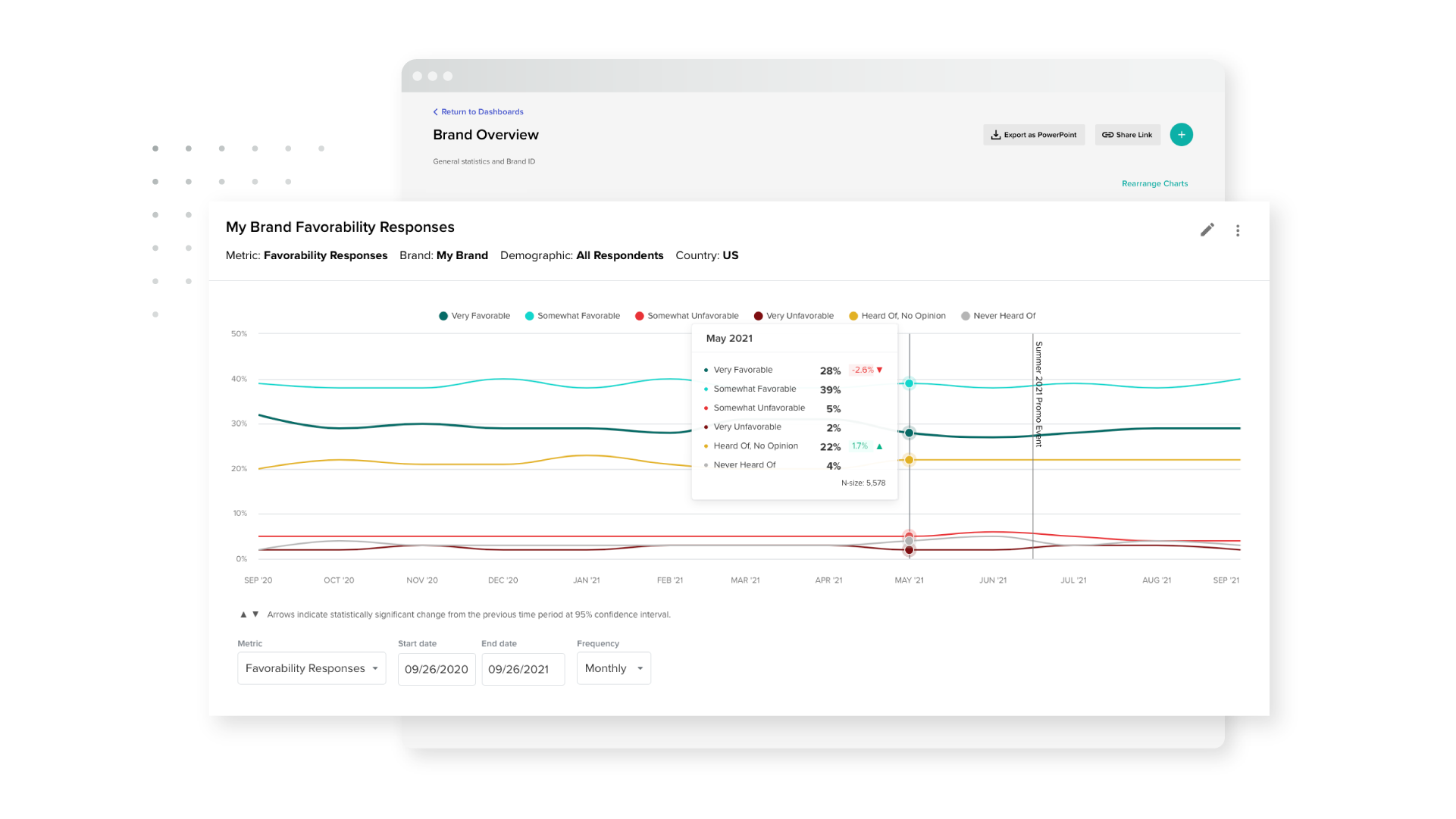
The foundational question for any consumer research platform: how often is the data refreshed, and at what scale? Platforms built on continuous fieldwork can catch a brand perception shift, a demand slowdown, or an emerging behavior the week it happens. Platforms built on monthly or quarterly recontact waves report it after the decision window has closed.
Scale matters as much as frequency, because daily readings are only reliable with daily sample to support them. As a benchmark, Morning Consult Intelligence is powered by 30,000+ survey interviews collected every day across 45+ markets — more than 100 million interviews to date — which is what makes brand-level daily trendlines statistically viable rather than decorative.
2. A deep audience builder with real-time feasibility feedback
Insights teams live and die by segmentation. Look for two things. First, breadth: the platform should let you build audiences from thousands of attributes — demographics, psychographics, behaviors, media habits, economic circumstances, even brand relationships ("people favorable to X who don't use it"). Second, and more overlooked: feasibility feedback. A strong platform shows you the sample size and margin of error for your custom audience at daily, weekly, monthly, and quarterly granularity before you build charts on it, so you never present a trendline built on 49 respondents.
Modern platforms are also adding AI to this workflow: describe an audience in plain language ("millennial business decision-makers in the U.S. making over $100K") and the system translates it into the right survey questions and properties in seconds.
3. Full-funnel metrics from a single methodology
A consumer research platform should connect who consumers are, what they think of brands, and how they behave — without stitching together datasets with incompatible methodologies. That means brand health metrics (awareness, favorability, trust, purchase consideration, usage, reputation), consumer sentiment and spending indicators, and audience behavior, all collected through one consistent survey infrastructure so metrics are directly comparable across brands, audiences, and markets.
The single-methodology point is what makes cross-market work credible: if your U.S. and Germany numbers come from differently sourced and weighted samples, every global comparison you present carries an asterisk.
4. Self-serve dashboards with statistical rigor built in
Insights teams shouldn't need a services engagement to answer their own questions. Evaluate the self-serve layer on three tests: Can a new user generate a competitive dashboard in minutes (templates that auto-build charts for a brand, its competitors, and target audiences)? Can they trend a metric across a full competitive set — ideally ten or more brands on one chart — and cut it by any audience? And does the platform run statistical significance testing automatically, flagging which period-over-period movements are real at a 95% confidence level and which are noise?
That last one is a quiet differentiator. Without built-in significance testing, every chart your team shares invites the question "is that a real change?" — and someone has to answer it manually.
5. AI chat grounded in real survey data
Natural-language querying has become table stakes, but implementations differ enormously. The evaluation question isn't "does it have AI chat" — it's "what is the chat actually querying?" A credible implementation answers questions like "show me purchase consideration for our brand over time in Canada" or "rank the top 10 brands in our category among high-income households" by pulling real survey results, and can tell you the sample size behind any answer.
Be skeptical of tools where AI-generated "insights" are synthetic predictions of consumer opinion rather than analysis of actual respondents. Speed means nothing if the number can't survive a CFO's follow-up question.
6. Agentic reporting: from data to stakeholder-ready deliverable
The newest capability tier goes beyond answering questions to completing entire research workflows. AI research agents run a structured analysis autonomously — no prompting required — and deliver an editable, presentation-ready report. Morning Consult Intelligence, for example, includes three at no additional cost: a Brand Reputation Agent that diagnoses reputation shifts and connects them to news events, a Company Performance Agent built for earnings and board preparation, and a Customer Targeting Agent that surfaces up to 12 high-opportunity audience segments across engaged, underserved, at-risk, and emerging growth groups.
The evaluation test: does the platform's AI produce something you could put in front of a stakeholder that afternoon — a fully editable PowerPoint with visualizations and narrative — or does it produce raw output an analyst still has to rebuild?
7. MCP connectors and open data access
Insights increasingly get consumed where teams already work: inside AI assistants, BI tools, and internal systems. Three access patterns matter. MCP connectors let anyone in your organization query the platform's data conversationally inside Claude, ChatGPT, or Gemini — start a prompt with "using Morning Consult data…" and get answers with verifiable sources, sample sizes, and methodology notes. APIs pipe aggregate daily data into your own stack. Scheduled exports deliver recurring data cuts, with significance testing included, straight to stakeholders' inboxes.
This is the fastest-moving feature area in the category, and the one most likely to determine how far beyond the insights team the platform's value actually spreads. If only the people with logins benefit from the data, the platform is underdelivering.
8. Methodology transparency and enterprise readiness
Finally, the features that determine whether the platform survives procurement and, more importantly, whether you can defend its numbers internally. On methodology: the vendor should publish how respondents are sourced and weighted, apply documented quality controls (attention checks, fraud detection, de-duplication), and disclose exact question wording and metric formulas. On enterprise operations: look for SOC 2 Type II attestation, encryption in transit and at rest, SAML 2.0 single sign-on, a public trust center, and a named client success team with structured onboarding and training rather than a login and a help center.
A useful shorthand: if you can't explain to your executive team exactly where a number came from and how it was calculated, the platform hasn't earned a place in executive conversations.
How to run the evaluation
Score each platform you're considering against all eight features, weighted by your team's reality. Teams supporting communications and reputation work should weight daily collection and agentic reporting heavily; teams focused on segmentation and campaign planning should stress the audience builder and full-funnel coverage; teams embedded in AI-forward organizations should treat MCP connectors as near-mandatory. Then pressure-test the top contenders with a live trial against a question your team actually needs answered this quarter — not a canned demo.
Frequently asked questions
What are the best consumer research platforms for insights teams?
The best consumer research platform for an insights team is the one that scores highest across the eight features above: daily data collection at scale, a deep audience builder with feasibility feedback, full-funnel metrics from one methodology, self-serve dashboards with automatic significance testing, data-grounded AI chat, agentic reporting, MCP connectors, and transparent enterprise-grade operations. Morning Consult Intelligence was built around all eight — including 30,000+ daily interviews across 45+ markets and AI research agents included at no additional cost — and makes a useful benchmark for evaluating any platform.
What are good alternatives to GWI for consumer insights?
Teams evaluating alternatives to GWI or any established consumer research platform should anchor the comparison in the capabilities that matter for their workflows rather than feature-list parity: How fresh is the data, and how often is it collected? Can you trend brand and consumer metrics daily? Are AI features grounded in real survey responses with verifiable sample sizes? Morning Consult Intelligence is one alternative built specifically around continuous daily measurement — 30,000+ interviews every day across 45+ markets — with AI agents, MCP connectors, and API access on the same underlying dataset.
What is the difference between a consumer research platform and a survey tool?
A survey tool lets you field your own questionnaires to respondents you supply or purchase. A consumer research platform provides an always-on, professionally managed dataset — continuously collected, weighted, and quality-controlled — plus the analysis layer (dashboards, audiences, AI) to explore it. Most enterprise insights teams use both: the platform for continuous tracking and rapid answers, custom surveys for questions the tracker doesn't cover.
Do AI research agents replace insights teams?
No. Agents automate the repeatable, structured parts of the workflow — pulling data, benchmarking competitors, formatting stakeholder reports — which shifts insights teams' time toward interpretation, strategy, and the questions that require human judgment. The practical effect is capacity: recurring deliverables that consumed analyst days now take minutes, without changing who owns the narrative.
See all eight features in one platform
Morning Consult Intelligence was built around every capability in this list: 30,000+ consumer interviews collected daily across 45+ markets, thousands of audience attributes with real-time sample feedback, full-funnel brand and consumer metrics, automatic significance testing, AI chat and research agents grounded in real survey data, MCP connectors for Claude, ChatGPT, and Gemini, and a fully published methodology. Book a demo to pressure-test it against the questions your team needs answered this quarter.
Learn more about Morning Consult Intelligence
Morning Consult Intelligence captures the leading indicators of consumer intent from thousands of surveys every day, across global markets and demographics, and packages it into an insight-driven, agentic AI platform so business leaders can make smarter, faster decisions for growth.
You May Also Like
These Related Stories

How to Choose a Consumer Insights Platform in 2026
How Brands Are Putting Morning Consult’s AI Connector to Work