
Social media is among the most used yet least trusted categories in the American consumer landscape. Every major platform clears 60% aided recognition, yet only 35% of U.S. adults agree that social media companies act responsibly, and just 37% say these platforms can be trusted. The Category Advantage research makes clear that the sector is governed by habit rather than affinity — no platform generates meaningful emotional brand love. Even Facebook and Instagram, the two highest-scoring brands on emotional closeness at 4.23 and 3.67, respectively, sit well below the top of the scale in a category where users show up by default rather than by choice. These platforms are embedded in daily life because leaving feels more disruptive than staying — love has nothing to do with it. The top consumer frustrations — too many ads (47%), privacy concerns (46%), and resistance to paying for features (40%) — point directly at the sector's most entrenched business models. Sixty percent of heavy weekly users worry that too much technology is a bad thing, yet they keep scrolling. The sector's strategic challenge lies between habitual engagement and the belief that these platforms are doing anyone any good — and that gap is widening.
Nowhere is that gap more evident than in authenticity and safety. Two-thirds of adults (67%) say it is becoming harder to tell what is real on social media, and 71% believe platforms should clearly label AI-generated content. Yet only 28% believe platforms are preventing manipulated or fake content, and just 31% believe they protect children and teens. These are structurally embedded reputation liabilities — present for years and still unresolved by any platform in the sector.
The Reputation Landscape
The Emotion × Reputation quadrant maps all thirteen platforms along two axes: their Reputation Score — a composite of favorability, trust, value, community impact, and admiration — and their Emotion Score, which captures the depth of consumer closeness. The mean breaks (Rep: 49.8 / Emotion: 3.06) define four strategic zones, each with distinct communications implications.
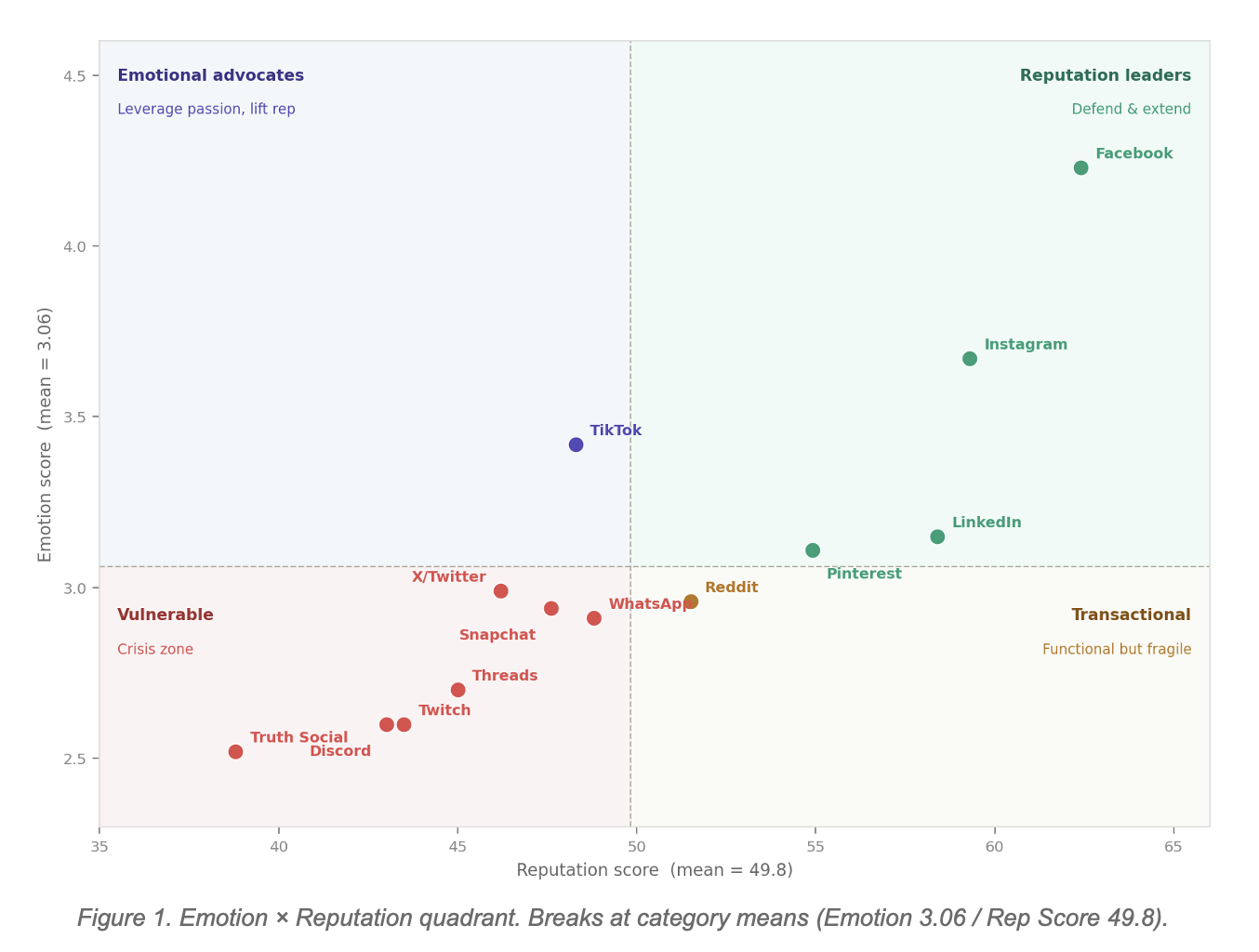
Four brands sit in the Reputation Leaders quadrant — Facebook, Instagram, LinkedIn, and Pinterest. Facebook's Rep Score of 62.4 and Emotion Score of 4.23 — the highest in the category — reflect deep habitual entrenchment among older cohorts: 45% mental market share among adults 45–64 and 57% among those 65 and over. Among 18–34-year-olds, that share falls to 22%, matching Instagram and TikTok. Its reputation lead is real and demographically concentrated — it is simultaneously the strongest brand in the sector and the one with the most contingent long-term position.
Instagram (Rep Score 59.3) and LinkedIn (58.4) each have distinct permission structures. Instagram benefits from its visual positioning without bearing the full weight of Meta's institutional controversies. LinkedIn's advantage is the cleanest in the category — harmful perception at just 1.4%, community impact net of +22%, and uncontested professional networking CEP ownership (39%). Pinterest (54.9) operates similarly: minimal harm association (1.3%), strong community sentiment (+19%), and deep ownership of inspiration and discovery, especially among women.
TikTok stands alone as the category's sole Emotional Advocate — high closeness, underperforming reputation. Its Emotion Score of 3.42 is above the mean, but its Rep Score of 48.3 is not. TikTok leads all platforms as the most harmful (28%) and carries a community impact net of −1.0%, yet sits in a statistical dead heat with Facebook and Instagram among 18–34-year-olds at 21% mental market share. Enormous cultural presence, no reputational foundation beneath it — mental availability built alongside a deepening reputation deficit.
Reddit is the category's lone Transactional brand — Rep Score above the mean at 51.5, emotion below at 2.96. For the mid-tier platforms — WhatsApp, Snapchat, and X/Twitter — the picture is consistently Vulnerable. WhatsApp's positive community net (+11%) and low harm association suggest genuine permission that its reputation scores have not yet captured. Snapchat and X/Twitter carry above-average harm perceptions and below-average trust, with little differentiation between them. Threads, Discord, Twitch, and Truth Social cluster deepest in the Vulnerable zone.
The Feeling Dimension
The second quadrant maps Feeling Score (positivity) against Emotion Score (closeness), using means of 2.95 and 3.06. It asks not whether a brand has earned a strong reputation, but whether the emotional relationship is likely to be sustained or eroded under pressure.
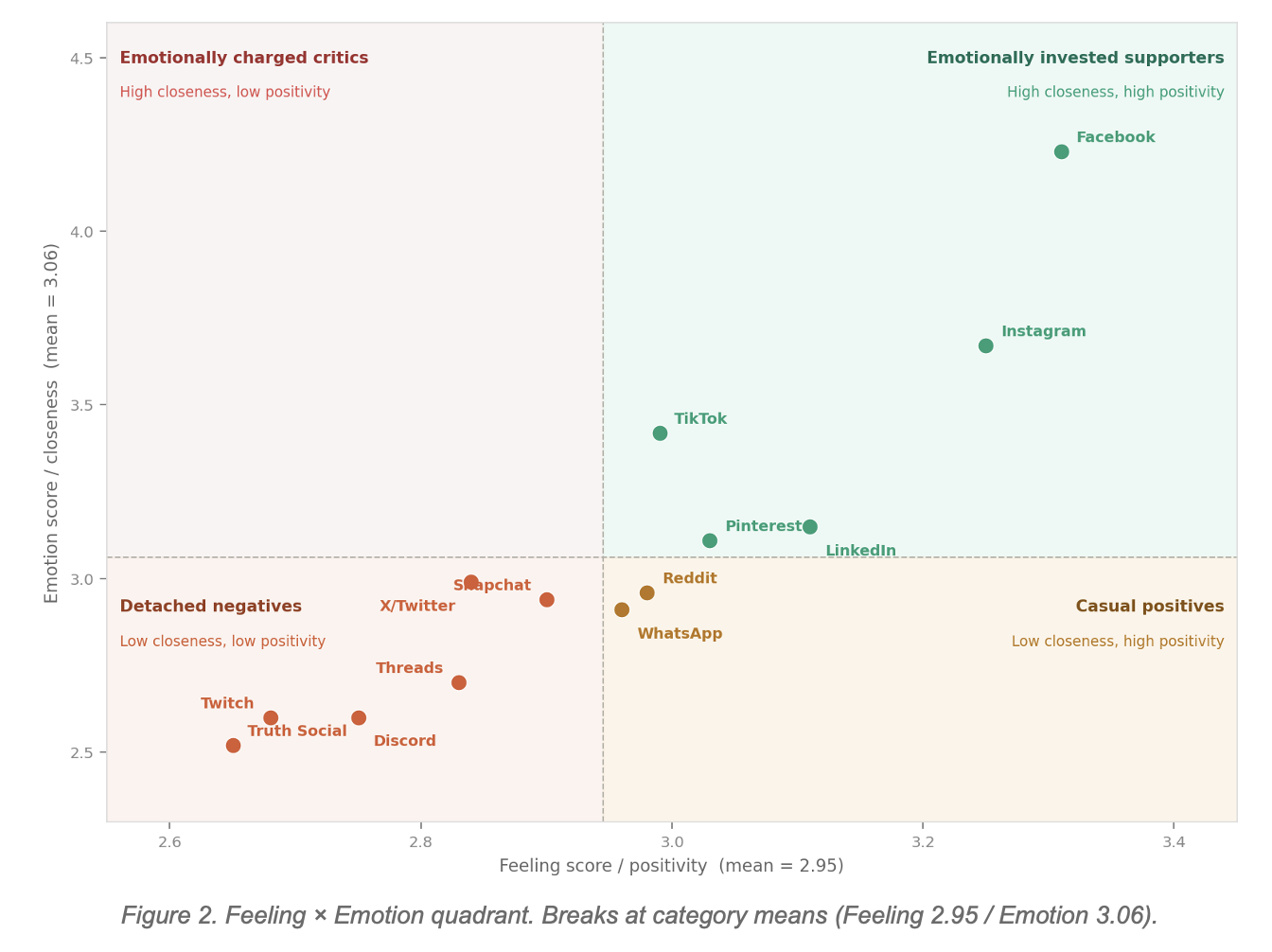
Five brands qualify as Emotionally Invested Supporters — Facebook, Instagram, TikTok, LinkedIn, and Pinterest. Facebook leads in closeness (4.23) but its positivity score (3.31) barely clears the mean, reflecting the ambivalence that high-frequency habit produces. TikTok's placement is the most notable finding: despite leading in harmful associations and a negative community impact score, its users rate it above average on both dimensions. This is a platform whose audience has not yet translated ambient concerns into emotional withdrawal — a window that the litigation environment around addictive design and teen safety is well-positioned to close.
No brand lands in the Emotionally Charged Critics zone. X/Twitter and Snapchat instead fall into Detached Negatives — users have drifted rather than stormed out, making detachment the dominant mode of disengagement. Reddit and WhatsApp, as Casual Positives, carry goodwill without deep investment — a genuine opportunity to deepen relationships through consistency and a focus on community.
Self-Expansion: The Habit vs. Meaning Gap
The Self-Expansion framework, measuring whether a platform feels like a natural part of life, makes time feel well spent, helps users discover new things, and generates pride of association, surfaces the category's most uncomfortable finding. Platforms with the largest footprints score lowest on the dimensions that predict durable brand relationships.
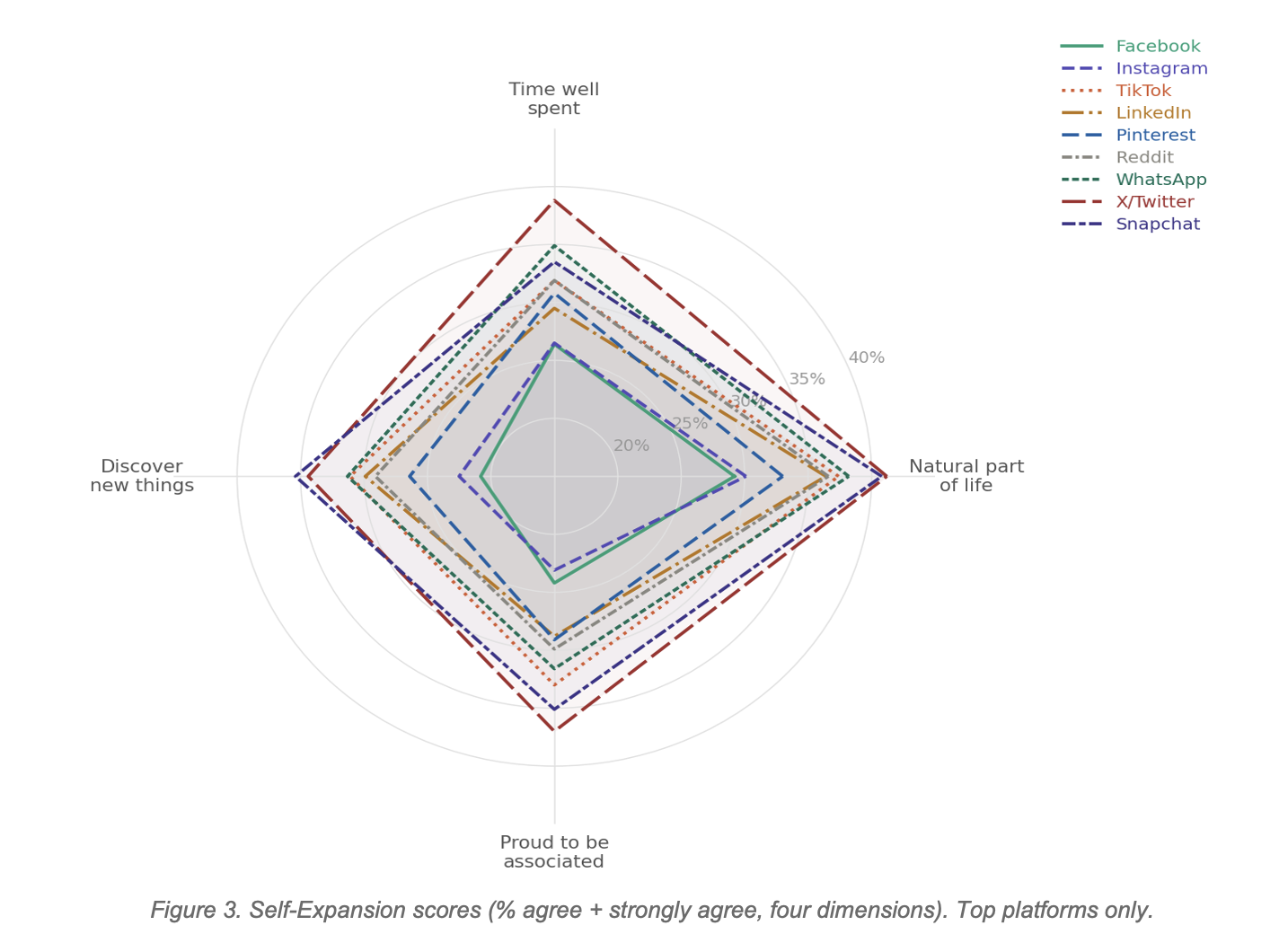
Facebook averages just 25% across the four dimensions — the lowest among top platforms — while Instagram is essentially tied at 26%. TikTok (33%), WhatsApp (34%), and LinkedIn (31%) perform meaningfully better. The two platforms with the greatest scale and the highest reputation scores are also the ones users find least personally meaningful. Category Advantage can be built on habit; lasting reputation — the kind that provides genuine permission in a crisis — requires meaning. The Self-Expansion gap is where Facebook and Instagram are most exposed.
Category Advantage Meets Reputation: The Integration View
The table below integrates Category Advantage metrics with reputation survey results for the nine most relevant platforms, revealing where reputation enables category advantage and where the two are in tension.
|
BRAND |
MMS |
REP SCORE |
MOST TRUSTED |
MOST HARMFUL |
COMM. IMPACT |
REP QUADRANT |
FEELING QUADRANT |
|
|
38% |
62.4 |
38.2% |
21.7% |
+28.2% |
Rep Leader |
Invested Supporter |
|
|
15% |
59.3 |
13.0% |
8.1% |
+18.5% |
Rep Leader |
Invested Supporter |
|
TikTok |
13% |
48.3 |
9.5% |
27.8% |
−1.0% |
Emotional Advocate |
Invested Supporter |
|
|
4% |
58.4 |
12.1% |
1.4% |
+22.3% |
Rep Leader |
Invested Supporter |
|
|
5% |
54.9 |
2.9% |
1.3% |
+19.0% |
Rep Leader |
Invested Supporter |
|
|
5% |
51.5 |
3.9% |
2.3% |
+11.3% |
Transactional |
Casual Positive |
|
|
4% |
48.8 |
4.0% |
5.3% |
+10.9% |
Vulnerable |
Casual Positive |
|
X/Twitter |
5% |
46.2 |
6.9% |
8.9% |
+5.8% |
Vulnerable |
Detached Negative |
|
Snapchat |
5% |
47.6 |
2.7% |
9.8% |
+3.7% |
Vulnerable |
Detached Negative |
MMS = Mental Market Share (Morning Consult Category Advantage, April 2026). Rep Score = composite of favorability, trust, value, community impact, admiration. Most Trusted and Most Harmful = % selecting brand (SM1CT12/SM1CT13). Community Impact = net positive/negative impact on local community.
The table tells three stories. Facebook's dominance and reputation are aligned — 38% mental market share, a 62.4 Rep Score, and the highest trust nomination in the category — but that rests on an older base, and a 22% harmful association is nontrivial for a brand that also leads on trust. TikTok's tension is acute: 13% mental market share among a coveted young audience, yet it leads on harmful perception with a negative community impact score. For LinkedIn and Pinterest, reputation is outpacing scale — stronger Rep Scores than their modest MMS requires, near-zero harmful associations, and consistently positive community sentiment. Their reputational surplus is precisely the buffer that protects them when category-wide controversies arise.
Reputation Risk Signals & Comms Implications
Four structural risk signals demand urgent attention from comms and reputation teams. The AI authenticity crisis: with two-thirds of adults unable to reliably identify real content and 71% demanding AI labeling, the first platform to move credibly on a transparent content policy can claim a differentiated position in an open vacuum. Child safety has entered active litigation — only 31% of adults believe platforms protect children, and courts have ruled that design features, including infinite scrolling and algorithmic loops, are not shielded by Section 230. Reactive comms positioning compounds exposure as the litigation wave broadens.
The ambient skeptic — 60% of heavy users who worry about too much technology yet keep engaging — occupies an unmet emotional need. No platform currently helps users feel their time is well spent. The one that does will differentiate its brand and address the category's deepest unmet need. Finally, the perception of privacy and commercial overreach underlies the entire trust deficit. Subscription paywalls will deepen resistance in a category where 40% already refuse to pay for features; demonstrating and communicating genuine data stewardship with specificity will erode that resistance.
The overarching implication is this: in the social media sector, reputation is the key determinant of whether category advantage is sustainable — a halo is too thin a description of what the data shows. Mental market share built on habit without emotional meaning, on engagement without trust, and on scale without community benefit is structurally fragile. The brands that close the gap between use and belief — between how often people show up and how good they feel about it — will consolidate category leadership over the next decade. The data suggests that the gap has never been wider or more available to be closed.
.png)
Beers, Spirits, Wine and THC Drinks: The Alcohol Category Landscape
.png)
Inside American Sports Leagues: Brand and Category Research
.png)