

The bottom line up front
The American drinking landscape looks stable at the surface—a handful of familiar moments still drive most consumption. But beneath that stability, the mental map of what belongs in each occasion is diverging sharply by generation and gender. Beer and wine together account for ~27% of mental market share. As a GLP-1-exposed audience (~16% currently on weight-loss medications) recalibrates its relationship with alcohol, and as younger drinkers carry wider consideration sets into different occasions, the category’s growth question is shifting from “what do people drink?” to “what do people drink instead?”
The Alcohol Category Today
Beer’s mental dominance is real but narrowing. Domestic beer leads MMS at ~14%, followed by wine at ~13% and imported beer at ~10%. Beer is the default in social and spectator contexts. But wine achieves the highest mental penetration (82% vs. 76% for domestic beer) and an average network size of 8.3 occasions, virtually tying beer at 8.7. Wine’s emotional connection score (3.9 on a 7-point scale) is more evenly distributed across genders, ages, and income than beer’s (4.2 overall, but 4.7 M vs. 3.3 F)—a more durable equity asset.
Spirits are specializing; the emerging tier is structurally interesting. Whiskey owns “premium and indulgent” (31% association). Tequila surges among 21–34 (MMS ~7% vs. ~4% for 45+). Vodka shows the flattest age profile of any spirit. Meanwhile, hard seltzer, ready-to-drink (RTD) cocktails, THC beverages, and non-alcoholic options collectively hold under 12% of MMS—but achieve 52–78% mental penetration among 21–34. These are the mental architecture of the next generation of drinkers.
The Moments that Matter to Beer, Wine and Liquor Companies
Occasions cluster into four zones. “Relaxing at home” (~41%) is the single largest and most contested entry point, with domestic beer (43%) and wine (41%) virtually tied while RTD cocktails (24%) and THC beverages (22%) make inroads.
Social performance occasions (~37–38%) reward variety—vodka (35% at parties), tequila (28% on nights out), and imported beer (38% at parties) all carve positions alongside beer. Elevated and celebratory moments (~29–34%) are wine’s zone: 44% for dinner pairings, 52% for gifting, with champagne co-leading celebrations and holidays at 40%. Active lifestyle occasions (~22–32%) default to beer (53% for sports, 46% for outdoors), with craft beer and hard seltzer at their strongest relative position.
How Segments in the Alcohol Category Differ
The core occasion structure holds across demographics. What changes is which beverage wins each occasion. Age changes which occasions matter; gender changes which type wins them.
Age: Different occasion structures entirely
Wine is the relaxation drink for 21–34—and this vanishes for older cohorts. Wine’s brand occasion index (BOI) for “relaxing at home” is +14.5 among 21–34 but drops to -2.3 for 35–44. Younger drinkers associate wine with everyday unwinding, not just celebrations. Meanwhile, wine’s meal-pairing mental advantage starts at +14 for 21–34 and peaks at +31 for 45–64—a reinforcing advantage that compounds over time.
Domestic beer’s action-occasion dominance intensifies with age. Beer’s outdoors mental advantage rises from +10 (21–34) to +20 (65+); pre-gaming from ~0 to +15. Older drinkers’ mental model of beer is far more occasion-concentrated. Meanwhile, emerging categories occupy unexpected niches: THC beverages’ “healthier” mental advantage peaks among 35–64 (+12–13), not 21–34, and RTD cocktails for hosting is a young-only association (+9.4 for 21–34, near zero for 45+).
Gender: Same occasions, different portfolios
Men and women are effectively drinking from different portfolios: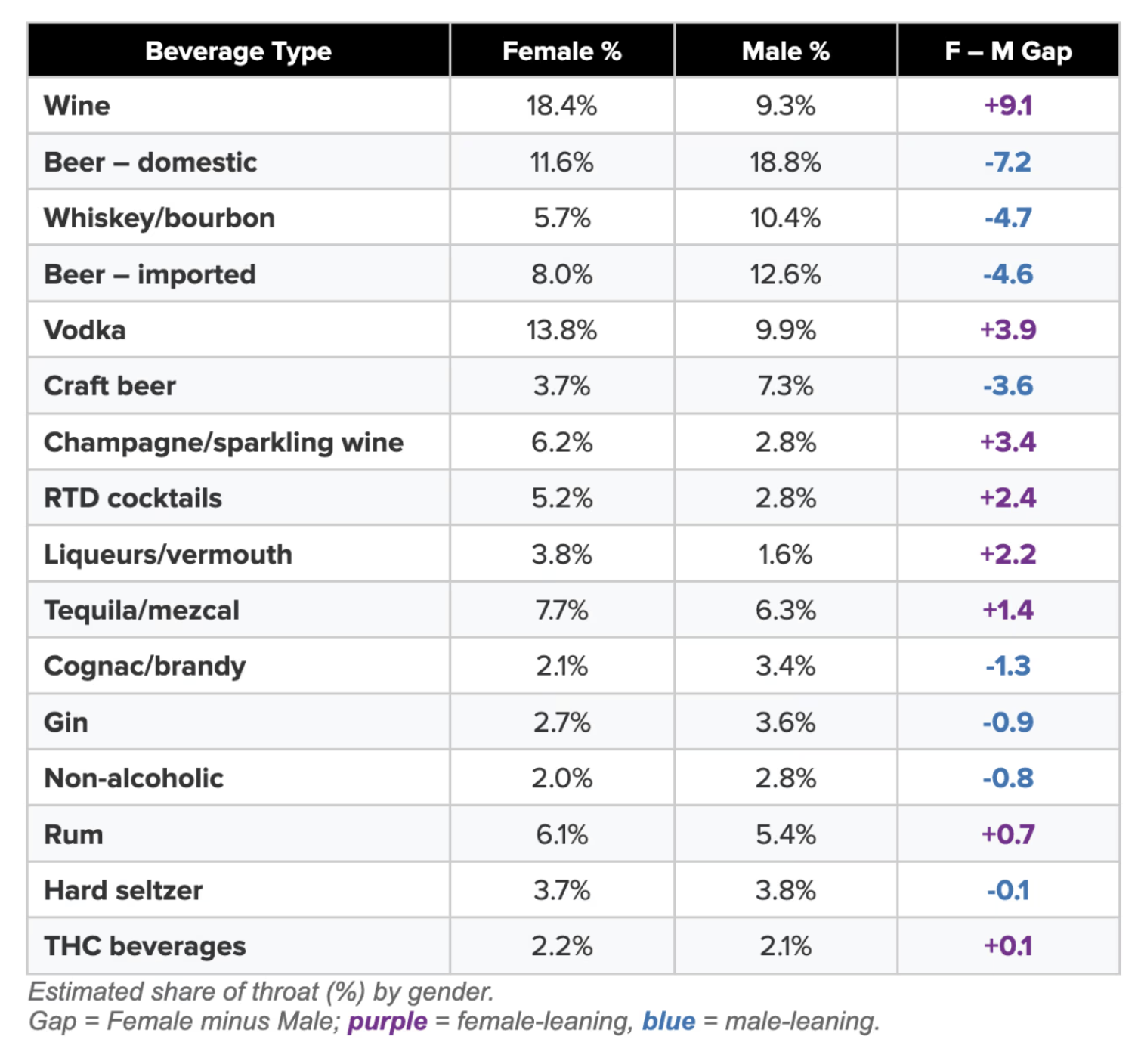
Wine’s occasion structure diverges sharply by gender. Wine’s mental advantage for “relaxing at home” is +11.9 for women but -2.8 for men—a 15 point gap, the largest gender divergence in the data. For women, wine is the versatile default across emotional occasions; for men, it’s narrower—primarily dinner, romance, and gifting. Hard seltzer shows a similar pattern: women’s mental advantage for “joining because others are drinking” is +10.0 vs. -1.0 for men, with strong female overperformance in pre-gaming, live events, and outdoors. For men, seltzer is undifferentiated.
The “healthier drinking” and “premium” occasions are gender-neutral in salience but gender-split in category. For healthier options, women reach for non-alcoholic (+22.2 vs. +13.9 for men); men lean toward THC (+10.4 vs. +2.0 for women). For premium occasions, men favor cognac (+8.7), whiskey (+7.2), and tequila (+6.3); women favor liqueurs (+15.0), champagne (+10.6), and cognac (+9.4). Tequila is a dinner drink for women (+6.3) but not men (-1.7)—inverting the assumption that tequila is male-coded.
Where Alcohol Companies Can Grow
Comparing mental share to estimated share of throat reveals where consumption is running on autopilot without strong occasion associations to defend it. Vodka is women’s most vulnerable category (–3.8pp gap—consumed at 13.8% share but only 10.0% mental share). Domestic beer has the same vulnerability for men (–2.6pp gap). Both are habitual defaults, not actively chosen ones—meaning any competitor that builds stronger occasion associations in their territory can peel share away.
Wine’s gap tells different stories by gender. For women, a –1.9pp gap (consumed more than thought of)—comfortable habit. For men, +0.5pp (thought of more than consumed)—a small conversion friction. The lever for wine among men isn’t awareness; it’s removing friction between consideration and purchase. Champagne shows untapped male potential (+0.7pp gap), rare for men, combined with strong celebration (+16.9pp) and romance (+9.4pp) BOI.
What's Blocking Conversion
Price friction dominates (~35%) and skews older (40% of 65+ vs. 25% of 21–34). Complexity friction skews young (“harder to choose in-store”: 18% of 21–34 vs. 3% of 65+). Preparation friction limits spirits (16% cite it as a barrier)—RTD cocktails solve this structurally, but at 79% “ever consumed” and only 23% past-4-week, the habit isn’t forming yet.
Why This Matters Now
“Relaxing at home” splits by gender. Wine owns it for women (+11.9pp); beer and THC split the male side. Brands pursuing the at-home occasion need gender-aware messaging, not one-size-fits-all.
The GLP-1 effect is not theoretical. Over a quarter of alcohol consumers have a medicalized reason to reconsider consumption. The “better for you” shelf isn’t one category—it’s two: non-alcoholic for women, THC for men.
Defend habitual consumption before chasing new occasions. The biggest share-of-throat positions—vodka for women, domestic beer for men—are the most mentally under-defended.
Breadth beats depth—but depth pays a premium. Wine proves that owning the right occasions can match beer’s total mental footprint. Whiskey proves that a narrow, high-value position sustains emotional connection. Growth can come from expanding occasions or from deepening the ones you already own.
About this research
Morning Consult conducts over 30,000 daily proprietary surveys in 45 countries covering more than 5,000 brands and 50 economic indicators.
Our category advantage research is aimed at understanding the needs driving consumers in your category — and how your brand can own more of them. This research is built on validated principles of brand-driven growth and powered by Morning Consult’s industry-leading sampling technology.
Measure the true drivers of brand strength
Capture both mental availability (the likelihood your brand comes to mind when consumers face a need or occasion) and emotional closeness (how strongly consumers connect with your brand), benchmarked against competitors.
Uncover Category Entry Points (CEPs)
Directly tied to mental availability, see the specific needs, occasions, and triggers that drive purchase decisions in your category, and how strongly your brand is linked to them.
Pinpoint growth opportunities
Direct investment toward the moments and consumer segments with the greatest potential to grow your brand.
Turn insights into action fast
Get survey results in 4–5 days through a centralized dashboard and short-form memo that equips stakeholders with clear direction on where and how to win.
Learn more
.png)
Facebook Leads the Social Media Category, But There's a Youth Problem
.png)
Exploring GLP-1 Users' Relationship with Alcohol and THC Drinks
.png)