

The bottom line up front
Five mass brands account for roughly 54% of Mental Market Share in the skincare category, and no single brand has broken away. The cultural heat around Rhode, Glow Recipe, Drunk Elephant, and The Ordinary has not translated into broad mental ownership; even The Ordinary, the strongest of the trend cohort, remains small in MMS despite strong associations among those aware of it. The opportunity is not generic awareness. It is converting known brands into occasion-salient brands — especially around context-specific use, new routines, value reassurance, and skin-safety confidence.
In this briefing, we use the Category Advantage research framework. A few terms you should know:
- Mental Market Share (MMS) measures a brand’s "mental availability"—how often it comes to mind, compared to competitors, when consumers think of buying in a category
- Category Entry Points (CEPs) are the specific needs, motivations, situations, or feelings that trigger a consumer to consider a product category and the brands within it
- Network Size refers to the average number of distinct usage occasions or buying situations that consumers mentally associate with a brand
The Category Today
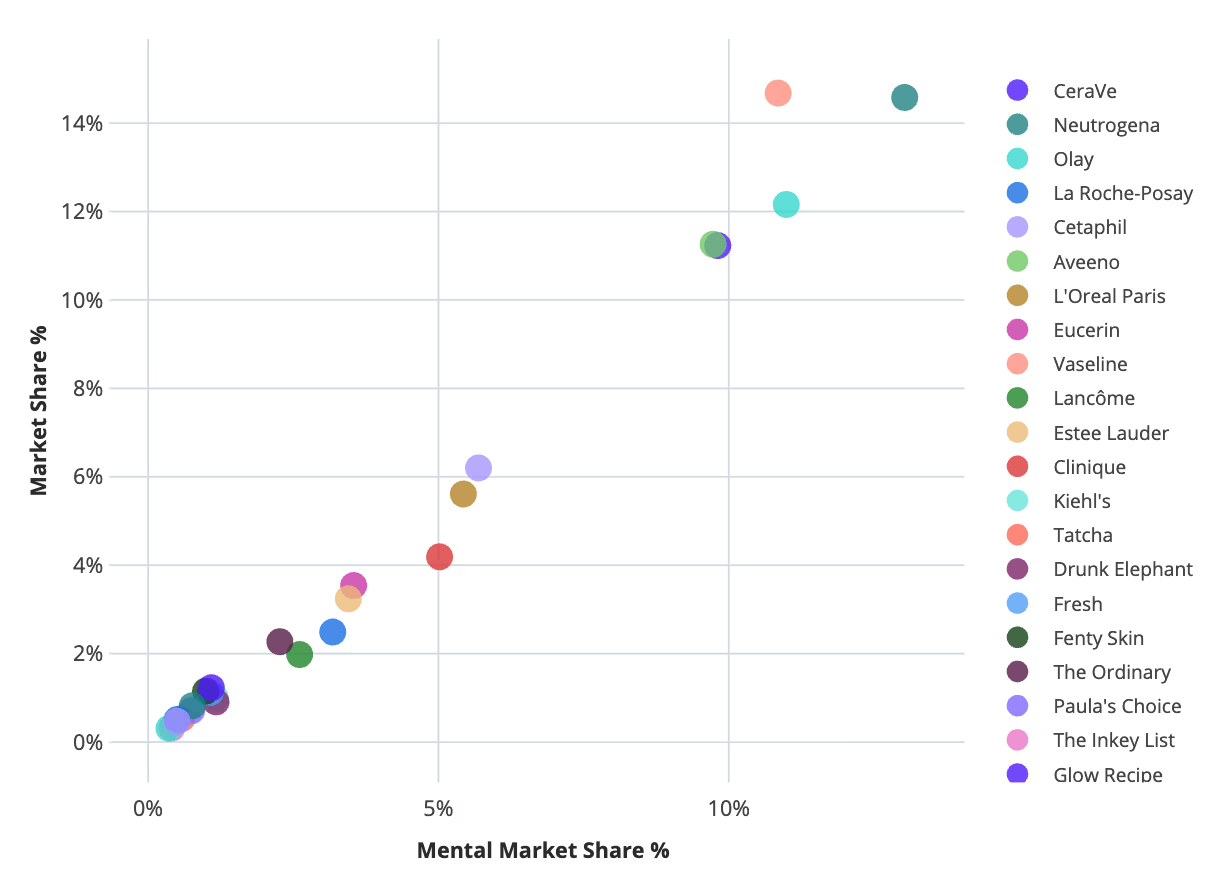
Five mass-market brands hold the mental high ground. Neutrogena (~13% Mental Market Share), Olay (~11%), Vaseline (~11%), CeraVe (~10%), and Aveeno (~10%) sit in a tight band at the top, with Cetaphil (~6%) and L’Oreal Paris (~5%) anchoring a clear second tier. Below 5% MMS, every premium and trending brand looks small. Five-way clustering is the structural fact: there is no Coke or Tide here, only a peer set.
Breadth and scale separate the mass leaders — but breadth alone doesn’t. Network Size — the average number of purchase moments a brand surfaces in among consumers aware of it — is high for the mass leaders: Neutrogena (7.1) and CeraVe (6.9) are the broadest “front doors,” covering routines, dryness, sensitivity, breakouts, and dermatologist recommendations alike. Importantly, several trending brands are also broad among the aware: The Ordinary (6.6), Glow Recipe (6.2), Fresh (6.3), and The Inkey List (6.3) all carry mental networks comparable to the mass leaders — just within a much smaller awareness base. The genuinely narrow brands are Rhode (4.2) and the legacy prestige cohort: Lancôme (4.6), Estée Lauder (4.6), Eucerin (4.7). The mass leaders combine breadth with scale; some trend brands have built breadth without it. The split that matters is awareness-times-breadth, not breadth alone.
The trending set has cultural weight without mental scale. The Ordinary leads the trending cohort at ~2% MMS, with Drunk Elephant and Glow Recipe just above 1% and Rhode and Summer Fridays at ~0.5% — each well below the second-tier mass brands. Mental Penetration is healthy across the cohort (66–78%), so the brands aren’t being mis-categorized — just narrowly placed. The Ordinary is best-positioned of the group: among consumers aware of it, the brand over-indexes sharply on discovery and treatment moments, especially trying something new (~34%), uneven tone or dark spots (~35%), and starting a new routine (~33%). But its low awareness keeps those strengths from translating into category-scale mental ownership; the mass leaders still generate more total mental associations on the same moments. The Ordinary’s mental footprint is roughly double the next-largest trending brand, which makes it the most likely to translate cultural attention into mass mental presence — if it can extend awareness without losing the sharpness of its associations.
Awareness-to-relevance is the category’s largest open ledger. Every leading brand carries an Awareness–MMS gap of 50 points or more — Neutrogena ~69% aware, ~13% MMS; Olay ~57 points apart; CeraVe ~50. People know these brands and don’t surface them when they need skincare. That’s friction, not unawareness, and the lever is occasion-claiming, not media weight.
Beauty Audience Context
The demographic and behavioral profile below is drawn from Morning Consult Intelligence’s broader beauty-user audience (skincare, makeup, fragrance, haircare), not the skincare-specific survey audience. The MMS, CEP, and barrier data elsewhere in this memo come from the skincare survey workbook.
Personal optimism is the macro context, but it’s softening. Per Morning Consult Intelligence, beauty users have run consistently above gen pop on the Index of Consumer Sentiment for the past seven months, with their personal-finances 12-month outlook (~120) well above current conditions (~95). Spend intent on small, controllable purchases should remain durable. If the aspiration-vs-reality gap keeps widening, the value brands of this set (CeraVe, Cetaphil, The Ordinary) get a tailwind and the prestige tier gets pressured.
Beauty users are politically mixed with a slight Republican tilt. Per MCI, beauty users split 36% Republican / 33% Democrat / 31% Independent — a 3-point Republican plurality, with 52% having voted for Trump in 2024. Notably, the same audience’s Trump approval skews net-disapproving, similar to gen pop. The audience is not the coastal-progressive caricature beauty culture often implies, nor is it overtly right-coded. The opening is messaging that’s stylistically modern but tonally non-partisan, especially for brands chasing suburban-mom and middle-American expansion.
The activation map is digital and visual. Per MCI, Pinterest, Snapchat, Spotify, TikTok, LinkedIn, WhatsApp, and Twitch all over-index 16–20 points among beauty users; sports, podcasts, gaming, concerts, and movie theaters also over-index. This is a planning-and-discovery audience: Pinterest is where routines are saved, TikTok is where new entrants are discovered. Social, creator, podcast, and platform-native testing should be prioritized; any shift away from broadcast should be based on channel performance, not audience indexing alone.
The Moments That Matter
Four triggers carry the category. Replacing a product I’ve run out of (~33%) is the largest occasion and rewards whoever surfaces first — Neutrogena (~34%), CeraVe (~34%), and Olay (~32%) win it cleanly. Doing my regular routine (~31%) is the consistency moment, again won by Neutrogena (~40%) and CeraVe (~37%). Noticing dry or dehydrated skin (~28%) is the only top-five trigger Vaseline owns outright (~41%). Addressing signs of aging (~21%) is Olay’s territory (~41%), with The Ordinary (~33%) and La Roche-Posay (~30%) following — the only major moment where a trending brand has a real claim.
The cleanest under-owned moment is preparing for a specific context (~14% salience, no sharp leader). Upgrading to premium (~12%) is attractive but not empty: La Roche-Posay leads conditionally at ~40% among the aware, with Tatcha, Estée Lauder, Fenty Skin, Lancôme, and Clinique all clustered behind — and at category scale, high-awareness brands like Neutrogena, L’Oreal Paris, and Olay also surface. Following dermatologist advice (~13%) is already defended: CeraVe (~36%), Neutrogena (~35%), and Cetaphil (~34%) anchor the trust incumbency. The most claimable moment is context-specific use; the others are opportunities, but harder ones.
How Segments Differ
Income shapes which trigger fires. Among $100K+ households, regular routine jumps to ~37% (+6pp), aging to ~27% (+6pp), and influencer-recommended trial to ~16% (+6pp). This is the routine-and-ritual buyer who will also try new things on creator cues — the natural expansion target for premium tiers.
Age scrambles the leader board. The 18–34 cohort cuts MMS for Neutrogena (–4pp) and Olay (–4pp) but lifts CeraVe (+3pp). Among 18–34s, replacement remains an important trigger but loses dominance, while breakouts, oily skin, uneven tone, new routines, and dermatologist advice move up sharply. Aging falls back, making this a different trigger map than the one Olay and Neutrogena have historically owned. CeraVe is the only mass brand currently positioned to win the next decade of skincare buyers; Olay and Neutrogena are aging up.
Gender’s bigger story is in friction. Women cite price as a barrier at 50% versus 33% of men. The category’s affordability problem is fundamentally a women’s-purchase problem.
Premium-tier emotional connection is concentrated in high-income and higher-education audiences. Among $100K+ households and post-grads, scores for Rhode, Glow Recipe, Paula’s Choice, and Tatcha lift roughly 0.8–±1.5 points. Rhode’s overall connection is low (~2.3) and improves materially among high-income consumers (~3.6), though not enough to suggest broad emotional scale. These premium and trend bases are small (Rhode high-income n~41 unweighted), so the readings are directional rather than precise. The pattern holds: cultural footprint dramatically overstates mental footprint.
What's Blocking Conversion
Price-and-affordability friction is the largest barrier, full stop. 42% of skincare buyers cite price, climbing to 50% among women and ~56% among 65+. For mass brands, this is a packaging-and-promotion problem — value-pack, club, subscription. For prestige brands, it’s a sampling problem.
Reaction anxiety is the category’s hidden brake. ~24% cite fear of skin reactions and ~18% cite “not suitable for my skin tone or condition.” Together these form a substantial skin-risk cluster, though the net combined size would require respondent-level de-duplication to confirm. CeraVe’s structural advantage on the sensitivity, dermatologist, and simple-routine triggers is built precisely on neutralizing it. Brands without that credibility need dermatologist endorsement, ingredient transparency, and visible “tested for” claims.
Sampling and access friction is concentrated at the prestige end. ~20% can’t try samples before buying; ~19% report the brand isn’t available at the stores where they usually shop; ~18% balk at shipping costs; ~17% hit stock-outs on the specific product they want. A meaningful share of prestige-brand non-purchase is solvable with retail trial programs and distribution depth, not media spend.
Why This Matters Now
Diagnose before spending. Every leader has an Awareness–MMS gap of 50+ points. Adding awareness on top of awareness will not move share. Brands high in recognition but low in mental availability — Estée Lauder, Lancôme, Eucerin — should redirect spend from reach to occasion-claiming.
Pick moments to claim, not all of them. Preparing for a specific context is the cleanest under-owned moment. Premium upgrading and dermatologist advice are attractive but not empty: premium is contested by La Roche-Posay and the legacy prestige cohort, and dermatologist advice is already defended by CeraVe, Neutrogena, and Cetaphil. Starting a new routine is contested by The Ordinary among aware consumers but not yet category-scale. Owning a moment is cheaper than dethroning a leader \u2014 but only when the moment is actually open.
Win 18–34 or age out. The next decade’s skincare buyers cite breakouts, oily skin, and discovery more sharply than older cohorts — a different trigger map than the one Neutrogena and Olay currently lead. CeraVe is the only mass brand with a positive 18–34 MMS skew today. Every other established brand needs a youth-trigger strategy now; the cohort sets early and consolidates fast.
Awareness-times-breadth, not breadth alone. The brands that win this category combine wide mental networks with the awareness scale to populate them. Several trend brands (The Ordinary, Glow Recipe, Fresh, The Inkey List) already have broad networks among the aware, but the awareness base is too small to convert into category-scale presence. The Ordinary’s path to the top tier is awareness expansion that preserves the sharpness of its current associations. Rhode’s path is mental availability outside the $100K+ post-grad bubble. The next mover-up will be a brand that converts narrow emotional connection into broad mental presence.
About this research
Morning Consult conducts over 30,000 daily proprietary surveys in 45 countries covering more than 5,000 brands and 50 economic indicators.
Our category advantage research is aimed at understanding the needs driving consumers in your category — and how your brand can own more of them. This research is built on validated principles of brand-driven growth and powered by Morning Consult’s industry-leading sampling technology.
Measure the true drivers of brand strength
Capture both mental availability (the likelihood your brand comes to mind when consumers face a need or occasion) and emotional closeness (how strongly consumers connect with your brand), benchmarked against competitors.
Uncover Category Entry Points (CEPs)
Directly tied to mental availability, see the specific needs, occasions, and triggers that drive purchase decisions in your category, and how strongly your brand is linked to them.
Pinpoint growth opportunities
Direct investment toward the moments and consumer segments with the greatest potential to grow your brand.
Turn insights into action fast
Get survey results in 4–5 days through a centralized dashboard and short-form memo that equips stakeholders with clear direction on where and how to win.
Learn more
Why Dunkin’ Is So Efficient at Converting the Audience It Reaches
.png)
The Citi Strata Elite Card Over-Indexes on Lifestyle and Status
.png)