

The bottom line up front
The Citi Strata Elite occupies a curious position in the premium credit card category: reasonable aided awareness (~30%) but thin mental availability (~3.5% MMS) and shallow mean emotional connection (~2.97 out of 7 — the lowest in the category). The brand over-indexes on lifestyle, status, and sign-up bonus occasions — a cluster that skews toward acquisition-minded, socially-motivated consumers — but it lacks the broad occasion coverage or emotional depth to be considered a front-door brand by any segment. Citi's strategic challenge is structural: it has a niche position in a category where the top three brands hold nearly two-thirds of all mental market share, and its clearest advantages are in occasions that competitors can easily match with a promotional offer.
Where the Citi Strata Elite Card Stands in the Premium Credit Card Category
Citi is a niche brand in a category dominated by three front-door competitors. At ~3.5% Mental Market Share and 57.0% mental penetration, Citi ranks sixth in MMS — behind American Express (~24.5%), Chase (~20.4%), Capital One (~19.9%), Bank of America (11.5%) and Wells Fargo (5.5%). Its Network Size (7.2) is nearly 2.5 points below the top-three average, meaning that among the consumers who do think of Citi, they link it to fewer purchase occasions than they link to the leaders. The brand is known — 29.7% aided awareness gives it a foundation — but it is not broadly recalled when specific card decisions arise.
Citi's emotional connection is the weakest in the category — a structural problem for a premium brand. At ~2.97 on a 1–7 emotional connection scale, Citi scores below all other brands in the survey. This is not a positioning nuance — it is a brand health signal. Premium card consumers are likely willing to pay $500+ annually for a card they feel good about. A brand they don't feel connected to will not survive fee renewal scrutiny. Citi's functional positioning (status, sign-up bonuses, high-spend optimization) has not translated into the emotional resonance that sustains a premium relationship.
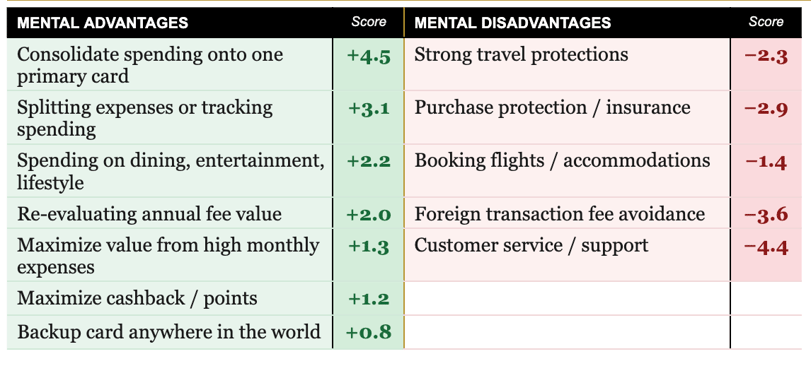
The mental advantage pattern reveals a brand associated with acquisition incentives more than sustained value. Citi's strongest performance relative to competitive cards — lifestyle/status (+3.5), sign-up bonuses (+3.5), high-spend value (+2.6), and dining (+2.1) — skew toward the moments when consumers are actively evaluating a new card, not the moments when they're committed to using one. The category's consolidation, backup-card, and customer-service occasions — the mental territory of a trusted long-term card — show consistent Citi disadvantages. This is the mental profile of an acquisition brand, not a loyalty brand.
The CEPs Citi Owns — and the Ones It Doesn’t
 The lifestyle and status occasion is Citi's most distinctive position — and the category's most contested. Citi leads the category on "wanting a card that reflects my lifestyle or status" (+3.5), ahead of American Express (+3.1) and well ahead of Chase and Capital One. At ~14% salience, this occasion is not high-volume — but it is high-margin: consumers motivated by status are among the least price-sensitive in the category. The risk is that this position is fragile. No brand holds the status occasion with more than a 3-point advantage, making it volatile and easily disrupted by a competitor's campaign or product launch.
The sign-up bonus advantage reflects a promotional orientation that has limited durability. Citi's over-index on sign-up bonuses (+3.5) is real but double-edged. Consumers who reach for Citi primarily because of a welcome offer might be the least loyal and most likely to churn after the bonus posts. The brand's simultaneous disadvantage on annual fee re-evaluation (−2.3) suggests that consumers who came for the bonus don't build the ongoing value association that survives renewal. This is a conversion-stage advantage with a retention-stage problem.
The everyday utility occasions are Citi's structural gaps. Consolidating spending (−2.1), tracking expenses (−1.8), customer service (−3.3), and backup card reliability (−2.9) are the occasions that define a card consumers trust and keep. Citi under-indexes on all of them. Until the brand builds mental availability on at least one of these occasions, its recall will be associated with new-card consideration rather than ongoing card preference — limiting lifetime customer value.
Who Citi Is Winning — And Losing
Younger and more educated consumers are Citi's relative strengths. Citi's best segments skew toward 18–34 year olds and post-grad consumers — the audiences most responsive to sign-up bonus promotions and most engaged with lifestyle and status signaling. The Northeast shows the brand's strongest regional performance. These are plausible growth segments, but they are also the most promotion-responsive and least loyal cohorts in the category. Building on this base requires converting acquisition relationships into sustained usage.
Older consumers are virtually the toughest to reach for Citi given its current positioning. Among 45–64 and 65+ consumers, Citi's MMS drops below 3% — negligible in a category where Amex holds 29–32% in these cohorts. This is partly a legacy brand perception issue and partly a category reality: older premium card consumers formed their primary associations with Amex and Chase years ago and are not actively reconsidering. Citi's path to these segments runs through younger cohort acquisition and loyalty-building, not direct targeting.
Male consumers are Citi's more responsive gender segment. Citi skews slightly toward male consumers in MMS — consistent with the brand's over-indexing on status and high-spend optimization occasions, which also index more male. This is not a targeting advantage so much as a natural alignment: the occasions Citi is known for tend to be occasions that male premium card consumers prioritize more often.
What's In the Way
The emotional connection deficit is the most urgent brand health issue. A 2.97 emotional connection score — the lowest in the category — in a segment where annual fees demand emotional justification is a direct retention risk. Citi's acquisition advantages (sign-up bonuses, status occasions) bring consumers in; the lack of emotional depth is what lets them leave. No acquisition strategy will compound if renewal rates are structurally suppressed by emotional detachment.
Customer service disadvantage (−3.3) reinforces low emotional connection. The two signals are related: a brand that consumers don't feel connected to is also a brand they don't trust to take care of them when something goes wrong. The customer service gap is both a cause and a symptom of the emotional connection problem — and it is the occasion most directly actionable through operational investment rather than advertising spend.
Fee complexity hits a brand without a clear value narrative. The ~37% rewards complexity barrier and ~40% fee barrier are category-wide problems — but they hit Citi disproportionately because the brand lacks a simple, memorable value proposition. Amex can say "the travel card." Chase can say "the spending card." Citi's mental associations are scattered across status, bonuses, and high-spend — which is not a story a cardholder can tell themselves at renewal time.
About this research
Morning Consult conducts over 30,000 daily proprietary surveys in 45 countries covering more than 5,000 brands and 50 economic indicators.
Our category advantage research is aimed at understanding the needs driving consumers in your category — and how your brand can own more of them. This research is built on validated principles of brand-driven growth and powered by Morning Consult’s industry-leading sampling technology.
Measure the true drivers of brand strength
Capture both mental availability (the likelihood your brand comes to mind when consumers face a need or occasion) and emotional closeness (how strongly consumers connect with your brand), benchmarked against competitors.
Uncover Category Entry Points (CEPs)
Directly tied to mental availability, see the specific needs, occasions, and triggers that drive purchase decisions in your category, and how strongly your brand is linked to them.
Pinpoint growth opportunities
Direct investment toward the moments and consumer segments with the greatest potential to grow your brand.
Turn insights into action fast
Get survey results in 4–5 days through a centralized dashboard and short-form memo that equips stakeholders with clear direction on where and how to win.
Learn more
.png)
Vuori: An Under-the-Radar Story
.png)
Xfinity’s Bundle Mental Advantage Is Its Main Advantage in the Cellular Category
.png)