

The bottom line up front
OpenAI is the category’s strongest challenger to Google’s leadership — and it is winning the IT decision-maker (ITDM) audience. Among decision-makers, OpenAI leads on network size (9.7 vs Google’s 9.5) and emotional closeness (4.3 vs 4.2), and it is the only brand in the category where the ITDM emotional score exceeds the business decision-maker (BDM) score. The mental advantage data reveals a distinctive profile: OpenAI punches dramatically above its weight on Clarity in Complexity (+9 ITDM), Low-Regret Start (+8 ITDM), Adoption Enablement (+6 ITDM), and Adoption That Sticks (+5 ITDM). But this strength comes with a mirror-image vulnerability: severe underperformance on governance and institutional trust CEPs — Maturity Signaling (-8 ITDM), Audit-Ready Governance (-6 ITDM), and Measurable Value Realization (-7 ITDM). OpenAI’s growth challenge is clear: build the institutional credibility to match its functional dominance before governance-sensitive buyers default to competitors.
The Enterprise AI Category Landscape
OpenAI holds the #2 mental market share position among SMBs: 12.6% among BDMs and 11.4% among ITDMs. When rebased to the 8-brand competitive set, OpenAI captures roughly 24% of mental market share — a strong second to Google’s 30%. But share alone understates OpenAI’s competitive position. The depth metrics tell a more nuanced story: OpenAI’s ITDM network size (9.7) and ITDM emotional closeness (4.3) both lead the category, suggesting that technical buyers who know OpenAI associate it with more use cases and feel more connected to it than to any competitor.
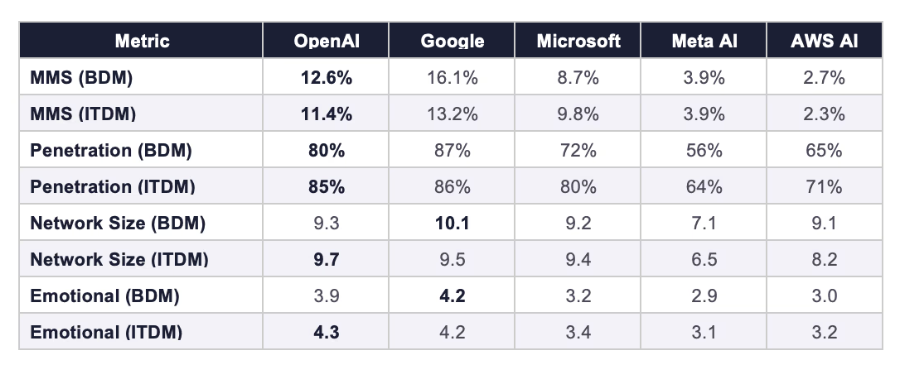
OpenAI is the only brand in the competitive set where ITDM depth metrics exceed BDM metrics across the board. This is a brand being built from the technical buyer up — a fundamentally different growth trajectory than Google’s BDM-led model.
Where OpenAI Stands
The Good News
OpenAI leads the category on ITDM depth. At 9.7 network size and 4.3 emotional closeness among ITDMs, OpenAI exceeds every competitor including Google. Its buyer network size (10.0 ITDM) exceeds non-buyer size (5.5) by 82% — the largest buyer premium in the competitive set, suggesting that hands-on experience with OpenAI deepens associations more dramatically than with any other brand.
Clarity in Complexity is OpenAI’s single most distinctive ITDM strength (+9). This is the largest positive mental advantage score for any brand on any CEP among ITDMs. Technical buyers overwhelmingly associate OpenAI with making complex problems understandable. Combined with its CEP linkage rate of 55.1% on this dimension, this is a genuinely owned brand territory.
OpenAI dominates the adoption-oriented CEPs among ITDMs. Low-Regret Start (+8), Adoption Enablement (+6), and Adoption That Sticks (+5) are all strong green cells. In a category where 28% of buyers cite commitment anxiety as a barrier, OpenAI is uniquely positioned as the brand that feels safest to try. This ‘easy entry’ advantage is a powerful growth engine.
Trustworthy AI is a strength in both audiences. OpenAI scores +3 among BDMs and +5 among ITDMs on the category’s most important CEP (DI: 0.039). While Google’s advantage is larger (+6/+7), OpenAI is one of only two brands that punch above their weight on Trustworthy AI in both audiences.
Usage-to-preference intensity is strong. 70% of the total audience used OpenAI in the past four weeks, and 85% of ITDMs have OpenAI in their mental consideration set. Among BDMs, 78% say they will definitely or probably use OpenAI in the next year.
The Challenge
OpenAI’s strengths are functional and experiential. Its weaknesses are institutional and governance-related — the exact dimensions that enterprise buyers use to justify procurement decisions.
Maturity Signaling is OpenAI’s single largest weakness (-8 ITDM). Technical buyers do not yet associate OpenAI with being a mature, proven enterprise vendor. This is a perception problem with real procurement consequences: IT leaders need to signal to their organizations that a vendor choice is prudent, not experimental.
Audit-Ready Governance underperforms in both audiences (-4 BDM, -6 ITDM). OpenAI’s governance perception trails competitors who have decades of enterprise compliance history. As the category anchors in trust and security, this gap directly undermines OpenAI’s Trustworthy AI strength — buyers trust OpenAI’s product but not yet its institutional governance.
Measurable Value Realization is a red cell among ITDMs (-7). The technical buyers who most deeply associate OpenAI with AI capability do not yet associate it with trackable business outcomes. This is the gap between ‘this tool is powerful’ and ‘this tool delivers ROI I can measure.’
Security-First AI underperforms in both audiences (-4 BDM, -4 ITDM). In a category where Security-First AI is the #2 derived importance CEP for BDMs (0.040), this is a high-stakes gap. It gives governance-focused competitors (Microsoft in particular) an opening to reframe the competitive narrative.
The Core Insight
OpenAI’s brand profile is the inverse of a traditional enterprise vendor: extraordinarily strong on adoption ease, clarity, and user-facing value, but significantly weak on the institutional trust signals that procurement committees require. The brand is being chosen by individual users and technical evaluators but not yet trusted by the organizational structures that approve enterprise commitments. Every strategic move should be oriented around building institutional credibility without sacrificing the experiential advantages that make OpenAI distinctive.
What OpenAI Owns — and Where It’s Exposed in the Enterprise AI Category
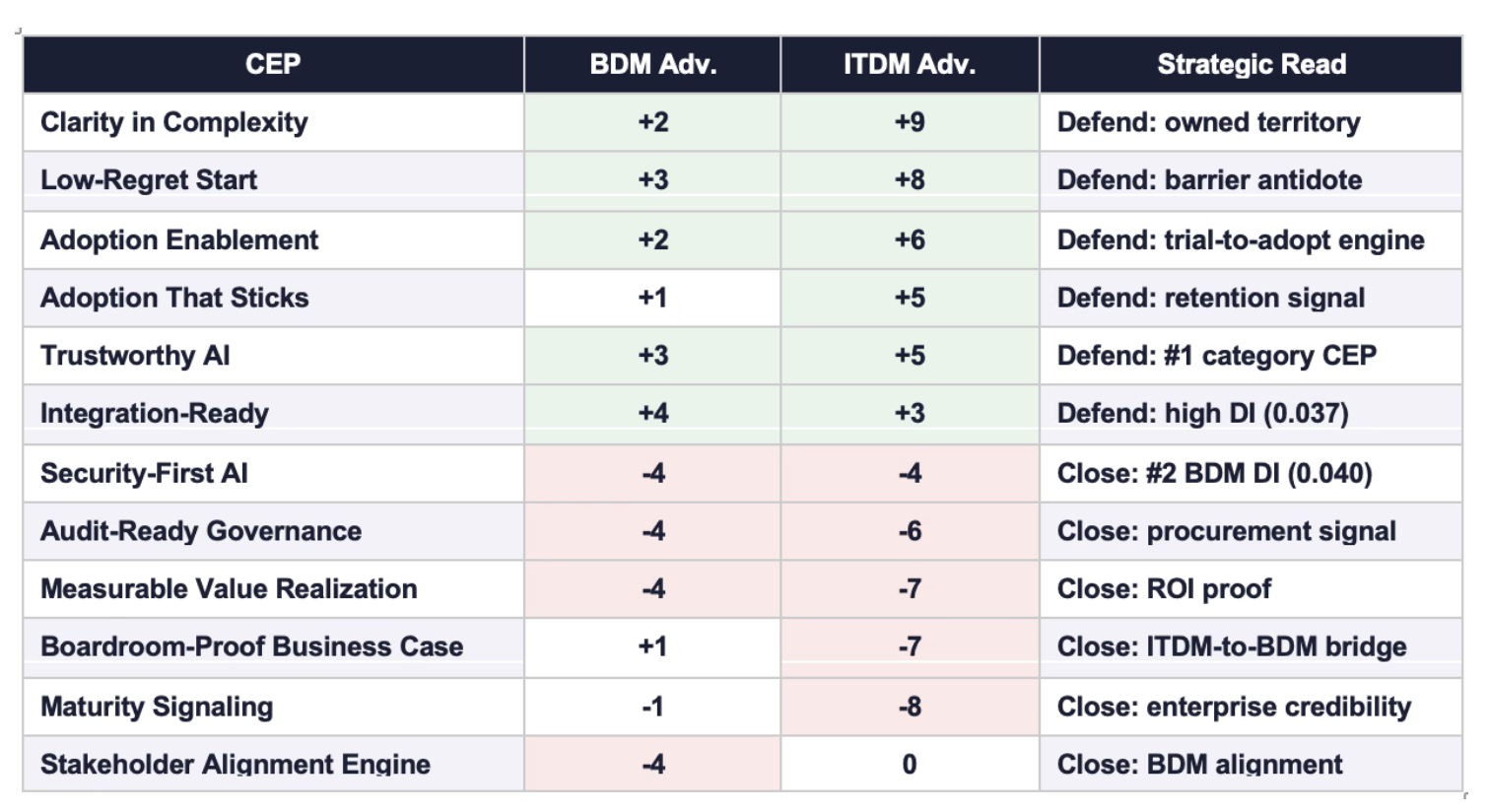
The polarity is striking. OpenAI’s six strongest ITDM cells (Clarity +9, Low-Regret +8, Enablement +6, Sticks +5, Trust +5, Integration +3) represent the experience of using AI. Its six weakest ITDM cells (Maturity -8, Business Case -7, Value Realization -7, Governance -6, Reliability -4, Security -4) represent the experience of buying AI for an organization. OpenAI is winning the user. It has not yet won the buyer.
Five strategic priorities for OpenAI based on this research
Invest in Maturity Signaling without losing the innovation edge. The -8 ITDM score is OpenAI’s deepest weakness. Enterprise certifications (SOC 2, ISO 27001), uptime SLAs, dedicated support tiers, and ‘enterprise-ready’ packaging signal maturity to procurement committees. The key is to add these without diluting the product simplicity that drives OpenAI’s adoption advantages.
Close the Measurable Value Realization gap with outcome tracking. At -4 BDM / -7 ITDM, this is the gap between ‘AI is impressive’ and ‘AI delivers ROI.’ Built-in usage analytics, time-saved calculators, and customer case studies with quantified outcomes can shift this perception.
Protect the ITDM emotional lead. OpenAI’s 4.3 ITDM emotional closeness is the highest in the category — but it leads Google by only 0.1 points. Continued investment in developer experience, API quality, and technical community engagement will defend this advantage.
Make Security-First AI a visible priority. The -4/-4 score on the category’s #2 BDM-importance CEP is a high-stakes vulnerability. Security certifications, data handling transparency, and compliance messaging should move from documentation to marketing headlines.
Leverage the software displacement wave. With 55% of SMB buyers believing AI can clone enterprise software within a year, OpenAI is uniquely positioned as the replacement candidate. Its adoption strengths (Low-Regret +8, Enablement +6) map directly to the buyer journey of switching from legacy tools. The strategic opportunity: position OpenAI not just as an AI tool but as the platform that replaces the software stack.
About this research
Morning Consult conducts over 30,000 daily proprietary surveys in 45 countries covering more than 5,000 brands and 50 economic indicators.
Our category advantage research is aimed at understanding the needs driving consumers in your category — and how your brand can own more of them. This research is built on validated principles of brand-driven growth and powered by Morning Consult’s industry-leading sampling technology.
Measure the true drivers of brand strength
Capture both mental availability (the likelihood your brand comes to mind when consumers face a need or occasion) and emotional closeness (how strongly consumers connect with your brand), benchmarked against competitors.
Uncover Category Entry Points (CEPs)
Directly tied to mental availability, see the specific needs, occasions, and triggers that drive purchase decisions in your category, and how strongly your brand is linked to them.
Pinpoint growth opportunities
Direct investment toward the moments and consumer segments with the greatest potential to grow your brand.
Turn insights into action fast
Get survey results in 4–5 days through a centralized dashboard and short-form memo that equips stakeholders with clear direction on where and how to win.
Learn more
.png)
Enterprise AI for SMBs: How Google, OpenAI & Microsoft Compare in 2026
.png)
Microsoft's Position in Enterprise AI for SMBs
.png)