Morning Consult's Category Advantage study on premium credit cards found that no brand has secured mental dominance — American Express leads in mind-share, but Chase and Capital One are within striking distance, and the category’s primary entry point is financial optimization, not aspiration. The Reputation Advantage data confirms the same fragmentation in the emotional and reputational landscape. What it adds is something the mental availability data cannot show: the reason so much consideration fails to convert is a reputation problem disguised as a price objection. The brand that earns the right to say “this card is genuinely worth it, for you, right now” will not simply gain market share. It will unlock a conversion pool that awareness-building alone cannot reach.
That task is more urgent than it was a year ago. Morning Consult’s February 2026 macro update documented a 17.8-point decline in consumer sentiment among high-income adults — a fall second only to the COVID-19 crash — driven primarily by labor market anxiety and rising price sensitivity. The K-shaped economy that sustained premium spending through 2025 has peaked. High earners still hold accumulated savings, but their purchasing intentions are pulling back across every category. In this environment, a premium card’s annual fee does not simply compete with other financial products. It competes with a consumer’s growing instinct to scrutinize every recurring cost. The reputational case for the category has to be made more explicitly than ever.
Integrated Scorecard: Category Advantage + Reputation Advantage
|
Brand |
MMS (%) |
Reputation Score |
Emotions Score |
Feeling Score |
|
Capital One (Venture X) |
19.9 |
67.8 |
3.35 |
3.37 |
|
American Express (Platinum) |
24.5 |
67.0 |
3.33 |
3.38 |
|
Chase (Sapphire Reserve) |
20.4 |
65.6 |
3.30 |
3.45 |
|
Bank of America (Premium Rewards Elite) |
11.5 |
61.7 |
3.09 |
3.19 |
|
Citi (Strata Elite) |
3.5 |
59.7 |
2.99 |
3.19 |
|
U.S. Bank (Altitude Reserve) |
3.2 |
59.5 |
2.84 |
3.19 |
|
Wells Fargo (Autograph Journey) |
5.5 |
54.4 |
2.90 |
3.16 |
|
Robinhood (Platinum Card) |
2.7 |
51.6 |
2.61 |
2.98 |
|
Bilt (Palladium) |
1.0 |
45.4 |
2.52 |
2.92 |
MMS = Mental Market Share from Morning Consult Category Advantage study, April 2026. Reputation Score = composite of Favorability, Trust, Value, Community Impact, and Admired Employer. Emotions Score on 1–7 scale. Feeling Score on 1–5 scale. Reputation Score color coding: teal = Tier 1 (65–68), gray = Tier 2 (59–62), dark red = Tier 3 (45–55).
The table's central tension is evident at a glance. American Express holds the highest mental market share in the category — the greatest likelihood of coming to mind when a consumer considers a premium card — yet has no clear edge on any single reputation metric. Capital One, Chase, and Amex are statistically indistinguishable on both the Reputation Score and the Emotions Score — separated by fractions of a point that fall well within the study’s margin of equivalence. That parity is as important as any individual ranking: three brands have reached essentially the same reputational position while producing meaningfully different mind-share outcomes. That divergence between reputation equivalence and mental market share is the category’s defining competitive tension, and it is the thread that runs through everything that follows.
A Category the Public Respects but Does Not Belong To
The category-level climate data tells a story that should concern every brand in this space. Two-thirds of U.S. adults agree that premium card fees are too high for what they get. A nearly identical share agrees that these cards reward people who already spend the most and that their benefits are designed for heavy users, not most people. Six in ten describe the category as becoming too expensive and more about status than value. More than half find premium cards too complicated to use effectively.
What makes these numbers strategically significant is what sits alongside them. Despite all of that, 52% of the same adults agree that premium credit cards treat customers fairly. Nearly half say the experience matches the price. The category is not being accused of bad faith. It is being accused of irrelevance — of being a well-constructed system designed for someone else. That distinction matters enormously. A trust crisis requires damage repair. A belonging crisis requires a different kind of communication entirely: one that repositions the category’s definition of who it is for.
The behavioral consequence of this perception is clear. Only 22% of U.S. adults believe premium cards are worth it, and only 16% would recommend one to others. Nearly half — 49% — say they actively avoid premium cards because of cost or complexity. These are not passive non-participants. They are people who have considered the category and concluded it is not for them. Closing that gap is the sector's central commercial challenge, and it is fundamentally a reputation and communications challenge, not a product design one.
Three Tiers, Three Strategic Realities
The Reputation Score data organizes the nine brands into three structurally distinct positions, each carrying different strategic implications for communications.
The top tier — Capital One at 67.8, American Express at 67.0, and Chase at 65.6 — is a cluster, not a hierarchy. Differences in Reputation Score and Emotions Score among these three brands are marginal, and the more useful observation is that all three have reached rough reputational parity while their mind-share outcomes diverge. Within that parity, certain patterns are worth noting. American Express holds its strongest ground on Community Impact (49.2% positive, highest in the category) and Admired Employer (52.3%), metrics that reflect institutional authority and heritage. Capital One registers the highest directional scores on Trust (51.9%), Value (46.4%), and the two identity measures that predict sustained emotional commitment — 45.6% agree the brand makes them feel successful, and 48.0% say they would feel proud to use it. Chase posts the highest Feeling Score (3.45) and net favorability (49.4%), suggesting the widest positive sentiment. These are directional signals within a statistically tied group, not a definitive pecking order. What matters for communications strategy is which dimension each brand can build a distinct narrative around, because functional parity means narrative differentiation is the only available form of separation.
The middle tier — Bank of America at 61.7, Citi at 59.7, U.S. Bank at 59.5 — is less dangerous than it appears and more strategically challenging than the numbers suggest. These brands are credible and widely recognized, and they are not generating significant reputational resistance. What they are generating is flatness — a neutral reception that forecloses differentiation. For communications professionals managing these brands, the priority is not reputation repair. It is reputation construction: identifying one dimension where the brand can move from adequate to distinctive and building a sustained narrative around it.
The bottom tier — Wells Fargo at 54.4, Robinhood at 51.6, and Bilt at 45.4 — faces a permission deficit, though the causes differ. Wells Fargo carries legacy reputational debt stemming from its institutional conduct; its Trust score (38.2%) is the lowest among all legacy brands, and its Feeling Score (3.16) suggests the brand is tolerated more than it is liked. Robinhood and Bilt face a different problem: unfamiliarity masquerading as low reputation. Bilt’s “Heard Of, No Opinion” favorability response sits at 47% — nearly half of adults who have encountered the brand have formed no view of it. For both challengers, the communications task is less about correcting negative perceptions and more about earning the category’s foundational trust currency, which requires consistent signaling over time.
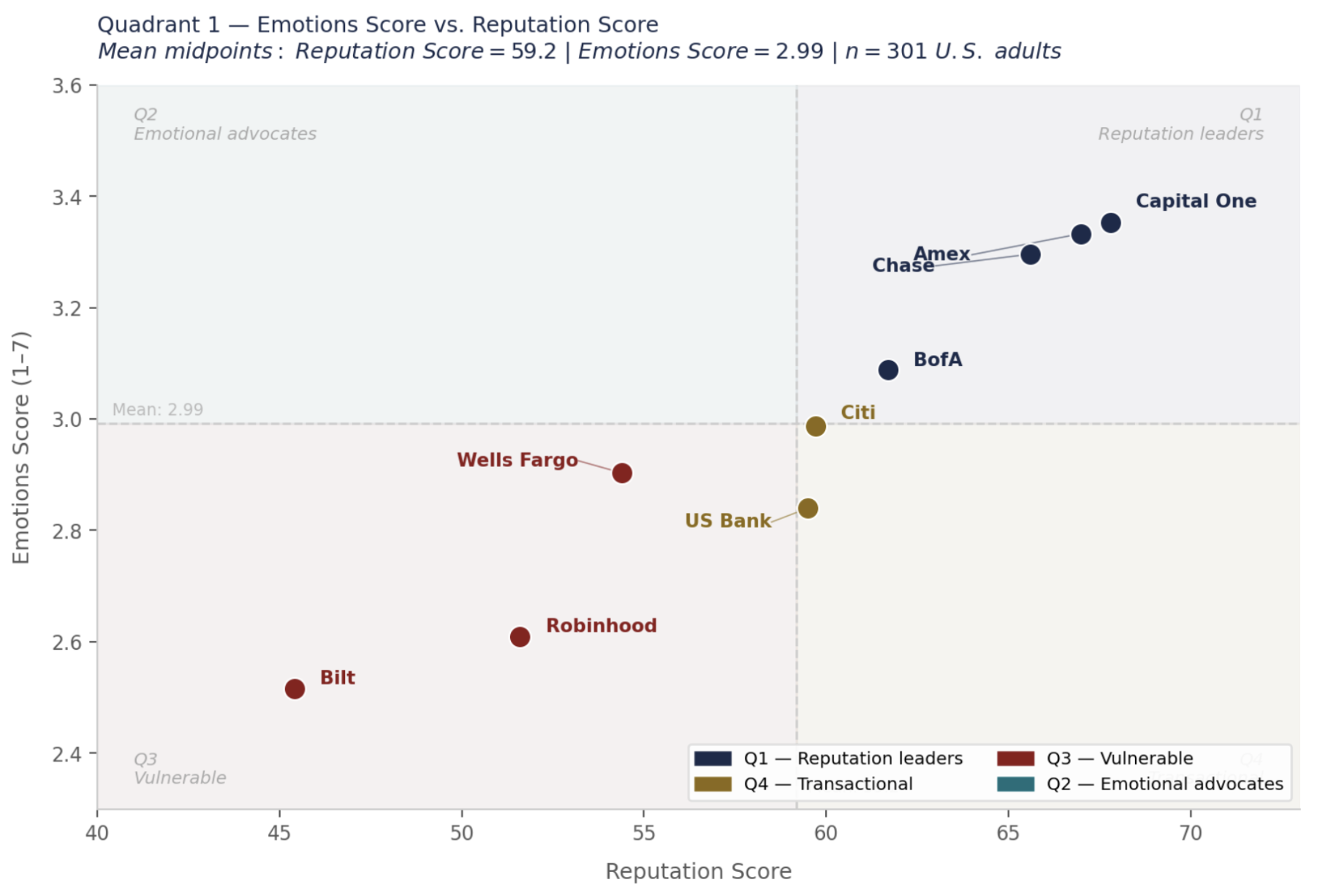
The first quadrant clarifies the structural situation. American Express, Chase, Capital One, and Bank of America occupy the upper-right as Reputation Leaders — brands with above-average scores on both dimensions. Citi and U.S. Bank sit in the Transactional quadrant: reputation scores that clear the category mean, but emotional connection scores that fall below it. Wells Fargo, Robinhood, and Bilt cluster in the Vulnerable zone — below average on both. The striking feature of this chart is not which brands are where. It is how tightly the Reputation Leaders cluster near the midpoint of the axes. No brand is deeply positioned in the high/high space. The upper-right corner is essentially unoccupied. That gap is not a weakness in the data. It is an opportunity in the market.
The Capital One Paradox
The most strategically revealing pattern in this study involves the brand that matches Amex and Chase in reputation while trailing them in mind-share. Capital One sits within a fraction of a point of its top-tier peers on Reputation Score and Emotions Score, registers the highest directional scores on Trust, Value, and both identity dimensions, yet ranks third in mental market share — behind American Express by 4.6 points. The reputation equity is there. The gap between that perception position and its MMS ranking points to a broadcast problem, not a perception problem. The communications priority is amplification of an existing truth, not construction of a new narrative. Brands that build trust before they build salience are in a rare position — the right message already exists. It simply needs more surface area.
Chase Feels Good. It Does Not Yet Pull.
Chase leads the category in Feeling Score at 3.45 and in net favorability at 49.4% — the widest positive reception of any brand in the study. Yet its Emotions Score (3.30) trails Capital One and Amex, and its identity metrics rank below Capital One across all four dimensions. Chase is the most consistently liked brand in the category and the most broadly distributed in terms of demographic reach. The communications gap is depth: a reason for cardholders to feel something specific about Chase rather than something generally positive. That is a narrative investment, not an awareness one.
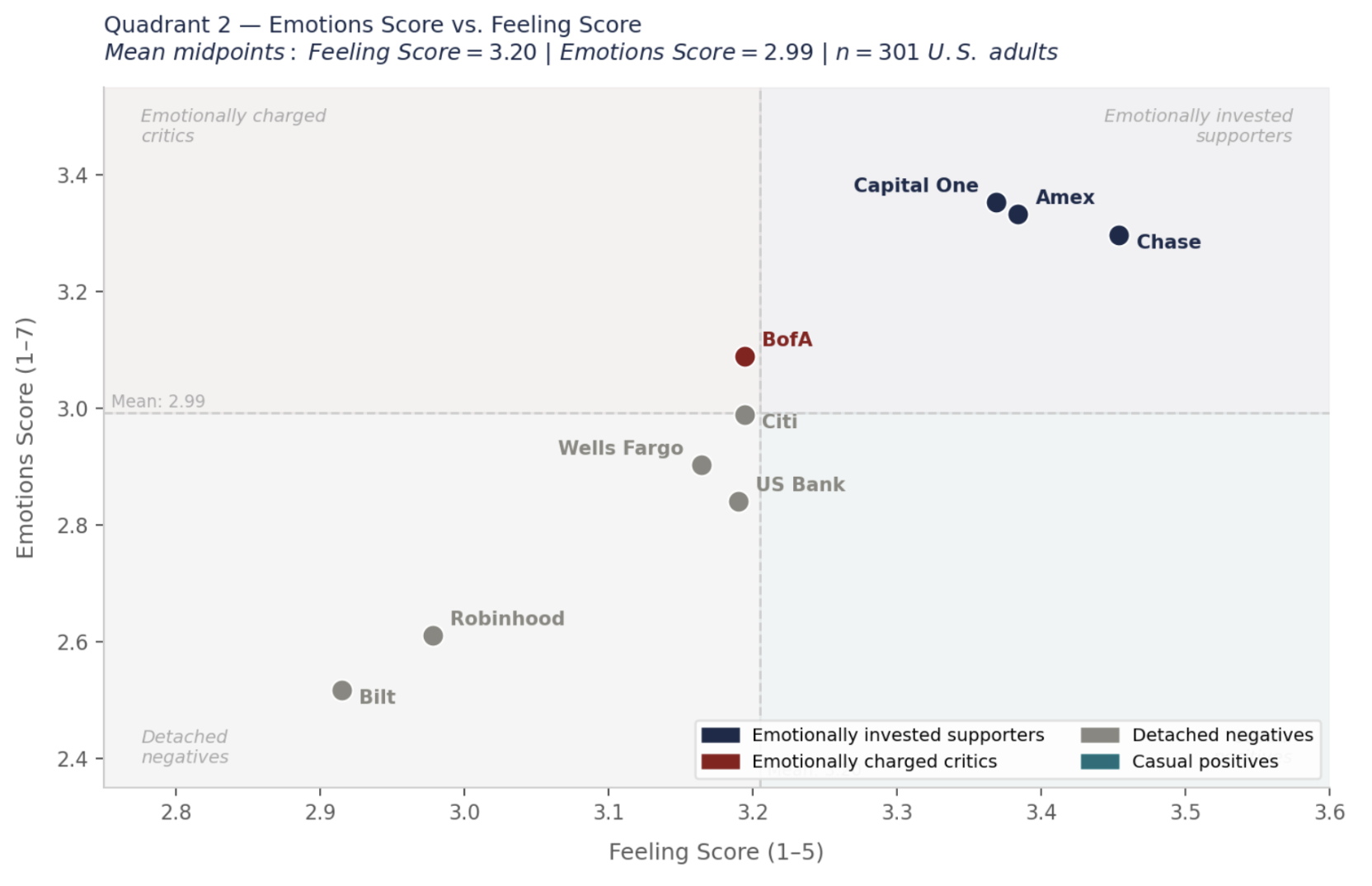
The second quadrant separates the category more sharply. American Express, Chase, and Capital One are Emotionally Invested Supporters — above average on both emotional connection and positive feeling. Five brands — Citi, U.S. Bank, Wells Fargo, Robinhood, and Bilt — fall into the Detached Negatives zone: below average on both dimensions, a cluster that represents the category’s most significant reputational inertia. Bank of America occupies the most diagnostic position in this chart: it lands in the Emotionally Charged Critics quadrant, with above-average emotional engagement relative to a below-average Feeling Score. Adults who have a view of Bank of America feel something about it — but the sentiment tilts negative relative to the emotional investment. That gap between engagement and satisfaction is where reputational risk accumulates. For a brand with BofA’s physical distribution footprint and awareness levels, this suggests that familiarity has not consistently produced goodwill.
The Conversion Equation
The Category Advantage study identified the annual fee as the category’s primary conversion barrier, cited by about 40% of participants. The Reputation Advantage data suggest the problem runs deeper than that figure implies. When surveyed directly about category attitudes, 66% of U.S. adults — not 40% — agree that fees are too high. The discrepancy is explained by context: when asked in isolation what prevents card adoption, consumers cite the fee. When asked how they feel about the category as a whole, they reveal broader skepticism about whether premium cards deliver on their fundamental promise.
The benefit-of-the-doubt score from this study offers a partial counterweight. When asked how likely they would be to give a premium card the benefit of the doubt if something went wrong, 48.5% said they would. Goodwill exists in the category. The problem is that goodwill without a supporting narrative is inert. Consumers who feel broadly positive about a brand but cannot quickly calculate the value of its annual fee default to inertia — and inertia, in a category where renewal is annual and competition is increasing, is not a stable position.
The communications priority is value legibility. Brands that reduce the cognitive cost of calculating fees — through clear, personalized, and proactive benefit summaries rather than marketing-led benefit claims — will convert more of the consideration they already hold. This is as much a reputation exercise as a product one. A brand trusted to be honest about what its card is actually worth to a specific cardholder earns a different relationship than one that makes aspirational claims in acquisition advertising and leaves the value calculation to the cardholder.
The White Space No Brand Has Claimed — and What the Next 12 Months Will Test
Every competitive analysis in this study points to the same conclusion: the emotional marketplace of the premium credit card category is more fragmented and therefore more accessible than its mental marketplace. No brand is seen as unambiguously on the cardholder’s side. No brand has made value transparency a durable reputation position. No brand has established itself as the one that makes the premium experience feel genuinely within reach rather than aspirationally adjacent. First-mover advantage on any of these dimensions is entirely open.
The forward context makes that white space both more valuable and more contested. Morning Consult’s K-economy research from February 2026 found that high-income purchasing intentions have declined across every spending category since late 2025, with price sensitivity among $100k+ adults rising to levels not seen since the tariff disruptions of early 2025. These consumers retain the financial capacity to sustain premium card spending in the near term — accumulated savings still buffer them — but attitudes are clearly shifting toward greater scrutiny of recurring costs. For premium card brands, this creates a specific vulnerability: the renewal decision. A cardholder who felt marginally positive about their card during a period of financial confidence may re-examine that relationship during a period of tightening sentiment. Retention communications — the messages that remind existing cardholders why they made the right decision — are underinvested across the category.
The broader cost-of-living environment and ongoing geopolitical uncertainty add another dimension. New entrants to the premium card category will face headwinds from consumers who are more risk-averse about annual financial commitments. Acquisition messaging built on aspirational travel imagery and lifestyle positioning is likely to underperform compared with messaging that foregrounds financial return, fee transparency, and tangible everyday value. The Category Advantage finding that the primary entry point into this category is financial optimization — at 33%, larger than any travel or lifestyle trigger — gains additional weight in this environment. It was always the strategic priority. In the current macro moment, it becomes the most credible entry point for new communications investment.
For reputation and communications leaders across this sector, the operational implication is a shift in the balance between acquisition and retention, and a shift within acquisition from status signaling to value demonstration. The brands that build reputations as honest, accessible, and transparent stewards of their cardholders’ money will not simply weather a more difficult consumer environment. They will emerge with the kind of earned trust no media budget can manufacture after the fact. The permission slip has always been reputation — and in the environment taking shape right now, it is also the most durable asset any of these brands can build.
|
Methodology Online survey of n=301 U.S. adults, fielded April 14–15, 2026. Weighted to U.S. Census benchmarks on age, gender, education, race/ethnicity, and region. Margin of error ±5.6 percentage points at the 95% confidence level. Reputation Score is a Morning Consult composite of five brand metrics: Favorability, Trust, Value, Community Impact, and Admired Employer. Quadrant midpoints set at category mean values: Reputation Score 59.2, Emotions Score 2.99, Feeling Score 3.20. MMS = Mental Market Share from Morning Consult Category Advantage study, April 2026. |
.png)
Chase Sapphire Reserve: A Consistently Positioned Brand
.png)
Perplexity AI: The Trusted Research Engine in Consumer AI