

The bottom line up front
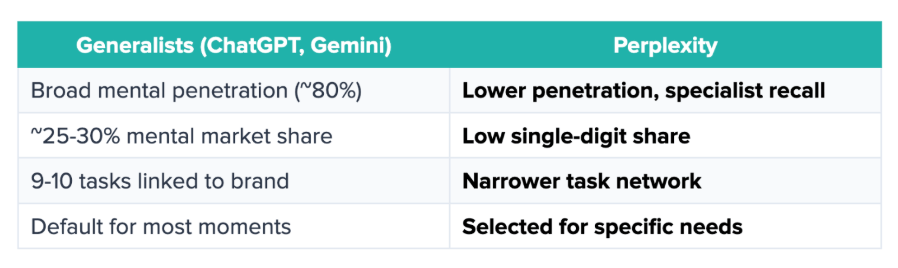
Perplexity has a clarity advantage in the category, with a mental role that is tightly concentrated around research and credibility-seeking tasks. It tends to be remembered as a 'research/answer-with-sources' tool rather than a general-purpose assistant — valuable, but inherently narrower. The strategic priority is to expand Perplexity's mental footprint beyond 'research mode' while doubling down on the proof points that make it feel more trustworthy than generalist chatbots.
The Enterprise AI Category Today
Consumer AI is driven by mainstream utilities anchored by ChatGPT and Google Gemini, which dominate both mental penetration and mental market share. A second tier (Copilot, Meta AI, Grammarly AI, Apple Intelligence, Canva AI) competes through ecosystem distribution or task specialization.
Beneath that, a long tail of specialists — including Perplexity — competes on sharper roles rather than broad recall. This is typical of maturing categories: a couple of generalist 'front doors' plus a widening set of specialists who win on distinct jobs.
Perplexity’s Competitive Strengths:
1. 'Research-first' clarity. Perplexity positions itself as an ‘answer engine’ that provides answers with sources/citations you can verify — and can credibly position itself as the tool for 'I need to be sure,' not 'I need to chat.'
2. High-quality usage moments. The use cases it naturally fits — researching topics, understanding complex issues, comparing options, and verifying claims — are high-value and repeatable, especially for knowledge workers, students, and high-intent decision-makers.
3. Built-in differentiation. In a market where generalists can feel like black boxes, Perplexity's 'answers with sources' posture gives it a trust hook that can scale with the category's rising concerns about accuracy and misinformation.
Perplexity’s Challenges:
-
Low top-of-mind share. Even when mental penetration is respectable for a specialist, Perplexity's mental market share sits in low single digits, meaning it is often a known option but not a default retrieval in most moments.
-
Narrow task network vs. generalists. Perplexity is primarily associated with 'information work' tasks (research, quick answers, understanding) and less with life admin, planning, writing polish, or entertainment — limiting how often it comes to mind across the week.
-
Distribution disadvantage. System-embedded assistants (Copilot, Apple Intelligence, Meta AI) reduce friction at the moment of need, and generalists dominate habit. Perplexity must win on reason to choose, not convenience alone.
The core insight: Perplexity is primarily retrieved for information and verification-oriented tasks, rather than social or entertainment-driven chat occasions.That's a strength: it gives the brand a clean narrative and a defensible niche. But it also means growth will come from expanding the number of occasions where 'certainty' is relevant, not from trying to become everything to everyone. The strategic imperative is to turn Perplexity into the category's default 'truth-seeking' engine — and then broaden that role into everyday tasks where proof matters.
Who Uses Perplexity Today
Strongest segments:
1. Students and knowledge workers: Heavy need for research, synthesis, and credible sources.
2. High-intent decision makers: People comparing purchases, planning travel, evaluating health/finance info, or making work decisions.
3. Multi-tool AI users: Those who already use ChatGPT/Gemini but want a second tool for verification.
Opportunity segments:
1. Mainstream users who are accuracy-anxious: People curious about AI but wary of hallucinations.
2. Older and more cautious cohorts: Where trust and clarity can be stronger adoption drivers than novelty.
3. Parents / family decision-makers: Homework help, health questions, and planning decisions where 'show your work' reduces anxiety.
Five Strategic Priorities for Perplexity Based on This Research
1. Codify the brand as 'answers you can trust.' Make 'with sources' a signature cue, not a feature footnote. Build consistent demonstrations showing verification, comparison, and traceability.
2. Expand task network by 'proof-ifying' everyday moments. Don't reposition into life admin by imitating generalists. Instead, bring Perplexity into moments where evidence reduces risk: health questions, big purchases, travel planning, schoolwork. Use simple language cues: 'When it matters, use Perplexity.'
3. Create distribution wedges that match the role. If Perplexity is a research engine, it should behave like one: browser/search entry points, extensions, default search partnerships, and 'right-click to verify' flows. Presence in education and knowledge platforms where research tasks are frequent.
4. Win the 'second step' in the AI workflow. Make Perplexity the natural follow-up after a generalist answer: 'Got an answer? Verify it.' Workflow packaging that encourages people to use ChatGPT/Gemini for ideation, then Perplexity for sourcing and validation.
5. Measure success through mental availability expansion. Track growth in mental penetration (more people link Perplexity to at least one task), growth in network size (more tasks where Perplexity is recalled), and improved mental share specifically in 'research/proof' tasks.
About this research
Morning Consult conducts over 30,000 daily proprietary surveys in 45 countries covering more than 5,000 brands and 50 economic indicators.
Our category advantage research is aimed at understanding the needs driving consumers in your category — and how your brand can own more of them. This research is built on validated principles of brand-driven growth and powered by Morning Consult’s industry-leading sampling technology.
Measure the true drivers of brand strength
Capture both mental availability (the likelihood your brand comes to mind when consumers face a need or occasion) and emotional closeness (how strongly consumers connect with your brand), benchmarked against competitors.
Uncover Category Entry Points (CEPs)
Directly tied to mental availability, see the specific needs, occasions, and triggers that drive purchase decisions in your category, and how strongly your brand is linked to them.
Pinpoint growth opportunities
Direct investment toward the moments and consumer segments with the greatest potential to grow your brand.
Turn insights into action fast
Get survey results in 4–5 days through a centralized dashboard and short-form memo that equips stakeholders with clear direction on where and how to win.
Learn more
-1.png)
ChatGPT Leads the Consumer AI Category on Every Core Mental Availability Metric
.png)
The Dynamics Shaping the Consumer AI Category in 2026
.png)