

We last looked at consumer AI back in January. This memo tracks how the category has shifted since then.
The bottom line up front
Google Gemini is one of the category’s clearest winner this wave. The brand consolidated its position as the search-replacement and information-utility AI: mental advantages strengthened on Quick Answer (+10 → +13), Translation (+5 → +8), and Health Info (+8 → +11) — three of the four largest CEPs in the category. Mental penetration rose +3pp to 61%; active use rose to 43%. Crucially, growth concentrated in segments that matter most: 18–34 active use rose +6pp; $100K+ rose +4pp; post-graduates jumped from 45% to 56%. The brand is also retreating from conversational territory — mental disadvantages on Boredom (-5 → -9), Dating (-4 → -8), and Rewriting still at -9 — and that retreat is strategic, not threatening. Gemini is becoming a sharper, narrower, more useful brand. The implication: Gemini is no longer competing with ChatGPT for the same lane. It is winning a different one.
|
In this memo, we use the Category Advantage research framework to measure how consumers consider different types. A few terms you should know: |
|
Where Gemini Stands
|
Gemini is the category’s clear #2 across every mental availability metric — and the gap to ChatGPT is closing on penetration measures. Mental Market Share of 27% sits behind ChatGPT (33%) but ahead of Microsoft Copilot (9%) by a wide margin. Mental penetration of 81% means eight in ten AI users link the brand to at least one purchase trigger — ahead of ChatGPT’s 67% and well ahead of Copilot’s 58%. Network size of 8.1 — the average number of triggers linked to Gemini per person who recalls it — is second only to ChatGPT’s 9.0. Gemini’s habits are forming, not just its awareness. Awareness held flat at 75% this wave (the brand has effectively saturated awareness within the AI-user audience), but mental penetration rose +3pp and active use rose modestly. This is the cleanest signal in the category that exposure is converting to use: a brand whose awareness has plateaued but whose penetration and use are rising is one whose users are moving from “have heard of” to “reach for.” ChatGPT’s penetration was flat to slightly down on the same wave; Gemini’s was up. Mean emotional connection declined alongside the leaders. Gemini scores 3.35 on emotional connection (1–7 scale), down from 3.80 four months ago. The 0.45 decline is consistent with the broader category pattern in which AI brands are losing affective warmth as use becomes routine. Gemini’s position is not differentiated on this dimension: like ChatGPT and Copilot, the brand is being used more utilitarianly than it was. The implication is that Google’s AI is now a tool, not a relationship — which is consistent with the brand’s strengthening identity as the information-utility default.
|
The CEPs Gemini Owns — and the Ones It Doesn’t
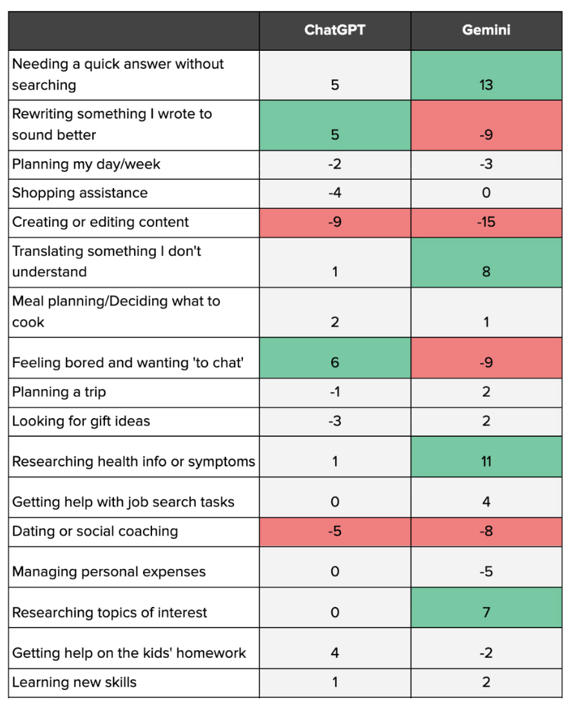
The information-utility lane is consolidating decisively in Gemini’s favor. On the four largest CEPs in the category — Quick Answer (48% salience), Researching topics (47%), Health Info (31%), and Translation (28%) — Gemini holds the strongest mental advantages in the dataset. Mental advantage — a measure of whether the brand captures more or less than its fair share of a given CEP based on its size alone — on Quick Answer rose from +10 to +13. Translation from +5 to +8. Health Info from +8 to +11. Researching held strong at +7. Together these four CEPs represent more than half of all AI moments in the category, and Gemini’s position on each strengthened or held this wave. The brand inherits Google’s existing search schema directly into the AI era, and consumers are increasingly mapping that heritage onto Gemini specifically.
Smaller adjacent advantages are emerging in family and life-management CEPs. Mental advantage on Meal planning rose from -1 to +1 (now slightly positive). On Kids’ homework, the brand’s disadvantage softened from -6 to -2. On Learning new skills, +1 → +2. These are not yet ownership positions, but they signal that Gemini’s utility framing is extending beyond pure information into adjacent practical CEPs. If these gains continue, the brand could broaden into family and household decision-making — territory currently held by ChatGPT.
The brand is retreating from conversational and personal territory — and the retreat is strategic. Mental disadvantages deepened on Boredom/chat (-5 → -9), Dating/social coaching (-4 → -8), and Managing expenses (-0 → -5). Rewriting improved slightly (-11 → -9) but remains the brand’s deepest disadvantage. Creating content held at -15. These CEPs are increasingly uncontested by Gemini — the brand is not competing for them. For a brand consolidating an alternative identity, this sharpening is a feature, not a bug. The conversational, creative, and emotional-support lane is ChatGPT’s; Gemini is choosing to be something else.
Who Gemini Is Winning — and Losing
|
What’s In the Way
Affection is not deepening alongside use. Gemini’s emotional connection dropped 0.45 even as mental penetration and active use rose — users are reaching for the brand more often without feeling more warmly about it. For a habitual utility, this is acceptable in the short term but limits identity-driven loyalty. The risk is that Gemini becomes the AI of necessity rather than choice — a position vulnerable if a competitor delivers similar utility with stronger emotional resonance.
The conversational gap is structural. Gemini’s mental disadvantages on Boredom, Dating, and Rewriting are not narrowing; on Boredom and Dating they are widening. While retreating from conversational territory sharpens the brand’s identity, it also caps the addressable use cases. As CEP salience evolves over time, occasions that lean conversational (advice, support, creative iteration) will accrue to ChatGPT and Claude, not Gemini.
The emerging “third lane” challenger is also in Gemini’s territory. Claude is gaining in $100K+ and post-grad segments — the same audiences Gemini is consolidating. While the brands appear differentiated today (Gemini for quick utility, Claude for considered work), the audiences overlap. Without sharpening the distinction further, the two brands could begin to compete directly for the discerning user segment as their respective positions mature.
What to Do About It |
|
Lock in the information-utility lane with explicit positioning, not implicit habit. Gemini’s mental-advantage gains on the four largest CEPs are largely earned through Google’s existing schema. The window to convert this from inheritance into a defended brand position is now. Explicit messaging that anchors Gemini as “the AI built for information” — research, fact-checking, source synthesis, real-time knowledge — would harden the lane against ChatGPT’s potential repositioning toward research. Extend strategically into family and life-management adjacencies. The emerging mental-advantage gains on Meal planning, Kids’ homework, and Learning new skills suggest Gemini’s utility framing can credibly extend beyond pure information. These CEPs are also where ChatGPT’s parent-segment loyalty is anchored. A focused campaign on practical family-life occasions — leveraging Google’s existing family-product ecosystem — would broaden the brand’s CEP footprint without compromising its sharpening identity. Convert post-graduate momentum into premium subscription growth. The 12pp active-use gain among post-graduates is the brand’s most valuable single data point this wave. These users are the early indicators of where the broader $100K+ audience moves next. Investment in tier-differentiated features for this segment — research depth, multi-step workflow capability, document-grounded analysis — would convert use into subscription before Claude positions itself as the alternative for the same audience. Build emotional differentiation before the EC gap matters. The 0.45 EC decline is consistent with category dynamics, but Gemini’s strategic position depends on being chosen over ChatGPT, not just used alongside it. Brand-experience signals — Google’s responsibility framing, source transparency, factual reliability — can build emotional resonance specific to the utility lane (trust as a feeling, not a feature). This is where the EC gap to ChatGPT becomes addressable without abandoning the sharpening identity. |
About this research
Morning Consult conducts over 30,000 daily proprietary surveys in 45 countries covering more than 5,000 brands and 50 economic indicators.
Our category advantage research is aimed at understanding the needs driving consumers in your category — and how your brand can own more of them. This research is built on validated principles of brand-driven growth and powered by Morning Consult’s industry-leading sampling technology.
Measure the true drivers of brand strength
Capture both mental availability (the likelihood your brand comes to mind when consumers face a need or occasion) and emotional closeness (how strongly consumers connect with your brand), benchmarked against competitors.
Uncover Category Entry Points (CEPs)
Directly tied to mental availability, see the specific needs, occasions, and triggers that drive purchase decisions in your category, and how strongly your brand is linked to them.
Pinpoint growth opportunities
Direct investment toward the moments and consumer segments with the greatest potential to grow your brand.
Turn insights into action fast
Get survey results in 4–5 days through a centralized dashboard and short-form memo that equips stakeholders with clear direction on where and how to win.
Learn more
Hotels & Lodging with Gen Z: Which Brands Lead
.png)
Why Instacart Wins Grocery Delivery — but Struggles in Meal Moments
.png)