

Download our Most Trusted Brands 2026 report here for the definitive ranking of the brands that lead the way on consumer trust — spanning 184 brands across 30 rankings.
The bottom line up front
This is a category where the hard part is already done — almost everyone knows the major brands. Awareness sits at 70–83% for the leaders. Yet the category remains highly competitive and fractured, and the biggest occasions — going out with family — is up for grabs. Growth here won't come from being remembered or from trial; it will come from claiming an unowned moment and removing the price-and-wait friction that stops a known, tried brand from being chosen again. With this audience more optimistic than average but cooling and increasingly value-conscious, the lever is perceived value and ease — not discounting.
In this briefing, we use the Category Advantage research framework. A few terms you should know:
- Mental Market Share (MMS) measures a brand’s "mental availability"—how often it comes to mind, compared to competitors, when consumers think of buying in a category
- Category Entry Points (CEPs) are the specific needs, motivations, situations, or feelings that trigger a consumer to consider a product category and the brands within it
- Network Size refers to the average number of distinct usage occasions or buying situations that consumers mentally associate with a brand
The Category Today
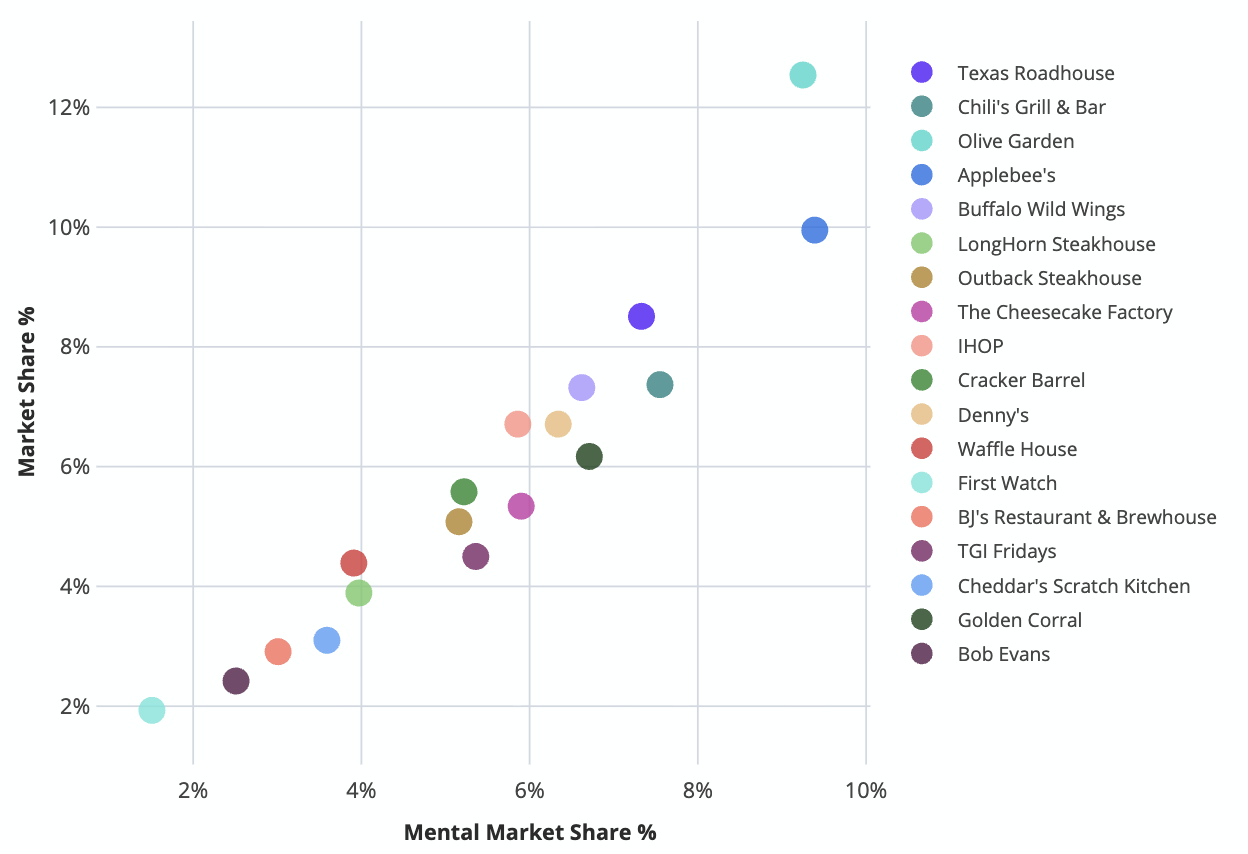
Broad presence, shallow distinction, defines the field. Applebee’s (~11% mental market share, the brand’s share of all purchase-trigger associations) and Olive Garden (~10%) lead, but the gap to Chili’s (~8%) and Texas Roadhouse (~8%) is narrow, and a dense middle tier of Denny’s, Buffalo Wild Wings, and IHOP all cluster near 6.5%. This is a field of near-parity, not a hierarchy. Brands tied to a single occasion are the most exposed, because when that one trigger does not fire, there is no fallback association to catch the diner.
No brand owns the occasions that matter most. On “going out with family,” the single largest entry point, the top four brands sit within seven points of each other. On “not wanting to cook” and “going out for lunch,” the same compression holds, with no brand’s lead approaching the threshold that signals real ownership. The mental real estate is shared, which means it is available.
Awareness without mental presence marks the clearest growth signal. IHOP and Denny’s are widely known (~78% and ~76% awareness) but convert that into only middling mental market share, a sign their physical familiarity is not attached to enough occasions. First Watch, the inverse case, holds the category’s second-highest mental penetration among the diners who know it (~72%) on just 18% awareness, the profile of a brand whose ceiling is recognition, not relevance.
Emotional connection is the category’s missing layer. Olive Garden edges the field on warmth (~3.7), but no brand breaks away, and the wide spread within every brand’s score shows diners are split rather than indifferent. In a category where being thought of is table stakes, feeling is the unclaimed differentiator.
Who Are Casual Dining Users?
Economic sentiment. Casual dining users stay more optimistic than the general public, on personal finances especially, even as sentiment cools for everyone. That optimism coexists with sharp price sensitivity at the table, which means value messaging should speak to confidence and treating, not austerity.
Political and messaging profile. The audience leans Republican and was likelier to back Trump in 2024, though it has grown more pessimistic about the country’s direction and shifted to net-disapproval of the president over the year. Messaging anchored in family, affordability, and everyday reliability travels further than anything culturally polarizing.
Media and activation. Users over-index across social platforms, led by X, Snapchat, and Pandora, and consume sports media at much higher rates than the public across every sport. Their clearest behavioral edge is operational, +14pp on making online reservations and +11pp on meal delivery, pointing activation toward digital booking and off-premise convenience rather than mass broadcast alone.
The Moments That Matter
The category’s triggers are routine and family-anchored, beginning with obligation far more often than indulgence.
“Going out with family” (~44%) is the dominant entry point by a wide margin, and it rewards brands with broad, all-ages appeal and a reputation everyone at the table will accept.
“Not wanting to cook” (~33%) is a convenience-and-relief trigger that favors brands with easy access and a low-friction path from impulse to table.
“Going out for lunch” (~31%) and “meeting friends for a meal” (~28%) reward midday accessibility and social comfort. Secondary triggers, craving a specific food (~28%), celebrating an occasion (~27%), and the value-led “a sit-down meal without spending too much” (~25%), round out a demand space defined by family, routine, and price-consciousness.
How Segments Differ
The structure holds across demographics; the weighting shifts. Every figure below is mental market share by segment.
Age. Among 18–34 year-olds, Buffalo Wild Wings and IHOP each reach ~9% mental market share, jumping into the top tier they do not occupy overall (~7% and ~6% respectively at total), while Olive Garden’s strength concentrates among 65+ at ~12%.
Income. Among $100k+ diners, Olive Garden (~12% mental market share), Chili’s (~10%), and The Cheesecake Factory (~8%) index up, while IHOP and Golden Corral fall off (each dropping 2+ points versus their total figure), splitting the category into an aspirational-casual tier and a value tier.
Region. On mental market share, the South rewards Texas Roadhouse, Cracker Barrel, and Waffle House, while Applebee’s and Olive Garden over-index in the Northeast (Applebee’s reaches ~13% there versus ~11% at total), a reminder that footprint, not message, drives regional weighting.
What’s Blocking Conversion
Price and affordability friction is the dominant barrier (~48% cite prices too high), concentrated among the value-tier brands and lower-income diners. The lever is visible everyday value, bundles and named price points, not blanket discounting that erodes the family-occasion premium.
Access and location friction is the second wall (~39% cite no convenient location nearby), a structural constraint for the lower-awareness, regionally concentrated brands. Where mental presence exists without a nearby unit, off-premise and delivery close the gap.
Experience friction caps the upside at peak (long waits ~34%, too crowded ~32%), hitting exactly the family and weekend occasions the category depends on. Reservations, waitlist tech, and throughput management convert existing demand that is currently walking away.
Why This Matters Now
Claim the family table. The largest occasion in the category has no owner. A brand that builds a distinctive, emotionally warm association with “going out with family,” through consistent message and experience, can separate from a field where everyone is merely present.
Compete on felt value, not low price. With price the top barrier but the audience optimistic and treat-motivated, the win is communicating confident value, what the family gets, not just what it costs.
Fix the peak before buying more reach. Where waits and crowding suppress conversion on prime occasions, throughput and reservation investment will outperform incremental awareness spend.
Breadth beats depth. In a category this compressed, the brands linked to the most occasions, and easiest to act on when the trigger fires, are best positioned to pull ahead of a crowded, undifferentiated middle.
About this research
Morning Consult conducts over 30,000 daily proprietary surveys in 45 countries covering more than 5,000 brands and 50 economic indicators.
Our category advantage research is aimed at understanding the needs driving consumers in your category — and how your brand can own more of them. This research is built on validated principles of brand-driven growth and powered by Morning Consult’s industry-leading sampling technology.
Measure the true drivers of brand strength
Capture both mental availability (the likelihood your brand comes to mind when consumers face a need or occasion) and emotional closeness (how strongly consumers connect with your brand), benchmarked against competitors.
Uncover Category Entry Points (CEPs)
Directly tied to mental availability, see the specific needs, occasions, and triggers that drive purchase decisions in your category, and how strongly your brand is linked to them.
Pinpoint growth opportunities
Direct investment toward the moments and consumer segments with the greatest potential to grow your brand.
Turn insights into action fast
Get survey results in 4–5 days through a centralized dashboard and short-form memo that equips stakeholders with clear direction on where and how to win.
Learn more

Royal Caribbean Is the Cruise Category’s True Generalist
.png)
Exploring the Leading Brands in the Cellular Service Category
-1.png)