

Download our Most Trusted Brands 2026 report here for the definitive ranking of the brands that lead the way on consumer trust — spanning 184 brands across 30 rankings.
The bottom line up front
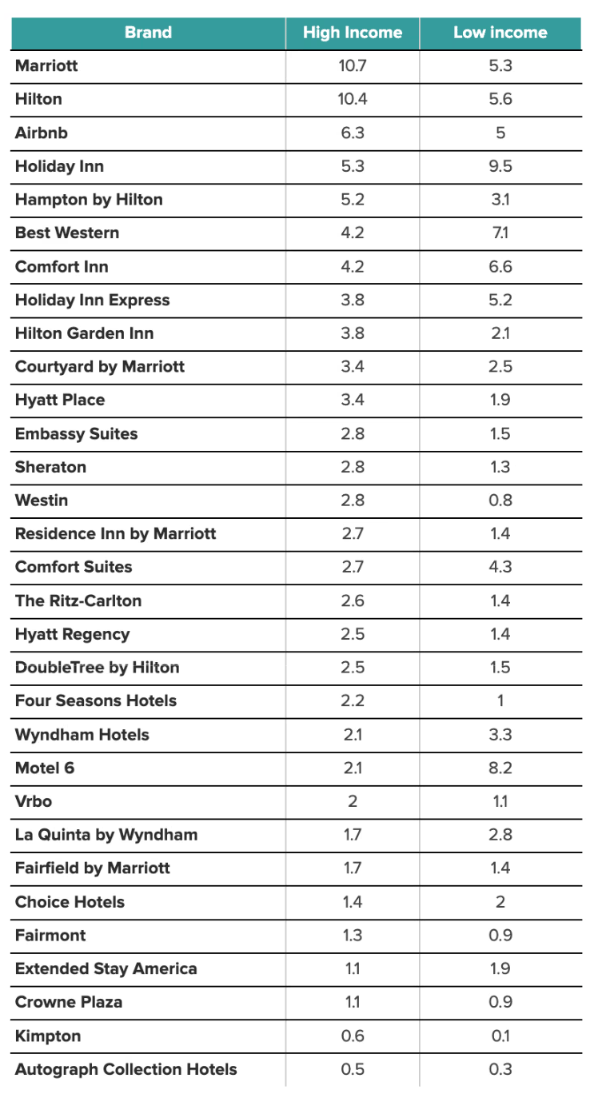
Holiday Inn leads the U.S. hotel and lodging category in mental availability — but among the travelers with the most to spend, the brands that come to mind first are Marriott and Hilton. The aggregate ranking conceals a structural split: Among households earning $100k or more, Marriott and Hilton each surface as the most mentally present brands in the category, reaching ~11% and ~10% respectively in mental market share, while Holiday Inn drops to just over 5%. Among households earning under $50k, the order flips: Holiday Inn is the brand consumers reach for, at nearly 10%. In a category shaped by a widening K between economy and premium travelers, the strategic question isn't how many people think of your brand. It's which people — and whether they are the buyers worth fighting for.
The Category Landscape
At a total level, no brand has locked in dominance but the category has a visible pecking order. Holiday Inn holds ~8% mental market share (a brand’s share of all purchase-trigger associations in the category) across all travelers, with Hilton and Marriott each at ~7%. Below them, Best Western, Motel 6, Comfort Inn, Holiday Inn Express, and Airbnb cluster between 5–6%. Mental penetration confirms the pattern: Holiday Inn leads at ~74%, Marriott at ~69%, Hilton and Airbnb both at ~66%. This rank order however changes as we look among key audiences, including income breaks, Gen Z travellers, and parents with children.
The top occasions are universally contested. No brand owns them. Visiting friends or family (~31% salience), taking a weekend trip (~26%), and exploring a new city (~26%) account for the large majority of category purchase triggers. On each, the spread between the leader and the fourth brand rarely exceeds 7–8 points. Holiday Inn leads weekend trips at ~27%, with Comfort Inn and Best Western trailing by 3–5 points. On new-city exploration, Hilton (~26%) and Marriott (~26%) lead, with Airbnb at ~24%. These are occasions all consumers consider and no brand has claimed as its own.
The luxury tier converts awareness into a narrow mental footprint. Ritz-Carlton sits above 40% aided awareness while Four Seasons sits just below at ~39%; both hold only ~1.5% mental market share. Four Seasons’ clearest mental home is the anniversary and milestone occasion (~26%), where Ritz-Carlton leads the category at ~30%. That occasion accounts for just 17% of category purchase triggers. Outside it, luxury brands are largely absent from the active consideration set.
Income is the sharpest dividing line. Motel 6 holds ~8% mental market share among lower-income households and ~2% among $100k+ households. Marriott runs the inverse: ~6% among lower-income adults, ~11% among high-income ones. Hilton mirrors it at ~10% among $100k+ households. The premium traveler is already a three-brand contest — and one of those brands is not a hotel.
Mental Market Share % By Income
Who Are Hotel & Lodging Accommodation Users?
Category users are more optimistic about both personal finances and business conditions than the general US adult population, per Morning Consult Intelligence. The core user is a Millennial-skewing, majority-male parent with above-average income representation, entering purchase moments with the means and intent to act.
Decision-making is driven by novelty, trends, and status, which connects directly to why milestone occasions and new-city exploration carry strong purchase weight even in a value-sensitive environment.
On media, users over-index on LinkedIn, WhatsApp, Yelp, and Spotify: professional and taste-making channels that skew toward considered, social-proof-influenced decisions. Sports media consumption is notably higher than gen pop. They also over-index on concerts, sporting events, and movies, tying their media habits directly to the travel occasions they book around.
Request a briefing on your category's users
The Moments That Matter
The top purchase triggers are social and exploratory: visiting friends or family (~31%), taking a weekend trip (~26%), and exploring a new city for sightseeing and food (~26%). Together they reward brands with broad geographic footprints and strong awareness among younger, mobile travelers.
The next tier includes life-event occasions (attending a wedding or graduation out of town at ~20%, celebrating an anniversary or milestone at ~17%) and price-driven triggers (booking last-minute at ~18%, best deal at ~17%). Life-event occasions reward reliability and scale; price-driven ones reward value associations and deal visibility. Roadside stops (~16%) and extended stays (~16%) occupy their own competitive space.
The extended-stay occasion stands apart. Airbnb associates with it at 31% and Extended Stay America at 32%, while no major full-service hotel brand clears 21%. This is the one occasion where the competitive geometry has shifted, driven by STR structural advantages: space, kitchen access, and flexibility.
What’s Blocking Conversion
Price is the dominant friction category. Roughly 39% of category users name “nightly rate outside my budget” as the top barrier. Counter-intuitively, this friction peaks among middle-income travelers (43%) and high-income travelers (42%), not the lowest earners (35%). Lower-income consumers tend to self-select into affordable options; it’s the aspirational middle-income and premium-seeking high-income traveler who most frequently hits the rate wall. Transparent total-cost presentation and loyalty discounts surfaced early in the booking flow are the clearest conversion levers for these segments.
Location and availability friction is a structural constraint, not a messaging problem. “Property not conveniently located” (~29%) and “no availability on my dates” (~29%) are the second and third most common barriers. Brands with strong mental availability in markets where they lack physical inventory face a conversion ceiling that positioning cannot close.
Logistics friction explains the extended-stay gap. Pet-friendly policy (~20%), mandatory fees (~19%), minimum-stay requirements (~18%), and no kitchen access (~19%) cluster around extended-stay scenarios. These are structural disadvantages for full-service hotel brands in a high-salience occasion, not positioning decisions. They might explain why Airbnb and Extended Stay America have consolidated mental presence on week-plus stays that traditional hotels cannot match through messaging alone.
Why This Matters Now
Premium growth is already a three-brand contest. Marriott and Hilton both clear 10% mental market share among $100k+ households, and Airbnb holds ~6% in that segment, ahead of Holiday Inn’s ~5%. Hotel operators competing for premium travelers should treat Airbnb as a direct mental competitor, particularly for extended-stay and exploratory occasions. The response is sharper occasion ownership and lower friction in the booking experience.
Match investment to income segment. Holiday Inn and economy-tier brands hold strong mental availability among lower-income travelers, but the dominant conversion barrier in that segment is location and availability, not rate. Rate friction concentrates among middle-income and high-income travelers. Additional reach investment will underperform in any income segment where the real blocker is structural. Diagnose before spending.
The extended-stay occasion belongs to STR and extended-stay specialists. No full-service hotel brand holds above 21% association with the week-plus stay occasion. Brands without dedicated extended-stay product should not attempt to compete on this occasion through messaging. For upper-midscale brands with suites and kitchenettes in their portfolio, closing the flexibility gap on pet policy and mandatory fees is a concrete near-term conversion play.
Breadth beats depth in the contested middle. The three occasions driving the most category volume are all contested within 7–8 points. No brand has locked in ownership. Brands that show up consistently across all three, through national footprint, booking-channel presence, and visible loyalty benefits, will compound their position. Concentrating investment on a single occasion in a field this compressed is a losing strategy.
About this research
Morning Consult conducts over 30,000 daily proprietary surveys in 45 countries covering more than 5,000 brands and 50 economic indicators.
Our category advantage research is aimed at understanding the needs driving consumers in your category — and how your brand can own more of them. This research is built on validated principles of brand-driven growth and powered by Morning Consult’s industry-leading sampling technology.
Measure the true drivers of brand strength
Capture both mental availability (the likelihood your brand comes to mind when consumers face a need or occasion) and emotional closeness (how strongly consumers connect with your brand), benchmarked against competitors.
Uncover Category Entry Points (CEPs)
Directly tied to mental availability, see the specific needs, occasions, and triggers that drive purchase decisions in your category, and how strongly your brand is linked to them.
Pinpoint growth opportunities
Direct investment toward the moments and consumer segments with the greatest potential to grow your brand.
Turn insights into action fast
Get survey results in 4–5 days through a centralized dashboard and short-form memo that equips stakeholders with clear direction on where and how to win.
Learn more
.png)
Why Honda Is One of the Auto Category's Most Structurally Sound Brands
.png)
Why Toyota Leads the U.S. Automobile Category
.png)