Building on our prior article on Category Entry Points, Barriers, and Where Advantage Is Won—how readily a brand comes to mind in buying situations and what gets in the way—this memo synthesizes findings from the same 20 category studies but focuses on brand-level Emotional Connection (EC) scores gathered across 300+ brands.
The bottom line up front
Every brand choice begins with the options our brain brings forward for consideration in a given situation (mental availability). This is largely shaped by past experiences, the current situation, and future goals. This also means that many of the brands we are aware of never make it past this first filter, while those with strong mental availability get to compete for selection.
Emotional Connection— and more precisely how psychologically distant or close one feels toward a brand —plays an important role in determining which brand holds differential value in someone’s mind compared with other options being considered. That sense that this brand is “me” or “not me” can play into what we prefer and the choices that we make as our brains tend to blur “what is me” with “what is good.”
Emotional connection, as defined above, is therefore an important addition to the mental availability framework to diagnose strengths and weaknesses, and what to do about it.
- Category-level emotional connection is measured on a 7-pt scale, and varies in a way that tracks how experiential — versus utilitarian and friction-bound — a category is. Streaming, pet retail and premium cards run the warmest, while cellular and airlines are the coldest. Social media sits low too (~2.8), but for a different reason — its score is almost entirely usage-bound, so it's "habit" more than "warmth."
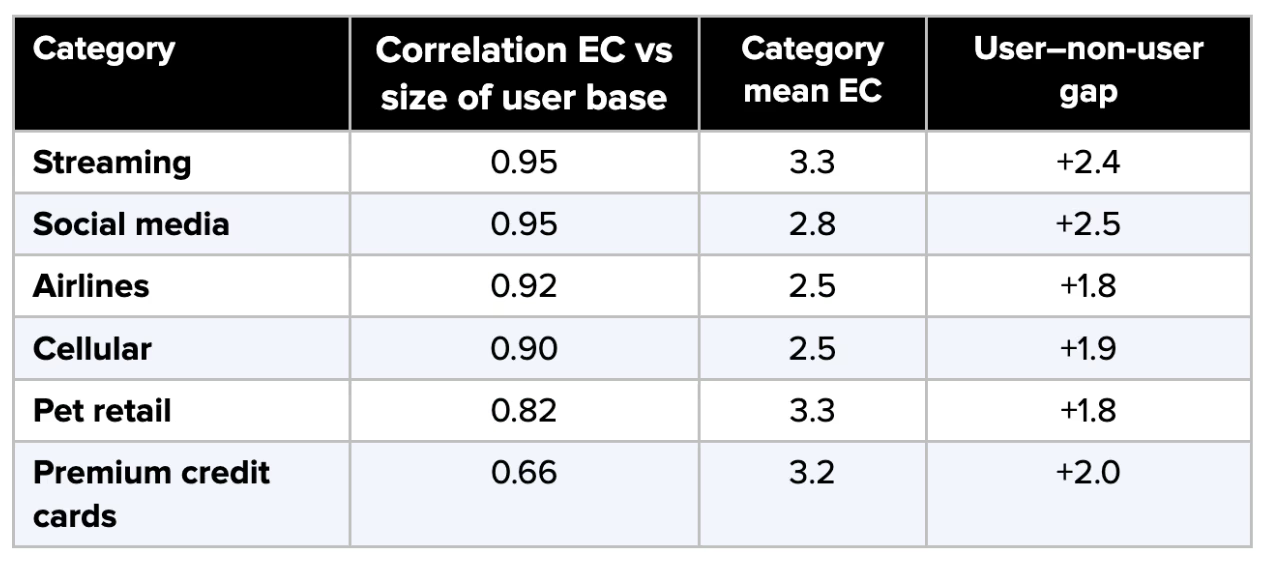
- The mean EC score we report for each brand is, in most categories, a restatement of how big the brand is. Across six of seven categories, a brand’s mean EC correlates 0.66 to 0.95 with the size of its user base. A brand’s average is mostly a blend of “high score from my users” and “low score from everyone else,” weighted by penetration.
- The most useful signal is therefore not the mean — it is the part of EC that size does not explain: how bonded a brand’s own users are (independent of how many there are), and how much warmth a brand carries among people who do not yet use it or seldom use it. Those residuals behave very differently from the mean, and they are not redundant with Mental Market Share.
Mean emotional connection is mostly a size mirror
Correlating each brand’s mean EC with the size of its user base, within the category, produces a consistently high coefficient. EC tracks penetration almost mechanically: the more users a brand has, the more of its average is pulled up by the user halo.
Emotional connection is earned through usage
The relationship between emotional connection and share of category requirements typically follows a J-curve. At 0% share — non-users who give the brand none of their category consumption/usage — emotional connection sits at its lowest (often below 2 on the 1–7 scale). As share of requirements rises, connection climbs steeply, then flattens: the move from non-user to light user (0% → ~10%) buys the biggest jump in stated connection, while the move from heavy user to near-exclusive (20% → 30%+) adds progressively less (see Instagram example below).
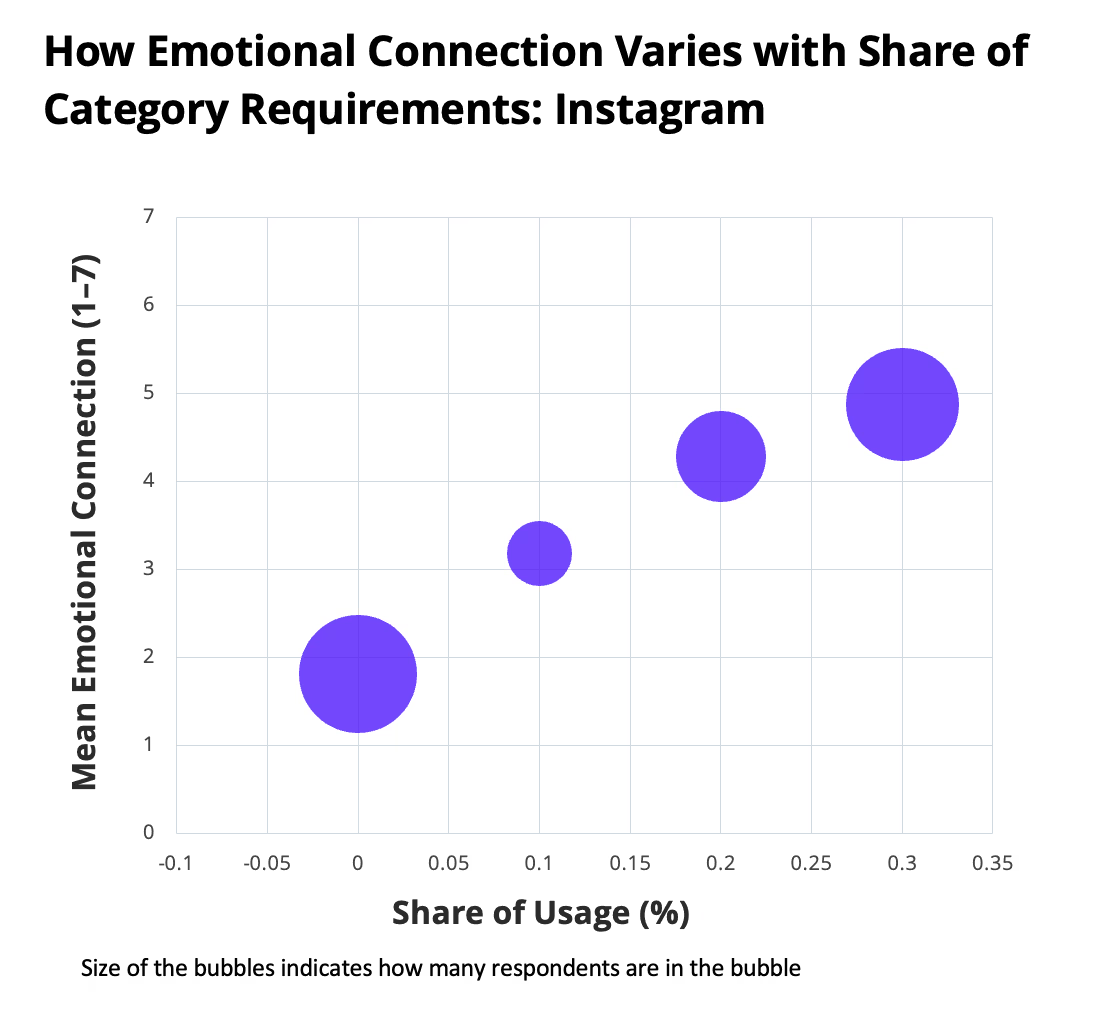
The shape reinforces the core point being made: emotional connection is largely earned through usage rather than the other way around — most of the emotional payoff is unlocked simply by converting a non-user into a user, with deepening share delivering diminishing emotional returns. Practically, that means the highest-leverage emotional work is at the bottom of the curve (getting non- & light users to first meaningful usage), not at the top (squeezing more devotion from already-heavy users).
What the average leaves out is what's worth reading
Once size is set aside, three size-independent measures carry real information
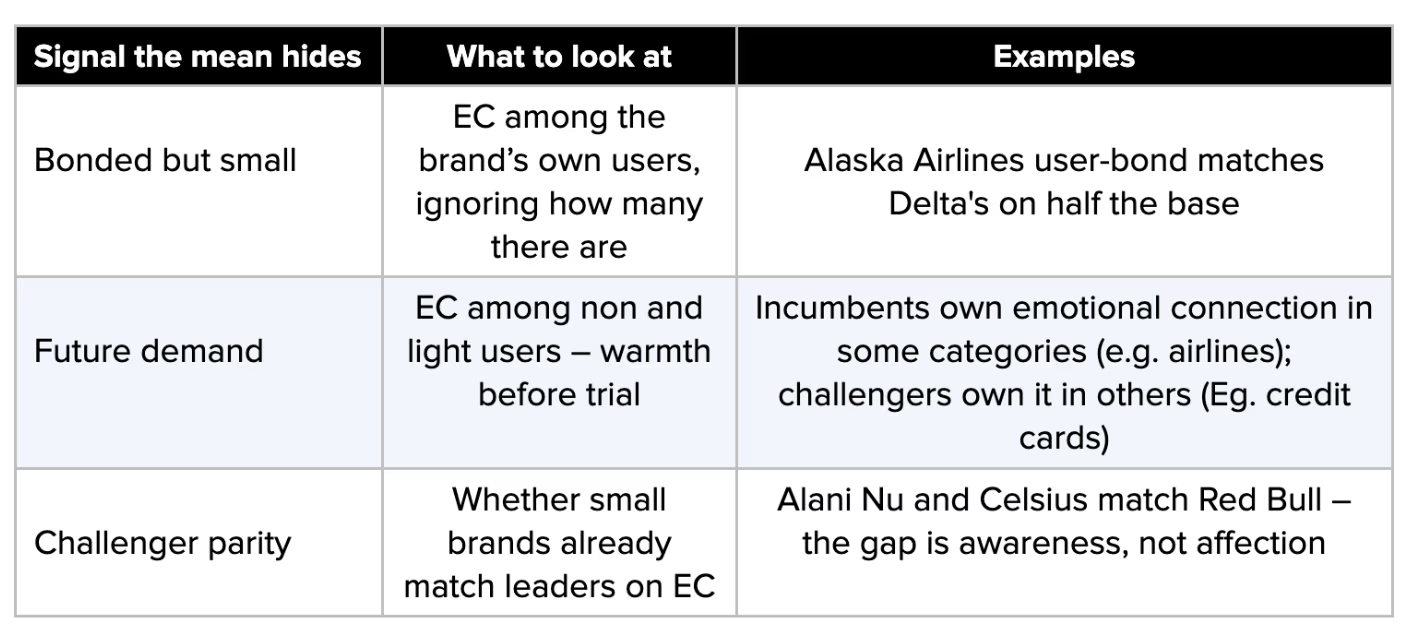
Future demand — EC among non-users — is the genuine leading indicator, because it is warmth that exists before usage and therefore before the mean can capture it. Its direction is itself diagnostic: in airlines the incumbents own the latent warmth (people aspire to fly Delta), while in premium cards the relationship inverts (non-user warmth correlates negatively with size, ~−0.75 — the challengers carry the aspiration while the largest issuers meet non-user resistance). A single mean score collapses all of this into one number that mostly reflects headcount.
Category “coldness” tracks friction — where EC matters most but is hardest to build
At the category level, mean EC sorts cleanly along the same stakes-and-friction axis that governs the barriers analysis we presented in our earlier memo. The coldest categories are the high-friction, defensive, utility ones — cellular and airlines both sit around 2.5, the lowest in the set — while experiential categories (streaming, pet, cards) run warmer at ~3.2–3.3. Even the warm ones are lukewarm in absolute terms.
This creates a strategic tension: Emotional connection does its most valuable work precisely in the high-friction categories — it is what earns forgiveness after a service failure and what sustains renewal when switching is painful (the airline and insurance evidence both point this way). Yet those are exactly the categories where EC is coldest and hardest to build, because the relationship is transactional and usage is sticky-but-unloved. The brands that break out are the ones that carry warmth beyond their user base: in airlines, the carriers with the highest non-user connection (Delta, United) are the ones positioned to convert friction-driven switching into share.
Conclusion
Mental availability explains which options the brain brings forward in a buying situation. But because several brands are usually summoned at once, being available is only the price of entry. Emotional connection helps decide which of those available brands are more likely to get chosen, more often. A strong Mental Market Share gets you into the room; it does not guarantee you walk out with the sale. See The context advantage for more details, including the methodology used for Emotional Connection with examples.
About this research
Morning Consult conducts over 30,000 daily proprietary surveys in 45 countries covering more than 5,000 brands and 50 economic indicators.
Our category advantage research is aimed at understanding the needs driving consumers in your category — and how your brand can own more of them. This research is built on validated principles of brand-driven growth and powered by Morning Consult’s industry-leading sampling technology.
Measure the true drivers of brand strength
Capture both mental availability (the likelihood your brand comes to mind when consumers face a need or occasion) and emotional closeness (how strongly consumers connect with your brand), benchmarked against competitors.
Uncover Category Entry Points (CEPs)
Directly tied to mental availability, see the specific needs, occasions, and triggers that drive purchase decisions in your category, and how strongly your brand is linked to them.
Pinpoint growth opportunities
Direct investment toward the moments and consumer segments with the greatest potential to grow your brand.
Turn insights into action fast
Get survey results in 4–5 days through a centralized dashboard and short-form memo that equips stakeholders with clear direction on where and how to win.
Learn more
.png)
U.S. Auto Market Trends: What's Driving Purchase Decisions
-1.png)
Microsoft Copilot Is at a Make-or-Break Moment