In order to understand the current state of AI adoption at the enterprise level, Morning Consult conducted a survey of 3,003 U.S. Business Decision Makers (BDMs) — employees who are influencers or primary decision-makers for strategic initiatives, operations, resources, or other business decisions, holding a manager-level title or above. This survey was conducted July 21–24, 2026.
|
|
at companies with |
at any size company |
Key Takeaways
The bottom line: Large enterprises plan to increase AI spending over the next 12 months, with Microsoft Copilot holding the widest adoption. Substantial shares of buyers also remain open to changing platforms, and decision criteria center on accuracy, security and compliance.
-
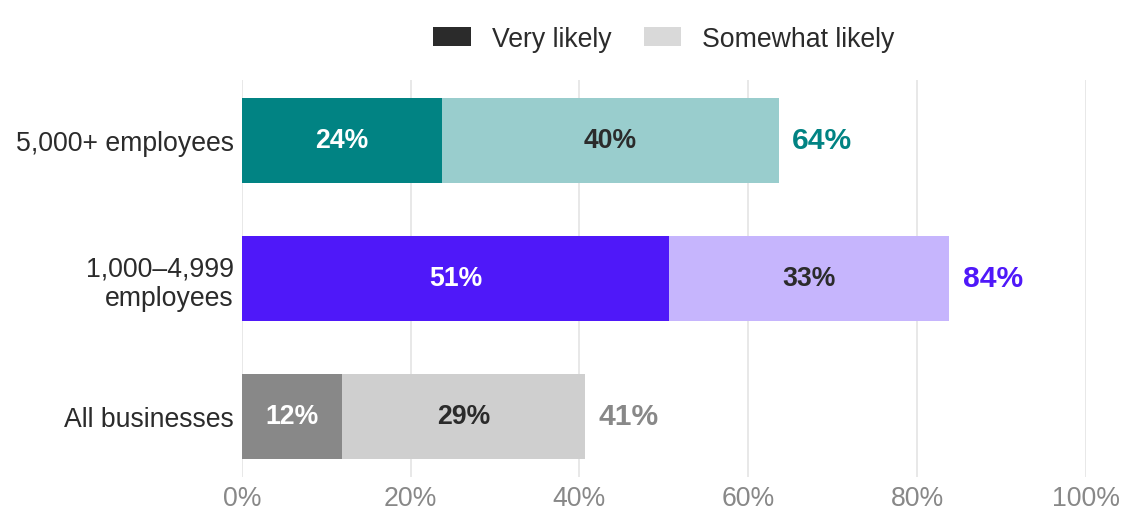
64% of decision makers at companies with 5,000 or more employees — and 84% at companies with 1,000–4,999 — say their organization is likely to increase spending with current AI platform providers over the next 12 months.
-
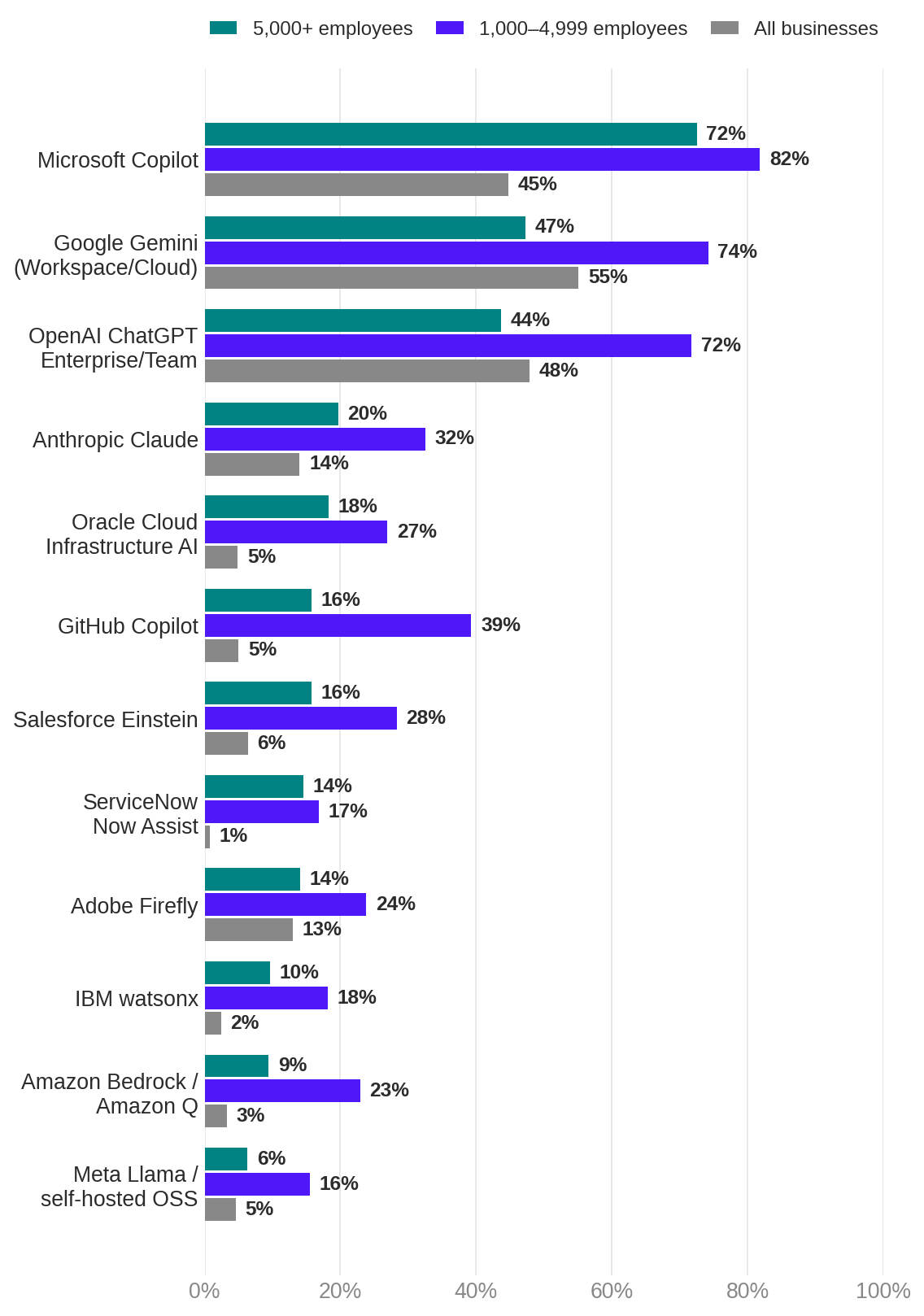
Microsoft Copilot has the widest adoption footprint among enterprises: 73% of the largest companies and 82% of less large enterprises have approved it or use it, followed by Google’s Gemini and OpenAI’s ChatGPT Enterprise.
-
Most enterprises run multiple platforms. 27% of the largest companies operate a single primary enterprise-wide platform, and over the past year companies added platforms far more often than they cut them.
-
Accuracy and quality of outputs is the top decision criterion in every segment, followed by security and compliance. Total cost of ownership ranks eighth of 12 factors at the largest companies and last among less large enterprises.
Note: Companies with 5k+ employees are referred to as "largest" and those with 1-4.9k are referred to as "less large."
The corporate AI platform market entered the second half of 2026 with adoption broad, budgets growing and standardization still incomplete. New Morning Consult survey data map where the market stands: which platforms enterprises have approved, how they plan to change their setups over the next 12 months, and what drives those decisions.
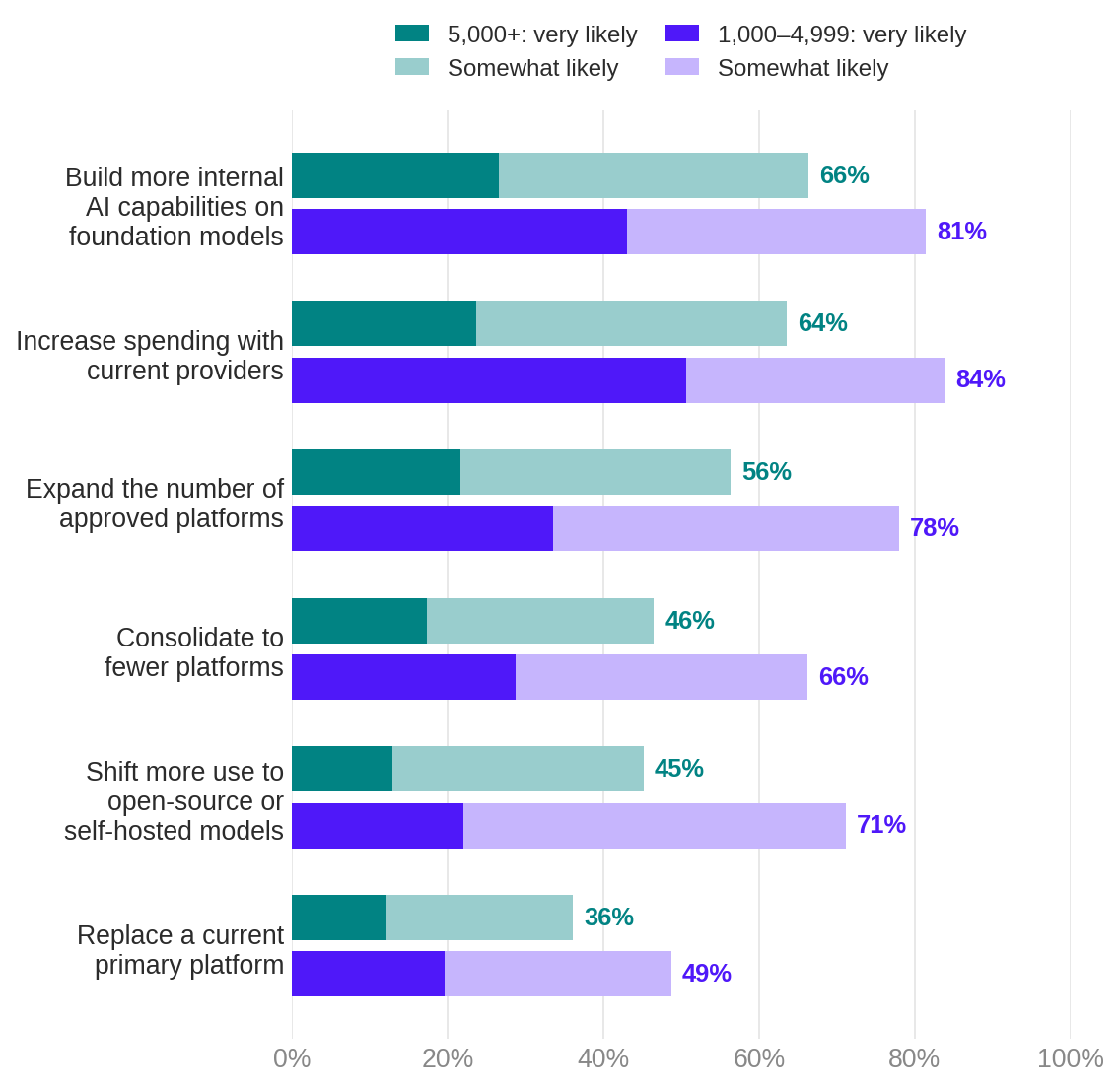
Among the largest companies — the segment that accounts for the bulk of enterprise software spending — 64% say they are likely to increase spending with their current AI providers over the next 12 months, including 24% who call it very likely. At less large companies, 84% expect to spend more. At the same time, 36% of the largest companies and 49% of less large firms say they may replace a current primary platform within the year.
Most Enterprises Plan to Increase AI Spending
Share saying their organization is likely to increase spending with current AI platform providers in the next 12 months
Microsoft Copilot has the widest enterprise footprint: it is approved or in active use at 73% of the largest companies and 82% of less large ones. Google’s Gemini (47% of the largest companies) and OpenAI’s ChatGPT Enterprise (44%) follow, with Anthropic’s Claude leading the next tier at 20%. Among businesses of all sizes — a population dominated by firms with fewer than 100 employees — Gemini is the most commonly used platform at 55%, ahead of ChatGPT at 48% and Copilot at 45%.
Most enterprises operate more than one platform. 27% of the largest companies and 31% of less large firms run a single primary enterprise-wide platform, while roughly half maintain a small roster of approved tools for different needs. Over the past year, 44% of the largest companies added at least one new platform and 5% reduced their count; 21% expanded use of existing platforms without changing vendors, and 20% made no meaningful changes.
Microsoft Copilot Leads Enterprise AI Adoption
Share of decision makers saying each AI platform is approved for use or actively used anywhere in their organization
How Adoption Varies by Company Size
Company size shapes both the breadth and depth of adoption. Less large enterprises report higher adoption than the largest companies on most platforms measured — ChatGPT Enterprise reaches 72% of less large firms versus 44% of the largest, and Gemini 74% versus 47% — and greater depth of use: 72% of less large firms say AI is used widely across relevant teams for general productivity work, compared with 48% of the largest companies, where governance and compliance review cover more territory.
Smaller businesses trail on both counts. Across businesses of all sizes, 24% report no meaningful AI platform use today, 42% made no changes to their AI setup over the past year, and 18% have standardized on a single primary platform. Spending intent is also softer: 41% expect to increase spending with current providers over the next 12 months.
Plans for the Next 12 Months
Asked what their organization is likely to do over the coming year, decision makers at the largest companies most often point to building internal AI capabilities on top of foundation models (66% very or somewhat likely) and increasing spending with current providers (64%). 56% say they are likely to expand their roster of approved platforms, 47% to consolidate to fewer, 45% to shift more use toward open-source or self-hosted models, and 36% to replace a current primary platform.
Less large enterprises report higher likelihoods on every action, ranging from 49% for replacing a primary platform to 84% for increasing spend, while the broader business population reports lower ones: 42% of all businesses expect to expand their platform roster and 33% to consolidate. That many companies rate both expansion and consolidation as likely suggests platform lineups remain in flux, with new evaluations running alongside efforts to standardize.
Large Enterprises Prioritize Internal AI Capabilities and Higher Spending
Share saying their organization is very or somewhat likely to take each action in the next 12 months
What Drives Platform Decisions
Accuracy and quality of outputs is the most widely cited decision criterion in every segment: 78% of decision makers at the largest companies call it very important, along with 75% for security, privacy and data handling and 73% for legal, risk and compliance requirements. Total cost of ownership ranks eighth of the 12 factors at the largest companies (52%), last among less large enterprises (45%) and sixth among businesses of all sizes (54%), where ease of use for employees also rates higher (58%) than it does among enterprises.
Recent behavior is consistent with those priorities. Among the largest companies that changed their AI setup in the past year, 49% cite better model quality or performance as a major reason and 48% cite security, privacy or data governance, compared with 22% who cite lower total cost. The pattern is similar at less large firms, where 65% cite quality and 65% cite security, versus 28% for cost.
Accuracy, Security and Compliance Lead AI Platform Decision Criteria
Share saying each factor is “very important” when deciding whether to keep or change AI platforms 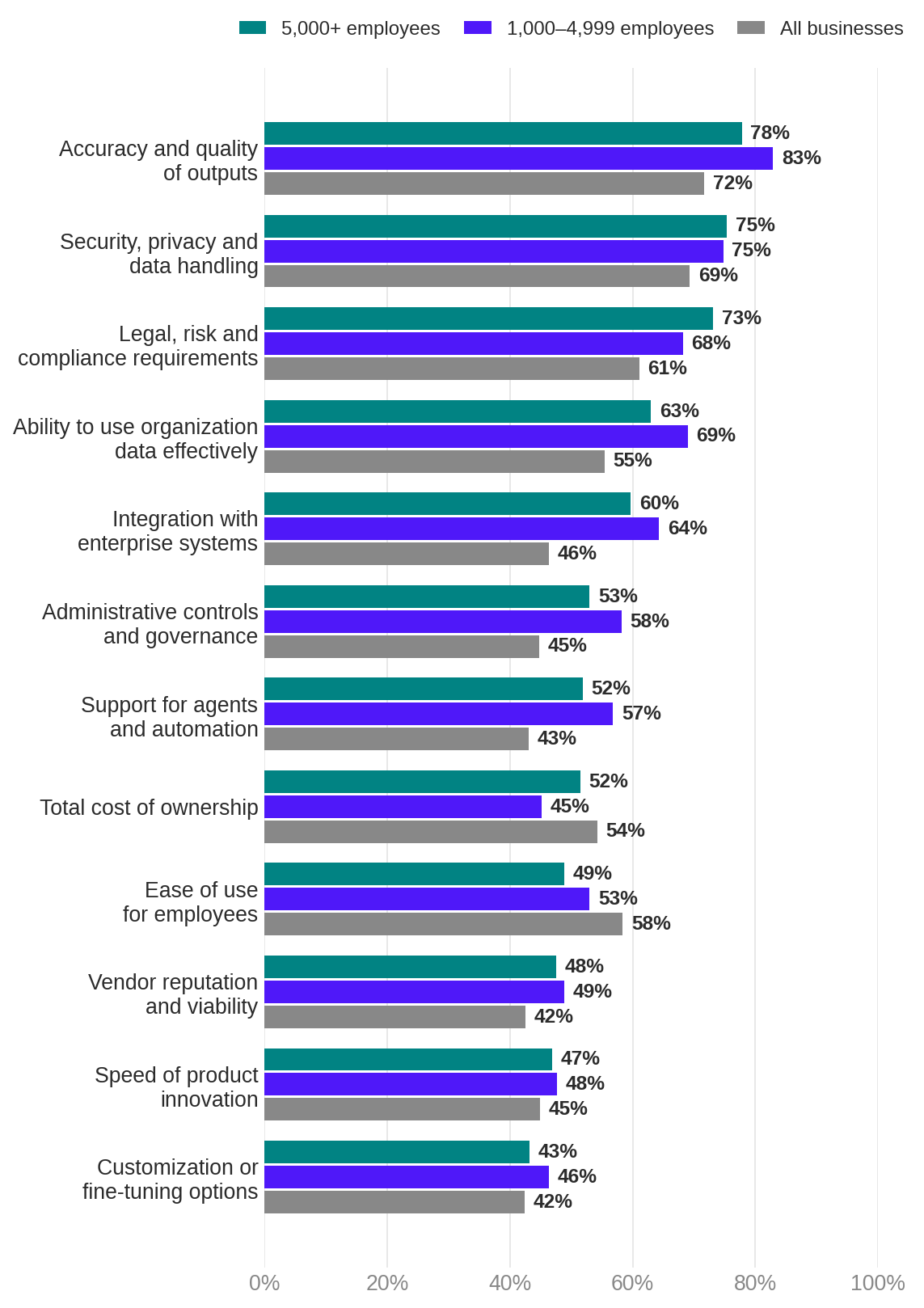
Taken together, the data describe a market with established leaders and unsettled loyalties. Microsoft, Google and OpenAI hold wide adoption leads among enterprises, budgets are set to grow, and a meaningful share of buyers — 36% of the largest companies — remain open to replacing a primary platform within the year, with quality, security and compliance the criteria on which those decisions will turn.
Frequently Asked Questions
What is the most widely used AI platform among U.S. businesses?
Google Gemini is the most widely used AI platform across U.S. businesses of all sizes, approved or in active use at 55% of organizations, ahead of OpenAI’s ChatGPT (48%) and Microsoft Copilot (45%), according to Morning Consult’s July 2026 survey. Among enterprises with 1,000 or more employees, Microsoft Copilot leads, reaching 73% of the largest companies and 82% of less large companies.
How much do companies plan to spend on AI platforms in the next year?
Most enterprises plan to spend more. 64% of decision makers at companies with 5,000 or more employees and 84% at companies with 1,000–4,999 say they are likely to increase spending with their current AI platform providers over the next 12 months. Among businesses of all sizes, 41% expect to increase AI spending with current providers.
Are companies switching AI platforms?
Companies are adding platforms more often than they are switching or cutting. Over the past year, 44% of the largest companies added at least one new AI platform while 5% reduced their number of platforms. Looking ahead, 36% of the largest companies and 49% of less large enterprises say they may replace a current primary platform within 12 months.
What factors matter most when businesses choose an AI platform?
Accuracy and quality of outputs is the top decision factor in every business segment, rated very important by 78% of decision makers at the largest companies, 83% at less large enterprises and 72% of all businesses. Security, privacy and data handling ranks second across segments. Total cost of ownership ranks eighth of 12 factors at the largest companies, last among less large enterprises and sixth among businesses of all sizes.
How many small businesses use AI platforms?
Adoption is broad but shallow among smaller firms. In a Morning Consult survey of 2,003 decision makers at U.S. businesses of all sizes — most at firms with fewer than 100 employees — 16% use none of the AI platforms measured, and 24% report no meaningful AI platform use today. Only 18% have standardized on a single primary platform.
Who conducted this survey and how?
Morning Consult conducted the surveys July 21–24, 2026, among 3,003 U.S. business decision makers holding manager-level roles or above: 2,003 at businesses of all sizes, plus 500 at private-sector companies with 1,000–4,999 full-time employees and 500 at companies with 5,000 or more. Unweighted margins of error are ±2 percentage points for the all-business sample and ±4 points for each enterprise segment.
Methodology
Morning Consult surveyed 3,003 U.S. business decision makers July 21–24, 2026: 2,003 at businesses of all sizes (most at firms with fewer than 100 full-time employees), plus enterprise oversamples of 500 at private-sector companies with 1,000–4,999 full-time employees and 500 at companies with 5,000 or more. Respondents hold manager-level roles or above. Unweighted margins of error: ±2 percentage points for the all-business sample and ±4 points for each enterprise segment. The three samples are reported separately and are not combined.

Global Consumer Confidence Drops After Iran Strike
.png)
Should Monster Energy Keep Playing the Generalist Game?