
Marketers spend their working week thinking about whatever brand they are marketing. Their next buyer gives it seconds. That does not make brands irrelevant. It sets a harder standard: your brand has to easily come to mind in critical moments, or its chances of being selected are very slim. For this to happen, people must feel something about your brand.
Which is why one of the biggest hurdles to growth is not convincing the people who dislike your brand. It is connecting more deeply with people who know it exists and feel nothing. They are the least likely to think of you when it counts.
Every market divides into buyers who favor a brand, buyers who dislike it, and buyers who know it but are indifferent. Morning Consult measures that third group directly. In plain terms, it is the buyer who says, "I have heard of you. I have no opinion." It is a sizable share of most markets, and it is the cheapest share available to win. We call it brand indifference, and we think it matters a great deal.
Energy drinks show how big the unclaimed ground is. Over the past year, between a fifth and a third of U.S. adults who know each major energy drink brand told us they have no opinion of it. Red Bull, the most recognized name in the category, still leaves 22% of its aware audience feeling nothing. CELSIUS is the sharper case: it has spent years as the category's growth story, yet 36% of the people who know it have not formed a view either way.
A Fifth to a Third of Aware Consumers Feel Nothing About Energy Drink Brands
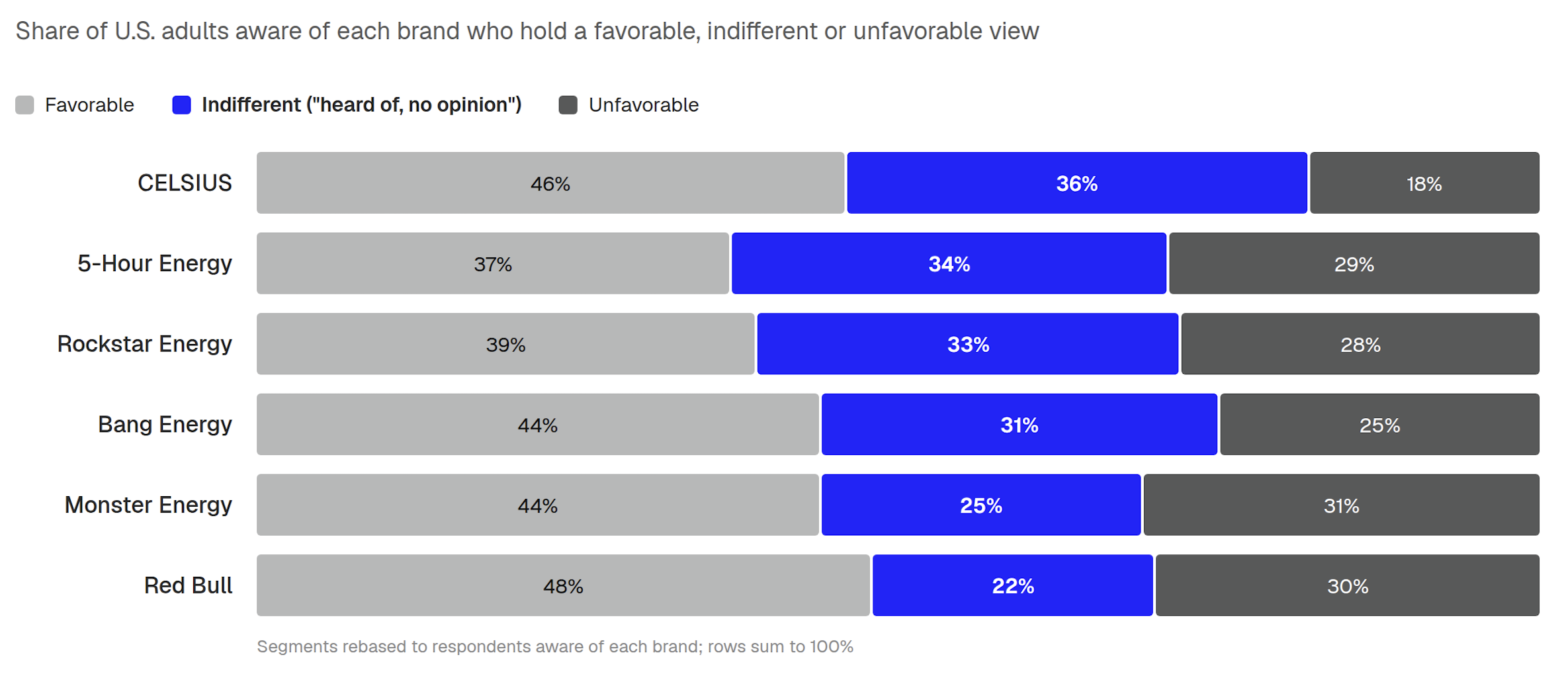
The natural assumption is that indifference sits halfway between liking and disliking. It does not. In our own research, the indifferent group showed lower emotional connection than people who were actively skeptical of the brand. Skeptics are at least engaged. They have weighed the brand and pushed back. Indifference means the brand was never part of the conversation at all. On a tracker, "no opinion" looks like neutral ground. It is weaker than that.
Only a small slice of any category is in-market at a given moment. Everyone else is forming impressions, or failing to, long before they are ready to buy. By the time an indifferent buyer is finally ready to purchase, there is no conviction behind choosing you.
Indifference Hands the Choice to Price and Habit
Where no preference exists, choice defaults to price, convenience, and habit. That shows up as:
- Price shopping in place of brand choice
- Softer loyalty and easier switching
- Weaker engagement with campaigns, apps, and owned channels
- Little room to charge a premium
- No advocacy, so no organic reach
- Thinner presence in LLM-generated answers, even where awareness is high
This holds in B2B as much as in consumer categories. A large share of any B2B market is not buying right now, and the risk inside that group is not rejection. It is the absence of any reason to choose you when the buying cycle starts.
Indifference Is the Cheapest Share to Win
Indifference is unclaimed ground, not lost ground. Taking a share point from a rival means dislodging a preference someone already holds. Taking it from the indifferent means supplying a reason where none exists yet. An indifferent prospect is easier and cheaper to win than a hostile one, and in most categories there are more of them.
The Data to Diagnose It Already Exists
We already capture "heard of, no opinion" as its own answer, continuously, across thousands of brands, with history and audience detail behind it. No new fielding is needed to get a first read. The diagnostic is three moves.
Size it. Measure indifference as a share of the people who actually know the brand, not of everyone. Raw numbers make smaller and newer brands look decided when their audience simply has not met them yet.
Focus on non-buyers. Among current customers, a positive opinion is mostly a rationalization of a purchase already made. The number that tells you whether brand building is working is indifference among the people who do not buy you yet.
Watch where it goes. Falling indifference is only good news if those people become favorable rather than unfavorable. Reading all three together catches brands that are shrinking indifference by creating detractors, which a headline favorability score will not reveal.
From there the question shifts from how much indifference a brand carries and among whom, to why. That is where a syndicated read hands off to a custom deep dive.

Three Brands Dominate the Cruise Category

Gen Z Brand Trust: Why 94% of Brands Score Lower
.png)