Download our Most Trusted Brands 2026 report here for the definitive ranking of the brands that lead the way on consumer trust — spanning 184 brands across 30 rankings.
The bottom line up front
The cruise category is anchored by three brands that dominate how people think about cruising, with a wide field of lines that rarely come to mind first. Royal Caribbean, Carnival and Disney together account for well over a third of all mental market share (the share of category thinking a brand commands across purchase occasions). The rest of the field draws considerably less attention. Awareness is not the category's problem, since most major lines are well known. What separates the leaders is breadth of association, meaning how many different reasons to cruise a brand connects to.
The Category Today
Three brands lead the category's mental landscape, and the gap after third is a cliff rather than a slope. Royal Caribbean leads at roughly 20% mental market share, with Carnival close behind at ~17.5% and Disney third at ~16%. Then the floor drops. Norwegian, the fourth brand, sits at ~9%, and no one else clears 7%. The three leaders together hold more than half of all mental share, leaving the remaining nine brands to split what is left. When a consumer thinks about cruising, a few names surface first and the rest have to be summoned.
Breadth of association is what the leaders actually own. Royal Caribbean and Carnival attach to more purchase occasions than anyone else, with network sizes (the average number of category entry points a brand connects to) around 11.3 and 10.5 respectively, against a field that mostly clusters between 7 and 9. These two are the category's generalists. They come to mind for the family vacation, the group trip, the deal-hunting getaway, and the all-inclusive escape alike. That versatility, more than fame, is why they lead.
Disney is the category's most efficient specialist. Disney converts its awareness into mental share better than any brand except the two leaders, and among younger adults it is the top cruise brand outright, reaching ~22% mental share with 18–34s and ~25% among Gen Z adults, ahead of Royal Caribbean in both. Among adults 65 and older, Disney falls to ~7%. No other major brand swings this hard by age. Disney has not won the category. It has won the family and the young-adult imagination, and it should defend that ground rather than chase the retiree cruise.
Awareness is cheap; conversion into mental share is where brands separate. Norwegian is known to ~60% of adults yet converts that into only ~9% mental share. Princess is known by ~54% and lands at ~7%. These are familiar names that fail to connect themselves to specific reasons to cruise, so they sit in the consideration set without ever surfacing first. Royal Caribbean and Carnival, by contrast, convert roughly a quarter of every awareness point into mental share. The middle of the pack is leaving mental share on the table it has already paid for in awareness.
The Moments That Matter
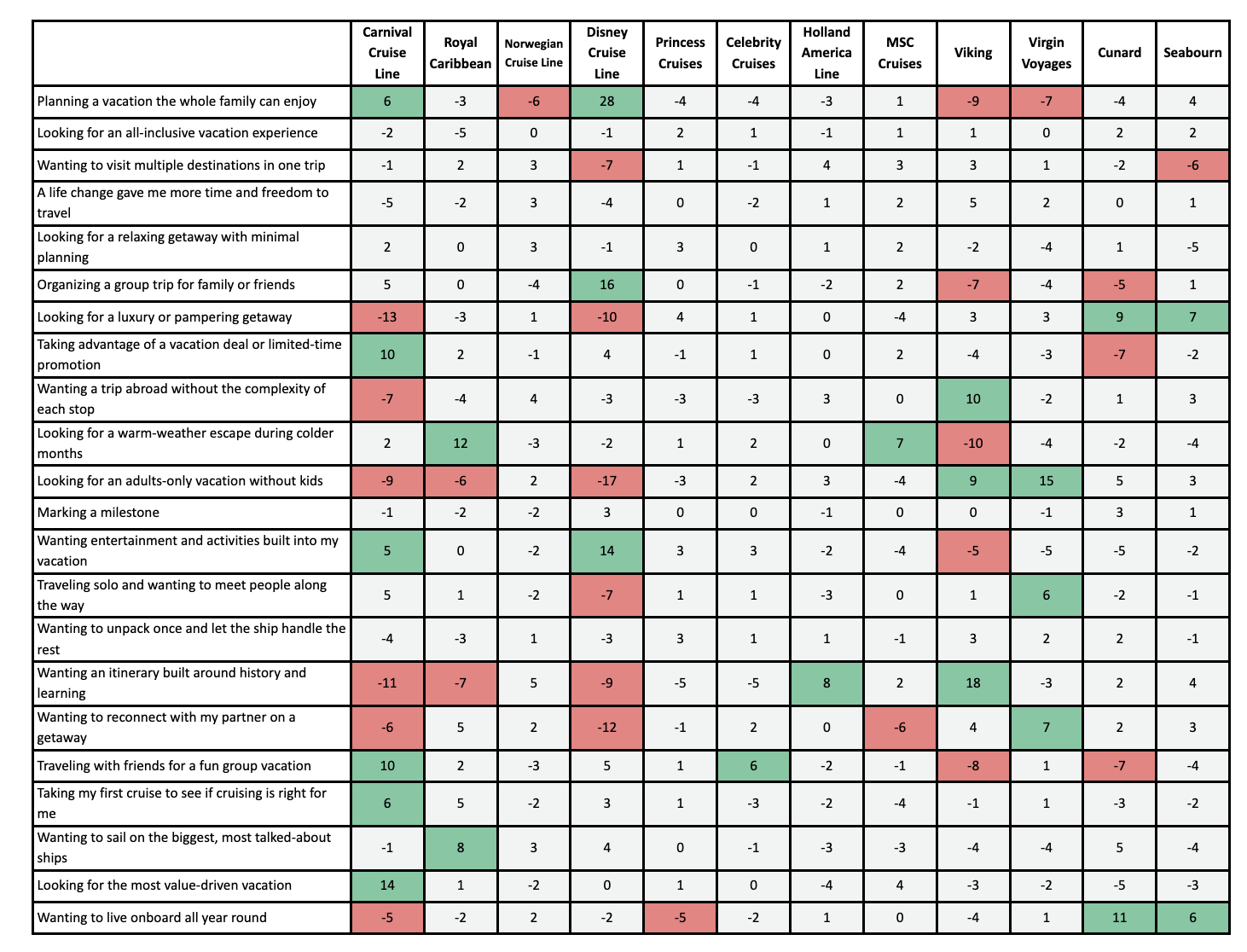
Four triggers dominate what pulls people toward a cruise, and they cluster tightly at the top. The all-inclusive, low-effort escape leads at ~26% salience (“looking for an all-inclusive vacation experience”), with the relaxing getaway with minimal planning essentially tied at ~25%. These two reward brands that own the “unpack once and let the ship handle it” promise, which is precisely the generalist territory Royal Caribbean and Carnival dominate. Visiting multiple destinations in one trip follows at ~23%, the itinerary-driven occasion where premium lines like Viking have a natural claim they are underexploiting. The family vacation the whole family can enjoy rounds out the top tier at ~21%, and this is Disney's home turf.
Below the leaders sit the value and deal triggers (taking advantage of a promotion, ~20%; most value-driven vacation, ~15%), which favor Carnival's price-forward positioning. The identity-driven occasions such as adults-only escapes and first-time cruising trail the practical ones. The category is organized around ease and inclusiveness far more than around thrill or status.
How Segments Differ
The differences that matter here are almost entirely about age, with income and region doing little to change the picture.
Age flips the ranking at both ends. Disney leads with under-35s and Gen Z, displacing Royal Caribbean at the top. Viking and the luxury lines only become relevant past 45 and peak with Boomers. The implication is that a single national message will underperform for any brand whose mental share is age-concentrated. Disney and Viking in particular should treat their strong cohorts as the strategy rather than as a segment to optimize around the edges.
Income does not rescue narrow brands. The premium lines do not gain enough among high-income households to offset their weakness everywhere else. Cunard reaches only ~2% mental share even among Baby Boomer men, its single best group. Being the affluent choice is not a growth position in this category when the affluent still think of Royal Caribbean first.
Gender and region produce no strategically meaningful reshuffling of the leaders. Where a difference does not change a recommendation, it is noise.
What's Blocking Conversion
Price and cost-predictability friction is the dominant barrier, and it is remarkably flat across income. The total cruise price being out of budget tops the list at ~37%, and it is nearly identical for households under $50K (~37%) and over $100K (~36%). Add-on costs making the total price hard to predict hits ~28%. This is not simply an affordability problem for the poor. It is a trust-in-the-sticker-price problem for everyone. The lever is transparent, bundled pricing, and the all-inclusive trigger being the single most salient reason to cruise suggests the market is actively asking for it.
Travel-logistics friction is a high-income and older-traveler problem specifically. The cost of flights to reach the departure port blocks ~31% overall but jumps to ~37% among both $100K+ households and adults 65+. Port proximity compounds it. For premium lines whose customers skew older and affluent, solving the getting-to-the-ship problem through bundled airfare, more embarkation ports, and pre-cruise stays may unlock more than any message about the onboard experience.
Health and crowding anxiety is a secondary but persistent drag. Concern about illness on board (~26%) and crowding (~20%) sit below cost but do not disappear in any segment. These favor the lower-density premium product and give Viking and Celebrity a defensible contrast to the mega-ship lines.
Why This Matters Now
Diagnose before spending. For Norwegian, Princess, and Celebrity, awareness already exceeds what their mental share reflects. Pouring budget into more awareness will not fix a breadth problem. The bottleneck is that these brands are not connected to enough reasons to cruise, so the work is associative, tying the brand to two or three specific high-salience occasions, rather than promotional.
Own an occasion instead of renting the category. The winning specialists, Disney with families and young adults and Viking with older destination-seekers, got there by dominating a cluster of triggers completely. A mid-pack brand will get further claiming the multiple-destinations occasion or the adults-only escape outright than by being everyone's fourth choice for everything.
Fix the price story, because the category is asking for it. The most salient reason to cruise is the all-inclusive promise, and the biggest barrier is unpredictable total cost. Any brand that closes that gap with genuinely transparent, bundled pricing is answering the exact tension the data exposes, and it can do so without a single new ship.
Breadth beats depth for the ones with room to grow. Royal Caribbean and Carnival lead because they surface for many occasions, not because they are beloved on one. For any brand with the awareness base to support it, the path to mental share runs through connecting to more moments rather than going deeper on the moment it already owns.
About this research
Morning Consult conducts over 30,000 daily proprietary surveys in 45 countries covering more than 5,000 brands and 50 economic indicators.
Our category advantage research is aimed at understanding the needs driving consumers in your category — and how your brand can own more of them. This research is built on validated principles of brand-driven growth and powered by Morning Consult’s industry-leading sampling technology.
Measure the true drivers of brand strength
Capture both mental availability (the likelihood your brand comes to mind when consumers face a need or occasion) and emotional closeness (how strongly consumers connect with your brand), benchmarked against competitors.
Uncover Category Entry Points (CEPs)
Directly tied to mental availability, see the specific needs, occasions, and triggers that drive purchase decisions in your category, and how strongly your brand is linked to them.
Pinpoint growth opportunities
Direct investment toward the moments and consumer segments with the greatest potential to grow your brand.
Turn insights into action fast
Get survey results in 4–5 days through a centralized dashboard and short-form memo that equips stakeholders with clear direction on where and how to win.
Learn more
Disney Cruise Line Is the Category’s Most Powerful Specialist
Royal Caribbean Is the Cruise Category’s True Generalist