Download our Most Trusted Brands 2026 report here for the definitive ranking of the brands that lead the way on consumer trust — spanning 184 brands across 30 rankings.
Most brands are trusted less by Gen Z than by the average American adult. According to Morning Consult's Most Trusted Brands 2026 report, 94% of tracked brands score lower on net trust with Gen Z than with all U.S. adults, and Gen Z's average net trust sits about 8 points below the general adult population. The gap is near-universal. But it isn't a sign of active hostility, and a handful of brands are clearly beating it.
Here's what the data shows and what brands can do about it.
Why does Gen Z trust fewer brands?
The Gen Z trust gap is structural rather than the result of brands making missteps. Gen Z enters its relationship with corporate brands from a more skeptical starting point, shaped by broader institutional distrust and a social media environment that amplifies negative brand stories faster than positive ones.
There's also a simpler explanation: time. Trust is built through years of repeated, positive exposure, and Gen Z hasn't had those years yet. Older consumers have spent decades with legacy brands on their kitchen counters; Gen Z is still forming first impressions.
How big is the Gen Z trust gap?
94% of tracked brands score lower on net trust with Gen Z than with all U.S. adults.
Gen Z's average net trust score sits roughly 8 points below the general adult population. In the chart below, each line represents the difference in net trust between Gen Z and all adults for a given brand.
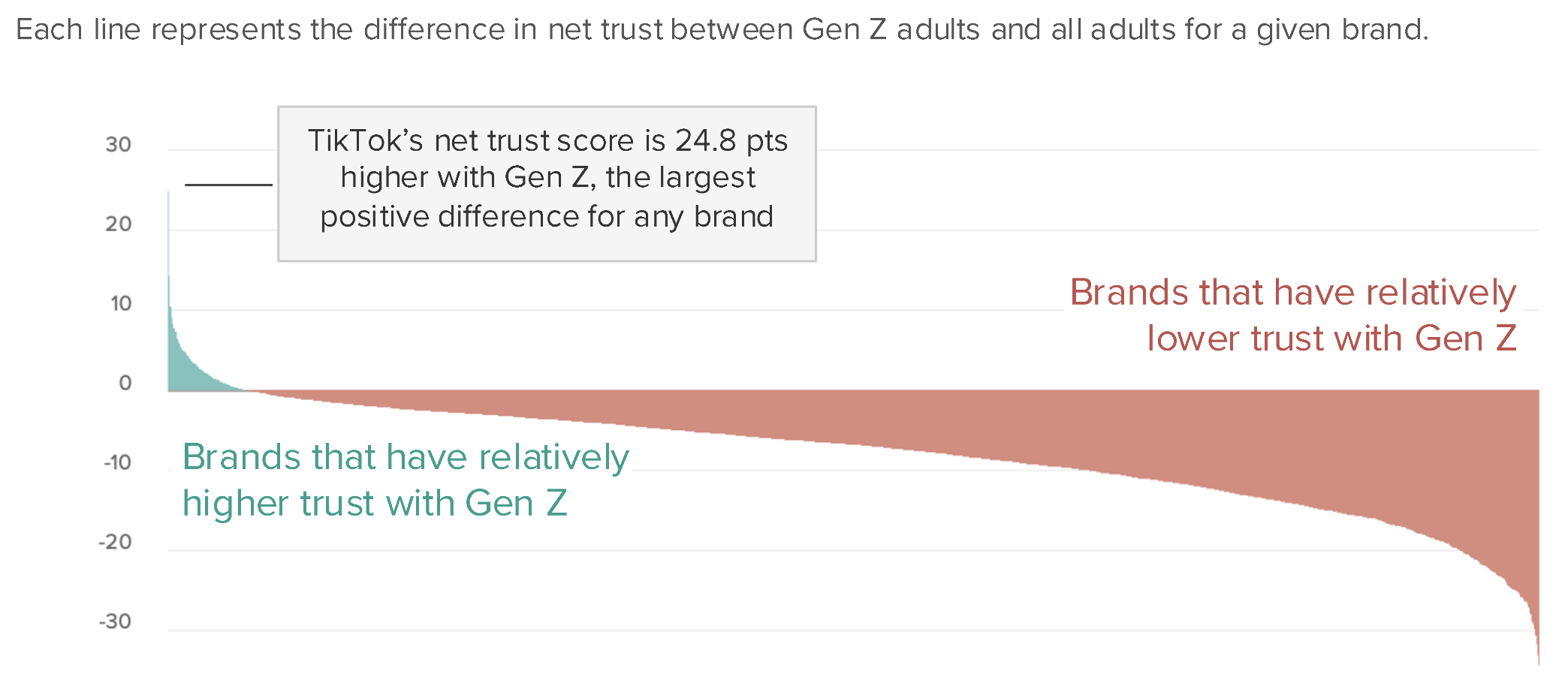
A 2024 Morning Consult analysis found a nearly identical figure — 95% of brands scored lower with Gen Z — meaning the picture has barely shifted even as the oldest Gen Z consumers move into their late 20s.
In other words, the gap has proven durable even as Gen Z ages into prime consumer years.
Is the Gen Z trust gap getting better?
There is one encouraging signal beneath the flat headline numbers. The share of brands scoring 10 or more points lower with Gen Z fell from 43% in 2024 to 33%. The gap remains widespread, but its severity is easing at the margins — exactly what you'd expect as Gen Z accumulates more direct experience with brands over time.
Which brands have the widest Gen Z trust gaps?
The largest gaps belong to legacy consumer-goods brands. Nabisco, General Mills, Kraft, Charmin, and Pepperidge Farm all score 27 to 34 points lower with Gen Z than with all adults.
Crucially, this isn't active distrust. Most of these brands still post positive net trust scores with younger consumers. The gap reflects the exposure advantage older generations have accumulated over decades — not a rejection of the brands themselves.
Which brands does Gen Z trust most?
Despite the broad gap, plenty of brands earn high trust from Gen Z. The most trusted brands among Gen Z in 2026, by net trust score, are:
| RANK | BRAND | TRUST |
| 1 | YouTube | 49.1 |
| 2 | Dawn Dish Soap | 49 |
| 3 | Dove Soap | 47.7 |
| 4 | Costco | 46.9 |
| 5 | PayPal | 46.4 |
| 6 | Sprite | 45.8 |
| 7 | 45.6 | |
| 8 | Colgate | 45 |
| 9 | Doritos | 44.6 |
| 10 | Cheerios | 43.9 |
| 11 | Gatorade | 43.4 |
| 12 | Nike | 42.3 |
| 13 | Domino's | 42.2 |
| 14 | CeraVe | 42.1 |
| 15 | PetSmart | 41.9 |
Which brands over-index most with Gen Z?
Beyond raw trust scores, some brands are trusted far more by Gen Z than by the general population. These over-indexing "standouts" reveal where the generation's affinities diverge sharply from everyone else's:
- TikTok over-indexes by 15.4 points — the single largest positive Gen Z trust gap of any brand tracked (its net trust runs 24.8 points higher with Gen Z than with all adults).
- Crocs (+9.1), CapCut (+8.8), Fenty Beauty (+8.4), and Jarritos (+8.2) round out a list weighted toward digital-native platforms, creator tools, and culturally fluent consumer brands.
- Duolingo (+8.1) and Fortnite (+7.2) underscore how engagement-first brands have built trust with a generation that grew up with them.
Download the report here to see the full list of brands Gen Z overindexes with.
What can brands learn from the Gen Z trust gap?
A low Gen Z score is often an exposure problem. Before treating it as a crisis, check whether the brand simply hasn't had time to build the relationship. Keep in mind: The gap is closing slowly. As Gen Z ages and gains direct experience, the most severe gaps are already narrowing, rewarding brands that invest in the relationship now.
Frequently asked questions
How does Morning Consult measure brand trust?
Morning Consult asks survey respondents "How much do you trust this brand to do what is
right?" Rankings are determined by net trust — the share who answered "a lot" or "some" minus
the share who said "not much" or "not at all." This year's analysis covered more than 3,200
brands, with an average of over 10,000 surveys per brand.
What percentage of brands does Gen Z trust less than the average adult?
94% of brands tracked by Morning Consult scored lower on net trust with Gen Z than with all U.S. adults.
How much lower is Gen Z's brand trust on average?
Gen Z's average net trust score sits about 8 points below that of the general adult population.
Which brand does Gen Z trust most?
YouTube is the most trusted brand among Gen Z in 2026, with a net trust score of 49.1, followed closely by Dawn Dish Soap and Dove Soap.
Which brand over-indexes most with Gen Z?
TikTok over-indexes by 15.4 points, the largest positive Gen Z trust gap of any brand, with a net trust score 24.8 points higher among Gen Z than among all adults.
Is the Gen Z brand trust gap improving?
Yes, at the margins. The share of brands scoring 10 or more points lower with Gen Z fell from 43% in 2024 to 33% in 2025.
When was this study conducted?
Surveys were conducted between January 1 and May 15, 2026. Year-over-year comparisons reference the same window in 2025. The report was published June 15, 2026.

Why Nostalgic Brands Are Winning Consumer Trust in 2026
High-Income Consumer Confidence Is Cracking. Luxury Brands Are Next.