

We last looked at consumer AI back in January. This memo tracks how the category has shifted since then.
The bottom line up front
Grok AI gained meaningful awareness since January, but its awareness without a conversation and a user base shifting downscale. Active use rose only +1.5pp. High-income engagement collapsed (-7pp); Bachelor’s-degree holders fell -4pp. Lower-income and lower-education segments grew (<$50K +3pp, <College +4pp). The mental advantage profile is sharpening around casual and conversational use cases (Boredom/chat +2.8, Trip planning +1.7, Kids’ homework +1.1, Dating +1.1) and away from utility — the prior advantage on Researching topics collapsed from +2.1 to -1.4. Grok is finding an identity as the casual, edgier, X-native AI for personal contexts, but losing the credibility position with the premium audience. The brand has reach but is not yet earning preference from the segment that subscribes.
|
In this memo, we use the Category Advantage research framework to measure how consumers consider different types. A few terms you should know: |
|
Where Grok Stands
Grok is mid-tier on awareness but among the lowest converters. Awareness of 38% places the brand fifth in the category, ahead of Claude (39%) by less than a point. Mental penetration of 43% and active use of 9% are smaller — the awareness-to-active-use conversion is in the bottom tier of the major brands. Mental Market Share of 3.7% places Grok ahead of Claude (2.7%) — but Claude is gaining momentum while Grok is plateauing.
Awareness is rising fast, conversion is not. Awareness rose +7.5pp this wave — the second-largest awareness gain after Claude (+13pp). But active use rose only +1.5pp, and conversion of awareness to active use weakened. The brand is being seen but not adopted at the same rate. Mental penetration rose +4.4pp, suggesting CEP associations are forming, but they are not yet translating into reach-for-this-brand habit.
Emotional connection declined alongside the leaders. Grok scores 2.3 on emotional connection (1–7 scale), down from 2.7. The 0.4 decline is in line with the broader category pattern. EC remains low compared to ChatGPT (3.7) and Gemini (3.4) — Grok is not yet building the affective attachment that drives identity-led loyalty.
The CEPs Grok Owns — and the Ones It Doesn’t
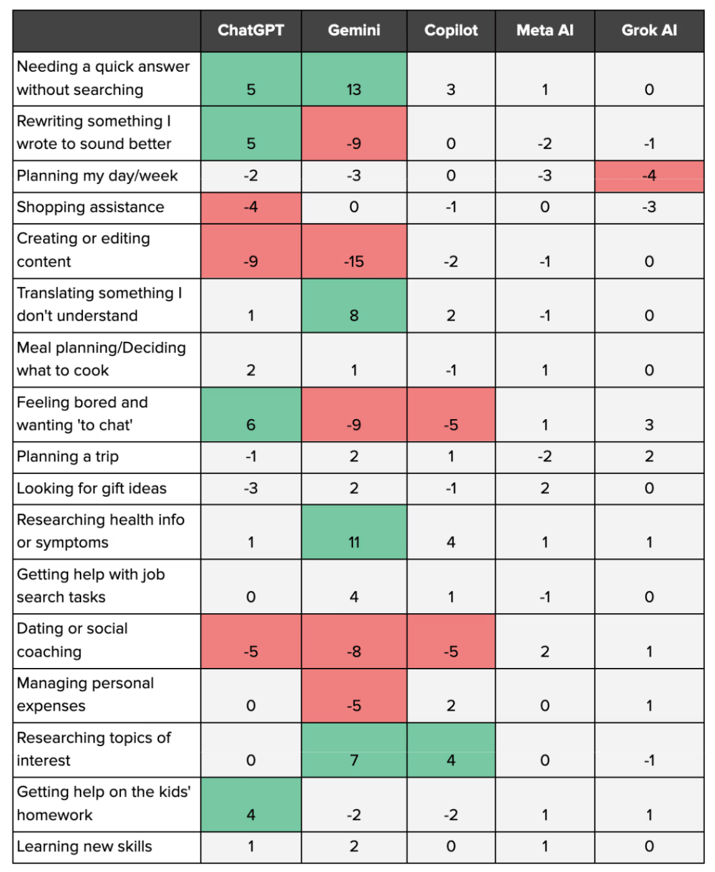
The mental advantage profile is sharpening around casual and conversational CEPs. Grok’s strongest mental advantages — a measure of whether the brand captures more or less than its fair share of a given CEP based on its size alone — are on Boredom/chat (+2.8), Trip planning (+1.7), Dating/social coaching (+1.1), and Kids’ homework (+1.1). These are conversational, casual, and personal-life CEPs — territory the brand is plausibly building given X (Twitter) integration and the casual-tone positioning. Notably, Boredom/chat is the largest mental advantage in Grok’s profile, consistent with the brand’s irreverent, X-native voice.
The prior research advantage collapsed. Researching topics fell from +2.1 to -1.4 (-3.5) — the brand’s sharpest single-CEP loss this wave. Dating/social coaching also fell from +3.3 to +1.1 despite remaining a relative strength. The previously emerging position on serious utility CEPs has receded as Gemini and ChatGPT consolidated the information lane. Grok is being sorted away from the utility lane and toward casual conversation.
The brand under-indexes on practical-utility CEPs. Day/week planning (-4.2), Shopping (-2.8), and Quick Answer (+0.3 — negligible) reveal where Grok is structurally absent. The brand has no claim on the largest information CEPs in the category and is competing in territory dominated by ChatGPT and Gemini at 3-4x the absolute share.
Who Grok Is Winning — and Losing
|
What's in the Way
The premium-segment leakage is the most concerning direction. Losing 7pp of $100K+ active use in four months while gaining among <$50K and <College segments shifts the brand’s economic profile away from subscription monetization. Grok is becoming a free-tier casual brand for users with lower willingness to pay. Reversing this requires either positioning that re-attracts the premium audience or pricing strategy that monetizes the downscale base.
Casual-conversational positioning has limited absolute upside. Boredom/chat has ~13% salience in the category — a relatively small CEP. Even if Grok fully owned this lane, the addressable use share is limited. The brand needs additional CEP territory to scale beyond niche, and the wave’s data shows it is losing rather than gaining in the larger CEPs.
The EC and trust gap caps premium conversion. Grok’s casual, irreverent voice is core to its differentiation but also caps the formality and trust signals that premium and professional users seek. Without a parallel “seriousness” frame, the brand will continue to under-perform in the segments where Claude is gaining.
What to Do About It |
Embrace the casual-and-conversational identity explicitly. Grok’s mental advantage profile is concentrating around Boredom/chat, Trip planning, and Dating/social coaching. These cluster in a coherent identity — the AI for casual, social, personal-life moments — differentiated from ChatGPT’s broader conversational position by edgier voice and X integration. Explicit positioning here would harden the lane that the brand is naturally consolidating.
Address the premium leakage with a complementary serious frame. Without giving up the casual tone, Grok needs proof points for premium users that the brand can also handle serious work — reasoning depth, accuracy, citation. The risk of the current trajectory is that Grok becomes structurally limited to the audience that does not subscribe.
Build CEP territory adjacent to the casual lane. Trip planning (~20% salience) and Kids’ homework (~10%) are larger CEPs where Grok is showing emerging mental advantage. Targeted feature investment and positioning around these specific occasions — personality-driven trip recommendations, casual homework help — would expand the brand’s addressable footprint without compromising its identity.
Use the X distribution surface for occasion-specific prompts. X integration is Grok’s structural advantage. Surfacing the brand at moments aligned with its mental advantage profile — trending casual conversations, social events, trip planning threads — would build CEP-specific habit faster than feature investment alone.
About this research
Morning Consult conducts over 30,000 daily proprietary surveys in 45 countries covering more than 5,000 brands and 50 economic indicators.
Our category advantage research is aimed at understanding the needs driving consumers in your category — and how your brand can own more of them. This research is built on validated principles of brand-driven growth and powered by Morning Consult’s industry-leading sampling technology.
Measure the true drivers of brand strength
Capture both mental availability (the likelihood your brand comes to mind when consumers face a need or occasion) and emotional closeness (how strongly consumers connect with your brand), benchmarked against competitors.
Uncover Category Entry Points (CEPs)
Directly tied to mental availability, see the specific needs, occasions, and triggers that drive purchase decisions in your category, and how strongly your brand is linked to them.
Pinpoint growth opportunities
Direct investment toward the moments and consumer segments with the greatest potential to grow your brand.
Turn insights into action fast
Get survey results in 4–5 days through a centralized dashboard and short-form memo that equips stakeholders with clear direction on where and how to win.
Learn more
.png)
Gen Z and the Beauty Industry: Brand Data and Audience Behaviors
.png)
Red Bull Has Already Won the Awareness Fight. What's Next?
-1.png)