
Reputation, Redefined: A New Framework for Brand Reputation
Reputation has always mattered. But the forces reshaping it — political polarization, accelerating news cycles, shifting stakeholder expectations, and the rise of AI — have made it harder to measure, harder to manage, and more consequential than ever.
In this webinar, we present a new framework for reputation management that moves from subconscious emotional connection through conscious perceptions and internalized feelings, all the way to the business outcomes that reputation ultimately drives. Along the way, we walk through real brand case studies, introduce the Morning Consult Reputation Score™, and show what's possible when always-on consumer data meets a model designed around how communication teams actually work.
Recorded June 25, 2025
Host(s) / Author(s)

Bill Pink
SVP, Brand and Data Strategy

Ivan Rocabado
Lead Solutions Architect, Reputation
What We Covered
Why Reputation Needs a New Framework
Reputation in Real Time: What You Can Do With the Morning Consult Reputation Score™
The score tracks brand appeal and corporate credibility across 4,000+ brands in 45+ markets, updated daily in Morning Consult Intelligence. We walk through real-world case studies showing how to diagnose what's driving brand reputation via the score's component metrics, compare reputation across brands and categories, and drill into specific audiences to find where perception is shifting before it shows up anywhere else.
From Emotions to Actions: Morning Consult's New Reputation Framework
Go Deeper
The Brand Reputation Agent
Now available in Morning Consult Intelligence, the Brand Reputation Agent uses continuous consumer data and proven reputation science to diagnose shifts and deliver trusted, stakeholder-ready insight in minutes.
Reputation Activation: Why Modern Communications Needs a New Kind of Intelligence
For communications, strategy, and executive leaders thinking about how to protect and build trust in a more volatile environment, this is your starting point.
Introduction to Morning Consult's Reputation Solutions
Get a full overview of our reputation framework and solutions.
Turn Reputation Into Strategy
Track your brand's reputation with a clear, real-time score and a proprietary reputation framework that helps you safeguard and fortify your brand reputation.
Full Transcript
Table of Contents
Morning Consult's First Principles: Decision Intelligence, Sampling, and Actionability
Why Reputation Needs a New Lens: The Challenges CCOs Face Today
Reputation in Action: Patagonia, Tesla, and the Wells Fargo Rebuild
The Evolving Role of the Chief Communications Officer
Morning Consult's New Reputation Framework: From Emotions to Actions
How Morning Consult Intelligence Tracks Reputation Across 5,000 Brands and 40 Markets
Morning Consult Reputation Data in Practice: TikTok, Google, and the Daily AI User Lens
The Four-Step Framework in Depth: Emotions, Perceptions, Feelings, and Business Motivators
Closing Slides and Q&A Introduction
Q&A: What Is the Difference Between Brand and Reputation?
Q&A: How Does This Framework Improve on Legacy Reputation Models?
Q&A: Where Does the Reputation Score Live and How Is It Defined?
Q&A: Has the Reputation Score Been Validated Against Real Business Outcomes?
Q&A: Is Reputation Just for Communications, or Does It Belong Across the Organization?
Q&A: How Is the Score Indexed and How Does Awareness Factor In?
Opening and Introductions
Bill Pink: Greetings to everyone that's here today. My name is Bill Pink and I lead the Solutions Architecture team here at Morning Consult. My team is responsible for the development of all of our offers across various business domains. That includes segmentation, pricing, campaign effectiveness, and of course the topic for today's session, corporate reputation.
Joining me today is my friend and colleague Ivan Rocabado, who's our Lead Solutions Architect for Corporate Reputation. And together we are delighted to present to you our webinar, Reputation Reimagined: A New Framework for Strategic Communications.
Bill Pink: Before we really begin the presentation, a little housekeeping. There should be about 35 to 40 minutes of content and we will be able to answer questions for about 10 minutes or so at the end. While we are presenting, we won't be able to answer questions on the fly, but please share your comments and questions in the chat and we will get to as many as we can at the end. And of course, we will follow up with others offline as time permits. Our ultimate goal is for this session really to be the beginning of a conversation, not the end.
Morning Consult's First Principles: Decision Intelligence, Sampling, and Actionability
Bill Pink: Now, we're going to dive in. What you see here is what we really believe sets Morning Consult apart. Whether we're talking about reputation or any of our offers, we feel that these are our first principles behind all the offers that we build. And we want to share that with you and have you think about that as Ivan moves into how this applies to reputation in a moment.
Bill Pink: To start, we always begin with decision intelligence. This is our north star and we always think about the decisions you need to make, in this case as it relates to reputation management and measurement, when we're building our solutions, with a goal to everything being faster, being deeper, and being more actionable insights.
To get there, we've set up technology-enabled sampling as our foundation for everything we do. This allows us to cover the highest level of frequency in data collection, the highest coverage of audiences from general population to niche audiences, as well as fuel our analytics, uncover patterns, uncover hidden insights, and inform decisions.
Third, everything we build and you're going to learn about has an end-to-end data creation and curation process behind it, built off technology, analytics, and expertise. And knowing who's in this audience, I know you're fully aware of how messy data can be. And we're always working to ensure all of our results and recommendations are as accurate as possible.
And then our fourth first principle that informs everything we do is we're always grounded in evidence of how people think, feel, and act and how this translates into commercial effects. This knowledge or IP is embedded in all of our offers in terms of the design, which ensures actionability tied to the decisions you want to make. So again, this framing is our first principles for everything we do. And as Ivan walks you through the framework, you'll see how this applies to reputation.
Bill Pink: We also wanted to share, in case you're not familiar, we have three primary ways of delivering insights and all of them apply to the framework you're about to learn about. Whether we're talking about a macro-level context and trends, which we deliver through what we call Pro, which are highly curated summaries, data analyses, and reports from our team of consumer, economic, and political experts. Whether we're talking about our Intelligence Platform, which provides instant access and insights about reputation, psychographics, economics, and media habits across thousands of businesses around the globe, and houses our new Reputation Score, which Ivan will share in a moment. And last but not least, the framework also encompasses our custom reputation solutions where we standardize around best-in-class measurement techniques to get at emotions, specific category attributes, and ultimately depth in informing decision points along your strategic journey. So all of this is the setup for the reputation framework you're about to learn about. Ivan, over to you.
Why Reputation Needs a New Lens: The Challenges CCOs Face Today
Ivan Rocabado: Thank you. I would assume most of you have heard these facts about reputation before, about how reputation impacts market value, how reputation is a talent magnet, right? 69% of job seekers won't work for a company with a poor reputation. We know that reputation impacts consumer loyalty and purchase intent. And right now, reputation is part of the dashboards of the CEO and even the risk frameworks. Certainly, there are key topics to consider as reputation is one of the company's most important intangibles that greatly impacts its market value. We have all, at some point over the past 5 to 10 years, discussed the importance of reputation. Yet agencies continue to bring these topics up. I think it's time to move forward.
Ivan Rocabado: Hello, my name is Ivan Rocabado and I have been an advisor in the reputation management space for over 12 years, with experience in both the US and Europe. Today I'm speaking to you from Spain, having spent three years as a digital nomad working on US and global reputation projects across multiple types of communication teams. Joining Morning Consult opened up the opportunity for me to collaborate with a team of experts in brand and research fundamentals, which enables me to design the next-generation reputation framework. This framework is supported by rapid insights, technology-enabled sampling, and a culture of innovation.
Ivan Rocabado: Why is this important to me? Because I noticed how the legacy reputation models I worked on connected with the communications team as if they were researchers, forcing the teams to adapt to the models instead of the models adapting to the teams. I recall during the pandemic, with my dear friend Anne Potts, we conducted interviews with communication leaders and CCOs about how they were utilizing reputation data from all these various legacy models that they were purchasing. I have to tell you, it was a clear turning point for me as I heard how they had to adapt the information they received to make it actionable. That became my guiding principle: how to support actionability for the communications team. The focus, both for me and for Morning Consult, is to evolve how we support the communication function with a new perspective on reputation management. As both reputation and the communications functions have evolved, reputation needs a new lens, and it's because of the recent reputation evolution.
Ivan Rocabado: When I look at the space today, these are some of the key pressing challenges in reputation. First, the concept of a trust deficit. There's a declining confidence in business. Trust in institutions, especially large corporations, is weakening worldwide, with only 26% of stakeholders believing companies can address societal issues. Stakeholders are skeptical of vague messaging and performative purpose statements. Trust across all groups, from employees, customers, regulators, investors, key opinion leaders, prospects — they require consistent action, transparency, and clear intent.
Ivan Rocabado: The second point is around hyper-polarization creating a narrative risk. Social, political, and generational divides transform once-neutral topics like ESG and DEI into reputation minefields. Even silence is viewed as taking a stand. Words or omissions are interpreted through a polarizing lens. Messaging that appeals to one group might alienate another. Using the same language for everyone can harm brand authenticity.
Ivan Rocabado: The third point is around reputational speed, because of the acceleration of risk. AI, social media, and the 24/7 news cycle have shrunk reaction windows to minutes. Reputation crises unfold faster than most teams can respond. By the time traditional research flags the shift, the narrative has hardened. Proactive insights and preemptive messaging are now essential.
Ivan Rocabado: And lastly, there's identity fragmentation and at the same time a cultural relevance challenge. It continues to surprise me that we now have four generations in the workplace. And on top of that, we need to deal with dozens of cultural lenses outside of the organization. Stakeholders want to see themselves reflected in a brand story. And here is the most important part of all: employees also want to be part of building a reputation from the inside out. Corporations often struggle to speak to multiple audiences authentically and simultaneously. Relevance and emotional connections are the new currency of reputation.
Reputation in Action: Patagonia, Tesla, and the Wells Fargo Rebuild
Ivan Rocabado: Let me give you a couple of examples. Let's take a look at Patagonia. Everyone loves the brand and what it stands for. But that was not enough for the company. Although they are consistently recognized as a purpose-driven organization, their founder has given away the company to fight climate change. The result? It went from media admiration to employee devotion to customer uber-loyalty, and the brand mythology just exploded. They created an even stronger emotional bond with their customers. The result is what you see here: a constant increase in favorability.
Ivan Rocabado: Now let's look at the other side of the coin: Tesla. We have seen over and over again cases around Tesla. The company has been declining over the past five years and we know that Tesla has attempted to shape perceptions of the organization, but it hasn't boosted consideration. Why? In my opinion, it's because we're asking the wrong question. The question should be: would you buy a Tesla? If, after evaluating all the company attributes and crafting narratives around them, there is still no change in consideration, it indicates a deeper issue. The brand doesn't connect with stakeholders. The brand self-expansion isn't present. Relating to the organization is not there. So fixing this requires actions on values, on identity, on emotional bonds. Once we understand that, then communications can respond accordingly. It's about taking action in the narrative, linking the stakeholder to the company, not just talking about linking attributes of the company.
Ivan Rocabado: Another example is Wells Fargo. Wells Fargo is a traditional reputation crisis case study, but take a look at the trend on trust. Right now, what we're seeing is that Wells Fargo is a prime example of how to build trust. They've done it through five key areas.
They launched the Rebuilding Trust campaign — it's a highly impactful PR campaign focusing on transparency, accountability, and structural reforms that they launched back in 2023. Second, they expanded community investment and financial inclusion. Wells Fargo focused its initiatives in underinvested communities, with campaigns such as the Banking Inclusion Initiative and partnership with Unidos US for Latino home ownership. These programs supported financial literacy, small business growth, and economic empowerment. A lot of community impact was recognized on Wells Fargo. Then, pioneering sustainable finance and ESG infrastructure. Wells Fargo committed over $178 billion in sustainable finance starting in 2021. They launched the Institute for Sustainable Finance and issued a $2 billion climate bond to aid low-carbon and housing projects. Then in June 2025, the Federal Reserve lifted the long-standing $1.95 trillion asset cap imposed after the fake account scandal. And finally, they looked inward. They improved governance, employee care, and operational transparency. They published a comprehensive sustainability and governance report, revamped their code of conduct, enhanced benefits like child care leave and health savings, and increased voluntary disclosure related to diversity, ESG, and stakeholder impact, building reputation from within.
Ivan Rocabado: So to support a trust journey like what we're seeing here for Wells Fargo, or for any client, there's a need not just to take a look at a standard set of attributes to measure the perceptions of an organization, but we need to do a specific view of a set of attributes that are unique for the client or unique for the sector. The communication teams require proprietary attributes to support their message house or their corporate playbook or their communication strategic plan, however it's named at the organization. And we know that we have methods that can help identify those unique attributes to support distinctive message building. Trust is unique for everyone, and Morning Consult knows that every study needs to be designed to evolve with the organization.
The Evolving Role of the Chief Communications Officer
Ivan Rocabado: Talking about evolution, we know that the communications role is evolving as well. Communication is now a strategic force at the core of corporate decision making, with the Chief Communications Officer sitting at the C-suite table, guiding reputation risk strategy and AI policies with data and foresight. The idea of having a seat at the table is already outdated. The new CCOs are strategic advisors who shape the business agenda. We could say it's now the strategic table that they are part of.
Ivan Rocabado: So these that you see on the screen here are, in my opinion, four of the most pressing reputation challenges CCOs face today. First, reputational volatility and real-time risk is key. The speed of reputational damage has accelerated due to AI, social media, misinformation, and hyper-politicization. Narrative threats emerge in minutes, not weeks. CCOs are no longer responding to yesterday's news cycle. They must anticipate sentiment shifts before they spike, especially across polarized audiences and stakeholders with conflicting expectations.
Ivan Rocabado: Second, the loss of stakeholder confidence. According to the Page Society, and the Confidence Index report that they issued, fewer than 30% of stakeholders believe businesses can solve societal challenges. That means community impact and admired employer metrics need to be enhanced. Even fewer believe that brands offer both action and context. It's not enough to act. You must explain why you act. Stakeholders demand transparent context, and not corporate generalities.
Ivan Rocabado: Third is fragmented stakeholders and polarized narratives. Different audiences interpret the same brand message in radically different ways. Gen Z wants values-first storytelling while Baby Boomers want clear messaging on financial responsibilities. Political identity now affects brand affinity. One-size-fits-all messaging erodes reputation. CCOs must understand the emotional alignment across all groups they need to manage and plan strategies accordingly.
Ivan Rocabado: And finally, the topic of AI from the ethics of reputation as a battleground. We know that AI is transforming businesses, but also creating ethical landmines. Privacy, transparency, and misinformation — stakeholders are watching how companies implement it. Communication leaders must guide internal AI use and shape narratives that reinforce transparency, ethics, and corporate character and credibility.
Morning Consult's New Reputation Framework: From Emotions to Actions
Ivan Rocabado: Therefore, we require a new lens for reputation, one that is designed explicitly for communications. We know that stakeholders usually develop an emotional bond with brands before they understand them logically. A strong reputation is built when emotions create positive perceptions, which then become ingrained feelings that influence behavior. Communication needs to be actionable, that's the clear pillar. We need to focus on the stories that communications teams share daily, shaping emotional response, framing perceptions, and guiding narratives through meaningful outcomes. That's why this model was developed for communication professionals, not for researchers.
Ivan Rocabado: Therefore, the new Morning Consult reputation framework links emotions, which drive first impressions, to perceptions on the conscious side, because perception gives meaning to emotions. Then we measure conscious emotions, which are feelings. Feelings are different from emotions because feelings are where reputation solidifies, and then we end up with business motivators, because the reality is that reputation only matters if it drives action. This is a process, a process that was meant to be undertaken by communications, in the same way that they do their work in terms of storytelling, we are managing this philosophy.
Ivan Rocabado: At the core of this, we have the new strategic perspective on an overall reputation score. It's an open score system that considers brand appeal and corporate credibility. We aim to reflect the promise a brand makes to its stakeholders through favorability and value, as well as how the company fulfills its commitments via corporate credibility and character. This includes trust, being an admired employer, and community impact. How do they see you? Do they want to work for you? How do you represent yourself in the community, in sustainability efforts, etc.
Ivan Rocabado: We identify positive and negative associations to each one of these metrics because we recognize that negative influences are influencing reputation. We need to acknowledge and address negative perceptions through strategic communication that builds on positive associations over time. We can address negatives, but we also know that there is a clear validation of reputation enhancement when we talk about positives over negatives. More positives will cover your negatives.
How Morning Consult Intelligence Tracks Reputation Across 5,000 Brands and 40 Markets
Ivan Rocabado: And this same perspective, we carry it on our syndicated platform, the Morning Consult Intelligence platform (MCI). The beauty of MCI is that it's always on. And it has been on since 2017. We've been measuring these five metrics since then, providing you today with a reputation score that goes back as long as we've been tracking your brands. So we're not starting today with a reputation score. We can build it from how we've been measuring those five metrics before. So once you go into MCI today, you'll see all the back data on the reputation score. It's phenomenal.
Ivan Rocabado: Our syndicated platform tracks more than 5,000-plus brands daily. It's built on 80 million-plus interviews across 40-plus markets that you can compare, updated daily, benchmarked across industries and regions. And with the massive sample size we gather, it allows you to build audiences specific to your interests.
Ivan Rocabado: Just look at how we can take a look at this wide variety of areas. We can take a look at brands from sports leagues to convenience stores to nonprofits to fast casual restaurants, motorcycles, apparel. It just gives us the opportunity to learn what is going on across categories and across audiences. Just look at how different brands relate in the sports league category, with the NFL being the top-ranked reputation brand versus a 23-point difference to the lowest performer. Same thing in nonprofits, where St. Jude Children's Hospital reputation versus the lowest performance shows a 32-point gap. Same thing in apparel. Things that we don't see in convenience stores or fast casual restaurants where the gaps are much lower. So you can learn what is going on across categories and across audiences.
Ivan Rocabado: And if we take the sports league and just go through different audiences, from the general population where the leader is NFL, and we see NFL leading obviously among NFL fans, college men respondents, weekly sports viewers. And for MLB fans, obviously MLB is the number one rated brand in terms of reputation. But when we take a look at women in college or liberal ideology, we see how the National Women's Soccer League starts going up in the ranking. And how this is very different from conservative ideology. So it's fascinating what you can discover and learn from all the possibilities that MCI offers. And the reputation score is now available for you.
Morning Consult Reputation Data in Practice: TikTok, Google, and the Daily AI User Lens
Ivan Rocabado: I know we always like to see examples, so let me take you to two examples that I got from the Most Trusted Brands report that I thought were really interesting. One is TikTok. With all the political rhetoric around TikTok that we heard at the beginning of this administration, I was expecting a clear decline in trust and reputation. Well, it's up there in the rankings for millennials. When we compare millennials versus all adults, there's almost a 14-point difference in TikTok among millennials.
Ivan Rocabado: Why is this? Look at how the trend of TikTok has moved in terms of trust across millennials. We see a big decline in TikTok in 2022 when ByteDance was accused of improper use of user data. But after that, it's been recuperating trust across millennials. We hit the first ban regulation conversation in the Biden administration. Then we hit the second conversation around a TikTok ban during this administration, but trust continues to increase. And I went further, looking at Republicans. It's coming out of the red zone, it's coming out of negative trust and moving up in positive trust. And I went even deeper. I looked at the reputation score around millennials, and it's obviously because trust is one element of the reputation score, and among millennials it stays very stable through both bans and now we see how it's increasing. Even more, data-sensitive, tech-savvy millennials are a very unique audience. We see that trust is building, and it's building because there's a purpose behind TikTok and what they're doing. I just came across something really interesting on LinkedIn where they were talking about a TikTok quarterly safety report. So they're supporting trust broadly and it's working for them.
Ivan Rocabado: Let me give you another example: Google. Google, again, is one of the most trusted brands among millennials. And then we see here, we compare Google, the trend we have on trust versus Microsoft — there's always been an important gap. But if we now take a look at how the reputation score has been built and the trend that we have available, that gap is not there. And because reputation is a multidimensional metric that is comprised of five metrics, right, no black box, open for you to see, we can identify that net favorability and net value are the ones driving the reputation score for both companies. That's brand appeal, not corporate credibility or corporate character. So Google and Microsoft need to work more on what do they represent for their stakeholders? What do they represent for communities, to elevate trust?
Ivan Rocabado: And it was even interesting: we're starting to measure daily AI users. Two years ago, we couldn't even get five respondents. Now we have enough sample to take a look at the reputation score across Google and Microsoft through this interesting lens. And what we're seeing is that both companies are head-to-head in terms of the reputation score on daily AI users. That means that in the future, the success of the tech space is going to be about targeting unique audiences with unique messaging and unique narratives. So there's a lot to learn about what we can find in MCI. We can cut across different categories and cut across different audiences.
The Four-Step Framework in Depth: Emotions, Perceptions, Feelings, and Business Motivators
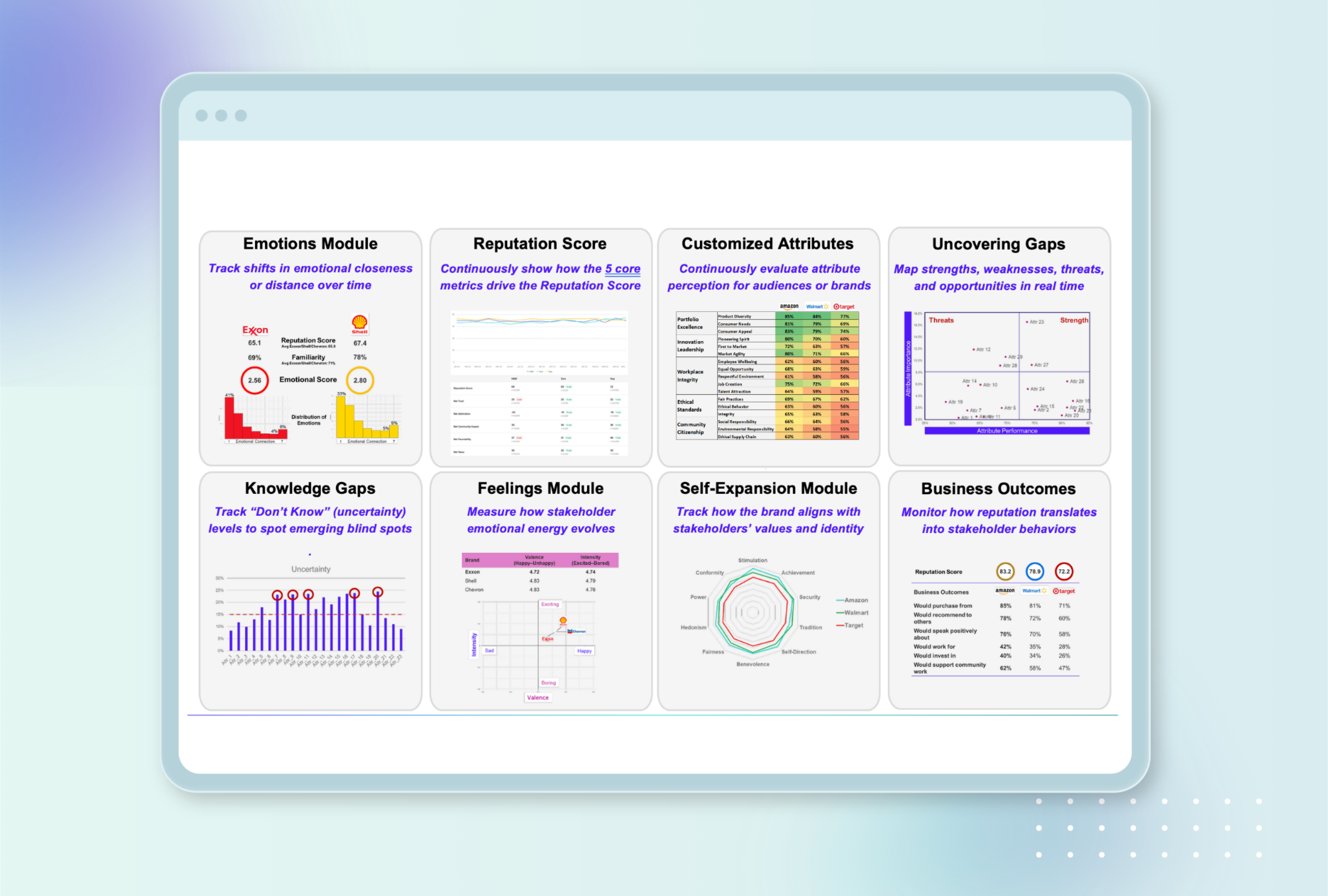
Ivan Rocabado: But if you want to go deeper and understand the why, that's why we built this new communication model, because it's a model that looks to understand audiences, different attributes, and different perspectives, to talk about a new way of addressing and being more actionable in reputation. A new model framework built on everything I've just talked about, from emotions to perceptions to feelings into the business motivators. And for each one of these sections, we have different research modules. It starts with the emotional score, reputational score, attributes, feeling, and self-expansion, leading us into action. It's a process. We were talking to a client yesterday and she clearly saw this. She said, oh, this is my process, this is my bread and butter in terms of what I do.
Ivan Rocabado: And everything starts for us with emotions, because emotions drive first impressions. Emotions are the automatic, gut-level reaction stakeholders have towards a company. These reactions are affective, fast, and largely subconscious. So even though we're measuring this implicitly, this is the starting point of affinity or aversion. It's often shaped by the tone, the symbolism, the crisis response, the authenticity of the corporate brand. And many companies say that they are giving you the emotional connection to their corporation, but they're based on conscious perceptions of metrics. We are using a true emotional understanding. It's been validated — it's a brand self-study where we're measuring emotional connection to the brand. We measure through this method of concentric circles that we're using in our brand studies.
Ivan Rocabado: So we have carried into reputation the whole validation that we've done in our brand work at Morning Consult, and that has been validated since the beginning of the 2000s. And it's interesting to see because we've implemented this across, as I told you, the brand work, and the emotional connection, we looked at it across share of wallet. But here in this example, in the top part, we see how the emotional connection increases and the share of wallet also increases for most QSR companies. We did the same thing with reputation. We measured banks, fintech, telecommunications, and beverage brands, and we correlated how this emotional connection correlates to actions. In this case, the chart below shows likelihood of recommending the companies as an action. We see at the top how Coca-Cola, PayPal, and Pepsi are highest in terms of how they are recommended depending on how emotionally connected they are. But it's interesting that there is a very important jump on Verizon. When they are highly connected to their stakeholders, we see a big increase in terms of their likelihood to recommend the company. So all this adds to the knowledge of how we need to interpret the communication that we're going to put out there, and how we increase this emotional connection.
Ivan Rocabado: Then we move into perceptions. In perceptions, we have the same reputation score as we discussed, five metrics, two dimensions, one point of view, no black box. But the uniqueness here is that we are customizing the attribute list to measure unique perception. As mentioned in the Wells Fargo example, the implications for the business must be assessed in the light of the unique set of attributes relevant to the sector and to the company. So we have a standard set of attributes, but we can define through a very robust analytic process which additional attributes to include, or if there are proprietary ones to consider. Attributes that support your strategy, your message house, or your corporate playbook are key because those are the ones needed to interpret perceptions. You don't need to adapt to a standard set of attributes. We adapt to you in terms of your needs.
Ivan Rocabado: Then we follow with feelings and self-expansion, to understand how perceptions are internalized and how stakeholders connect with the corporate brand. Feelings are where campaigns succeed or fail. This is where we succeed in terms of building loyalty, trust, and advocacy. And we measure this through the affective slider model, which is validated in the research space, and through the Schwartz theory that captures that essence of how stakeholders perceive their identities, values, and being reflected and enhanced through their association with the company.
Ivan Rocabado: This is the question we raised around the Tesla example. Would you buy a Tesla? All my perceptions are high. I understand what Tesla is in terms of innovation. I understand what Tesla is in terms of sustainability impact. But I would not buy a Tesla because I don't have this affinity with them, I don't have this emotional bond with them. So it allows us to understand that we can do a lot of effort in communicating messaging that resonates on the perception side, but as long as we don't move the needle on feelings and self-expansion, we're not getting change in consideration and change in recommendation.
Ivan Rocabado: We've been measuring different brands across feelings and self-expansion, and we can understand this texture of how feelings impact reputation. We can plot them in a quadrant analysis where we have balance, the positive and the negative in terms of feelings, and the arousal, which is the intensity of these feelings. We can plot all the brands and your benchmarks and understand where you fit into this model. At the top corner we have PayPal, Coca-Cola, and Pepsi leading this concept of delight in terms of brands, how people feel, high in terms of happiness, high in terms of excitement. And then we can go down, how Verizon is very similar to Chase, how AT&T is similar to Bank of America, and we come to how Wells Fargo emotionally is still in a neutral space. So all the good things that we talked about Wells Fargo, it can continue to enhance and be better if we understand how to manage that affinity and those feelings, and how to put that into the communication that we're doing.
Ivan Rocabado: And then we conclude the framework by understanding the business motivators and the actions. Again, this phrase is tremendously important: reputation only matters if it drives action. And we are going to measure here traditional business or supportive behaviors: consideration, recommendation, willingness to invest, willingness to work for the organization, willingness to forgive, to give the benefit of the doubt. All the ones that we know are the key KPIs for strategic reputation strategies.
Ivan Rocabado: So at the end of the day, what we're doing here is going from emotions to actions. We created this model with a single goal in mind: to give communications a more precise, quicker, and emotionally intelligent advantage. Because reputation management isn't just about the numbers, it's about shaping human reactions. That's the new strategic edge that Morning Consult is bringing to you. Thank you very much, Bill. I'll hand it over to you.
Closing Slides and Q&A Introduction
Bill Pink: Thanks, Ivan. And I know that was a lot. So we're going to switch over to Q&A quickly. But before we get there, just two more slides to close out the session — we wanted to bring this back to kind of where we were starting.
Bill Pink: As you're thinking about that broad framework, all the different thoughts and strategies and the role of emotions all the way through actions, we also just wanted to make it super clear how that ties back to all the core research questions and business questions we get and work on each and every day as it relates to reputation. Of course, as Ivan shared, the reputation score is sitting in the Intelligence Platform, so that's already ready to be used for all the brands that we're measuring across many markets. And of course a lot of this would apply to custom reputation tracking, deep dives, and measurement. But everything we're doing as it relates to narrative tracking, sponsorships, employer brand, and the range of custom reputation questions, this framework is guiding the development and the optimization of all the existing work. We just wanted to tie that back so you can see the connectivity.
Bill Pink: Of course, like I said right from the beginning, our goal is not just to have a webinar. Our goal is to have conversations with every interested party. And for anyone that really wants a personalized briefing on reputation, especially for the businesses among the thousands that we already have the data on, we'd be happy to schedule a dedicated session. The idea there is we walk you through your existing reputation score, benchmark how you're doing against industry peers, look at all the audience-level insights about what's going on for you and competitors in and out of category, and have a conversation about opportunities that the data may be identifying, or other questions you have, especially the strategic ones that naturally emerge and get to root causes, messaging strategy, etc.
Bill Pink: So that's the core content. Now we're going to switch to the Q&A. I'm looking at the questions and I'm happy to share that there are many and they're quite a range. I'm going to try to kick off with questions that are thematic.
Q&A: What Is the Difference Between Brand and Reputation?
Bill Pink: And the first question, Ivan, I've heard you talk about this a lot, so I want to direct this one your way. In today's world, what would you say is the difference between brand and reputation? And is there a difference?
Ivan Rocabado: Yes, it's a question that we hear often. From my point of view, I always take the concept of, we're measuring the corporation, we're measuring the corporate brand. And it's interesting when you take a look at it from that perspective. The brand basically is the promise that the organization makes to their stakeholders. And the reputation is this idea of can you keep that promise. So that's why when we were building the reputation score, brand appeal and corporate character were so important, because we want to understand how people see the brand promise. Is it favorable, is it relevant, is it authentic? But does it bring also, can I relate to it in terms of the value that it brings to me? So that's the brand appeal. The reputation side, for me, is more around the discussion of how do I keep that promise. Do you trust me as an organization? Am I the employer that I should be in your eyes for this sector? Am I treating my employees well, are my employees talking about the company well, would you work for me? But also what is my participation in community, in environment, sustainability, etc.
So for me, they go hand in hand. Reputation and brand go hand in hand. We're measuring the corporate brand here. Are you favorable to what we're putting out there? So this concept of authenticity, relevance, and value are tremendously key. But we cannot forget that people need to trust us. They need to see how we appeal in terms of the sector, how we are in terms of our corporate integrity, and how we manage the concept of impacting the sector that we belong to. I always talk about those two areas, and that's why the reputation score makes so much sense in terms of how we're putting it together.
Bill Pink: Thanks. And I'm going to add to that because there were so many questions related to it, and I know it's such a hot topic. I think it's really important to think of the Venn diagram, where, starting from the research side, there is a commonality of measuring predisposition associations with a business, service, or product that make you more inclined to either like it, to recommend it, to buy it, to consume it. So brand and reputation do have some overlaps, and some of the techniques Ivan shared we also use in more consumer brand type studies. But there are also big differences. Some of the biggest research differences tie down to the audiences, where we're doing many more niche audiences, whether they are policy makers, decision elites, even journalists, compared to big giant consumer studies on the brand side. On the brand side, we do a lot more about category entry points and those real motivations for an action or a shopping decision in and out of the moment of purchase, and sometimes way before the moment of purchase. And sometimes we will have reputation elements in a brand study, but other times we really keep them separate because the audiences are so different and the ultimate use cases sometimes are quite different, which ties right back to what Ivan was talking about — in reputation work on the sort of "permission to play" and all the benefits of reputation, where the brand work tends to be much closer to did you buy this, why did you buy this, yes or no. So that's a hot topic, more than one conversation for sure, as I can tell from all the responses here.
Q&A: How Does This Framework Improve on Legacy Reputation Models?
Bill Pink: So Ivan, another one I'm going to send your way. Knowing the existing reputation frameworks that are in the market, how would you say this helps make decisions better compared to the legacy models?
Ivan Rocabado: Oh, that's a great question. For me, it was really interesting to see the work that Morning Consult was doing on brand and understanding how we're getting to new ways of defining this unconscious connection that we have with organizations. And this concept of feelings and emotions for me is really interesting in terms of how it's taking shape, because we need to build messages that really resonate with our stakeholders. Those messages have evolved right now to a lot of conversations around narratives. There are sector narratives about how people feel the sector should be performing, but there is also corporate narratives. So for me, the biggest point here is that we are adding an emotional component and we are adding this feeling component to some of what has been out there in the market. Nobody else has these two components in the same process.
Ivan Rocabado: If you think about it on an ongoing basis, we start by understanding that emotional connection, and I know there's a question around the challenge around accuracy on measuring unconscious emotions. We're measuring it in an implicit way, but we're trying to get through this model that has been tested and validated, about the concentric circles and how people relate to an organization, that we've tested in brand and now are using in reputation. It just allows us to understand how close or distant our different stakeholders are from our organization. You could be a prospect and be very close to the organization, and you feel that you have that proximity, but there's something that hasn't let you come in to buy our products or services. Then we go through all the conscious pieces, the perceptions through the attributes which are unique for you, and we have a process to measure standard and unique ones. But then we come into the feelings side that separates feeling into this idea of how happy or how connected or what are your feelings toward the organization, and how intensive they are, but also the self-expansion, which is do you have the affinity towards the organization.
Ivan Rocabado: So knowing how close they are, knowing that there are positives and negatives in our attributes, we can craft messages that, if we know how close they are in terms of feelings and affinity towards the organization, we can tweak that language to talk about identity, to talk about values, to talk about emotional bonds that we haven't been able to track before. And tracking this over time, we'll see if the way that we are talking about our attributes, or the perceptions that our stakeholders have towards the organization, is it changing that self-expansion? Is it changing those feelings? And at the end of the day, are we changing the most important one, which is those emotions towards the organization? Having that on a continuous basis is the key pillar of this new framework. Something that I have never been able to do before. I have now all the tools here at Morning Consult to implement it, to create it, and now to move forward with a process. A process that communications can have, from emotions to understanding how they impact actions.
Q&A: Where Does the Reputation Score Live and How Is It Defined?
Bill Pink: Awesome. So I'm going to put a bunch of questions into one and I'll answer this one, because there's a bunch of questions that all tie to the scores themselves — such as: are they available in real time? Where do they exist? How do you define value and favorability in the scores? Let me address that as a group, and really try to clarify.
Bill Pink: All the reputation score data sits in what we call Morning Consult Intelligence, our syndicated platform. That is an all-day, every-day series of surveys that are completely standardized and cover about nine top-line brand and reputation measures, that cover attitudes towards the economy, psychographics, attitudes towards politics, media habits, and demographics. So it's constant. Some of it goes as far back as 2016, 2017, and then as it's grown, it goes all the way through today. It's thousands of brands in about 43 to 44 markets. So all of that exists at scale in a platform that you can subscribe to and then log into to get the score. While it is measured every day and available weekly per brand, we often look at it over longer time frames as we know some of this stuff evolves very slowly. But in particular when you take into account everything Ivan shared and what's going on, we also see things change fast. And all of that is then tied back to all those audience-level insights. Because the aggregate-level trends are one thing, the disaggregate-level trends by region, by segment, by ideology are where we're really seeing narratives emerge all the time.
Bill Pink: In those top-line measures is where we have our standardized value, favorability, trust, community impact, and admired employer that Ivan was going through. Those are asked the same for every brand because they're asked out of category. And there are questions around how do you then decompose that, and that ties right into what Ivan was sharing. We would look at audience differences, we would look at change over time, we would tie it to spend and other factors outside the platform. But all of the emotional depth and all of the deep dives is where the custom solutions come in. The platform has tons of information, it's amazing and highly empowering and fully real time, as we get into the reputation score in particular. But as we're thinking about emotional depth and these other things, that's where all the custom solutions come in. Ivan, would you add anything?
Ivan Rocabado: No, I think from my perspective coming into Morning Consult, that's the value of it. Having all that information that usually clients have to go in and do special research to find out some of the things, it's available there. You can understand what is going on, what is happening across markets, and then move into the framework and understand the why, and go deeper into asking the why questions.
Q&A: Has the Reputation Score Been Validated Against Real Business Outcomes?
Bill Pink: Yep. And another one that I'm going to take, because it's been asked about four or five different ways, so let me try to summarize it. This is all great, does it tie to sales? I think that's the simplest way to summarize it. Has it been validated to real-world business outcomes? And the short answer is yes, it has. The longer answer is in many different ways, shapes, and sizes. For us, validation takes many forms. We do a ton of work that is client-specific, where we're doing a consulting engagement that's all confidential and can't share. But we also do tons of work looking at the data across clients in a completely public manner.
Bill Pink: What we've really validated the most is the relationship of all the core elements with real-world behaviors. We've done that internally and externally. We've done that across lots of brands. We've done that at a category level. What we're going to do next is the score, because the score is the summary of those elements. But we have loads of validation to business outcomes for all the data already, and all of those outcomes are tied to the score and all the interrelationships therein. And that's all done outside the platform. From within the platform, all of those core nine measures have been validated repeatedly across multiple businesses.
Bill Pink: And what makes me particularly happy, as an old-school analytics guy, is that a lot of the validation isn't even done by us. It's done by others, which gives us a lot more credibility because others are publishing, hey, we just did this with Morning Consult data and here's the impact on business outcomes.
Q&A: Is Reputation Just for Communications, or Does It Belong Across the Organization?
Bill Pink: I think we have time for maybe one more question. And, Ivan, this is an interesting one. Are you seeing a relationship here where this is more used by communications alone, or marketing as well? And as we're talking about communications driving decisions, do we see any interactions with marketing? Do we see marketing sort of losing some of their strength? There's a bunch of questions that kind of look at different angles of the communication execs and marketing execs as end users and decision makers.
Ivan Rocabado: That's a great question. The one word I say on that question is "embedding." This is great because we're embedding reputation across the organization. Communications, marketing, HR, risk, investor relations, everybody can have value from working with reputation. Reputation needs to be embedded across the organization. The strategic table that the communications team is sitting at right now allows them to talk about strategy across the organization. You know that's, when I've seen the best teams outperform, that's what they're doing. When they take reputation and use it with marketing, how marketing can see how the house of brands benefits from having the corporate brand in their products, how they see that that elevates the reputation and the loyalty, how that elevates the security of buying their brands. But then we embed reputation in HR and take a look at how we can be an employer of choice. How do we attract talent? How do we keep talent? From the perspective of our attributes, our feelings, our emotions, how do we tackle the communication we're doing for job seekers?
Ivan Rocabado: And then if we move to the other side and we go into investor relations and crisis and all these other groups, how do they take pieces of this model and embed it into their work, because it's part of understanding where value comes from, where risk comes from, where do we build mitigation projects? Usually you don't start something on a crisis. We build an acumen prior to a crisis so we know how to act. Morning Consult Intelligence is amazing for crisis: daily we can take a look at millions of data points on how companies react. But when we're talking to risk and crisis teams, we can work pre-crisis, pre-event, and just work with them. So, embedded. That's the big word. How do we embed reputation across the organization, all working for the same strategic focus.
Q&A: How Is the Score Indexed and How Does Awareness Factor In?
Bill Pink: Awesome. So I'm going to answer just two more tactical questions that have come up. There's a bunch of questions tied to the role of awareness in the model and how the index is actually calculated and how high does it go. The short version is yes, it is indexed at 0 to 100. Generally in the upper 80s is really good. As Ivan showed, nonprofits tend to be some of the highest performers. And like we said, it's accounting for positives and negatives. In the white papers, the actual calculation is very straightforward in how it works. The awareness question is particularly interesting. What we ultimately did was take an empirical answer: when you're in the actual platform, the data is calculated without controlling for awareness, but it gives the user the option to rebase to awareness. The reason we did that was instead of putting a stake in the ground saying this has to be done one way or the other, it really helps to look at it multiple ways and kind of uncover the data and let the story emerge from different lenses. A lot of our end users really appreciate that because they don't want us constraining it to be looked at this way or that way. It gives a little more flexibility. So, in the platform, that's baked in.
Closing
Bill Pink: All right, there are more questions but we are out of time. So again, want to thank everyone for participating. These are great questions, I could clearly tell the audience is very engaged. We greatly appreciate your time and attention and have a great day. Thank you very much.