
How Edelman Builds AI With Morning Consult Data
Join Morning Consult for an executive conversation with Brian Buchwald, President of Global Transformation & Performance at Edelman, covering the convergence of real-time consumer data and AI-powered trust analytics.
Recorded December 4, 2025
Hosts
Brian Buchwald
President of Global Transformation & Performance, Edelman

Michael Ramlet
CEO, Morning Consult
What We Covered
How Edelman Is Building AI at Enterprise Scale
The Role of Morning Consult Intelligence in Edelman's AI Stack
Connecting Earned Media to Revenue
Full Transcript
Table of Contents
Reflecting on Three Years of Generative AI
The Inflection Point: When GPT-4 Made Two Years of Work Obsolete Overnight
How Edelman Built Its AI Organization: Center of Excellence, Ambassadors, and 90%+ Adoption
Who's Actually Using AI: Adoption Patterns Across the Organization
How Morning Consult Data Powers Edelman's TrustStream Platform
Morning Consult as the Data Engine Behind the Earned Flywheel
The Morning Consult Partnership: Data Infrastructure, Collaboration, and the Road Ahead
From Impressions to Impact: The Holy Grail of Proving Earned Media's Business Value
Connecting Communications to the CFO: Attribution, Trust, and Sales
Opening and Introductions
Michael Ramlet: Appreciate everyone taking a few minutes here on a Thursday on December 4th to join Brian and I for the first Morning Consult AI Spotlight. You'll have to at least give us a little bit of grace here as we work through the mechanics of it, but one of the goals I had mentioned to Brian was we really want to make sure that we are focused on highlighting the work we do with partners. And I think one of the things that stands out about AI is that, in particular for Morning Consult, on a daily basis, we collect 30,000 interviews around the world, and we've done 100 million interviews. There's a multitude of ways in which you can use that data, and I think we're incredibly grateful for the partners that we've been able to build, like Edelman. And so we're excited to have — which is sort of meant to be the opposite of a panel — two executives talking about AI. So, the hope is that this is pretty free-flowing. The overarching goal is that you learn something practical, and that we're actually talking about implementation. We're talking about things that really help you do your job. And so, whether that's on the client side or in other capacities, we want to make sure that this is practical.
Michael Ramlet: The overarching structure of this — there's a Q&A function to it, so we're gonna try and weave in the Q&A into the discussion, so hopefully we can have a tight 30 minutes here for everyone. But in addition, we'll also obviously follow up with anyone that asks a Q&A question, whether it's for Edelman or for Morning Consult. So, without further ado, and in the spirit of an open-ended, wide-ranging conversation between two executives talking about AI, I'm really excited to welcome Brian Buchwald, who is currently the President of Global Transformation and Performance at Edelman. You had come in 3 years ago, almost perfectly timed with the launch of ChatGPT 3.0, and you've previously been the Global Head of Product and Trust and Data Technology, and the Global Chair of AI and Product. I'm just really excited to welcome Brian, and, you know, I think we could spend 30 minutes just on the incredible, diverse experiences you have throughout your career, from DoubleClick to launching an analytics startup in China.
Michael Ramlet: But maybe for just a kickoff question to get this going conversationally. We just passed the 3-year anniversary of ChatGPT 3.0's launch. That was not the beginning of the work that many of us have been doing on machine learning and artificial intelligence, but it certainly feels like a marker. And I guess I'm just kind of curious: does that feel like forever ago? Does that feel like yesterday? Like, how do you think about the last 3 years? And is that even the right milestone?
Reflecting on Three Years of Generative AI
Brian Buchwald: Yeah, I guess I have the benefit now of being old, so I can look at things through larger or longer context windows. Well, first, thank you for having me here.
Generative AI is obviously something that is relatively new in terms of how we are commercially using it and how consumers are leveraging it — for instance, to find recommendations on products and services. But the technology behind it has been around for a while. If we think about natural language processing, if we think about machine learning, these are things that probably many of us have been using in our day-to-day work, whether we knew it or not, for well over a decade.
Brian Buchwald: But what we've seen in the last couple of years, Michael, is the scale and speed of how generative AI has impacted our work is like nothing I'd ever seen. I joke that sometimes I feel like the Forrest Gump of digital media. I was there in the early ad tech days, I was there in early digital media, I was on the founding team of Hulu, so early streaming. I had a startup that was focused on China as China really started to take over consumer spending globally. None of it compares to the reality of how generative AI has essentially washed over our businesses, our enterprises.
Brian Buchwald: Just as an anecdote, I had a call with a client about a year ago. We were launching a new service called Geosight, which is essentially a way in which you can optimize your visibility and favorability on LLMs. And the client asked me why we were doing it so late. We were actually the first company to offer a product like this in the market, but they were surprised it took us so long. And I said, well, yes, there are, you know, 500 million consumers now using LLMs for search purposes, but two years ago, there were zero. The concept of that scale within such a narrow time window is just phenomenal, right? So for all of us, it's really about how do we reorient ourselves to something that has become so meaningful so quickly? What does that mean for our organizations, for our teams, for our clients? And knowing that whatever we do today will probably be outdated in six months.
The Inflection Point: When GPT-4 Made Two Years of Work Obsolete Overnight
Michael Ramlet: Well, I was gonna ask — sorry, I feel like I had two follow-ups on this sort of framework. Is there, like, one moment in the last… I feel like when it came out, it was, what, November 27th or 30th of 2022? Or 2023. The first intro was like, hey, I can write this really funny Shakespearean email, all these different ways to use it. And all of a sudden it morphed into, okay, what does this look like in enterprise settings? But is there a milestone, when you think back over the last three years, that was just an inflection moment besides the launch?
Brian Buchwald: Yeah, so for us at Edelman, we had launched a platform called TrustStream, which we'll talk about in a little bit, where essentially we're able to predict changes in trust for a brand or for a corporation well before you actually see it in, for instance, quantitative research. And then we can dial into exactly what the causes are and the impact of, for instance, an earned media story or a social post. We had certain levels of accuracy, both in terms of the predictability and in terms of our ability to accurately quantify impact to a particular article or tweet. And we had spent 2 years building bespoke models. We implemented GPT-4.0, and it just blew away our prior accuracy, both in predictions and in the accuracy of the impact measurement, in ways that made it very clear that what our team had done over 2 years, millions of dollars, countless thousands of hours of development time and data science time, was basically rendered useless or antiquated overnight by a simple implementation of an API.
Leading Through Rapid Change
Michael Ramlet: So I was gonna ask — obviously you guys did everything perfectly over the last three years, and there were no changes that were made, and you…
Brian Buchwald: Only, only a thousand.
Michael Ramlet: I mean, the clairvoyance was amazing. But how have you mentally adjusted, or how do you, from a team leadership standpoint, think about just how fast things are changing? Like, avoiding the sunk cost fallacy?
Brian Buchwald: Yeah, so one of the key elements for me is I think about strategy as something that should be more like the climate, and the tactics that we use should be more like weather — in that tactics can change very quickly, whereas the strategy should be more stable. So, whether it's for the AI and product organization at Edelman, or now for Edelman itself where I'm driving the overall transformation, we want to know what our true north is. We want to understand where we're trying to get to over a 2- or 3-year time horizon, even 12 months, and then we understand that day-in and day-out, things are just going to change. The assumptions that we make in terms of what we can do with generative AI today will just be fundamentally different tomorrow. So part of it is also building better relationships with the OpenAIs and the Microsofts of the world, so that we have a peek into what their product roadmap looks like — so we're not building something that in six weeks or six months they're likely to launch as a simple feature on a current platform. Understanding who the best-of-breed partners might be that are building defensible positions that will be value-add for our clients, and that won't simply be subsumed by features within Claude or ChatGPT. But it's definitely not an exact science, and per your point, you have to be ready to burn the boats. You can't assume that just because you made the investment you should continue it, because you're just gonna be proven wrong time and again.
Michael Ramlet: Yeah, I think for us it was the launch of GPT-4 or 5, and the ability to work with tabular data. That was transformative. For us it was the economic data, The ability to do comparative economic analysis either across regions, or to do comparative economic analysis of sub-components of consumer sentiment, like what are current conditions versus future expectations over the next 12 months. I think that was the mind-blowing moment. But it feels like with each model — and it's obviously not just within OpenAI's world, you know, the Gemini 2.0 launch here over the last few weeks — it's this rapid pace of change. So maybe as a table-setter, and to kind of abide by the overarching framework for the AI Spotlight, do you mind sharing with us how you've approached AI, the work that you guys have done, what you're building, and what you guys see coming in the future?
How Edelman Built Its AI Organization: Center of Excellence, Ambassadors, and 90%+ Adoption
Brian Buchwald: Yeah, funny you should ask — I actually have slides. This is not going to be an infomercial for Edelman, but hopefully actually valuable to the folks on the call, this is just to give a peek into the mind of how we've operated. There's an advantage to our company, which is we're privately held, there's no debt on the books, so we're not operating under 90-day windows, we're not trying to create cash flow to pay down debt. We're typically thinking on 12- and 36-month time horizons, and that's enabled us to build an AI Center of Excellence of roughly 60 people, which includes product managers, data scientists, and developers, but also transformation consultants — what we call AI builders — and strategists who are really just fundamentally there as force multipliers within the organization.
Brian Buchwald: The work that we've done on some of our biggest accounts has actually seen, through this group, 50% average productivity gains on roughly 200 custom models that we've created through that Center of Excellence across those bigger accounts. We're seeing the team help in efficiency, but also in driving value. And one of the areas that we've also focused pretty assiduously on is how we impact the larger workforce. When I got this job, my CEO asked me how many resources we would need. And I said, enough to be effective, but not so many that people could think that we were going to do their job for them. So really, the primary purpose of the team is also to empower our staff so that they have the skills.
Brian Buchwald: We built, as a force multiplier, a team of roughly 300-plus ambassadors. These ambassadors work across geographies and across what we call sectors, as well as our client bases. It's their job to radiate out the capabilities, the knowledge bases, the tools, the workflows that we're creating centrally into those local teams. They carry that as a KPI, it's part of how they're goaled and compensated at the end of the year, and they've really been instrumental in getting to what we have right now, which is over 90% weekly active users of our enterprise platform. So we're seeing really good adoption.
Brian Buchwald: And the teams themselves have now created over 10,000 custom GPTs on top of the foundational GPTs that the COE is building. Think about this as a team member in Germany who wants to make a certain process that they do every day for the client more accurate, more effective, more efficient. They're able to now build this on their own. We vet those, we take the best versions of those, we bring them back into the center so we can push them back out to the broader teams. It's a way in which we can really scale with them.
Who's Actually Using AI: Adoption Patterns Across the Organization
Michael Ramlet: For the bottoms-up piece of it, have you noticed any trends in terms of which staff are most engaged, or characteristics among staff that are most engaged?
Brian Buchwald: Yeah, so that's an interesting question. We have roughly what we call levels 1 to 8 at the company, 1 would be someone leaving college, 8 would be our CEO. And it's really been in the 4 to 5 range where we've had the greatest adoption. Our hypothesis going in was that AI would be something that would really start to hollow out that level, because a lot of what they do is manage process — think about that as a director or a VP. But what we've actually seen is them diving in and being some of the best users of the platforms, which has been really educational for us in terms of how we think about what the organization of the future actually looks like.
Michael Ramlet: I mean, we've been surprised how much of that is a continuum, to your point. Obviously, folks coming right out of school presumably haven't used a number of these tools while in school. But also, some of our most experienced specialized staff have been yearning for this type of capability, or to automate some of those rote tasks. It's been interesting to see that every level has had a huge impact from it.
Brian Buchwald: Yeah, I mean, I can give you two ends of the barbell. I have a friend who runs a communications firm, and when they're interviewing college graduates, they ask them how they used generative AI to cheat on their exams in college. And if they don't have a good answer, they won't hire them. Which I thought was pretty interesting. We also have an Executive Vice President at Edelman who, a few months ago, was involved in a CEO resignation and the naming of a new CEO by the board. This was essentially a 3-day long weekend where he and the team worked on that transition — it included board materials, employee communications, press releases, Q&A, and LinkedIn posts. And what normally would have taken a team of 12 all weekend, he did with one other senior executive.
Brian Buchwald: They did that through the use of our foundational GPTs, the models that we created. He had analysis helpers, partners in the writing of content, in the customization of that content for different social platforms. And he said for him, it was just easier because his ideas were directly inputted into the revisions, and it was done instantaneously, so he saved a lot of time but also got a lot more value. So I've seen it work for really junior people, but also for the most senior people at the company.
How Morning Consult Data Powers Edelman's TrustStream Platform
Brian Buchwald: We're gonna touch on this in a second, but we've also created some proprietary tech internally. Principally something called TrustStream, and then Archie, which is the LLM that actually drives the TrustStream platform. I thought I'd give a little bit of a PSA for Morning Consult, who's been a great partner of ours. When I started running the product team, we were running our own surveys. We were essentially asking questions around trust globally for a certain number of our clients. What we found in partnering with Michael and the Morning Consult team was just much more respondents per brand, much greater depth by geography, many more brands we could track, and we could launch more efficiently. And ways in which we could cut the data to get to an even better understanding of what drives trust and what matters for our clients than we ever could have gotten to on our own.
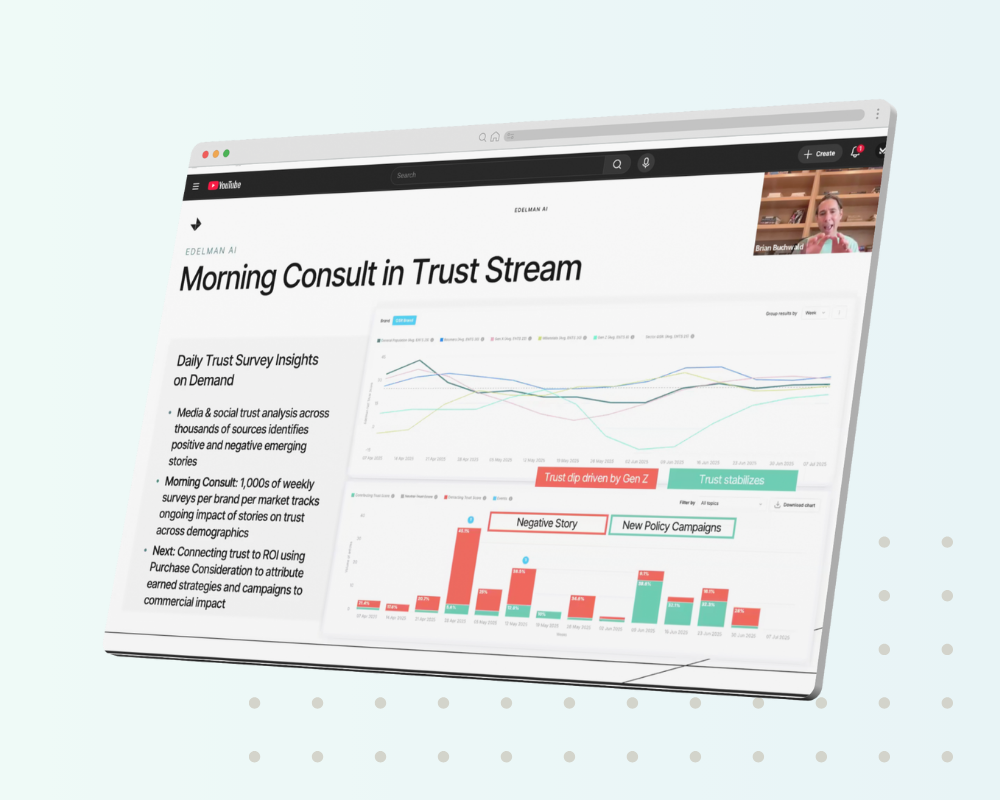
Brian Buchwald: So, Edelman has our own ETM survey platform, it's very good for specific purposes, but for this Morning Consult was, we thought, the best in the world. And what Morning Consult has enabled us to do — and you're seeing a little bit of it here, this is for one of our clients in the QSR space — we're able to identify how trust is moving for the brand overall, chronologically, but also what that means for, for instance, the general population versus Boomers versus Gen X versus Gen Z. And what we're then able to do is attribute impact to specific moments, specific events.
Brian Buchwald: What you're seeing on the bottom is a look at different events impacting the brand, and we can start to see, okay, well, this event impacted Gen Z by 5%, this impacted overall GenPop by 3%, and we can start to break it apart and really find a tail. And then we can take it one level deeper and get into the specific articles, specific posts, the specific influencers or creators who are actually making that difference. It puts us in a really different position as partners to our clients, where we're not discussing things post-facto. In the moment, we're actually able to dive in and help them navigate challenges, but also really interesting opportunities.
Morning Consult as the Data Engine Behind the Earned Flywheel
Brian Buchwald: Where we're going at Edelman is something we call the earned flywheel — and this is really a way in which we can identify cultural insights. Those insights can lead to earned-first ideas. We can validate and drive those earned ideas through different channels. We then can create content, distribute the content, and finally, on the back end, have both real-time optimization and attribution. So think about this as a closed loop. Publicis talks about, essentially, a push model regarding paid, a paid flywheel. This is a pull model. This is where an earned-first idea — think about earned not as a channel, but as a strategy — is proven to align between a brand and an audience, and then we can drive this through the flywheel to actually impact those audiences through the different channels that matter to them.
Brian Buchwald: We're already using Morning Consult data — both what I shared earlier like the trust data, but now also purchase consideration data — so that we can start to better identify, again, things like attribution further down the funnel. And for cultural insights: how do we start to think about predictive trends? Which trends are likely to be commercially valid for brand A versus brand B? How do we think about the influencers and creators we might partner with? Who are the right journalists we might pitch on the idea? How might we amplify these through paid? The data that we're getting from Morning Consult is really becoming, like, atomic-level oxygen that actually feeds the entire ecosystem. We're really pleased with the partnership. It's starting to really drive a lot of how we're thinking about the use of data. And back to the generative AI point — the way in which we can synthesize and integrate that data into a larger dataset, and make it truly useful, and not just correlative but actually getting to cause and effect, is something we just couldn't have done a couple of years ago. So it's a new dawn for all of us.
The Morning Consult Partnership: Data Infrastructure, Collaboration, and the Road Ahead
Michael Ramlet: Yeah, I think that's, from our perspective, it was a really kind of self-reflection for us. There are so many different ways you can use this dataset, and so for us it's like, how do we get the right investment in the data infrastructure to go along with the longitudinal data and the continued expansion? I think what's been exciting to see is we're building out the structure and we obviously can distribute that data through APIs or other means. But then to watch you guys build on top of it, it's just really exciting. This is the collaboration piece, and you guys obviously passed back plenty of feedback to us: hey, have you thought about adding these datasets to the daily tracking, or these brands? And that component to us, from a true partnership standpoint, has been so powerful.
Michael Ramlet: And from our 3-year outlook, I think we look and say, like, to your point, the ability to add more economic or geopolitical data into the mix is something that we've been trying to lay the foundation for. But I guess I was curious from your perspective, as we look out, it's been three years since ChatGPT 3.0, and maybe that feels like three decades, maybe that feels like three minutes, and it probably depends on the moment — if we're talking 3 years out, and hopefully we're talking more often than that, what are the milestones or the big inflection moments that you see in that 12, 24, 36 months? To your point about thinking more about the atmosphere while recognizing the tactics and the weather might change.
The Agentic Future
Brian Buchwald: Yeah, I mean, we believe in an agentic future. I'm not stating anything revelatory, in fact, I say that and I almost feel like I'm a walking cliché. But we actually do. A lot of the way that we're building at Edelman is fundamentally around how do we stitch together agents to optimize workflows, to make them more efficient but also more effective. And I think about it almost like a LEGO set, where we can add more pieces, it gets a little bit more sophisticated, it can build more complex or interesting things. That's kind of what we're doing now at the firm.
Brian Buchwald: If you were to look back six months ago, we saw how AI could impact roughly 70% of the work we do at the company — mostly text-based, the things that we know LLMs are really good at. That number is rising precipitously as we start to see advances in video, image, audio, and other areas as well. So I think where we are in a couple of years is the human is there to inject taste and judgment into the system, but the primary work will be done by the AI. And we're already thinking about what that means in terms of account staff versus subject matter experts versus how and where the work gets done. Because, you know, places like New York and London and Chicago are really important to be for our clients, but they're not important to get the work done. And then the question becomes, does the work need to get done in Mumbai, or in Saskatchewan, or could it get done in the cloud?
Michael Ramlet: Yeah, I think we talk a lot about this on the technical side. Writing about economics is not easy copy, and oftentimes not very accessible copy to non-economists. And so, one of the things we keep thinking about is how does that agentic future take multi-step tasks and make them more accessible to a broader set of business users? It's one thing to write for the Federal Reserve — we're grateful for our partnership with the Fed, and it's wonderful to talk about Bayesian models and whatnot — but that's maybe not the same tone or framing for data with a CFO. And so I think one of the areas where the agentic piece works is you can take very technical writing and start to make it more accessible. I guess I was curious — as you're thinking about some of the extensions, you mentioned purchasing consideration earlier — are there holy grails of where you see that, like, wow, we've gotten to that point?
From Impressions to Impact: The Holy Grail of Proving Earned Media's Business Value
Brian Buchwald: Yeah, so for me, I sold a company to Weber Shandwick in 2017, and Weber is a competitor to Edelman, and on my first day on the job, I had to learn what earned media was. I had no idea what it actually meant. And there was a question I had on day one: why are our primary KPIs things like impressions, articles, and share of voice, and why aren't they things like sales, market share, and profit margin? My holy grail since the day I started was, and is: how do we use communications and earned to both prove and improve the business value for our client, and not just reputational value?
Brian Buchwald: Those things are important, but what I'm looking at AI to do, and the reason why I walked through the earned flywheel, is fundamentally what we have to be able to do is prove the business value of our work in a way in which we can increase the pie. Our clients — and probably the clients of our competitors — spend anywhere between 3 and 7% of their overall marketing budget on earned-first ideas or communications. That number should probably be about 15%, which would increase the size of our industry by 2 to 3X. Part of the goal for me in all of this is I don't want to be the nicest house on a lousy block. I want to make sure that the block itself is nice, and that all of us are helping grow the industry. Where I think this gets us is a place where we can build media mix models, attribution models, and optimizations that get us out of how do we get more article impressions, how do we get more placements — and into how do we steal market share from competitors, how do we grow sales, how do we increase profit.
Connecting Communications to the CFO: Attribution, Trust, and Sales
Michael Ramlet: Are there case studies that come to mind where you've seen this done really well, and where you've told that story to the CFO? Because I think that's the other part, we get asked increasingly now by investor relations, hey, we need an earnings prep pack, can you put together all the quantitative economic data and the brand data? And that seems like it's a sort of expanding partnership between communications and public affairs leaders and the office of the CFO. But I guess I was curious on your end.
Brian Buchwald: Yeah, so one of our biggest hurdles is that oftentimes CCOs just don't see it as their job to drive sales. And these are some of the biggest, most important companies in the world. In fact, we had a client in the furniture space where we were able to build an attribution model for them to show how, essentially, a one-point rise in trust was equal to a 100 million euro growth in sales. And we could show them how to break down trust into discrete pieces, and how to use different tools at their disposal — earned strategies, media, etc. — to drive that trust. The initial reaction from the CCO was, "that's not my job." But as we start to work with them, we start to get them comfortable with the place that, no, actually, this is a way in which you're no longer having to fight for budget, you can actually go back to the CFO and make the case.
Michael Ramlet: Yeah, it's deeply empowering.
Brian Buchwald: Right, how this moves the needle for you. So for me, this goes back to something I said earlier, which is earned communications — earned is a strategy, it's how you build organic alignment between a brand and an audience. It's not a channel. And once we get people into that mindset, they start to see, okay, well now it's about ROI. How do I get to ROI? I need to have attribution on the back end. I should know what my media mix looks like predictively. I should have the right idea up front, and I should be able to validate that idea through synthetic audiences and other things. So it starts to become the starting point, or the kernel that grows into something far larger.
Closing
Michael Ramlet: Alright, so we did it. We got through the very first Spotlight. Obviously, folks can connect with you on LinkedIn, but if they want to learn more about Edelman's work on AI, where should they go?
Brian Buchwald: We have an Edelman AI page — edelman.ai. I'm happy to talk to you, even if you work at a competitor. Again, let's make the whole block better, not just our own house.
Michael Ramlet: And to that end, we'll be posting this on the Morning Consult YouTube page. I know a number of folks wanted to have a transcript or a video, and we must have done enough right in the first episode. We obviously want to build a better block, and we're focused on doing that through partnerships. We really appreciate the chance to partner with you, Brian, and Edelman writ large. Thanks for the time, and really appreciate everyone that joined us here this morning.
Brian Buchwald: Thanks, everyone.