Consumer AI has crossed the awareness threshold faster than any major consumer category in recent memory. The trust threshold is another matter. Adults who use these tools daily tell this survey that AI exploits their data, operates without transparency, and does not yet reflect who they are. Forty-one percent say their view of AI has improved over the past year. Fifty-three percent lean toward believing AI tools exploit rather than respect their data. Both are true, and that is the problem. The category has earned adoption; permission is the harder task still ahead, and the window to claim it is open but closing. Switching inertia is already rising: 29% of consumers say they are happy with their current AI tool, up more than 4 points over the past 4 months.
A Category People Use But Haven't Decided to Trust
The category-level data tells a story of ambivalence that no brand has yet resolved. Sixty-seven percent of U.S. adults find AI tools helpful and empowering, meaning the utility case has been made by the products themselves. The relational case has not: whether these tools can be trusted with what matters and whether the brand behind them is on the consumer's side.
Three attitudes define the structural anxiety underlying the usage numbers. Fifty-six percent describe AI as opaque rather than transparent, the largest negative margin across any dimension tested. 53% lean toward believing that AI exploits their data. Forty-nine percent lean toward viewing it as overhyped rather than innovative. People are using tools they do not fully trust, and that behavior is fragile.
The trust brief is explicit. Safety guardrails top the list of measures that would increase consumer trust (44%), followed by more user control (41%), better accuracy (40%), and clearer data privacy protections (39%). Endorsement from trusted brands ranks last at 13%. The brand that credibly addresses these conditions first will redefine what trustworthy AI means for every brand that follows.
A Morning Consult AI Trust Report published the same week as this study, based on continuous brand tracking of 3,000+ brands, reinforces the scale of the challenge: AI ranks 10th in awareness-adjusted distrust across 198 tracked categories, placing it alongside Tobacco and Crypto as one of the least trusted industries measured. The methodology differs from the reputation survey underlying this memo, but the structural anxiety it captures is the same.
Two Brands Have Earned Trust — the Rest Are Running on Adoption
Figure 1 plots all eleven brands on Reputation Score and Emotion Score, with crosshairs at the dataset means (Reputation: 49.4; Emotion: 3.11). The picture is less a competitive landscape and more a stress test: which brands have converted usage into genuine reputational standing, and which are holding positions built on familiarity or distribution they have not yet earned the hard way.
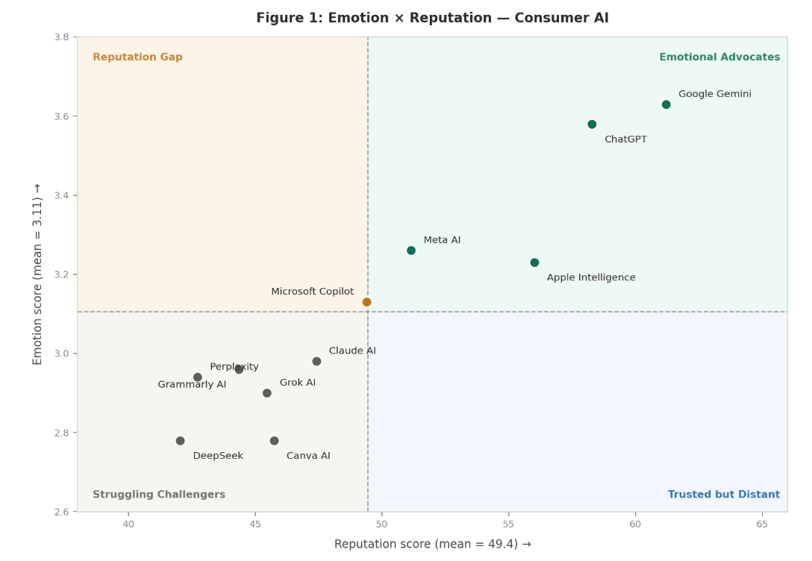
Figure 1: Emotion × Reputation — Consumer AI (n=302 U.S. adults, May 2026). Crosshairs at dataset means: Reputation = 49.4, Emotion = 3.11.
Google Gemini (61.2, 3.63) and ChatGPT (58.3, 3.58) are the only brands that clear both means by a meaningful margin, each occupying a distinct lane, as shown in the Category Entry Point data. Their leadership is structural: neither is gaining on the other, nor is either losing ground. However, the Category Advantage data shows emotional connection softening over four months for both ChatGPT (from 4.06 to 3.65) and Gemini (from 3.80 to 3.35). The Trust Report's continuous tracking adds a dimension our single-wave survey cannot capture: among the ten leading AI brands, only Gemini gained net trust year-over-year (+6 points), while seven lost ground. That directional signal aligns with the structural lead Gemini holds in this study.
AI is becoming a utility in the same way search did: used without affection, switched without grief. Brands that do not invest in the relational dimensions of their reputation while they still hold emotional standing will find it much harder to do so once that standing is gone.
Apple Intelligence sits in the Emotional Advocates quadrant by score (56.0, 3.23), but its trajectory tells a different story. Mental Penetration fell 3.5 percentage points over four months, and active use declined. Reputation has not protected Apple from losing AI mindshare, which is the clearest evidence in this dataset that scores and trajectories differ. Apple has the brand heritage; it has not yet delivered the AI product that justifies the promise.
Distribution Is Not the Same as Trust
Meta AI and Microsoft Copilot illustrate the category's most consequential mismatch: wide reach, unearned permission.
Meta AI scores above both means on Reputation (51.1) and Emotion (3.26), but its Feeling Score of 2.93 is the lowest among any above-mean brand in the study. Figure 2 reveals the pattern: Meta AI is the lone Emotionally Charged Critic, combining above-average emotional presence with below-average warmth. Its history of data controversies stands in stark contrast to the category's most active consumer anxiety. Distribution is generating encounters, but trust is a separate transaction entirely. In a category where the trust brief centers on data privacy and safety, the gap between what Meta needs to say and what its institutional record allows it to say credibly is the strategic constraint.
Microsoft Copilot, the sole occupant of the Reputation Gap quadrant, converts awareness into past-month use at roughly 36%, the lowest rate among major brands. Users who engage hold broadly positive views; the barrier is the lack of a clear consumer occasion. Copilot's workplace positioning is real, but translating it into a consumer-facing reputation claim that extends beyond the enterprise context remains work to be done.
The six brands in Detached Negatives sit below both the feeling and emotion means and face a different risk: irrelevance rather than resistance. In a category where switching inertia is hardening, generating neither positive feeling nor negative intensity is a position from which it becomes increasingly costly to move.
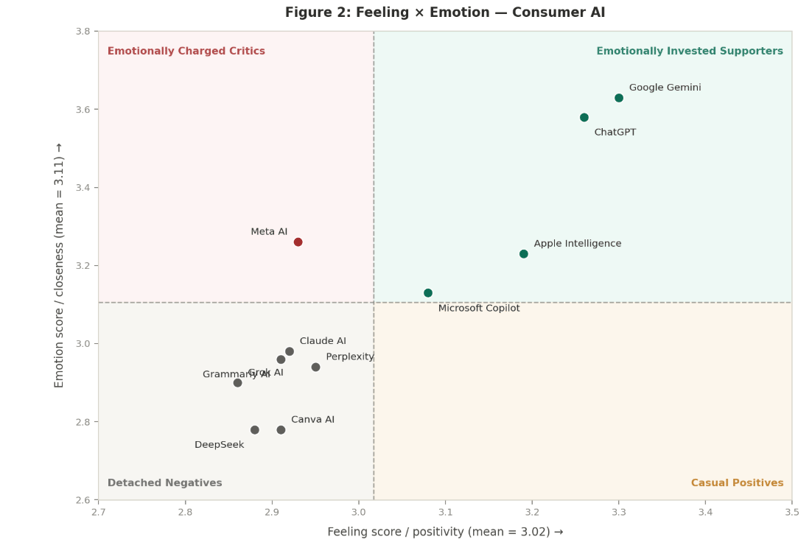
Figure 2: Feeling × Emotion — Consumer AI (n=302 U.S. adults, May 2026). Crosshairs at dataset means: Feeling = 3.02, Emotion = 3.11.
Claude's Window
The most strategically consequential signal in this dataset comes from a brand whose reputation scores alone would place it in the Struggling Challengers cluster. Claude gained 13 percentage points in awareness and 5 points in Mental Penetration over four months. Among $100K+ earners, active use nearly doubled to 17.1%. The Category Advantage data is unambiguous: Claude has entered the consideration set of the audience that pays for premium subscriptions, while every other challenger brand was gaining awareness without converting it to use.
The reputation survey tells the other side. Claude's Reputation Score (47.4) and Emotion (2.98) both fall below the dataset means. On the Self-Expansion dimensions in Figure 3, Claude scores lowest across nearly every measure: 16.9% on "reflects who I am," 22.0% on "I feel proud to use this AI tool," and 23.9% on "aligns with my values." Premium-audience adoption is converting; identity-level attachment has not followed.
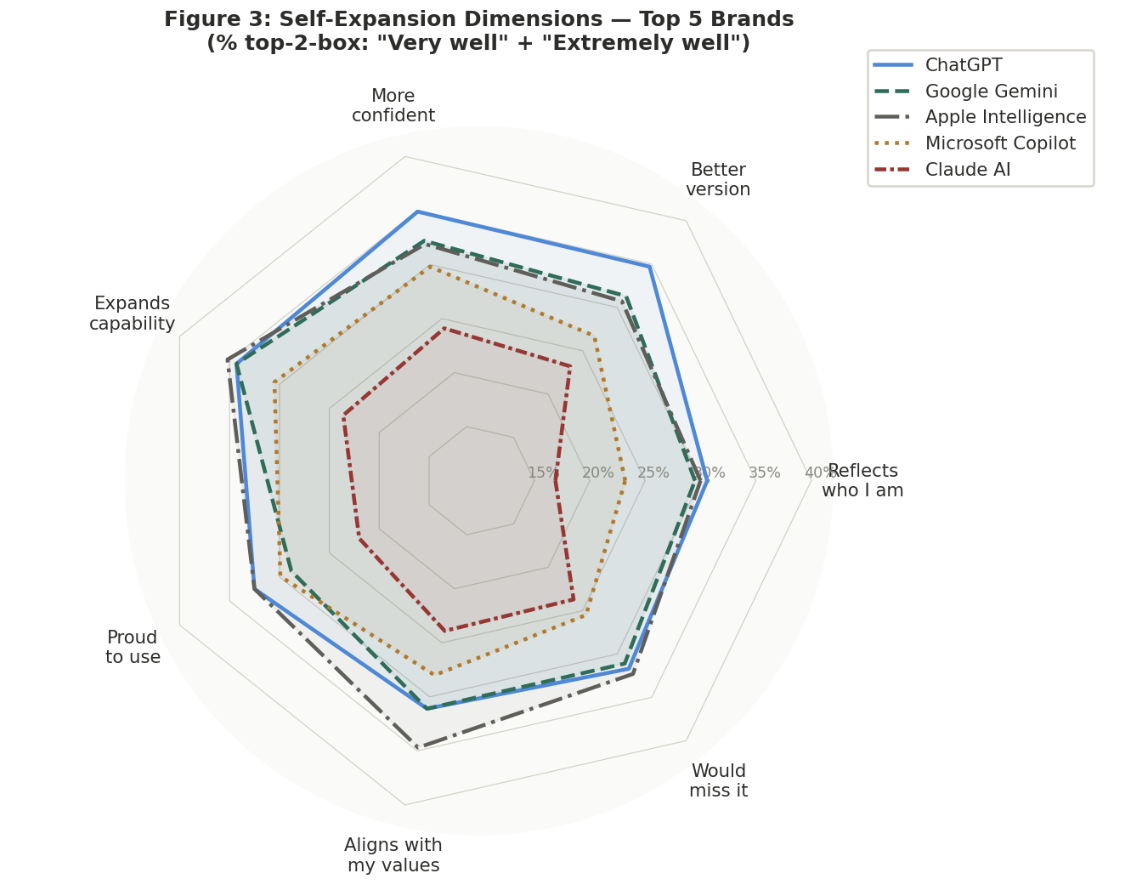
Figure 3: Self-Expansion Dimensions — Top 5 Brands (% top-2-box: “Very well” + “Extremely well”, n=302 U.S. adults, May 2026).
Adopting before building reputation is the typical sequence for a fast-growing challenger, but the timing here is strategically urgent. The impressions forming about Claude now, among the premium audience discovering it, will either become the foundation of a durable brand position or remain purely transactional. Anthropic's Constitutional AI positioning, safety-first framing, and values-led product decisions are the raw material for a reputation narrative no other AI brand can credibly replicate. The question is whether that narrative is reaching the premium audience at the pace of adoption.
Habit Without Meaning Doesn't Hold
Figure 3 is the most forward-looking chart in this study. Self-Expansion scores measure how deeply a brand is embedded in consumers' self-perception: the difference between a tool that is used and one whose absence would be felt.
The category scores are uniformly modest. Even among the leaders, top-2-box scores range from 29% to 35%. No AI brand has reached the point where consumers feel the product is part of who they are. The warning is direct: high usage without self-expansion attachment is a habit, and habits break. Behavioral lock-in is hardening as emotional investment is loosening, leaving consumers who cannot easily switch but feel no genuine attachment to the brand they are with. When a capable competitor arrives with a sharper identity claim, the switching cost is lower than inertia data would suggest.
The opportunity is equally direct. Values alignment, pride of use, and identity reflection have scores in the low twenties and thirties across the category: entirely unclaimed territory. The brand that earns those scores in the next twelve months will hold a position that late movers will find exponentially harder to contest.
Integrated Scorecard: Category Advantage Meets Reputation
The table below presents both frameworks, allowing a direct comparison of mental availability, behavioral conversion, and reputational standing for each brand.
|
BRAND |
MMS |
ACTIVE USE |
AWARENESS |
REP SCORE |
EMOTION |
FEELING |
QUADRANT |
COMM. IMPACT |
KEY CEP |
|---|---|---|---|---|---|---|---|---|---|
|
Google Gemini |
27% |
27.7% |
58.9% |
61.2 |
3.63 |
3.30 |
Emotional Advocate |
Positive |
Quick Answers, Research |
|
ChatGPT |
33% |
36.6% |
72.2% |
58.3 |
3.58 |
3.26 |
Emotional Advocate |
Positive |
Rewriting, Creative |
|
Apple Intelligence |
4% |
13.7% |
27.4% |
56.0 |
3.23 |
3.19 |
Emotional Advocate |
Positive |
Ecosystem, Utility |
|
Meta AI |
9% |
17.2% |
56.9% |
51.1 |
3.26 |
2.93 |
Emotional Advocate* |
Neutral |
Distribution reach |
|
Microsoft Copilot |
9% |
15.9% |
39.0% |
49.4 |
3.13 |
3.08 |
Reputation Gap |
Neutral |
Workplace tools |
|
Claude AI |
3% |
13.3% |
32.0% |
47.4 |
2.98 |
2.92 |
Struggling Challenger |
Positive |
Premium, post-grad |
|
Grok AI |
4% |
6.2% |
24.1% |
45.5 |
2.90 |
2.86 |
Struggling Challenger |
Neutral |
Awareness w/o use |
|
Grammarly AI |
2% |
27.9% |
21.0% |
44.4 |
2.96 |
2.91 |
Struggling Challenger |
Neutral |
Rewriting (task) |
|
Canva AI |
2% |
6.1% |
15.1% |
45.7 |
2.78 |
2.91 |
Struggling Challenger |
Neutral |
Creating (task) |
|
Perplexity |
2% |
6.9% |
17.8% |
42.7 |
2.94 |
2.95 |
Struggling Challenger |
Neutral |
Research niche |
|
DeepSeek |
1% |
6.9% |
22.3% |
42.1 |
2.78 |
2.88 |
Struggling Challenger |
Neutral |
Awareness w/o use |
Meta AI placed in Emotional Advocates on Emotion × Reputation chart; lowest Feeling score in that quadrant. MMS = Mental Market Share (Morning Consult Category Advantage, May 2026). Rep Score = composite of Favorability, Trust, Value, Community Impact, and Admiration (excl. DK/NO). Emotion = weighted mean on 1–7 connectedness scale (÷100). Feeling = weighted mean on 1–5 positivity scale (÷100). Key CEP source: Morning Consult Category Advantage memo, May 2026.
What Closes the Gap, and Who Is Positioned to Close It
The category's structural anxieties (opacity, data exploitation, overhype) will not fade with time. They harden into default assumptions unless a brand actively interrupts them. The trust builders consumers named describe the implicit contract this category still needs to establish: safety made visible, data handled transparently, and capability that matches its claims.
Comms priorities vary by position. Gemini and ChatGPT need to protect the emotional infrastructure they still hold while expanding into the identity dimensions where their scores are weakest. The risk is that the category's utilitarian drift pulls their brand experience toward pure function, leaving the values and identity space open to a challenger. For Apple Intelligence, the task is to close the gap between brand promise and product delivery: reputation built on hardware heritage will not indefinitely absorb the cost of an AI product that underperforms its marketing.
For Claude, the opportunity is specific: make Anthropic's safety and values architecture visible to the premium audience already converting. The Constitutional AI framing, transparency commitments, and values-first product decisions provide Claude with the raw material for a self-expansion narrative that addresses every dimension where its current scores are lowest. The work is to show the premium audience that using Claude reflects who they are, a reputation investment that needs to happen at the pace of adoption.
For Meta AI, credibility is the structural constraint. The anxieties the category has named are precisely the dimensions where Meta's institutional history is a liability. Copilot's path is narrower but clearer: establish a consumer occasion that converts the emotionally present audience it already has.
Consumer AI is the first major consumer category in which reputation has been asked to catch up to adoption rather than precede it. Every other category we track shows the opposite pattern: brands build trust, then earn use. Here, use came first, and the trust contract is still being negotiated in public. That is an unusual situation, and it creates an unusual risk. When trust is absent at the moment of adoption, the default assumption fills the gap. In this category, the default assumption is that AI exploits your data, operates without transparency, and was built for someone else. Brands that allow that assumption to calcify will find it costs far more to reverse than it would have cost to prevent. The permission gap in consumer AI is a reputation problem with a defined price: safety made visible, data respect made tangible, and an identity the consumer can claim as their own. That work is available to any brand willing to do it first. It will not be available to the brand that waits for the product to earn the trust that communications should have been building all along.
Your Consumer Data Has a Blind Spot
Saks Wins the Occasions That Matter to Affluent Shoppers