Download our Most Trusted Brands 2026 report here for the definitive ranking of the brands that lead the way on consumer trust — spanning 184 brands across 30 rankings.
The bottom line up front
Parents with kids at home are twice as likely as the average adult to think of a hotel for family travel — 27.5% vs. 13.8% — the widest gap of any occasion in the segment. Airbnb leads on strength of association in absolute (29.5%), followed closely by Holiday Inn (28.0%) and Marriott (27.9%) — but the more interesting story is in the relative strength data. Vrbo (+7.1 Mental Advantage) and Residence Inn (+6.3) are earning family-friendly associations well beyond what their 2% Mental Market Share would predict. That gap is likely a product story, not a messaging one: multi-room configurations, kitchen access, and space for a family of four are what generate the association. Parents with kids over-index sharply on solo business trips — these are dual-mode travelers, and the brands best positioned to win full-year consideration are the ones credible across both contexts.
Note: Marriott and Hilton were included in the survey as individual properties rather than corporate entities, along with several of their respective subsidiaries.
The Families Competitive Picture
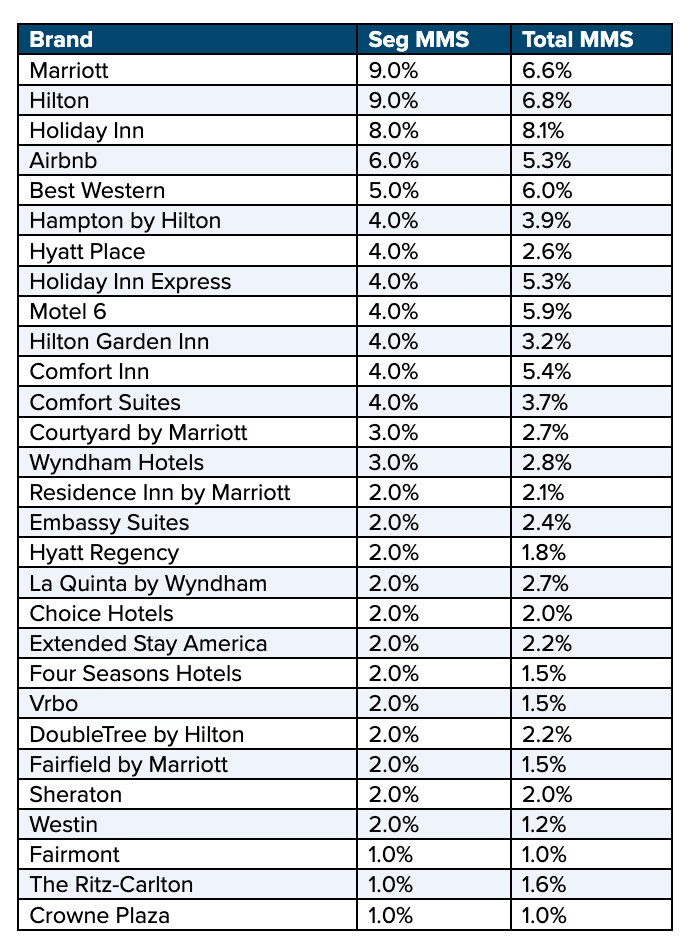
Marriott and Hilton, both at 9.0% Mental Market Share, are the predictable leaders of the table below. They are the brands you'd expect at the top of a family-focused segment that skews toward reliable, full-service properties. But what’s more interesting is in the tier below: Hyatt Place over-indexes at x1.53 and Westin at x1.66, neither of which runs explicit family-segment campaigns. Ritz-Carlton at x0.64 confirms that luxury and family travel don't mix; the product is wrong before the price is even a factor. The economy tier also under indexes amongst the family segment vs the total sample, though potentially for a different reason: budget-minimalism is harder to manage with children in tow. Holiday Inn at x0.98 is the most telling number in the table. The brand that owns the family road trip in advertising holds essentially no over-index in the segment.
Mental Market Share and Conversion Gap: Families Segment vs. Total Adults
The Occasions That Define Family Travelers
The family-friendly occasion, cited by 27.5% of parents vs. 13.8% of total adults, shows a clear split between who consumers actually think of and who is earning that association efficiently. In absolute terms, Airbnb is the most thought-of brand on this occasion at 29.5%, followed by Holiday Inn (28.0%) and Marriott (27.9%) — both large brands benefiting from scale. The mental advantage (MA) story tells a different tale: Vrbo (+7.1), Residence Inn (+6.3), and Autograph Collection (+5.5) all outperform their expected association rate by a wide margin, earning family-friendly mental equity far beyond what their footprint would predict. Holiday Inn at +1.1 MA is the most instructive contrast — 28.0% absolute association but essentially no over-index, meaning it is top-of-mind for families by virtue of size, not product differentiation. The brands with high MA are likely earning the association because they offer configurations that actually work: multi-room layouts, kitchen access, enough space for a family of four.
Less obvious, and just as strategically important: these parents travel heavily for work. Solo business trips (14.1% vs. 8.0% of total adults), extended work stays (11.3% vs. 7.0%), conference attendance (14.0% vs. 9.7%): parents with kids at home most likely travelfor work. The brand that serves a parent reliably on a solo Wednesday conference trip, then welcomes them back six weeks later with a family of four, holds a structural advantage: a single person generating bookings across multiple occasions over a calendar year. The deal and promotion occasion (14.2% vs. 10.1% of total adults) adds the third dimension: when this dual-mode traveler is booking for leisure, they're value-conscious in a way they aren't when their company is paying.
Top Over-Indexed Category Entry Points: Families Segment 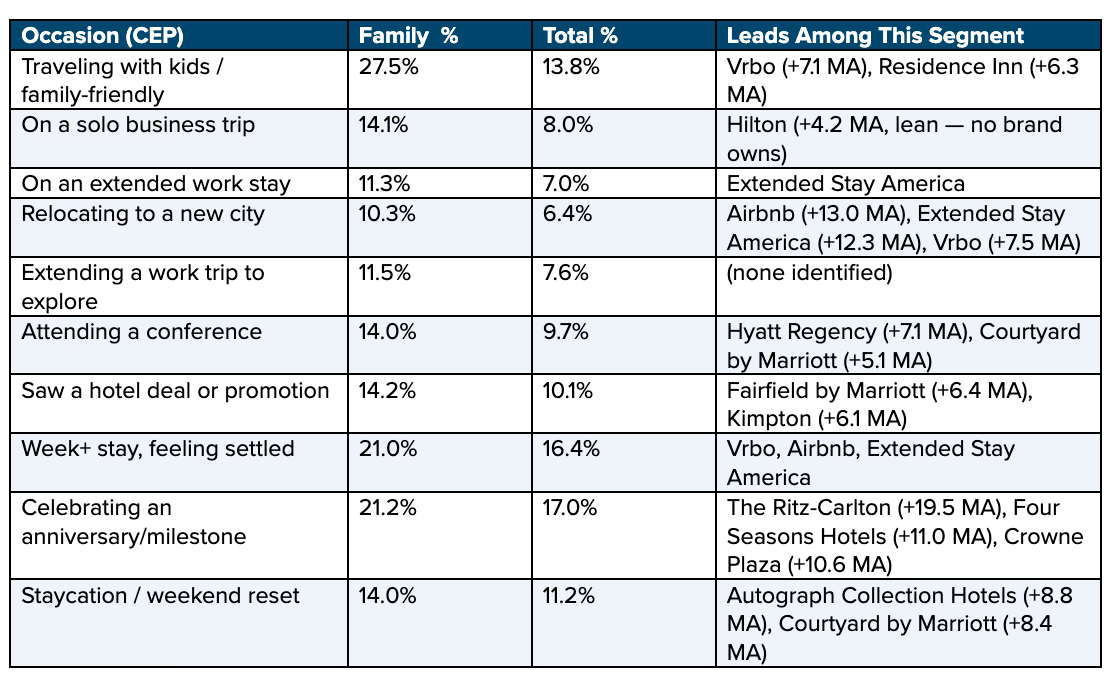
Request a briefing on your category's users
The Conversion Story
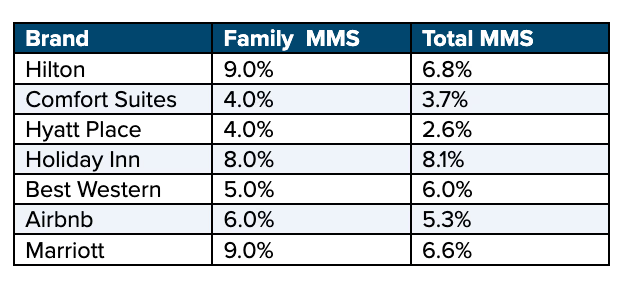
Hilton's +1.7pp gap between mental market share and market share is likely a product-geography problem, not a brand problem. Families consider Hilton readily; the brand is trusted and broadly known. The consideration is real; the inventory doesn't convert it. Airbnb's -0.8pp gap runs in the opposite direction: families book it more than they originally plan to likely because it solves a spatial problem that most hotels don't. Three bedrooms, a kitchen, a place where the kids can sleep before the adults do: those are functional requirements, and Airbnb meets them without requiring brand loyalty. That's a structural vulnerability for the hotel category, and the only brands positioned to compete with it directly are the extended-stay and suite concepts that match the functional profile at comparable price points.
Conversion Gap: Selected Brands Among Families Segment (Mental Market Share minus Market Share)
The Strategic Brief
For any brand that markets itself as the family hotel: the data's verdict is clear. Family-friendly CEP equity is largely earned through product. Airbnb leads in absolute (i.e., raw % of association with category entry points)at 29.5%, while Vrbo and Residence Inn earn their standing through differentiation (i.e. relative to other brands given its size) — generating family-friendly mental links at rates far above what their size predicts. The hotel brands with the highest absolute association (Holiday Inn, Marriott, Hilton) are largely at or near their expected MA scores, meaning their family presence is scale-driven rather than product-driven. If Holiday Inn, Hampton, or any upper-midscale brand wants to earn disproportionate equity on this occasion, the question isn't just how to market to families; it's also whether they can offer connecting rooms on request, guarantee them, and build a service model around them. Brands that can say yes have a path. And for the brands that can’t, they should rethink their level of spend toward communicating a family.
For Hyatt Place: a x1.53 over-index (relative to total) with no obvious family-segment targeting is a brief waiting to be accepted. Hyatt Place already has the product profile that works: complimentary breakfast, suite-style rooms, reliable quality at an accessible price point. Making the family pitch explicit (connecting room guarantees, kids-eat-free promotions, messaging that leads with breakfast and the suite layout) has the ability to convert passive mental share into booked nights without repositioning anything. The brand is already in families’ consideration set. It isn't being chosen at the rate its over-index suggests it could be. Ritz-Carlton at x0.64, not in the top 10 but notable, confirms the luxury-family incongruence: families simply aren't considering premium brands at meaningful rates. Westin (x1.66, 2.0% MMS) and Vrbo (x1.34, 2.0% MMS) both over-index but sit outside the top 10 by segment MMS; both surface more prominently in the occasion data below.
For extended-stay and suite brands: Airbnb's -0.8pp gap is a marketing brief for Residence Inn, Hyatt House, and Embassy Suites. Families are likely booking Airbnb for functional reasons (space, kitchen, separate bedrooms), not only out of loyalty or brand preference. Any brand that matches those functional requirements and makes them visible at the moment of search (filtering tools, direct booking benefits, guaranteed connecting rooms) captures some of that Airbnb trial. The segment is value-conscious, with 14.2% citing deal-triggered stays vs. 10.1% of total adults, so a promotional rate that makes the suite option price-competitive with a comparable Airbnb is the activation mechanism, not a brand campaign.
About this research
Morning Consult conducts over 30,000 daily proprietary surveys in 45 countries covering more than 5,000 brands and 50 economic indicators.
Our category advantage research is aimed at understanding the needs driving consumers in your category — and how your brand can own more of them. This research is built on validated principles of brand-driven growth and powered by Morning Consult’s industry-leading sampling technology.
Measure the true drivers of brand strength
Capture both mental availability (the likelihood your brand comes to mind when consumers face a need or occasion) and emotional closeness (how strongly consumers connect with your brand), benchmarked against competitors.
Uncover Category Entry Points (CEPs)
Directly tied to mental availability, see the specific needs, occasions, and triggers that drive purchase decisions in your category, and how strongly your brand is linked to them.
Pinpoint growth opportunities
Direct investment toward the moments and consumer segments with the greatest potential to grow your brand.
Turn insights into action fast
Get survey results in 4–5 days through a centralized dashboard and short-form memo that equips stakeholders with clear direction on where and how to win.
Learn more
The Hotels and Lodging Category Today: Brand Research
.png)
Delivery Apps Win by Owning Moments, Not Meals