Policymakers are being asked to steer the economy with data that arrives late, updates infrequently and is subject to revision.
That is precisely the gap the Federal Reserve is now moving to close. At his first press conference as Federal Reserve Chair, Kevin Warsh announced a task force with a pointed mandate: evaluate new information sources and consider methodological improvements to give policymakers “more accurate, relevant, contemporaneous, and—perhaps most important—"actionable” data on the state of the economy.
It’s a challenge Morning Consult has been working to meet for years. I had the pleasure of presenting at the NBER Advancing Economic Measurement conference in November 2025 on our mission and track record alongside Fed, BLS, and academic researchers.
The problem: lagged data releases, extreme data revisions and outdated measurement concepts
Making good policy decisions is difficult on its own; making good policy decisions with outdated and imperfect data is impossible. Chair Warsh framed the problem this way:
"Most of the data that central bankers and other government officials in the United States consume come with old-fashioned survey methods, national accounts of what the U.S. economy looks like that looks very little like the U.S. economy in 2026, survey methods that don't have response rates that we need, asking questions that might've been quite applicable a generation ago that are less applicable now."
For many years, there wasn't an alternative model to traditional economic data. Economic data operated in a market without true competition, to use a concept from economics. Technological advances in the private sector have shown what's possible. Again, Chair Warsh's own words:
"Almost every private company CEO that's running his or her business are doing so with real-time information that isn't subject to much revision, that is telling them what just happened at that very moment. As you know, there are normal long and variable lags in the conduct of monetary policy. What we're really interested in is what's happening right now. What we're less interested in is echoes of history."
High-frequency data collection sits at the heart of Morning Consult's mission because of our close ties to the private sector. Corporate executives expect high-frequency data so that they can make the best strategic decisions possible, eliminating as much uncertainty as possible. Cox Enterprises has consistently relied on the high-frequency economic data we collect, and Ted Decker, CEO of Home Depot, cited Morning Consult's economic data at the peak of tariff uncertainty on his Q1 earnings call, stating: "Morning Consult just came out with their daily consumer sentiment tracking that showed significant improvement just in the last two weeks." And if you think corporate CEOs are at the forefront of high-frequency economic monitoring, you should see what macro hedge funds are doing, but more on that later.
The solution: Real-time data validated against official data—across the Federal Reserve System
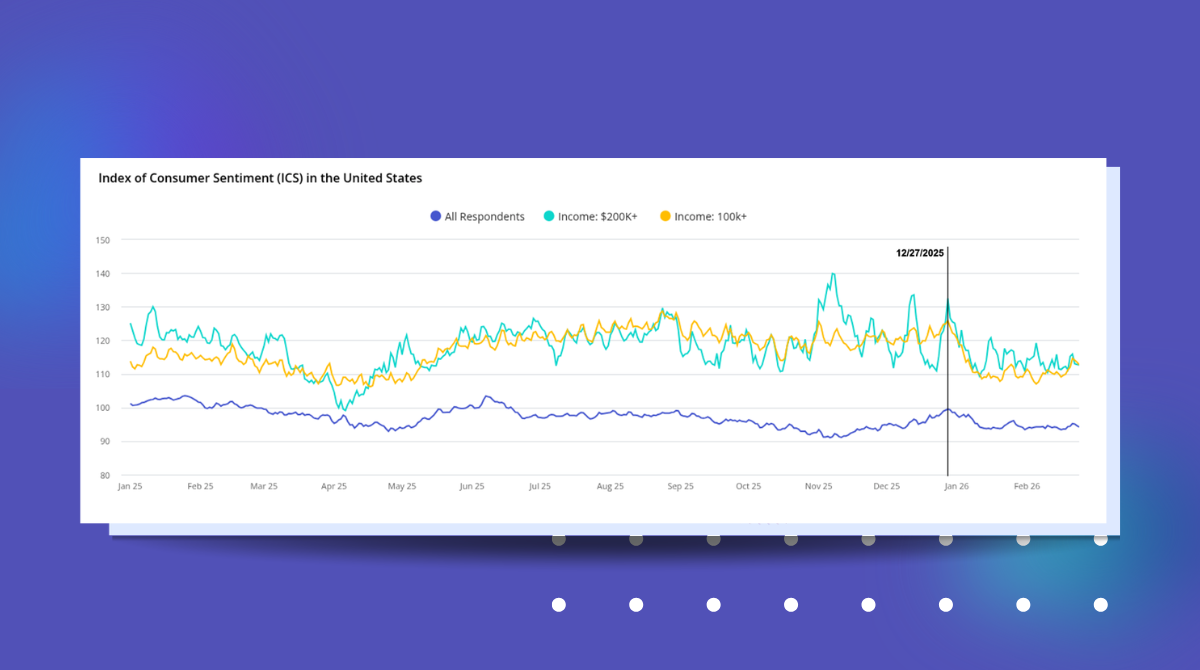
Morning Consult's consumer sentiment and labor market indexes update daily across 48 markets. That daily frequency is particularly important during periods of uncertainty.
Consumer sentiment - During the pandemic, the Federal Reserve cited Morning Consult's daily consumer sentiment data to get a read on the economy during their emergency FOMC meeting.
More recently, the Chicago Fed’s own research confirmed the value of high quality, real-time data: their new Composite Consumer Sentiment Index (C-CSI)—published in June 2026—finds that Morning Consult’s daily index is the predominant input for correcting known biases in the University of Michigan’s Index of Consumer Sentiment, accounting for roughly 93% of the C-CSI’s variance. The C-CSI, in turn, correlates more strongly with actual consumer spending than traditional measures do.
"the Morning Consult index (whose survey asks the same questions as the Michigan survey) ends up being the predominant indicator in the construction of the C-CSI..."
That same data feeds into the Chicago Fed Advance Retail Trade Summary (CARTS), providing a real-time measure of retail spending.
Unemployment and labor - The challenges extend well beyond measures of consumer sentiment. The unemployment rate plays a critical role in the Fed's dual mandate. However, the U.S. Government Shutdown in late 2025 highlighted the challenge of the Fed's data-dependent approach to monetary policy.
The Chicago Fed Labor Market Indicators and Unemployment Rate Nowcast draw on Morning Consult's Unemployment Index, Job Search Activity Index and Pay Loss Rate to provide policymakers critical updates during the shutdown.
Even without all of the complex modeling performed by Fed researchers, growing weaknesses in the labor market were evident in Morning Consult's data in 3Q25, when the path of monetary policy looked increasingly uncertain.
Inflation and inflation expectations - The second pillar of the Fed's dual mandate is price stability. Measuring what households think prices will do—and why those expectations diverge across groups—is central to monetary policy. Our Indirect Consumer Inflation Expectations survey is the largest survey of inflation expectations in the U.S. by respondent count, conducted weekly. Not only is the data conducted at a higher frequency, but the survey design improvements also guard against traditional challenges with inflation expectations surveys - namely that no one knows the definition of inflation!
FRB Cleveland research has drawn on the ICIE to show that expectations transmit through social networks, that passthrough from expected inflation to expected wages is incomplete (~20%), and that political affiliation is driving meaningful divergence across surveys—a finding with direct implications for how the Fed should weight different expectation measures. That last point took on new urgency after the 2024 election, when the Michigan survey’s sample composition shifted in ways that added nearly a full percentage point of noise to its headline inflation expectation reading.
“Reweighting along observed political affiliation shares lowers the mean point expectation from the MSC by roughly a whole percentage point... the average inflation expectations of Democrats in the MSC have recently exceeded those of Republicans by a greater margin than in the ICIE.”
Tracking how consumers are responding to price changes is equally important. Morning Consult's Price Response Indicators—tracking which categories consumers notice getting more expensive—have been historically predictive of monthly CPI movements. A multivariate model combining these indexes with lagged inflation data has tracked the topline consumer price index in real time, without waiting for BLS releases. In a policy environment where a single surprising inflation print can reshape market expectations overnight, having a forward-looking consumer-side signal matters.
Small businesses - While most of the U.S. economy is driven by the consumer, businesses play a critical role in hiring and investment decisions. There's very little data on small businesses, which often serve as an early warning indicator of future economic developments. To address this gap, we're working with researchers from the FRB Boston to measure and monitor the state of small businesses.
We published extensively on the impact of tariffs and tariff uncertainty of SMBs, filling a policy-relevant gap in the data. The findings are consequential: SMBs that believe tariffs will persist plan to pass through as much as three times more of their cost increases than those who expect tariffs to be short-lived. The same surveys show that tariff uncertainty is deeply intertwined with uncertainty about investment and headcount. For the Fed, this is precisely the kind of actionable, high-frequency business expectations data that Chair Warsh’s task force is looking for.
“SMBs that believe the new tariffs will persist for a year or longer anticipate notably higher pass-through rates; compared with their counterparts that believe the new tariffs will be short-lived, the former expected to pass through as much as three times more of their cost increases into consumer prices.”
The challenge is global
The challenges outlined by Chair Warsh are even more acute for policymakers outside the United States. During normal times when everything is operating as planned, traditional economic indicators collected monthly in the United States are often collected quarterly outside the United States. We are not in normal times.
During the COVID-19 pandemic—when conventional economic measures went dark — I worked with economists from the SF Fed and UC Santa Cruz to use Morning Consult's high-frequency sentiment data could proxy global underlying economic conditions in real time, allowing serious analysis even as lockdowns made the usual indicators unreadable. That's exactly the "contemporaneous" data Chair Warsh is asking for.
“All three [Morning Consult] sentiment indexes are strong predictors of PMI, with the latter reacting with a lag of about 2 weeks and the effect persisting through week 4.”
The findings showed procyclicality of fiscal policymaking during this time. Had this been known to monetary policymakers, there would have been a more compelling case to raise rates faster globally.
Across the world, statistical agencies are struggling to modernize in a way that allows them to meet the moment. Some of the challenges are budgetary, but some are also cultural. Perhaps the most glaring example is the United Kingdom, where virtually all trust in the official unemployment rate has been eroded due to ongoing issues with data collection.
In addition to funding limitations and modernization challenges, there's growing pressure across the world to influence the data reported by traditional economic indicators. For that reason, low correlations with government data can be a good thing, especially when the government in question has a vested interest in hiding the truth.
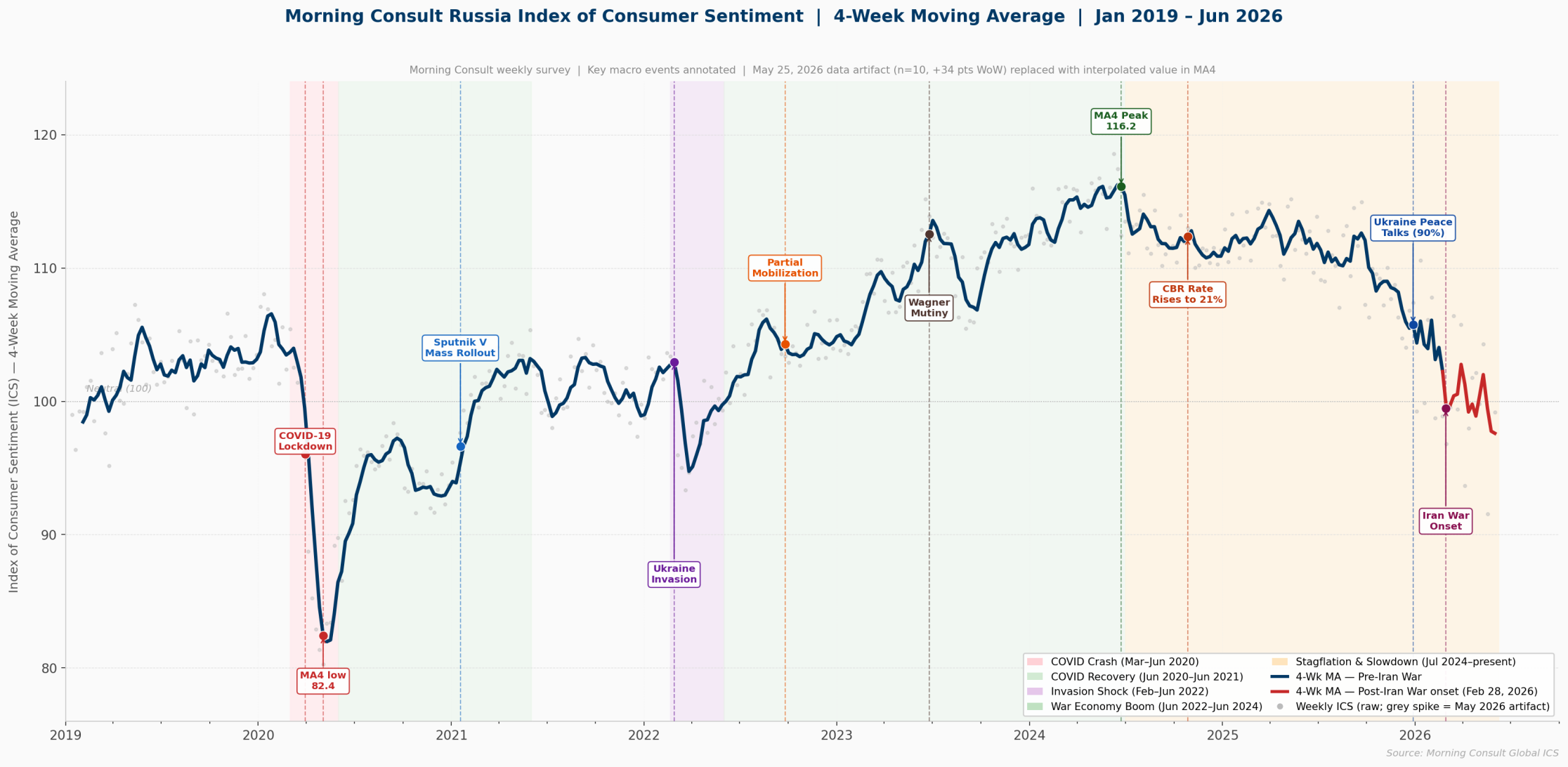
While Morning Consult's data is strong positively correlated with government datasets across the world, it tends to have lower correlations with data from authoritarian countries like Russia. Official government statistics from Russia have all but vanished in the past couple years, but Morning Consult's data clearly shows that the Russian war economy has hit a road block.
Looking Ahead: AI and productivity
Chair Warsh’s fourth task force—on productivity and jobs in an era of transformation—will estimate the economic impact of AI and explore its implications for the Fed’s dual mandate. Morning Consult is already generating the data this analysis will need. Expect a lot more from us on this front.
The conversation Chair Warsh is starting is one Morning Consult has been part of for years—not as an observer, but as a data provider actively embedded in Federal Reserve research across the system. We look forward to continuing that work as policymakers ask what better data can do for better monetary policy.
📊 Explore Morning Consult’s macroeconomic data and research: morningconsult.com/economics