Hotel spending in the United States reached a series high in May 2026, and the pool of buyers funding that record is shrinking. A smaller group of committed travelers is driving average spend upward, while a growing share of the market has been priced out entirely. In a K-shaped category, reputation determines which brands capture the committed buyer and which compete on rate alone. This study surveyed 1,009 U.S. adults and found a category in which functional trust is stable, emotional permission is unevenly distributed, and the gap between the two is widest where it is most commercially costly.
|
57% trust hotels to act in guests’ best interests |
58% named pricing as the top brand opinion driver |
57% agree the industry has become too expensive |
36% cited nightly rate as reason they did not book |
A category people price-check before they trust
Fifty-seven percent of adults agree that hotel and lodging companies act in the best interests of their guests, a workable baseline that coexists with sharper doubts. Only 51% say the industry is honest about pricing and fees. Just 49% believe travelers receive good value. Fifty-seven percent agree the industry has become too expensive. When asked what most influences their opinion of hotel brands, 58% named hotel pricing, the single most cited factor in the study. The category’s trust floor is holding. Its value ceiling is not. Morning Consult Intelligence data sharpens the picture further: the share of adults spending $400 or more on a hotel stay rose nearly eight percentage points year-over-year, while overall hotel purchase rates declined. The buyers who remain are spending more. The ones who left went on price.
Twelve brands have earned permission. The rest are competing on familiarity.
Figure 1 plots each brand on two axes: Reputation Score (a composite of favorability, trust, value, community impact, and admired employer) and Emotion Score (the depth of consumer connection). The mean break lines sit at Reputation 66.0 and Emotion 3.94, dividing the field into four zones. Twelve brands fall into the Emotional Advocates quadrant; the rest fall short on one or both dimensions.
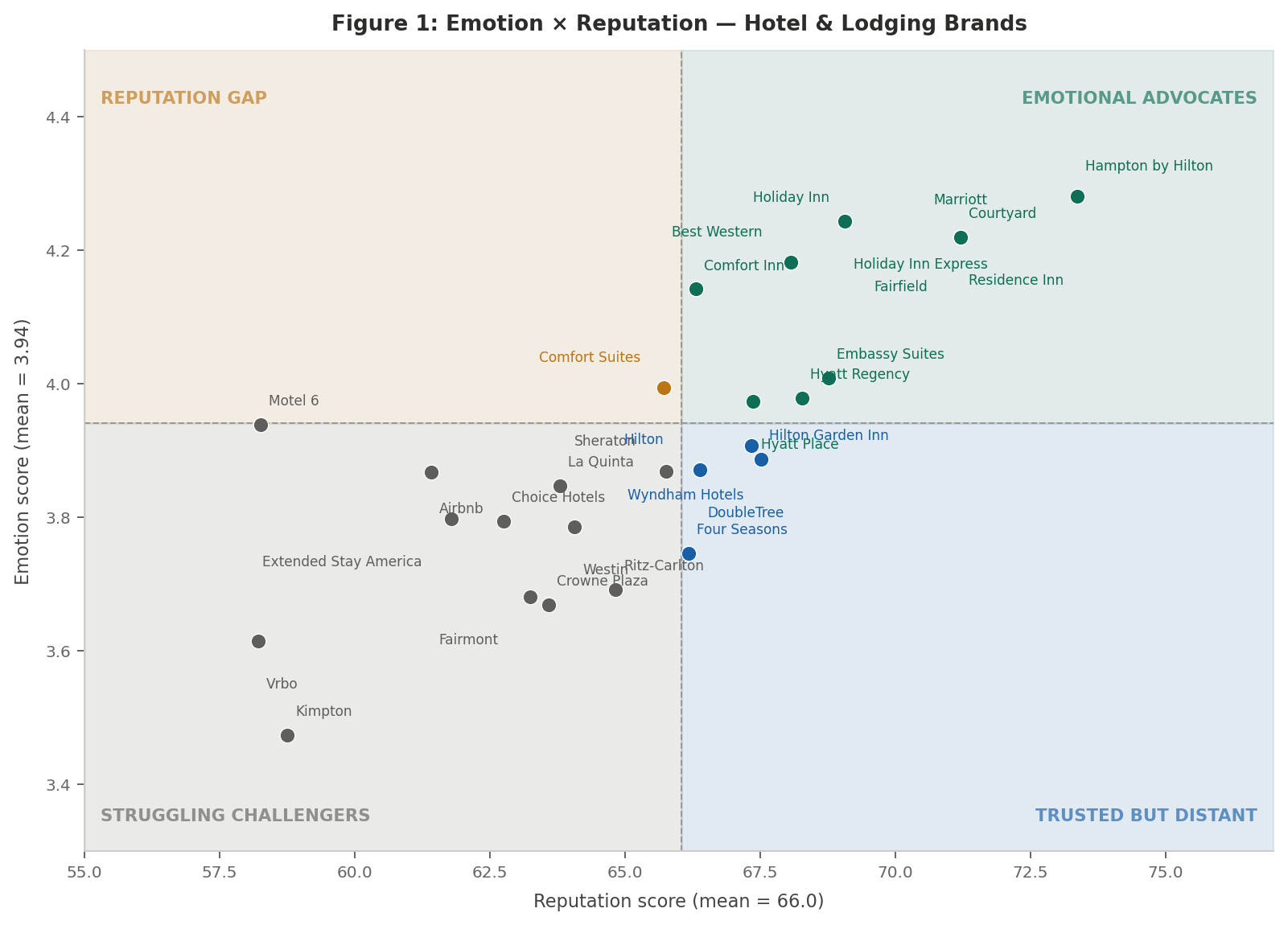
Figure 1: Emotion x Reputation, Hotel and Lodging Brands, U.S. Adults, June 2026. Quadrant breaks at category means (Reputation: 66.0; Emotion: 3.94).
Hampton by Hilton leads the field with a Reputation Score of 73.4 and an Emotion Score of 4.28, the only brand that tops every association attribute, from pricing honesty (36%) to consistent quality (38%) to creating meaningful travel memories (26%). Its position is structural, grounded in broad occasion coverage and above-average familiarity. Marriott’s four sub-brands cluster just below Hampton, sharing a Reputation Score of 71.2 and an Emotion Score of 4.22, with the highest Feeling Scores in the study at 3.60. Holiday Inn and Holiday Inn Express hold above-mean emotion (4.24) and strong breadth across weekend and family travel occasions that anchor their Category Advantage position. Transparent value communication, which surfaces total costs early and makes loyalty benefits visible, converts that permission into pricing resilience when the category is under rate pressure.
Hilton, the most recognized brand in the study at 66% awareness, sits in Trusted but Distant with a Reputation Score of 66.4 and an Emotion Score of 3.87. Wyndham Hotels, Hilton Garden Inn, and DoubleTree by Hilton occupy the same zone. These brands have built reputational floors that protect them from sharp consumer backlash, but they have not developed the emotional depth that drives advocacy or absorbs rate increases without friction. The comms mandate for Trusted but Distant brands is to deepen emotion before the floor erodes: occasion-specific identity work that gives consumers a reason to choose, not just a brand they recognize.
Feeling separates the brands that are chosen from the ones that are tolerated
Figure 2 introduces the Feeling dimension. A brand can score above average on Emotion and below average on Feeling: it draws consumers in without making them glad they went. That precise condition describes Hyatt Place, the sole Emotionally Charged Critic in the study, with an Emotion Score of 3.97 and a Feeling Score of 3.45. Consumers are involved with the brand; they are not satisfied with what they find. That gap reflects investment in service consistency and is worth closing before it migrates toward detachment.
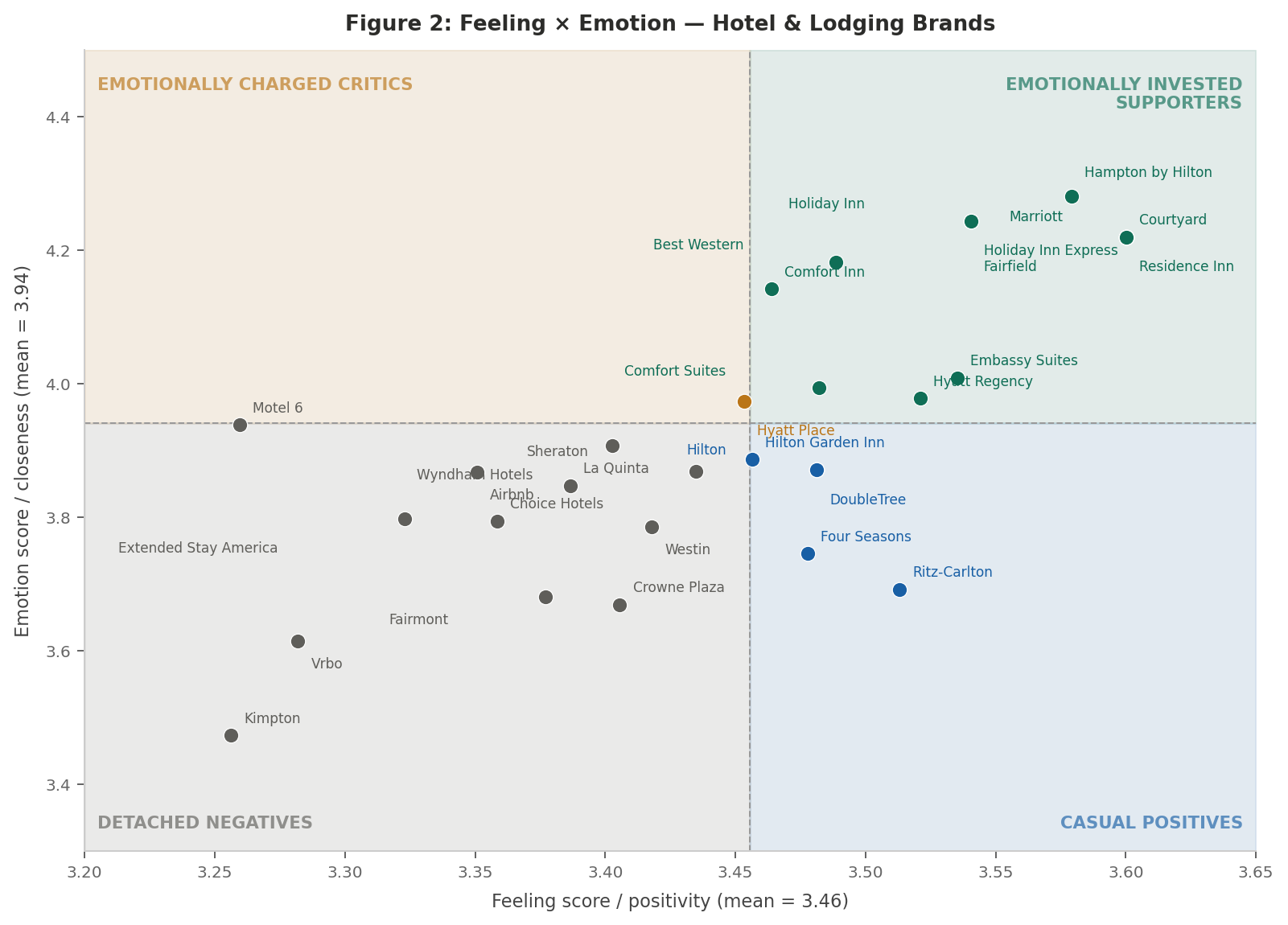
Figure 2: Feeling x Emotion, Hotel and Lodging Brands, U.S. Adults, June 2026. Quadrant breaks at category means (Feeling: 3.46; Emotion: 3.94).
The Detached Negative quadrant includes twelve brands: Wyndham Hotels, Motel 6, Airbnb, Vrbo, La Quinta, Extended Stay America, Choice Hotels, Westin, Fairmont, Crowne Plaza, Sheraton, and Kimpton. The risk this quadrant represents is indifference at scale in a market narrowing to committed buyers. For economy and midscale brands, detachment means rate sensitivity governs every purchase decision. For Westin and Crowne Plaza, it means a premium positioning that consumers acknowledge without feeling. Airbnb and Vrbo’s placement here is analytically significant: both appear as Struggling Challengers in Figure 1 and as Detached Negatives in Figure 2, confirming that the short-term rental category’s structural trust deficit is real and measurable.
For brands in the Detached Negative quadrant, the comms mandate is re-engagement: communications that give consumers a reason to feel something about a brand they only recognize.
Luxury’s permission problem
Four Seasons Hotels, The Ritz-Carlton, and Fairmont are three recognized premium brands in the study, but none has above-mean scores on both reputation and emotion. Four Seasons sits in Trusted but Distant; Ritz-Carlton and Fairmont are Struggling Challengers. All three fall in the lower half of the Feeling dimension, with Fairmont a Detached Negative and Ritz-Carlton a Casual Positive, meaning consumers feel warmly about it from a distance without feeling close to it.
Category Advantage data explains the structural constraint: luxury brands hold roughly 1.5% mental market share each, almost entirely on anniversary and milestone occasions, which account for only 17% of category purchase triggers. The comms path forward is to expand these occasions, not to deepen investment in the narrative of the occasions already owned. For Ritz-Carlton, city-break content and curated local narratives create familiarity at lower emotional stakes. For Fairmont, the priority is simpler: brand presence that establishes emotional contact before asking for loyalty. Both brands have enough residual reputation and credibility to build on. The action is to close the reach gap, not the trust gap.
Reputation and Category Advantage in a single view
The table below combines Category Advantage and Reputation metrics for twelve key brands. The comms strategy column translates the combined score into a direct communications priority. MMS (mental market share) and CEP (category entry point) data are from Morning Consult's Category Advantage: Hotel and Lodging, June 2026.
|
Brand |
MMS |
Key CEP |
Aware. |
Rep. |
Emot. |
Feel. |
Quadrant |
Comms Strategy |
|
Holiday Inn |
8.1% |
Weekend / Family |
57% |
69.1 |
4.24 |
3.54 |
Emotional Advocate |
Protect Emotional Lead |
|
Hilton |
6.8% |
New-city / Weekend |
66% |
66.4 |
3.87 |
3.48 |
Trusted but Distant |
Build Emotional Depth |
|
Marriott |
6.6% |
Weekend / Milestone |
63% |
71.2 |
4.22 |
3.60 |
Emotional Advocate |
Activate Value Narrative |
|
Airbnb |
5.3% |
Extended stay |
42% |
61.4 |
3.87 |
3.35 |
Struggling Challenger |
Address Trust Deficit |
|
Best Western |
6.0% |
Roadside / Family |
49% |
68.1 |
4.18 |
3.49 |
Emotional Advocate |
Amplify Occasion Breadth |
|
Hampton by Hilton |
3.9% |
Weekend / Business |
42% |
73.4 |
4.28 |
3.58 |
Emotional Advocate |
Own Pricing Honesty Claim |
|
Holiday Inn Express |
5.3% |
Last-minute / Deal |
46% |
69.1 |
4.24 |
3.54 |
Emotional Advocate |
Reinforce Deal Credibility |
|
Hyatt Regency |
1.8% |
Conference / Business |
41% |
68.3 |
3.98 |
3.52 |
Emotional Advocate |
Deepen Business Traveler Bond |
|
Motel 6 |
5.9% |
Roadside / Budget |
48% |
58.3 |
3.94 |
3.26 |
Struggling Challenger |
Rebuild Value Credibility |
|
Comfort Inn |
5.4% |
Budget / Road trip |
47% |
66.3 |
4.14 |
3.46 |
Emotional Advocate |
Convert Feeling to Loyalty |
|
The Ritz-Carlton |
1.6% |
Anniversary / Milestone |
32% |
64.8 |
3.69 |
3.51 |
Struggling Challenger |
Expand Beyond Milestone |
|
Kimpton |
N/A* |
City exploration |
8% |
58.8 |
3.47 |
3.26 |
Struggling Challenger |
Establish Brand Visibility |
MMS: Mental Market Share. Rep.: Reputation Score (0-100). Emot.: Emotion Score (1-7). Feel.: Feeling Score (1-5). Quadrant: from Figure 1 (Emotion x Reputation). Comms Strategy: two-to-five-word communications priority derived from the combined metric read. *Kimpton not present in Category Advantage MMS table.
Reputation is the permission structure that pricing power requires
The emerging K-shape spending patterns in the hotel industry carry significant implications for communications. Comms departments are shifting from managing brand growth to defending market share within a narrowing pool of active travelers. In this environment, every strategic message either reinforces or weakens the brand permission required to maintain premium price points.
Brands classified as Emotional Advocates are most likely to retain these committed customers. Hampton, for example, possesses unutilized assets in its reputation for consistent quality (38%) and pricing honesty (36%). Marriott holds the study's highest Feeling Score at 3.60, providing a strong basis for loyalty messaging that transcends traditional rewards programs. Conversely, Hilton must focus on developing occasion-specific identities for the Category Entry Points where it currently appears, as high awareness lacking emotional depth forces the brand into constant price-based negotiations.
The intersection of Category Advantage and Reputation data provides a comprehensive strategic roadmap. While Category Advantage identifies where a brand has mental availability, Reputation scores determine if the trust exists to transform that visibility into true advocacy and a higher willingness to pay. Relying on either metric in isolation is insufficient; presence without a strong reputation leads to inaction, while a positive reputation without occasion data lacks application. By integrating these frameworks, brands can pinpoint which narratives to challenge and which occasions to dominate, effectively setting the competitive standards for the entire category.
Methodology
Morning Consult surveyed 1,009 U.S. adults, June 23-26, 2026. Data weighted to U.S. Census benchmarks for age, gender, race/ethnicity, and region. Reputation Score: mean of five top-2-box components (Favorability, Trust, Value, Community Impact, Admired Employer). Emotion Score: weighted mean, 1-7 connected/disconnected scale (higher = more connected). Feeling Score: weighted mean, 1-5 positivity scale (higher = more positive). Quadrant breaks use arithmetic means across all 30 brands. MMS and CEP data from Morning Consult Category Advantage: Hotel and Lodging Accommodation, United States, June 2026. Kimpton not present in Category Advantage MMS table (N/A*). Column C (Adults) used for all reported figures.

K-Shape Spending in the Hotel Industry: An Economic Outlook
The Hotels and Lodging Category Today: Brand Research